I-9 form training: Best 2025 Resources!
Why Every Employer Needs Expert I-9 Training Right Now
I-9 form training is essential for every U.S. employer to verify employment eligibility, avoid costly penalties, and maintain federal compliance. Here’s where to find quality training:
Top I-9 Training Sources:
- USCIS Free Webinars: Official government training on form completion, documents, and retention, often eligible for SHRM/HRCI credit.
- Specialized Compliance Providers: Organizations like Valley All States Employer Service offer custom training with real-world scenarios.
- On-Demand Resources: 24/7 access to recorded webinars and guides for self-paced learning.
Since 1986, the Immigration Reform and Control Act has required all U.S. employers to complete Form I-9 for every new hire. While it sounds simple, the reality is complex.
Every year, businesses face penalties from hundreds to thousands of dollars per violation, often from innocent mistakes like missing signatures or incorrect dates.
The stakes are high. The Department of Homeland Security and ICE enforce these rules strictly. Penalties for paperwork violations start at $272 per form and can reach $2,701. For knowingly hiring unauthorized workers, fines jump to between $676 and $27,108 per violation.
Proper training dramatically reduces this risk. You don’t need to be an immigration lawyer, just have access to clear, practical guidance on completing the form correctly. Finding reliable I-9 training is the first step toward confident compliance.
Why I-9 Compliance is a High-Stakes Game for Employers
Form I-9 compliance is a critical, high-stakes part of running a business. This single document stands between you and significant penalties.
The Form I-9’s purpose is to verify that every new hire is legally authorized to work in the United States. This has been a legal obligation since the Immigration Reform and Control Act (IRCA) of 1986. The Department of Homeland Security (DHS) oversees this requirement, with U.S. Immigration and Customs Enforcement (ICE) handling enforcement.
Compliance is tricky because you must also avoid discrimination. IRCA’s anti-discrimination provisions, enforced by the Department of Justice, mean you cannot treat applicants differently based on citizenship or national origin during verification. It’s a delicate balance, and proper I-9 form training is key to navigating it confidently.
Failure to comply can lead to reputational damage, government scrutiny, and even debarment from federal contracts. Understanding I-9 Compliance Penalties is crucial.
Understanding the Form I-9: More Than Just Paperwork
Form I-9 is your checkpoint for confirming identity and employment authorization. Every person hired after November 6, 1986, needs one, regardless of their role or citizenship status. This federal mandate applies to everyone, from part-time student workers to your CEO.
The form comes from U.S. Citizenship and Immigration Services (USCIS) and is a fundamental part of the new hire process. For a complete overview, check out What is an I-9?. To streamline onboarding, our guide to New Hire Paperwork I-9 can help.
The Staggering Cost of Non-Compliance
Government audits are strict. ICE looks for two types of violations, both with financial consequences.
Paperwork violations include technical errors like a missing signature or incorrect date. Fines for these mistakes range from $272 to $2,701 per form. With multiple errors, penalties can quickly add up.
If the government finds you knowingly hired or continued to employ unauthorized workers, the penalties are much higher. First-time offenses result in fines between $676 and $5,404 per unauthorized worker. Subsequent offenses can lead to fines from $5,404 to $27,108 per violation.
Businesses face these penalties during ICE I-9 Audits every year. Serious cases can even lead to debarment from federal contracts. Fortunately, most violations are preventable with the right training and systems.
Mastering the Form I-9: A Breakdown of Key Sections and Common Pitfalls
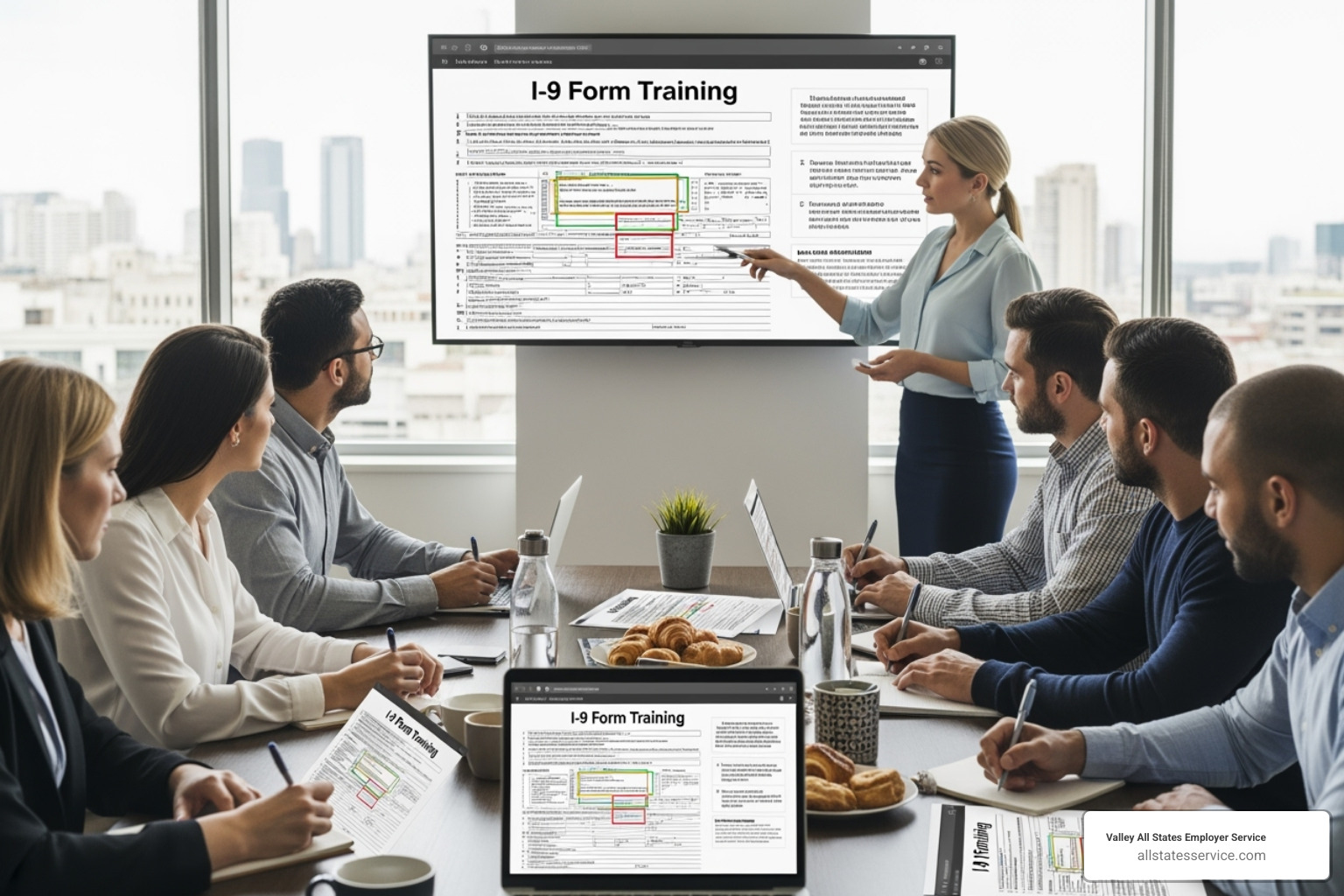
I-9 form training is invaluable for mastering the form’s details. While it looks simple, it’s easy to make mistakes like missing signatures or incorrect dates, which are common reasons for audit penalties. Most errors are preventable once you understand each section. Our guide on I-9 Form Completion offers additional support.
Section 1: Employee Information and Attestation
Section 1 is the employee’s responsibility. They must complete and sign it no later than their first day of employment. The employee attests to their status by checking one of four boxes: citizen of the United States, noncitizen national, lawful permanent resident, or alien authorized to work. If a preparer or translator assists, they must complete the certification block, a commonly missed step. You cannot tell employees which box to check. For more on employer duties, see Filling Out an I-9 Employer.
Section 2: Employer Review and Verification
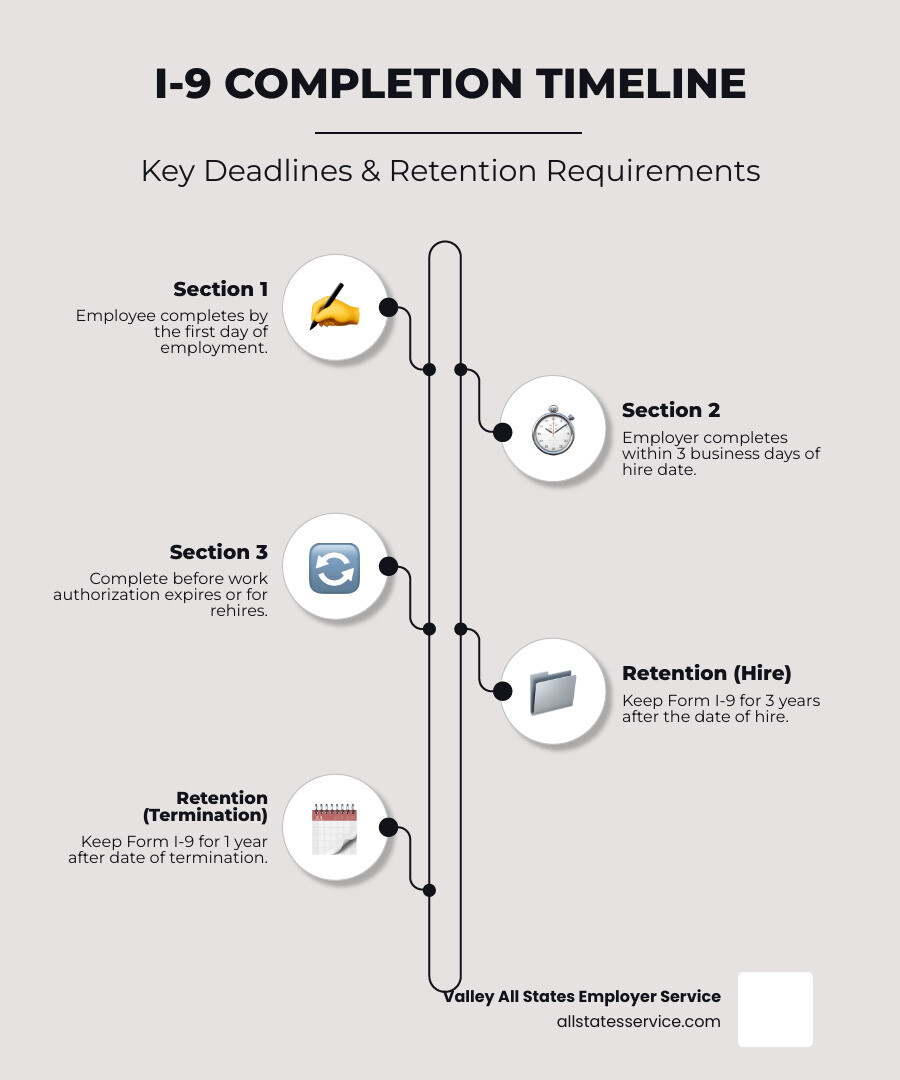
Section 2 is the employer’s part. The deadline is firm: within three business days of the employee’s first day of employment. You must physically examine the employee’s original, unexpired documents to ensure they appear genuine. Photocopies are not acceptable for initial verification.
Employees choose which documents to present: one from List A (establishing identity and work authorization, like a U.S. Passport) or one from List B (identity, like a Driver’s License) and one from List C (work authorization, like a Social Security Card). You cannot specify which documents they provide. After review, record the information in Section 2. For detailed guidance, see Verifying I-9 Documents. Remote verification rules have changed since the pandemic; the standard is in-person examination, though some E-Verify employers have other options.
Section 3: Reverification and Rehires
Section 3 is for ongoing compliance. Use it when an employee’s work authorization is expiring. You must reverify their eligibility before the expiration date. This section is also used for name changes and for rehires within three years of their original Form I-9 completion date, which streamlines the process. Learn more in our guide on the I-9 Process for Rehires. Effective tracking of expiration dates is key to using Section 3 correctly.
Your Ultimate Guide to I-9 Form Training Resources

Staying compliant with I-9 regulations is an ongoing commitment, not a one-time task. As rules evolve, quality I-9 form training is your best defense. It builds confidence, helps you handle tricky reverification or remote hiring scenarios, and often provides continuing education credits from SHRM and HRCI. Think of I-9 form training as an investment that pays dividends with every new hire. The key is finding the right resources for your needs.
Valley All States Employer Service: Your Trusted Source for I-9 Form Training
We know I-9 compliance can feel overwhelming. Our training programs are designed to be practical and accessible. Our live and on-demand webinars offer flexibility, allowing you to join interactive sessions or learn at your own pace. We use a step-by-step approach, walking you through each section of Form I-9 with real-world scenarios, like handling unfamiliar documents or name changes. Our interactive Q&A sessions provide clear, actionable answers. We also help you build an internal audit checklist and can tailor training for specialized industries. Explore our comprehensive I-9 Compliance Training to see how we can support your team.
Official Government Webinars: Additional I-9 Form Training Support
In addition to private providers, U.S. Citizenship and Immigration Services (USCIS) offers excellent free resources. These official webinars provide authoritative guidance on federal requirements. USCIS hosts free employer training webinars on topics from basic completion to specialized issues, many of which qualify for 1 professional development credit through SHRM and HRCI.
The Form I-9 Overview webinar is a great refresher, covering instructions, documents, and retention. It’s especially useful for new E-Verify users. Register here: Form I-9 Overview webinar.
If documents are a challenge, the Form I-9 Document Training webinar focuses on acceptable documents and how to spot issues. Find a session here: Form I-9 Document Training webinar.
USCIS webinars are a great complement to private training. Always ensure you are accessing the most current information, as rules can change.
Integrating E-Verify and Best Practices for I-9 Management
Managing paper I-9 forms is a challenge, but electronic solutions can streamline your compliance process. Digital systems reduce errors with built-in checks, simplify record keeping, and make audits less stressful. Exploring Electronic I-9 Solutions is a worthwhile step for any modern workplace.
The Role of E-Verify in Your Compliance Strategy
E-Verify is a web-based system from the DHS and Social Security Administration that electronically compares Form I-9 information with government records to confirm employment authorization. This electronic verification is fast, accurate, and significantly reduces unauthorized employment. For federal contractors, E-Verify is mandatory, but many other employers use it proactively to demonstrate good faith.
Crucially, E-Verify does not replace Form I-9. You must still complete a Form I-9 for every new hire before creating an E-Verify case. The form and E-Verify work together for robust compliance. Our I-9 E-Verify Compliance Guide explains how they integrate, and E-Verify and I-9 details the connection.
Best Practices for I-9 Record Keeping and Audits
Proper record keeping is essential, as an inaccessible form is treated as a missing one during an audit. Secure storage, whether in a locked cabinet or a secure electronic system, is your first defense. Many employers keep I-9s separate from personnel files for easier audit access and privacy.
The retention requirement is to keep each Form I-9 for three years after the date of hire or one year after termination, whichever is later. For mistakes, never use white-out. Draw a single line through the error, write the correct data, and add your initials and date. For major errors, complete a new form and attach it to the original with an explanatory memo.
Regular internal self-audits are the smartest move. Proactively reviewing your forms allows you to catch and fix problems before a government auditor does, saving you from potential penalties. Our guides on I-9 Record Keeping and the Internal I-9 Audit Complete Guide provide step-by-step strategies.
Frequently Asked Questions about I-9 Compliance
Here are answers to some of the most common I-9 compliance questions.
Can I-9 verification be done remotely?
The standard rule requires an employer or authorized representative to physically examine the original documents. Temporary COVID-19 flexibilities allowing virtual inspection have largely ended. For remote hires, you can designate an authorized representative (like a notary or local colleague) to complete Section 2 in person. However, you, the employer, remain fully liable for any errors they make.
Some E-Verify employers have additional options, but the rules are evolving. It’s crucial to check the latest USCIS guidance. Our resource on Remote Employee I-9 Verification provides more detail on designating representatives.
What are the most common I-9 errors employers make?
Simple oversights often lead to serious compliance issues. The most common errors include:
- Late completion: Missing the deadlines for Section 1 (employee’s first day) and Section 2 (within three business days of start date).
- Missing information: Incomplete fields, missing dates, or unsigned forms.
- Not examining original documents: Accepting photocopies or not physically inspecting documents is a violation.
- Accepting the wrong document combinations: An employee must provide one List A document OR one List B and one List C document. Two List B documents, for example, is incorrect.
- Specifying documents: You cannot tell an employee which document to provide; they must choose from the acceptable lists.
- Accepting expired documents (with few exceptions).
- Failing to reverify work authorization before it expires.
Regular I-9 form training and internal audits are the best defense. Our guide on Auditing I-9 Forms helps you spot these problems early.
How do I correct a mistake on a Form I-9?
To correct an error, draw a single line through the incorrect information so the original entry is still visible. Write the correct information nearby, then initial and date the correction. Never use white-out or correction tape, as this can look suspicious to auditors.
For complex errors or those found long after completion, attach a memo explaining the correction. If a form has too many errors, complete a new one and attach it to the original, along with a memo explaining why. Never discard the original form. Proper correction demonstrates good faith and can reduce penalties.
Simplify Your I-9 Process with Expert Help
Keeping up with I-9 form training and compliance is a significant task. Comprehensive training is your best defense, protecting your business from costly penalties and ensuring a fair hiring process. However, managing I-9 verification, especially while growing or hiring remotely, can be overwhelming.
You don’t have to do it alone. Valley All States Employer Service specializes in expert verification services that minimize errors and administrative headaches. We handle complex E-Verify cases, reverifications, and overall compliance, giving you peace of mind.
As your compliance partner, we bring years of experience and up-to-date knowledge to help your business succeed without getting tangled in red tape.
Ready to simplify your employment eligibility verification and focus on what you do best?