
E-Verify new hire 2025: Ultimate Guide
Why E-Verify Matters for Every New Hire
E-Verify new hire verification is a web-based system that helps employers confirm their new employees are legally authorized to work in the United States. It’s a critical step that comes right after you complete Form I-9 for each new team member.
Quick Answer: E-Verify New Hire Requirements
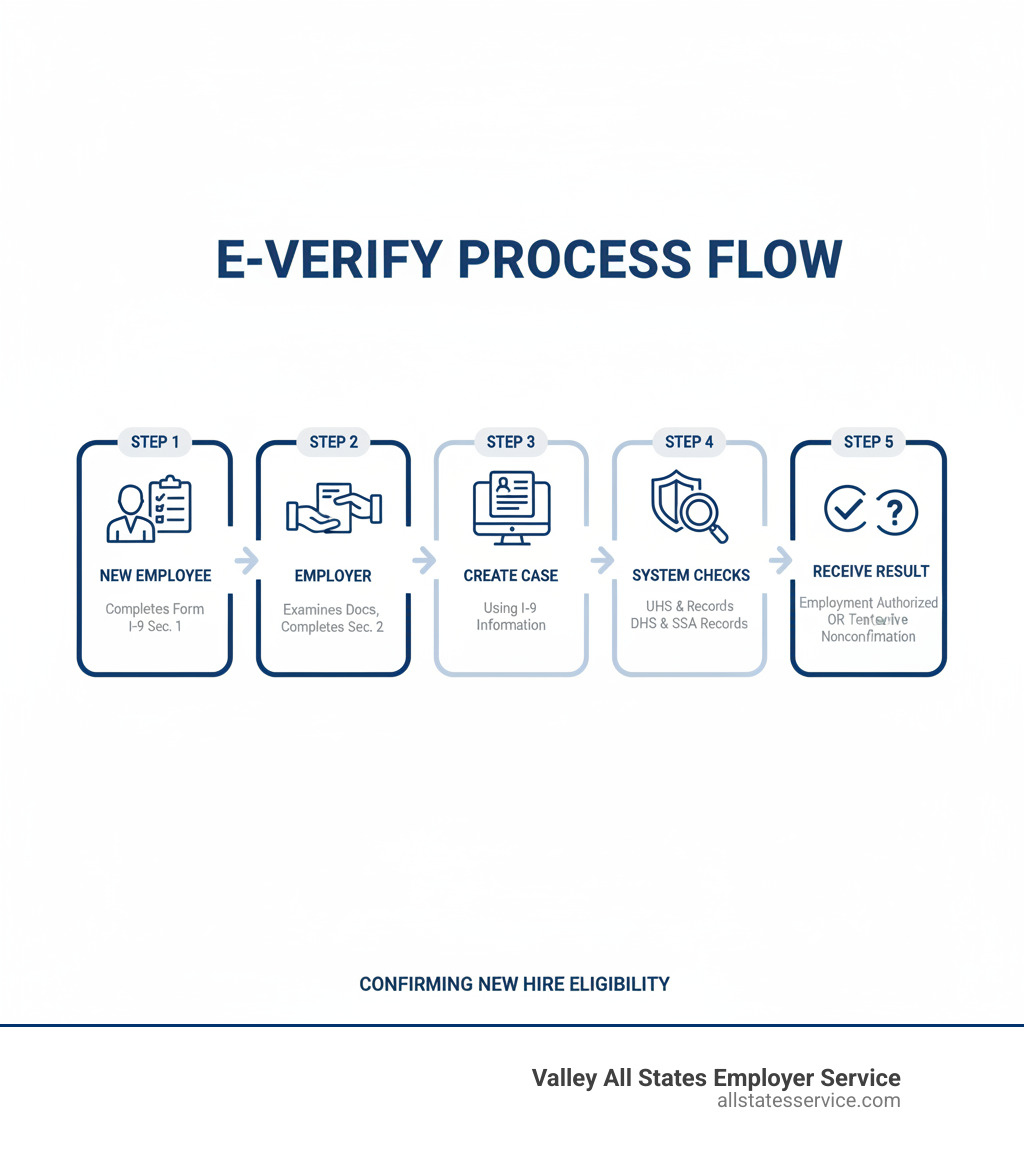
- Complete Form I-9 first – Your new employee fills out Section 1, you complete Section 2 within 3 business days of their start date
- Create an E-Verify case – Enter the I-9 information into the E-Verify system (typically within 3 business days)
- System checks government records – E-Verify compares data against Department of Homeland Security and Social Security Administration databases
- Receive a result – Most cases return “Employment Authorized” within seconds; some may require additional steps
- Know your requirements – E-Verify is mandatory for federal contractors and some state employers, voluntary for others
If you’re an HR manager juggling dozens of tasks during hiring season, you know the pressure. One mistake on employment verification can cost hundreds or thousands of dollars in fines. Knowingly hiring unauthorized workers can result in even steeper penalties and possible jail time.
E-Verify is free and available in all 50 states. Over 2,500 employers have already adopted the newer E-Verify+ platform, which streamlines the entire process. But is it right for your business? And if you’re required to use it, how do you avoid common pitfalls?
The good news: understanding E-Verify doesn’t have to be complicated. Whether you’re hiring your first employee or your five hundredth, this guide breaks down exactly what you need to know to stay compliant and keep your onboarding smooth.
What is E-Verify and How Does It Fit with Form I-9?
Many employers wonder how E-Verify new hire verification works. It’s not a mysterious government database that approves or rejects employees; the reality is much simpler.
E-Verify is a free, web-based system run by the federal government. It allows enrolled employers to confirm that their new hires are legally authorized to work in the United States. The system works by electronically matching information from your completed Form I-9 against records held by the U.S. Department of Homeland Security (DHS) and the Social Security Administration (SSA).
Think of it as a safety net. You’ve already done the work of verifying your employee’s documents. E-Verify just double-checks that information against official government records to make sure everything lines up.
Does E-Verify replace Form I-9? The short answer is no. Understanding how they work together is essential for compliance. Let’s break down how E-Verify and I-9 fit into your hiring process.

The Form I-9 Foundation
Before E-Verify even enters the picture, there’s Form I-9. This document has been the foundation of employment verification since 1986, and it’s required for every single new hire in the United States. Yes, every single one, regardless of citizenship status.
Here’s how it works. On their first day of work, your new employee fills out Section 1 of Form I-9. This is where they provide basic information and attest to their employment eligibility. Then you have three business days from their start date to complete Section 2. During this time, you’ll examine the documents your employee presents (like a driver’s license and Social Security card, or a passport) to verify their identity and work authorization.
This document examination step is critical. You must physically inspect the original documents to ensure they appear genuine and relate to the person presenting them. This hands-on verification is something E-Verify can’t do for you.
The new Form I-9 version that became mandatory on November 1, 2023, is actually shorter and easier to use than previous versions. If you haven’t seen it yet, check out the official USCIS Form I-9 page for the latest form and instructions.
How E-Verify Supplements the Form I-9
E-Verify is a companion to Form I-9, not a replacement. If you’re enrolled in E-Verify, you still need to complete the Form I-9 for every new hire and follow all the same rules. E-Verify simply adds an extra layer of verification.
After you’ve completed Sections 1 and 2 of the Form I-9, you’ll create an E-Verify case by entering that same information into the E-Verify system. The Initial Verification process happens almost instantly. E-Verify takes the data you entered and runs it through DHS and SSA databases for electronic confirmation.
In most cases, you’ll get an “Employment Authorized” result within seconds. The system has confirmed that the information matches government records, and you’re good to go. Sometimes, though, the system can’t immediately confirm eligibility, which leads to what’s called a Tentative Nonconfirmation. We’ll cover that scenario in detail later.
The beauty of E-Verify is that it adds accuracy and integrity to the process without replacing the human element of document examination. You’re still responsible for looking at those documents and making sure they pass the eye test. E-Verify just confirms what you’ve already verified.
For employers who want to get this right every time, the M-274 Handbook for Employers is your best friend. It walks through every scenario you might encounter with Form I-9 and explains how E-Verify fits into the bigger picture. When you understand how these two systems work together, the E-Verify new hire process becomes much less intimidating.
Is E-Verify Mandatory? Understanding Your Obligations
A common question from employers is, “Do I have to use E-Verify?” For most private businesses, E-Verify new hire verification is voluntary. You can enroll for that extra layer of verification, but it’s not legally required.
But here’s where it gets interesting. If you’re a federal contractor or you operate in certain states, E-Verify isn’t just a good idea. It’s the law.
Understanding whether E-Verify is mandatory for your business depends on two main factors: whether you hold federal contracts and where your business is located. Let’s break down both scenarios so you know exactly where you stand.
Federal Contractor Requirements
If your company has a federal contract, E-Verify might already be a requirement you can’t skip. Any federal contractor with a contract that includes the Federal Acquisition Regulation (FAR) E-Verify clause must use the system. This isn’t limited to just your newest team members, either. Depending on your contract, you may need to verify existing employees who are directly working on the federal contract.
The FAR E-Verify clause has its own special rules. Federal contractors often face different timelines and requirements for Form I-9s, and some must verify their entire workforce. It’s more complex than the standard process, so we recommend consulting the Supplemental Guide for Federal Contractors or specialists. Our E-Verify for Contractors page walks through these specific requirements in detail.
State-Specific E-Verify Mandates
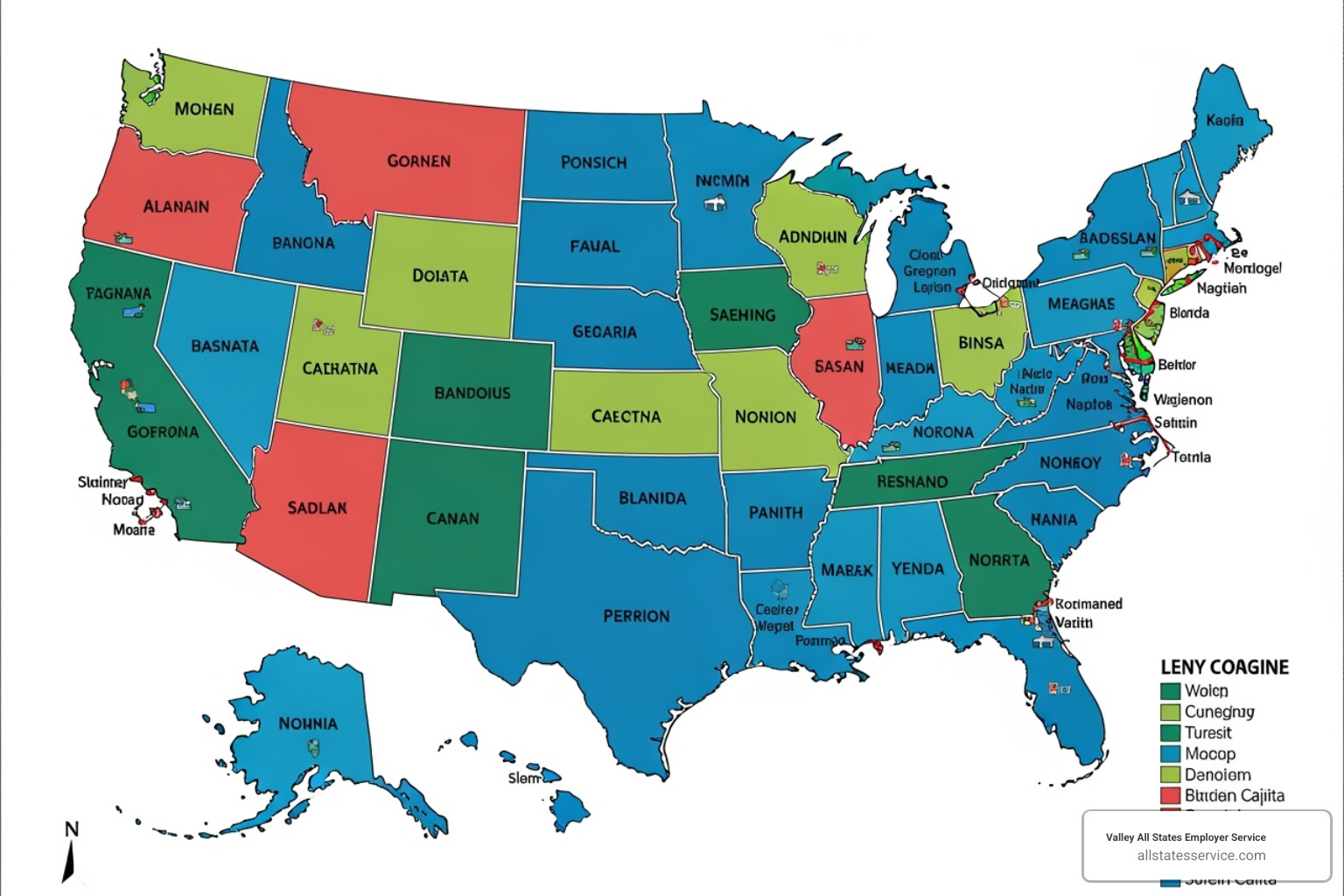
Beyond federal contracts, many states have created their own E-Verify rules. This is where things get a bit like a patchwork quilt. What’s mandatory in Arizona might be restricted in Illinois. Some states require all private employers to use E-Verify, while others only mandate it for public employers, state contractors, or private companies above a certain size.
Take Florida, for example. As of July 1, 2023, any private employer with 25 or more employees must use E-Verify for all new hires. Arizona takes it even further, requiring all employers, regardless of size, to participate. Meanwhile, states like California and Illinois have actually placed restrictions on E-Verify use, particularly when it comes to checking existing employees unless you’re federally required to do so.
The landscape keeps shifting, too. More states are considering E-Verify legislation each year, and some are tightening existing requirements. That’s why staying current on your state’s specific laws is so important.
We maintain an updated E-Verify State Requirements Guide 2025 to help you steer these varying rules. Whether you’re expanding to a new state or just want to confirm your current obligations, it’s worth checking what your state requires. For instance, if you’re in Illinois, their E-Verify restrictions are quite specific about employer rights and limitations.
Want a quick overview of who’s required to use E-Verify? Our guide on What Employers Are Required to Use E-Verify breaks it down by category and helps you determine if you fall under any mandatory requirements.
The bottom line: knowing whether E-Verify is mandatory for your business requires looking at both your federal contract status and your state’s specific laws. When in doubt, it’s always better to check than to face penalties for non-compliance down the road.
The Pros and Cons of Using E-Verify for a New Hire
Deciding whether to use E-Verify, if it’s voluntary for your business, requires weighing an upfront investment of time against the peace of mind it can provide. Let’s take a balanced look at both sides so you can make an informed decision.
The Upside: Benefits of E-Verify for Your Business
For many employers, E-Verify offers real, tangible benefits that go beyond just checking a compliance box. It’s about building confidence that every E-Verify new hire is legally authorized to work in the United States.
The most compelling benefit? E-Verify helps you maintain a legal workforce and avoid the steep penalties that come with knowingly hiring unauthorized workers. We’re talking about fines that can reach thousands of dollars per violation, not to mention potential criminal charges in severe cases. E-Verify is the most effective electronic tool available to confirm employment eligibility.
Here’s something that often surprises employers: participating in E-Verify can provide a good faith defense against charges that you knowingly hired an unauthorized worker. If you used the system correctly and received an “Employment Authorized” result, you’ve demonstrated real due diligence. That’s powerful protection.
The system is completely free, which makes it accessible whether you’re a small startup or a large corporation. Most cases return an “Employment Authorized” result within seconds, which means your new hire can get started without delays. We’ve seen how this speed helps businesses keep their onboarding momentum going.
Since August 1, 2023, E-Verify has offered remote verification options for employers examining Form I-9 documents. This is genuinely transformative if you’re hiring remote employees across the country. You can verify documents through live video interaction without requiring someone to drive to your office. For more details on getting started, check out Enrolling in E-Verify.
There’s also an often-overlooked advantage: E-Verify opens doors to hiring F-1 students in STEM fields who can qualify for a STEM OPT extension. This expands your talent pool in technical fields where qualified candidates can be hard to find. Our clients tell us regularly how E-Verify streamlines their entire E-Verify Onboarding Process. For a comprehensive look at the advantages, visit our page on the Benefits of E-Verify.
The Downside: Potential Challenges with E-Verify for a New Hire
Now, let’s be honest about the challenges. E-Verify isn’t a magic wand that makes all compliance worries disappear. There are real considerations you need to think through.
The resource question comes up first. While the system itself is free, using E-Verify requires dedicated staff time. Someone needs to enter data, monitor cases, and resolve any discrepancies that pop up. For smaller businesses without dedicated HR staff, this administrative burden can feel significant.
E-Verify isn’t foolproof. The system can sometimes generate a Tentative Nonconfirmation (TNC) for an authorized worker due to data entry errors, name changes after marriage, or outdated records in government databases. This can be frustrating for everyone involved. On the flip side, the system might occasionally fail to identify an unauthorized worker, though this is less common.
Privacy concerns are real for some critics. The system relies on government databases that aren’t always perfect, and errors can genuinely impact someone’s employment opportunities. These concerns have led states like Illinois to impose restrictions, which you can read about at the Illinois Department of Labor.
E-Verify users face additional management requirements beyond standard Form I-9 procedures. There are specific rules about List B documents, requirements to retain copies of certain documents, and strict timelines to follow. This means more training for your HR team and more vigilance in your processes.
Because E-Verify is web-based, it’s vulnerable to technical glitches and system outages. Government shutdowns can also freeze E-Verify operations, as highlighted in this Forbes article about government shutdown impacts. When the system goes down, you’re left to catch up on case submissions once it’s back online.
Finally, there’s the potential for discrimination if E-Verify is misused. You must use it consistently for all new hires, not selectively. Using E-Verify to pre-screen applicants before hiring, or applying it based on someone’s appearance or accent, can land you in serious legal trouble. The system is for verification after hire, not before.
Understanding these challenges helps you prepare properly. With the right training and support, many of these problems become manageable. That’s where understanding E-Verify Employer Responsibilities becomes crucial.
The Modern E-Verify: Remote Hires and E-Verify+
As remote work becomes business as usual, E-Verify has kept pace. It has rolled out new options for remote hires and a streamlined version called E-Verify+. These updates can make your E-Verify new hire verification process smoother for any distributed team.
Handling Remote Employees with the E-Verify New Hire Process
For years, the Form I-9 process hit a roadblock with remote employees. The law required us to physically examine documents, which meant either bringing remote workers into an office or relying on authorized representatives. Neither option was ideal, especially as remote work exploded.
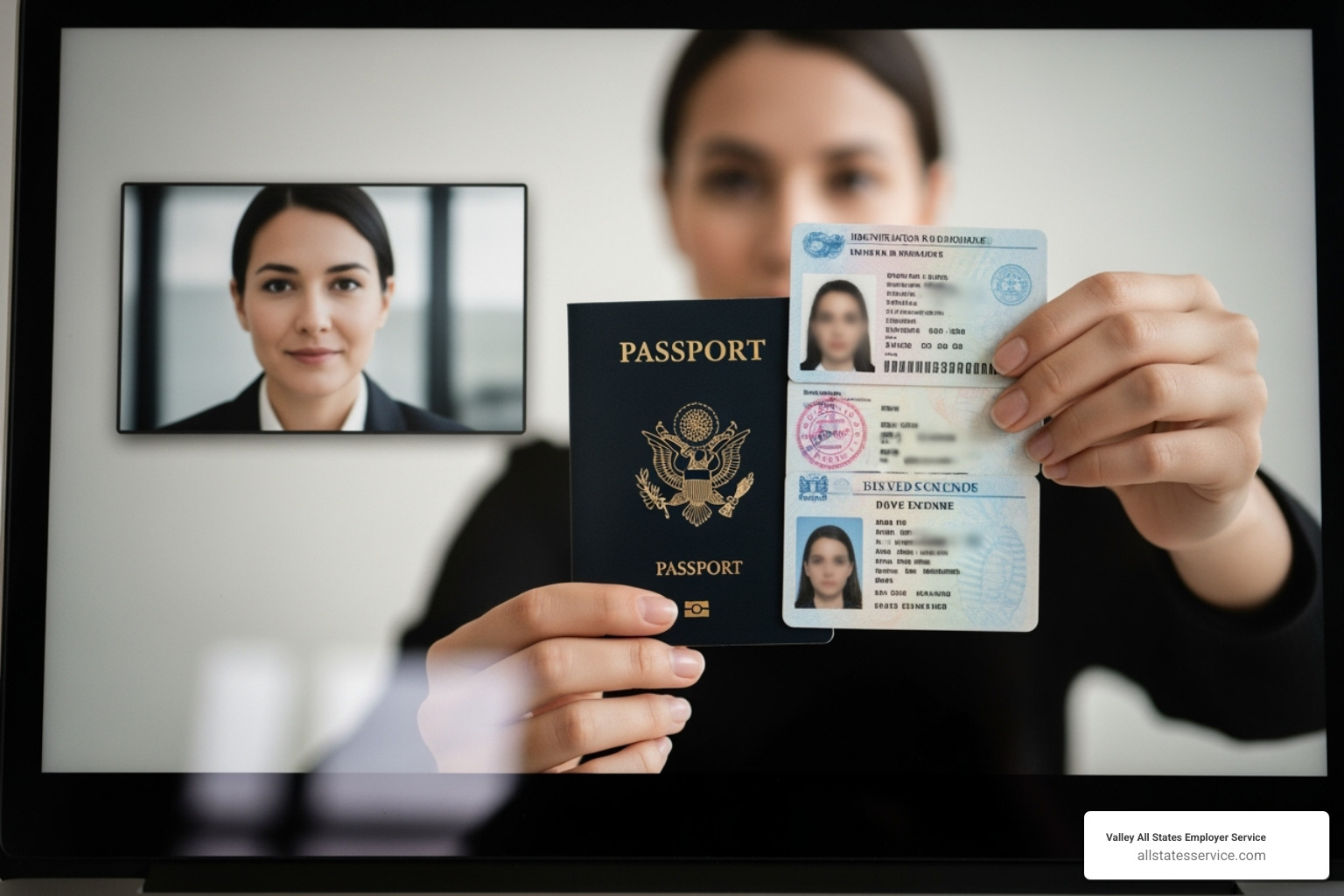
The Department of Homeland Security listened. Starting August 1, 2023, employers enrolled in E-Verify gained a valuable new option: an alternative procedure for remote document examination. If you participate in E-Verify, you can now verify your remote employees’ documents through a live video call instead of handling them in person.
Here’s how it works in practice. You schedule a live video interaction with your new hire. During the call, they hold up their documents to the camera while you examine them on screen. You’re checking that the documents look genuine and match the person you’re talking to, just as you would in person. After the video call, you keep clear copies of those documents for your records.
The new Form I-9 even includes a checkbox specifically for this alternative procedure, making it easy to document which method you used. This flexibility has been a game changer for companies with distributed teams. You can find the technical details in the Federal Register notice on remote procedures, and we’ve put together a comprehensive E-Verify Remote Complete Guide to walk you through every step.
What is E-Verify+ and Should You Use It?
What if you could combine Form I-9 and E-Verify into one streamlined digital process? That’s exactly what E-Verify+ does. Think of it as the next evolution of employment verification, designed to save you time and reduce headaches.
With E-Verify+, your new employee receives a unique link via email. They use this link to complete their Form I-9 information and upload their documents directly into the system. The magic happens next: E-Verify+ automatically creates and submits the verification case using the information your employee just entered. No duplicate data entry on your end. You simply review what they submitted, verify the documents, and complete your portion of the Form I-9 electronically.
Over 2,500 employers have already made the switch to E-Verify+, and they’re seeing real benefits. The process is more efficient, with fewer opportunities for typos or data entry mistakes. Both you and your employee get immediate status notifications, so everyone knows exactly where things stand. It’s a genuinely integrated approach to the E-Verify Onboarding Process.
Should you use it? For many employers, E-Verify+ offers clear advantages in speed and simplicity. However, there’s one important caveat: E-Verify+ isn’t currently available through Web Services or E-Verify Employer Agents. If you work with a third-party service (like us!) to handle your E-Verify processing, E-Verify+ might not be an option yet. That said, it’s worth keeping an eye on as the system continues to develop.
You can explore more details on the official E-Verify+ for Employers page, or dive deeper at Learn about E-Verify+. Whether you choose traditional E-Verify or E-Verify+, the key is finding the approach that fits your hiring workflow and keeps you compliant without adding unnecessary complexity.
Navigating E-Verify Compliance and Common Problems
Even the most organized HR department can hit a bump in the road with E-Verify, from simple typos to more complex situations. The good news is most problems are fixable, and knowing what to expect makes all the difference. Our goal is to help you maintain solid E-Verify Compliance, avoid penalties, and protect employee rights.
Understanding your E-Verify Employer Responsibilities is the first step toward smooth sailing. Let’s walk through some common scenarios you might encounter and, more importantly, how to handle them.
What Happens When You Get a Tentative Nonconfirmation (TNC)?
Picture this: you’ve just submitted an E-Verify new hire case, expecting the usual quick “Employment Authorized” response. Instead, you see something called a Tentative Nonconfirmation, or TNC. Before you panic, take a breath. This isn’t the end of the world, and it definitely doesn’t mean your new employee is unauthorized to work.
A TNC simply means there’s a mismatch between the information you entered and what’s in the government databases. Think of it as a yellow light, not a red one. It’s not a final determination, just a signal that something needs a closer look.
Why do TNCs happen? The reasons are often surprisingly simple. Maybe someone made a typo when entering the Social Security number. Perhaps your new employee got married last year and changed their name but hasn’t updated it with the Social Security Administration yet. We’ve seen TNCs triggered by incorrect birth dates, citizenship status changes that weren’t reflected in DHS records, or even just outdated information in government systems.
Here’s what you need to do when a TNC pops up. First, you must promptly notify your employee about the TNC and give them a “Referral Date Confirmation” notice. This isn’t optional, it’s required. Your employee then has the right to contest the TNC within 8 federal business days by contacting either the SSA or DHS, depending on which agency flagged the issue. For a detailed walkthrough of this process, check out our guide on E-Verify Tentative Nonconfirmation.
Critically, you cannot take any adverse action against the employee while they work to resolve the TNC. This means no firing, suspension, or reduction in hours. The employee is authorized to work while they sort things out. If they resolve the issue, the case updates to “Employment Authorized.” If they don’t contest it or can’t resolve it, it may lead to a Final Nonconfirmation.
Your employee can also track their case status anytime using the E-Verify Case Status tracker, which gives them visibility into the process.
Penalties, Shutdowns, and Employee Rights
Let’s talk about the less fun side of E-Verify: what happens when things go wrong. Form I-9 violations can cost hundreds or even thousands of dollars per form, depending on the severity and whether it’s a first-time offense. Knowingly hiring someone who isn’t authorized to work? That’s even worse, with penalties that can reach into the tens of thousands of dollars per violation, plus potential criminal charges including jail time. These aren’t hypothetical scenarios. Immigration and Customs Enforcement (ICE) conducts regular audits and takes these violations seriously.
Then there’s the curveball nobody likes: government shutdowns. We’ve witnessed how these can freeze E-Verify operations, leaving employers in a tough spot. During a shutdown, the system might be completely unavailable. When this happens, you’re not expected to magically verify employees through a system that doesn’t work. The government typically provides grace periods after the system comes back online, giving you extra time to submit cases for employees hired during the outage. For instance, after one recent shutdown, employers had until a specific date to catch up on cases for employees hired while E-Verify was down. Just make sure to document the situation and note “E-Verify not available” in your records. Staying informed through resources like this Forbes article on government shutdown impacts can help you prepare.
Now, let’s talk about something equally important: employee rights. E-Verify exists to confirm work authorization, not to discriminate or create unfair barriers. You cannot use E-Verify to pre-screen job applicants before they’re hired. You cannot selectively verify only certain employees based on how they look or sound. You cannot fire someone just because they received a TNC. These actions aren’t just bad practice, they’re illegal and can land you in serious hot water with the Office of Special Counsel for Immigration-Related Unfair Employment Practices.
Your employees have real protections under the law. They have the right to contest a TNC, the right to work while resolving it, and the right to report any discrimination or unfair treatment they experience. The official Employee Rights and Responsibilities page outlines all these protections in detail.
The best defense against compliance problems? Act in good faith, keep meticulous records, and treat all employees consistently. Whether you’re processing your first E-Verify new hire or your thousandth, following the rules protects both you and your workforce. And if you ever feel overwhelmed by the complexity of it all, help is available to guide you through every step.
Conclusion
You now have a solid understanding of how E-Verify new hire verification works and what it means for your business. While there are rules and procedures to master, you’re not alone.
E-Verify is more than just another compliance checkbox. It’s a practical tool that helps you build a legal workforce while protecting your business from costly penalties. Whether you’re required to use it as a federal contractor, mandated by your state law, or choosing it voluntarily to strengthen your hiring process, the key is understanding how it works and staying consistent.
The good news? The system keeps getting better. With remote verification options for distributed teams and the streamlined E-Verify+ platform rolling out to thousands of employers, the process is becoming more efficient every year. You can verify employment eligibility faster, with fewer errors, and with less administrative headache than ever before.
Managing E-Verify can feel overwhelming. Tracking deadlines, handling TNCs correctly, staying current with state mandates, and avoiding discrimination is a lot to juggle. One mistake can lead to fines or audits.
That’s exactly why Valley All States Employer Service exists. We specialize in expert, impartial, and efficient E-Verify processing that takes this burden off your shoulders. Our team handles the details, catches errors before they become problems, and ensures every new hire moves through the verification process smoothly. You get compliance peace of mind without the administrative headache.
Think of us as your backstage crew, making sure the show runs perfectly while you focus on building your business and welcoming great new team members.
Ready to simplify your hiring process? Our E-Verify Employer Agent Service is designed specifically for employers who want expert help without the hassle. For everything you need to know about staying compliant from start to finish, check out our comprehensive I-9 and E-Verify Ultimate Guide. Let’s make sure every new hire is good to go, together.