
Why Staffing Agency E-Verify Compliance Matters More Than Ever
Staffing agency E-Verify compliance is non-negotiable in 2026. If you place workers with clients, you need to understand when you’re responsible for employment verification, how to avoid discrimination claims, and what happens if you get it wrong.
Quick Answer: E-Verify Requirements for Staffing Agencies
- If you’re the employer of record (you complete Form I-9), you must create E-Verify cases for all new hires
- If you’re just a matchmaker (client completes Form I-9), the client handles E-Verify
- You cannot use E-Verify selectively across different hiring sites or clients without risking discrimination claims
- Cases must be created within 3 business days of the employee’s first day of employment
- Client demands don’t override your legal obligations to apply E-Verify consistently
The staffing industry faces unique E-Verify challenges. You’re managing high volumes of temporary workers, juggling multiple client demands, and operating across different states with varying requirements. One wrong move can trigger discrimination claims, federal audits, or significant fines.
Here’s what makes this complicated: your E-Verify responsibility depends entirely on whether you’re the legal employer of the worker. If you complete Form I-9, you’re in. If your client completes it, they are. But many staffing agencies operate in a gray area, sometimes acting as the employer and sometimes as a matchmaker.
And there’s more. You can’t just apply E-Verify when a client asks for it and skip it when they don’t. That selective approach, even if driven by client demands, can be evidence of unlawful discrimination based on national origin.
This guide walks you through exactly what staffing agencies must do to stay compliant, protect your business, and streamline your verification process.
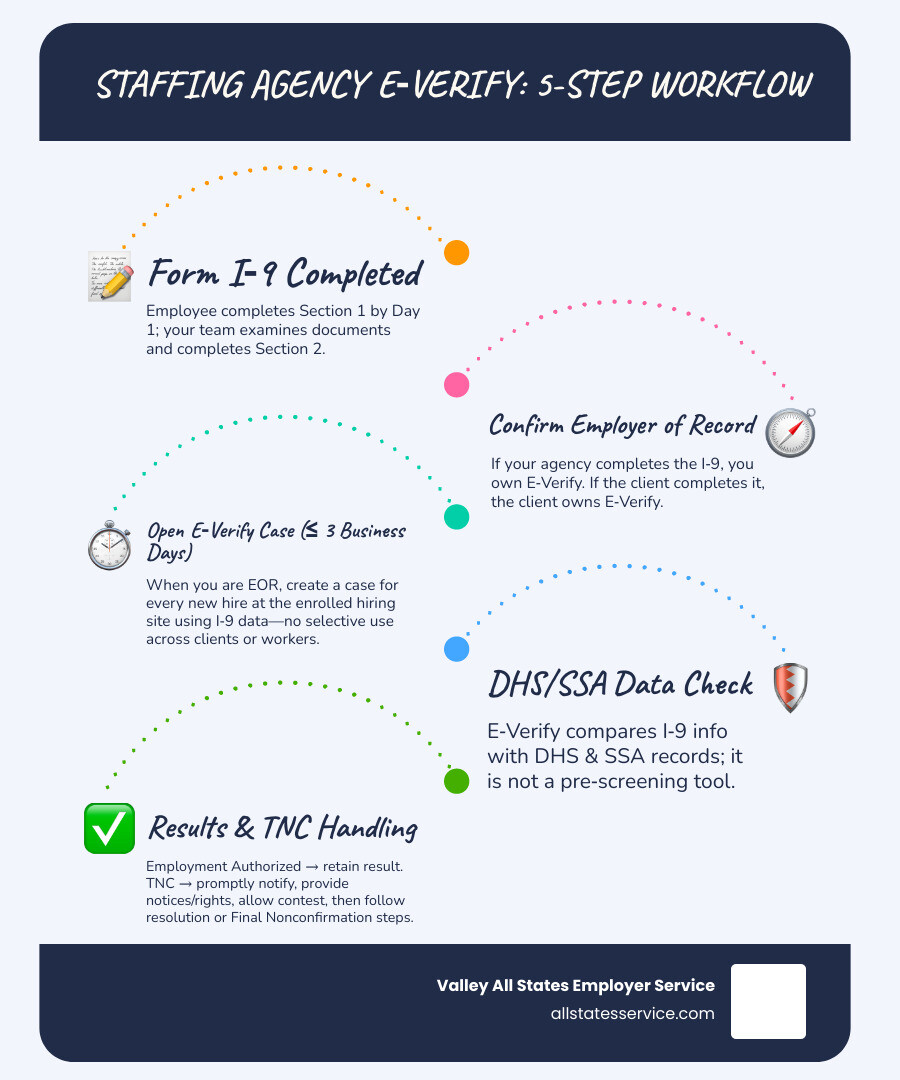
Simple guide to Staffing agency E-Verify:
The E-Verify Essentials: What Every Staffing Agency Must Know
E-Verify pairs with Form I-9 to confirm each new hire is authorized to work in the United States. Form I-9 is always step one. E-Verify is the electronic check that compares I-9 data against government records.
- Start with the foundation, the I-9. If you need a refresher, see our plain-English primer: What Is I-9 Form.
- E-Verify is an internet-based system run by USCIS, it compares I-9 information to records from DHS and SSA and returns a result in seconds. See the official E-Verify Overview.
- E-Verify confirms employment eligibility, it is not a background check and not a pre-screening tool. You run it only after an offer is accepted and the I-9 is completed.
- Confused about how I-9 and E-Verify fit together? Our side-by-side E-Verify vs I-9 Guide breaks it down.
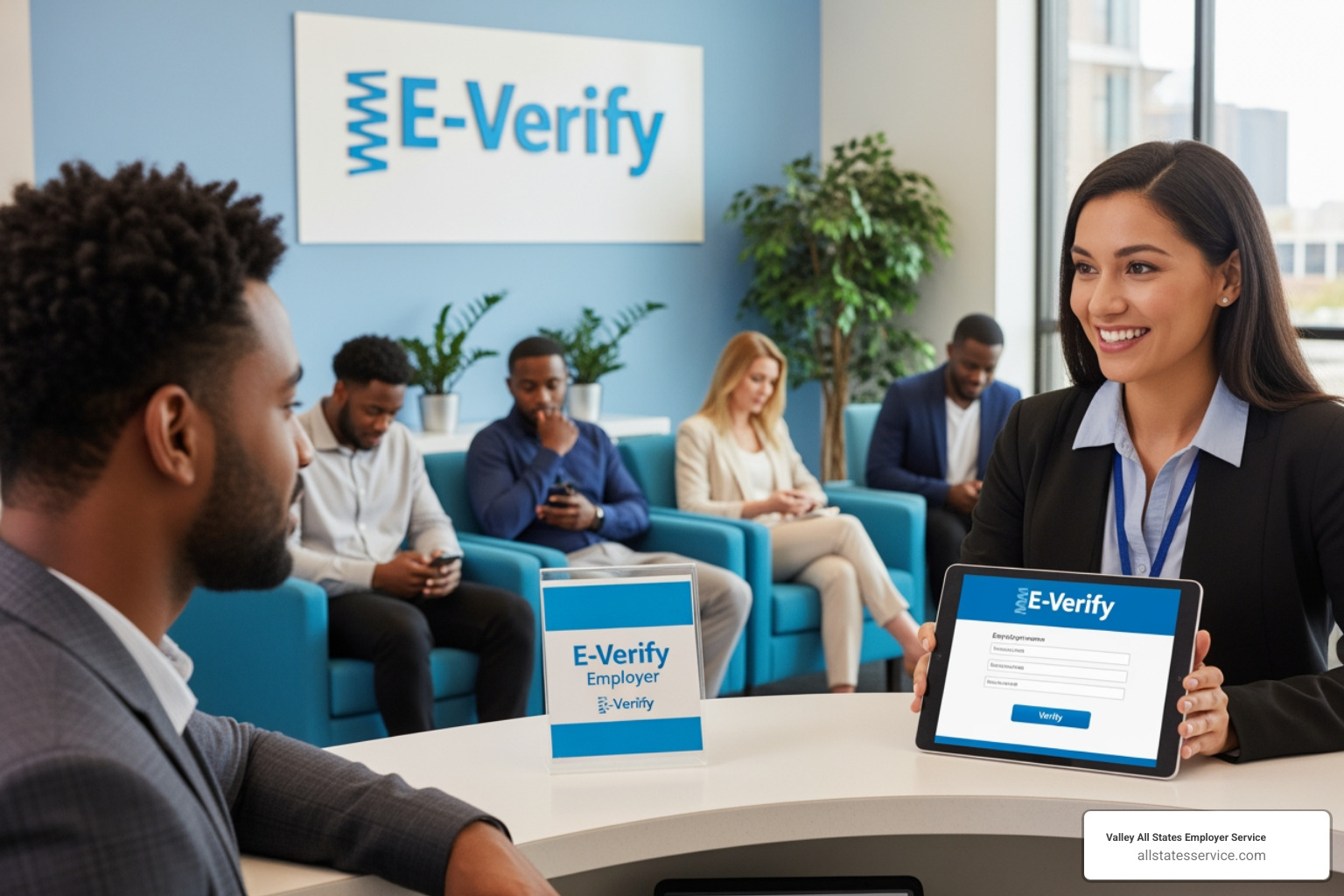
Key reminders for staffing teams:
- Use E-Verify for every new hire at an enrolled hiring site, regardless of citizenship or national origin.
- Never use E-Verify to pre-screen job applicants.
- Post the required “Notice of E-Verify Participation” and “Right to Work” posters where applicants and new hires can see them. The official employee page explains these rights and timelines: E-Verify Overview.
Navigating Your Legal Obligations as a Staffing Agency
Your responsibility hinges on a single question, who is the employer of record?
- If we are the employer of record, we complete the I-9 and must create the E-Verify case for every new hire at that hiring site.
- If we only match candidates and our client hires them as their own employees, the client completes the I-9 and owns the E-Verify case.
Put simply, if we complete the I-9, we must run E-Verify. For a deeper dive on obligations and common pitfalls, see our guide to E-Verify Employer Responsibilities.

Three practical rules to keep you safe:
- Apply E-Verify consistently at each enrolled hiring site. The rule is all new hires at that site, every time.
- Do not skip E-Verify because a client asks you to. Client requests do not override federal program rules.
- When duties are unclear, document who completes the I-9 and confirm in the staffing agreement which party runs E-Verify.
Helpful official resources for U.S. employers:
- Program basics and process steps: Employers | E-Verify
- Quick process reference: E-Verify Quick Reference Guide for Employers
The High-Stakes World of Staffing Agency E-Verify Compliance
Compliance mistakes cost real money and can put your business under scrutiny. E-Verify ties directly to the I-9, so errors often surface during audits.
Common risks for staffing agencies:
- I-9 and E-Verify audit findings leading to fines and required remediation, see our I-9 Audit Penalties Complete Guide.
- Allegations of discriminatory practices, especially if E-Verify is applied selectively.
- Contract risk and reputational damage if a client believes you failed to meet E-Verify commitments.
- Case handling violations, for example taking action on a Tentative Nonconfirmation before the employee can contest.
Leading staffing firms publicly commit to best practices, such as completing I-9s and running E-Verify within three days of the start date to align with federal guidance. The bottom line is the standard applies to everyone, large or small.
The Dangers of Selective Staffing Agency E-Verify Use
Selective use is the fastest way to invite a discrimination claim. The government has issued a specific reminder: do not selectively verify employees or sites. Review the official alert, Reminder: Staffing Agencies Must Not Selectively Verify Employees.
What not to do:
- Running E-Verify only for workers you suspect are foreign born.
- Using E-Verify only at certain client sites because a client asks for it.
- Treating temporary and permanent hires differently at the same enrolled hiring site.
What to do instead:
- Decide which hiring sites are enrolled and apply E-Verify to all new hires at those sites, consistently.
- Train staff on anti-discrimination rules and employee rights.
- Use standardized scripts and notices to prevent inconsistent treatment.
Integrating E-Verify into Your Onboarding Workflow
E-Verify works best when it is baked into your onboarding playbook, not treated as an afterthought. Here’s a simple model we use with clients.
- Offer accepted and I-9 completed
- Complete Form I-9 on or before day one. Need a clear roadmap? See our E-Verify Onboarding Process.
- Determine first day of employment for E-Verify timing
- Temporary staffing can pick a consistent approach, either the date the worker enters your active assignment pool or the first day they start on a specific assignment. Pick one approach and use it consistently on I-9 and E-Verify.
-
Create the E-Verify case within three business days of the first day of employment
- That three day window is strict, except for USCIS-announced outages or emergencies.
-
Review the result and take the correct next step
- Employment Authorized, close the case and file with the I-9 record.
- Tentative Nonconfirmation, give the required notice, review the mismatch reason with the employee, and let them decide whether to contest. Employees have rights during a mismatch, get the official overview on timings and protections here: E-Verify Overview.
- Final Nonconfirmation, follow your policy and the program rules for ending employment.
-
Document, retain, and move on to assignment
- Keep consistent records, including notices and any case updates.
Temporary and high-volume hiring
- Temporary hires follow the same rules, the timeline does not change. If you place a lot of temps, build standard steps and use checklists. We designed a guide for you, E-Verify Temporary Workers.
Handling Tentative Nonconfirmations with confidence
- A TNC does not mean unauthorized. It means the records did not match immediately. Your job is to deliver the notice, explain the process, and refrain from adverse action while the employee contests.
- See our detailed walkthrough of the TNC process and scripts you can adapt: E-Verify Tentative Nonconfirmation.
Pro tip for compliance posters and timing
- Post required notices where applicants and new hires can see them. If you cannot display at a virtual site, include them with application materials. The official employee page covers case timing, poster requirements, and rights: E-Verify Overview.
Special Cases and Recent Updates: Staying Ahead of the Curve
Federal contractors
- If you or your clients hold federal contracts with the FAR E-Verify clause, special rules apply. You must verify new hires and employees assigned to the covered contract. Start with our E-Verify for Federal Contractors Ultimate Guide and the official Supplemental Guide for Federal Contractors.
- Some contracts or employees may be exempt. Review official Exemptions and Special Rules.
State-specific mandates for Maryland-based operations
- State rules vary across the U.S. In Maryland, there is no broad statewide mandate for private employers at this time, but public contracts or specific client requirements can trigger E-Verify participation. Our location in Maryland, including Lutherville, means we keep our clients aligned with local expectations and federal rules.
- If you hire across the United States, track varying requirements and public-contract obligations. Our overview covers multi-state planning, E-Verify State Requirements Guide and Maryland specifics here: Maryland E-Verify.
What’s new
- Records disposal, USCIS has a policy of deleting E-Verify records that are more than 10 years old. You must download and retain Historic Records Reports for any cases you need to keep before they are purged to stay audit-ready. Official notice, E-Verify records scheduled for disposal.
- System outages and grace periods, E-Verify can be impacted by federal events. USCIS has granted grace periods to catch up on case creation after shutdowns. See the official service update, E-Verify Resumes Operations. Build procedures to document delays, select “Other” as the reason, and note “E-Verify not available” when USCIS instructs.
Remote I-9 inspection
- Since August 1, 2023, E-Verify enrolled employers can use DHS-authorized alternative procedures to examine I-9 documents remotely if they meet certain steps and requirements. Review the current guidance on the official program page, Employers | E-Verify.
Best Practices for Bulletproof E-Verify Compliance
You do not need to reinvent the wheel. A few habits, done every time, will keep your files audit ready.
- Write down your process
- Define when you run E-Verify, how you set the first day of employment for temps, how you handle TNCs, and who closes cases.
- Train your team
- Everyone who touches I-9s and E-Verify should be trained on discrimination rules, timelines, and documentation. Start here, I-9 Training for Employers.
- Audit yourselves
- Run periodic checks to catch timing errors, missing posters, or incomplete case notes. Use our checklist, I-9 Self Audit.
- Apply E-Verify consistently
- If a hiring site is enrolled, you must verify all hires at that site. No exceptions for particular clients or roles.
- Retain your records
- Keep I-9s according to retention rules and pair E-Verify records with their I-9s. Remember the records disposal policy.
- Follow program rules
- Refresh your team with a short list of dos and don’ts: E-Verify Best Practices.
Poster checklist and rights
- Display the Notice of E-Verify Participation and Right to Work posters or provide them with application materials when you cannot display them at the hiring location. The official employee page, including case timing and rights, is here: E-Verify Overview.
Stay current
- Subscribe to program alerts to catch policy changes fast: Subscribe for E-Verify News.
Technology and Your Staffing Agency E-Verify Strategy
Technology reduces errors and speeds up onboarding, especially for high-volume temporary placements in Maryland and across the United States.
- Use electronic I-9s and integrations
- Smart forms reduce typos and missing fields, and many systems connect directly to E-Verify. Explore options, Electronic I-9 Solutions.
- Outsource where it helps most
- An E-Verify Employer Agent can manage cases for you, standardize workflows, and maintain audit trails. Learn what to expect, E-Verify Employer Agent Complete Guide.
Where we fit in
- As Valley All States Employer Service, we provide outsourced E-Verify processing that is expert, impartial, and efficient. We minimize errors and administrative burden, so your recruiters can focus on placements while we keep your verifications clean, fast, and compliant.
Frequently Asked Questions about Staffing Agency E-Verify
Can a staffing agency use E-Verify for some clients but not others?
No. If a hiring site is enrolled in E-Verify, you must run cases for all new hires at that site. Selective use, even at a client’s request, can look like unlawful discrimination. See USCIS’s reminder aimed at our industry, Staffing agencies must not selectively verify employees.
What’s the difference between an E-Verify “Employer of Record” and a “Matchmaker”?
- Employer of record, you are the worker’s legal employer, you complete Form I-9 and create the E-Verify case.
- Matchmaker, you connect talent to a client who hires them directly, the client completes I-9 and runs E-Verify.
If you complete the I-9, you own the E-Verify case. If the client completes it, they do. Our guide to responsibilities explains the dividing line, E-Verify Employer Responsibilities.
How soon must a staffing agency run E-Verify on a new temporary hire?
Within three business days of the employee’s first day of employment. For temporary staffing, you can define first day consistently as either the date the worker enters your assignment pool or the first day on an assignment. Use the same rule on the I-9 and E-Verify case and apply it every time.
Simplify Your E-Verify Process and Ensure Compliance
You can make Staffing agency E-Verify reliable, fast, and low stress. Standardize your onboarding steps, train your team, use the right technology, and document everything. Use official resources when in doubt:
- Program hub for employers: Employers | E-Verify
- Quick how-to: E-Verify Quick Reference Guide for Employers
If you are a staffing firm in Maryland, Lutherville MD, or anywhere in the United States, we can take the heavy lifting off your plate. We run clean, consistent cases, help you handle TNCs correctly, and keep your records audit ready.
Ready to reduce risk and speed up onboarding? Streamline your hiring with expert employee onboarding compliance services.
Additional helpful links you can bookmark:
- Stay current on program updates, E-Verify website
- Enroll or log in when you are ready to participate, Login EnrollLogin
- Learn about the ICE partnership program for best practices, IMAGE program