
E-Verify temporary workers: Ultimate 2025 Guide
Why E-Verify Temporary Workers Verification Matters for Your Business
E-Verify temporary workers verification is required when staffing agencies serve as the employer of record, when workers are assigned to federal contracts with the FAR E-Verify clause, or when employers choose to verify temporary staff directly through E-Verify Employer Agent enrollment.
Key Requirements for E-Verify Temporary Workers:
- Staffing agencies must create E-Verify cases if they are the employer of record and complete Form I-9
- Federal contract workers assigned to contracts with FAR E-Verify clause must be verified
- Employers can verify directly by enrolling as an E-Verify Employer Agent
- Cannot bypass verification simply because a client requests it
If you’re managing temporary staff, you’re dealing with one of the most complex areas of employment verification. The rules change depending on whether you’re using a staffing agency, hiring directly, or working on federal contracts.
Here’s the reality: staffing agencies have different business models. Some act as the actual employer (employer of record), while others just match workers with companies. This distinction completely changes your E-Verify obligations.
When temporary workers are assigned to federal contracts containing the FAR E-Verify clause, verification becomes mandatory. The staffing agency must verify these workers’ employment authorization, but employers should confirm this happened.
You also have options. If you want more control over the verification process, you can enroll as an E-Verify Employer Agent. This lets you create E-Verify cases directly for temporary employees that agencies provide.
The stakes are high. Getting this wrong can mean compliance violations, delayed projects, and administrative headaches that no HR team needs.
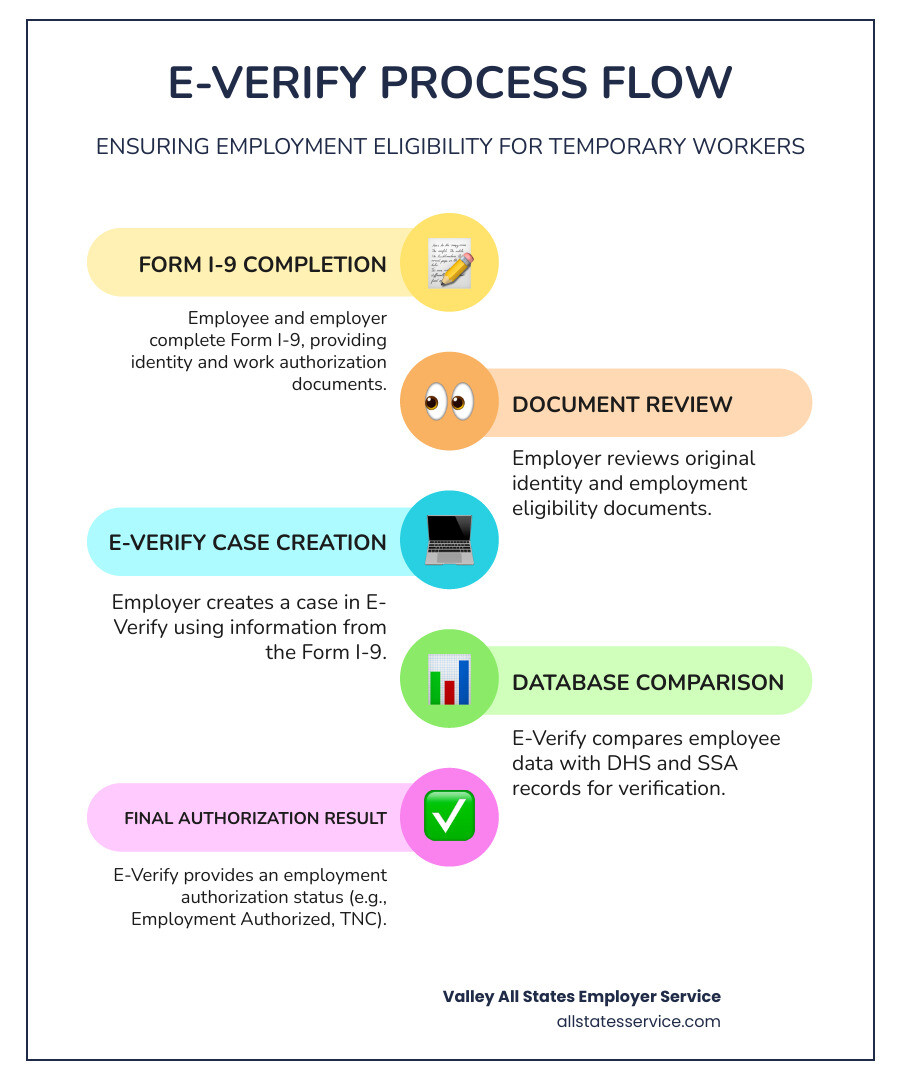
E-Verify and Form I-9: The Basics of Eligibility Verification
Think of employment verification like a two-step dance. First comes Form I-9, then E-Verify joins in. Together, they help you confirm that every person on your payroll has the right to work in the United States.
Form I-9 is your starting point. Every employer in America must complete this form for every new hire. It’s how you verify someone’s identity and work authorization. The process is straightforward: your employee shows you acceptable documents, you examine them, and you fill out the form. Simple as that.
You can dive deeper into the details with our comprehensive guide on What is I-9 Form?.
E-Verify takes things a step further. This internet-based system, run by U.S. Citizenship and Immigration Services (USCIS) and the Social Security Administration (SSA), compares the information from your employee’s Form I-9 against government databases. Within seconds, you get confirmation that matches your employee’s information with federal records.
The beauty of E-Verify lies in its simplicity. It’s free, fast, and gives you extra confidence in your hiring decisions. When you’re dealing with E-Verify temporary workers, this additional layer of verification becomes especially valuable.
What are the key differences between Form I-9 and E-Verify?
While these two systems work hand in hand, they have distinct differences that matter for your business. Understanding these differences is crucial, especially when managing E-Verify temporary workers.
The scope differs dramatically. Form I-9 is mandatory for everyone. Every U.S. employer must complete it for every new hire, no exceptions. E-Verify, however, is only required for federal contractors with specific contract clauses, some government agencies, and employers in certain states that mandate its use.
Document requirements get more specific with E-Verify. While Form I-9 accepts various document combinations, E-Verify requires a Social Security Number for every case you create. If an employee uses a List B identity document (like a driver’s license), that document must have a photo for E-Verify purposes.
The examination process offers more flexibility with E-Verify. Traditional Form I-9 completion requires you to physically examine documents in person. E-Verify allows eligible employers to use alternative procedures, including remote document inspection through live video interaction.
Reverification rules work differently too. You’ll need to reverify Form I-9 when work authorization expires, but E-Verify typically isn’t used for reverification unless you’re dealing with federal contractors or specific temporary work situations.
For a complete comparison of how these systems interact, check out our detailed resource on E-Verify and I-9.
Who is required to use E-Verify?
The answer depends on your specific situation, and it’s not always black and white.
Federal contractors face the strictest requirements. If your business holds federal contracts that include the FAR E-Verify clause, you must use E-Verify for employees working on those contracts. This requirement often extends to E-Verify temporary workers assigned to these federal projects.
State and local mandates create additional obligations. Seventeen states have already made E-Verify mandatory for some or all employers. These laws vary widely. Some apply only to government contractors, while others cover all private employers within the state.
For everyone else, it’s a choice. Many employers voluntarily enroll in E-Verify because they want the additional verification layer. It provides peace of mind and can streamline your compliance efforts.
The key is knowing which category your business falls into. Our comprehensive guide on E-Verify Employer Requirements can help you determine exactly what applies to your situation.
Special Rules for E-Verify Temporary Workers
Working with temporary staff? You’re entering one of the trickiest areas of employment verification. The rules aren’t just different, they’re layered with complexities that can catch even experienced HR professionals off guard.
Here’s what makes E-Verify temporary workers verification so challenging: staffing agency responsibilities shift dramatically based on their business model. Some agencies act as the employer of record, handling payroll, taxes, and all HR compliance. Others simply connect workers with companies, stepping back once the match is made.
When federal contracts enter the picture, everything becomes mandatory. If your project includes the FAR E-Verify clause, there’s no wiggle room. Every temporary worker assigned to that contract must be verified through E-Verify.
The good news? Once you understand the framework, managing compliance becomes much more straightforward. Let’s break down exactly how these rules work in practice.
How do E-Verify rules apply to staffing agencies?
The agency as employer distinction changes everything about E-Verify compliance. When a staffing agency serves as the employer of record, they’re not just placing workers, they’re taking full legal responsibility for employment verification.
This means completing Form I-9 for every new hire and creating E-Verify cases just like any other employer. The agency can’t skip verification simply because a client asks them to. Compliance requirements don’t disappear based on client preferences.
Case creation timing offers some flexibility, but consistency is crucial. Staffing agencies can choose either the date when an employee accepts an offer and enters the assignment pool, or the date they’re assigned to their first actual job. Whichever approach you pick, stick with it for all employees.
Never leave the certification date or “Employee’s First Day of Employment” field blank on Form I-9. This seemingly small detail can create major headaches during audits.
The reality is that many agencies struggle with these requirements because they’re managing dozens or hundreds of placements simultaneously. Our E-Verify Services help streamline this process, ensuring nothing falls through the cracks.
Key Considerations for E-Verify Temporary Workers on Federal Contracts
Federal contracts with the FAR E-Verify clause transform verification from optional to absolutely mandatory. There’s no middle ground here, and the stakes are high for both staffing agencies and federal contractors.
Verifying assigned workers becomes the staffing agency’s responsibility when they place employees on these contracts. This includes workers who are placed in a pool specifically for federal assignments, even before they start actual work.
Federal contractors using temporary workers must do their due diligence. You can’t just assume the staffing agency handled verification properly. Contact them directly and confirm that E-Verify temporary workers on your project have been verified.
Proof of E-Verify enrollment is simple to obtain. Staffing agencies can print their “Company Information” page directly from their E-Verify account. This one-page document provides concrete evidence of their enrollment and compliance efforts.
The E-Verify FAQ addresses this exact scenario, providing official guidance for federal contractors working with outside staffing agencies.
Understanding these requirements isn’t just about avoiding penalties. It’s about maintaining the security clearances and contract relationships that keep your business running. Our guide on E-Verify for Contractors covers these complexities in detail.
Your Options for Verifying E-Verify Temporary Workers
You have more control over temporary worker verification than you might realize. The key is understanding your options and choosing the approach that fits your business needs and risk tolerance.
Relying on staffing agency verification is the most common approach, especially when they serve as the employer of record. This makes sense, they’re handling payroll and compliance anyway. But smart businesses don’t just rely, they verify.
Requesting proof should be standard practice. Ask for documentation showing the agency’s E-Verify enrollment and confirmation that your specific workers have been verified. This is particularly critical for federal contracts where non-compliance can jeopardize your entire project.
Enrolling as an E-Verify Employer Agent gives you direct control over the verification process. Even if the staffing agency performs their own verification, you can create additional E-Verify cases for the temporary employees they provide. This dual approach might seem like overkill, but it provides maximum oversight and protection.
The Employer Agent option works especially well for businesses with ongoing temporary staffing needs or those working on sensitive federal contracts. You get real-time visibility into verification status and can address issues immediately.
Choosing the right approach depends on your specific situation. High-volume temporary staffing might benefit from agency reliance with strong oversight. Sensitive projects or federal contracts might warrant the Employer Agent approach.
Our E-Verify Employer Agent Service provides comprehensive support if you decide to take direct control of the verification process. Sometimes the peace of mind is worth the additional administrative effort.
Navigating E-Verify Processes and Ensuring Compliance
Compliance with E-Verify goes beyond just hitting “submit” on that initial verification. It’s like maintaining a garden – you need ongoing attention, understanding of what can go wrong, and knowing how to fix problems when they pop up. For businesses working with E-Verify temporary workers, staying on top of these processes isn’t just smart business, it’s essential for avoiding penalties that can really sting your bottom line.
Think of transparency as your first line of defense. Every employer using E-Verify must display two important posters: the “Notice of Participation” and “Right to Work” posters. These aren’t just bureaucratic decoration – they’re your way of telling employees and job applicants that you use E-Verify and what their rights are in the process. Both posters come in English and Spanish, so make sure you’re using the right versions for your workforce.
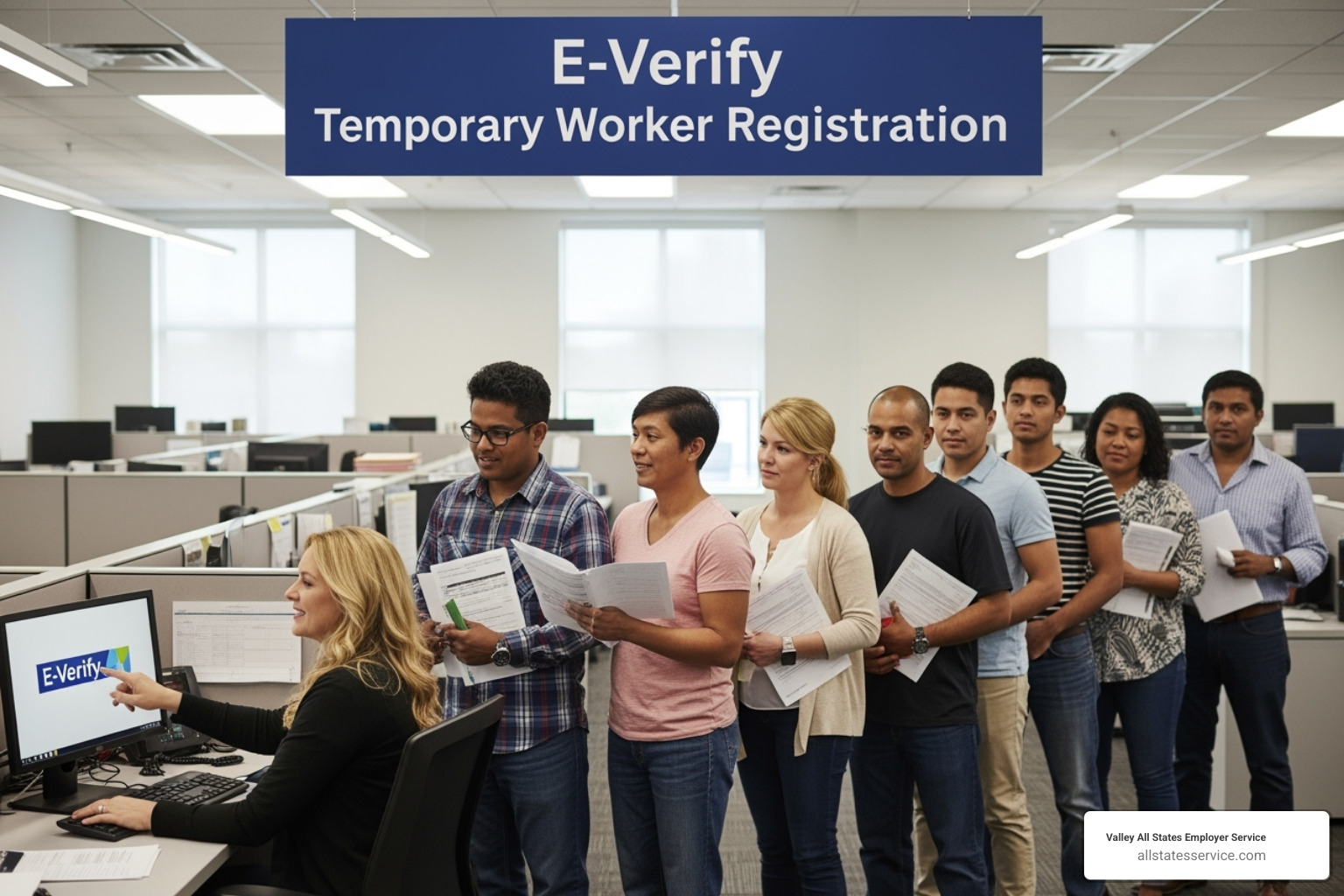
Building solid compliance habits means more than just following the rules – it means making them second nature. Consistent application is key. You can’t verify some employees and skip others based on how they look or sound. Accurate data entry prevents most problems before they start. And timely responses to E-Verify results keep your process moving smoothly. Our guide on E-Verify Best Practices can help you build these habits into your daily operations.
What are the rights and responsibilities of employees?
Understanding employee rights isn’t just about being nice – it’s about staying compliant and avoiding discrimination claims. When you use E-Verify, your employees have specific protections that you need to respect, and they also have responsibilities in the process.
Your employees have the right to know you’re using E-Verify. That’s why those posters we mentioned aren’t optional. They also have strong anti-discrimination protections. You cannot treat employees differently based on their accent, appearance, or name. The verification process must be the same for everyone.
When problems arise – and they will – employees have the right to fix mismatches. If E-Verify returns a Tentative Nonconfirmation (TNC), you must give the employee a “Further Action Notice” that explains what went wrong and how to fix it. During this time, employees can keep working while they sort things out. No suspensions, no reduced hours, no “temporary assignments” – they continue as normal.
But employees aren’t just passive participants. They need to provide accurate information on their Form I-9. If they’ve recently changed their name, become a citizen, or updated their immigration status, they should contact the Social Security Administration before starting work. This simple step prevents most mismatches from happening.
When a TNC occurs, employees must decide whether to contest it. They have eight federal government working days to contact DHS or SSA after you give them their “Referral Date Confirmation.” It’s their choice, but they need to communicate their decision to you clearly.
Employees can learn more through resources like the Employee Rights webinar information or check their status through our E-Verify Status Check service.
How do you handle an E-Verify mismatch or TNC?
A Tentative Nonconfirmation sounds scary, but it’s really just E-Verify’s way of saying “something doesn’t match up.” Don’t panic – about 96% of employees who go through E-Verify receive an immediate “Employment Authorized” result. For the small percentage who get a TNC, there’s a clear process to follow.
Speed matters when you get a TNC result. You must notify the employee immediately – not at the end of the week, not when it’s convenient. Hand them the “Further Action Notice” that E-Verify generates. This notice explains exactly what information didn’t match and gives them step-by-step instructions for fixing it.
Here’s where many employers mess up: you cannot take any adverse action against an employee who chooses to contest a TNC. They keep working at full pay with all normal duties while the case is pending. Think of it as “innocent until proven otherwise” – the mismatch might be due to a simple database error or recent name change.
The eight-day clock starts ticking when you give the employee their “Referral Date Confirmation” (if they choose to contest). They must contact the appropriate government agency within eight federal government working days. Your job is to track this timeline and document everything on their Form I-9.
What if they don’t contest or the case becomes a Final Nonconfirmation? Only then can you consider termination. But double-check that you followed every step correctly first – mistakes in the TNC process can lead to discrimination claims.
You can track case progress through the E-Verify system, which helps you stay on top of pending cases and follow up appropriately.
What are the alternative procedures for document examination?
Remember when COVID-19 turned everything upside down? The government created temporary flexibilities that let employers examine I-9 documents remotely instead of in person. While those emergency measures have ended, there’s now a permanent alternative procedure for E-Verify employers who used those flexibilities.
If you examined documents remotely between March 20, 2020, and July 31, 2023, you might qualify for this alternative procedure instead of having to bring employees in for physical document inspection. But you need to meet all four requirements: you must have been enrolled in E-Verify when you completed the Form I-9, created an E-Verify case for the employee, and still be actively participating in E-Verify today.
The alternative procedure isn’t just “keep doing what you’re doing.” You need to conduct a live video interaction with each affected employee to re-examine their documents remotely. This isn’t a phone call or email exchange – it’s a real-time video session where you can clearly see the employee and their documents.
Documentation is crucial for this alternative procedure. You must annotate each employee’s Form I-9 with “alternative procedure,” the date of your second remote examination, and your initials. Put this information in the “Additional Information” field or Section 3.
If you don’t meet all four requirements, you’ll need to arrange in-person physical document examination. There’s no middle ground here – it’s either the alternative procedure or traditional physical inspection.
This flexibility shows how employment verification continues evolving with technology and changing work patterns. Our I-9 Verification Remote Complete Guide walks you through all the details of remote verification procedures.
Handling Special Immigration Statuses: TPS and DED
When you’re verifying E-Verify temporary workers, you’ll occasionally encounter employees with special immigration statuses that can make the process feel like navigating a maze. Two of the most common are Temporary Protected Status (TPS) and Deferred Enforced Departure (DED). These designations provide temporary work authorization and protection from removal, but they come with their own set of rules that can trip up even experienced HR professionals.
The key challenge? These statuses often involve automatic EAD extensions that can make an employee’s work authorization document appear expired when it’s actually still valid. Understanding how to handle these situations correctly is essential for maintaining compliance with Workforce Eligibility Verification requirements.
What are the implications of TPS designations?
Temporary Protected Status isn’t just bureaucratic paperwork. It’s a lifeline for people from countries experiencing armed conflict, natural disasters, or other extraordinary circumstances that make return unsafe. When someone receives TPS, they can live and work in the United States temporarily, but the “temporary” part creates ongoing compliance challenges for employers.
Here’s where things get interesting for your verification process. TPS beneficiaries often receive automatic EAD extensions that can last up to 540 days beyond their document’s printed expiration date. This means you might receive a Form I-9 with an Employment Authorization Document that looks expired but is actually perfectly valid.
The employee should present their seemingly expired EAD along with a Form I-797C Notice of Action that confirms their eligibility for the automatic extension. You must accept these documents as valid proof of work authorization. It’s not optional, even if the combination feels unusual.
Venezuela provides a perfect example of how complex this can become. The country has had multiple TPS designations over the years. The 2023 designation was terminated, with benefits ending April 7, 2025. However, the 2021 designation remains active until September 10, 2025. Pay attention to the EAD category codes like A12 or C19, as these help you determine which designation applies and when reverification is required.
When TPS designations end, reverification becomes mandatory. Mark your calendar for these dates because missing a reverification deadline can create serious compliance issues. The Clarification on TPS EAD extensions provides detailed guidance on handling these extensions correctly.
For step-by-step instructions on completing Form I-9 for TPS beneficiaries, the I-9 Central TPS page offers comprehensive guidance that can save you from costly mistakes.
How does DED affect the E-Verify process?
Deferred Enforced Departure operates similarly to TPS but comes with its own unique characteristics. While TPS is designated by the Department of Homeland Security, DED is typically granted directly by the President for specific populations facing extraordinary circumstances.
The most recent example involves certain Hong Kong residents. President Biden extended DED and work authorization for this group through February 5, 2027. If you have employees with EADs showing a “Card Expires” date of February 5, 2023, or February 5, 2025, and a Category Code of A11, those documents are automatically extended.
Just like with TPS, you must accept these automatically extended EADs as valid during the extension period. The critical date to remember is February 6, 2027, when these employees must be reverified before they can continue working.
The automatic extension concept can feel counterintuitive. You’re trained to check expiration dates, but suddenly you’re accepting documents that appear expired. The key is understanding that the automatic EAD validity extends beyond the printed date, provided the employee meets specific criteria and the extension is still in effect.
These reverification deadlines aren’t suggestions. They’re firm compliance requirements that can result in penalties if missed. Building a system to track these dates is essential, especially when managing E-Verify temporary workers who might have various immigration statuses and expiration dates.
Understanding these nuances is part of developing a robust Automated Eligibility Verification System that keeps your business compliant with all immigration regulations, no matter how complex they become.
Conclusion
Managing E-Verify temporary workers doesn’t have to feel like solving a Rubik’s cube blindfolded. While the rules can seem overwhelming at first, breaking them down into manageable pieces makes compliance achievable for any business.
The foundation remains solid: understand your Form I-9 responsibilities, know when E-Verify is required, and recognize the special rules that apply to temporary staffing situations. Whether you’re a staffing agency acting as the employer of record or a federal contractor using temporary workers, clarity about your obligations keeps you on the right side of compliance.
Key takeaways for your business: staffing agencies must verify workers when they’re the employer of record, federal contracts with FAR E-Verify clauses require mandatory verification, and you always have the option to take control by enrolling as an E-Verify Employer Agent. Don’t forget about those automatic EAD extensions for TPS and DED beneficiaries either. Missing those reverification deadlines can create unnecessary headaches.
The administrative burden of tracking all these moving pieces is real. Between handling TNCs properly, staying current on immigration status changes, and ensuring your staffing partners are actually doing their verification work, it’s a lot to manage. That’s especially true when you’re trying to run your actual business at the same time.
At Valley All States Employer Service, we’ve seen how these compliance requirements can overwhelm even the most organized HR teams. Our expertise in outsourced E-Verify workforce eligibility verification means you get accurate, efficient processing without the stress of keeping up with every regulatory change yourself.
Ready to take the complexity out of employment verification? Learn more about E-Verify for Small Businesses and find how we can handle the details while you focus on growing your business.