
I-9 compliance for employers: 3-Step Flawless Guide
Why I-9 Compliance for Employers Is Non-Negotiable

I-9 compliance for employers is a mandatory federal requirement that can cost your business thousands of dollars per violation if handled incorrectly. Under the Immigration Reform and Control Act (IRCA), every employer must complete a Form I-9 for each new hire to verify their identity and authorization to work in the United States.
Here’s what you need to know right now:
- What it is: Form I-9 is a federal document required for all employees hired after November 6, 1986
- Key deadlines: Section 1 must be completed by the employee’s first day of work; Section 2 must be completed by the employer within three business days
- Retention rules: Keep completed forms for three years after hire date or one year after termination (whichever is later)
- Penalties: Paperwork violations can cost up to $2,861 per form, and hiring unauthorized workers can result in fines up to $28,619 per employee
- Who must comply: All U.S. employers, regardless of company size or industry
The stakes are high. With worksite enforcement increasing and updated fine schedules now in effect, getting ahead of I-9 compliance isn’t just about avoiding penalties. It’s about protecting your business from disruptions, legal challenges, and reputational damage.
Many HR managers feel overwhelmed by the technical requirements, confusing document lists, and constantly changing regulations. You’re juggling dozens of responsibilities, and I-9 verification can feel like one more complex task with serious consequences for even minor mistakes.
This guide breaks down everything you need to know about I-9 compliance into clear, actionable steps. We’ll walk you through the completion process, document requirements, error correction, retention rules, and how to prepare for audits. You’ll also learn how E-Verify integrates with your I-9 obligations and find best practices for maintaining ongoing compliance.
Whether you’re hiring your first employee or managing a growing workforce, this comprehensive resource will help you steer I-9 requirements with confidence. Learn more about HR compliance for small business to build a strong foundation for your hiring processes.
I-9 compliance for employers vocab explained:
- form i 9 section 2
- how to review i 9 documents for remote employees
- i 9 section 2 acceptable documents
The Foundations: Understanding Form I-9 and Key Deadlines
Navigating employment paperwork can sometimes feel like deciphering ancient hieroglyphs. For us, the Form I-9 stands out as one of the most critical documents. Let’s explain it and understand why it’s so important for every employer.
What is Form I-9 and Why Is It Crucial?
At its heart, Form I-9, Employment Eligibility Verification, is a standard federal form mandated by the U.S. Citizenship and Immigration Services (USCIS). Its primary purpose is to verify the identity and employment authorization of individuals hired to work in the United States. This means that if you hire someone to perform labor or services for wages or other remuneration, you must complete this form.
It’s crucial because it’s our first line of defense against unauthorized employment. By ensuring every new hire completes and verifies their I-9, we uphold federal law and contribute to a legal workforce. This requirement applies to every person hired for employment after November 6, 1986, who works for pay or other type of payment. Failure to comply can lead to significant penalties, making its accurate completion a non-negotiable part of our hiring process. What is an I-9 Form?
Employer vs. Employee Responsibilities
The I-9 process is a two-way street, with clear responsibilities for both the employee and the employer.
The employee’s responsibility centers around Section 1 of the form. No later than their first day of work, the employee must complete this section, providing their personal information and attesting to their citizenship or immigration status. They also commit to presenting documents that prove both their identity and their authorization to work in the U.S. They must sign and date this section, affirming the accuracy of their statements.
As the employer, our responsibilities primarily involve Section 2. Within three business days of the employee’s start date, we must physically examine the original documents presented by the employee. These documents must reasonably appear to be genuine and relate to the person presenting them. Our role is to complete Section 2 based on these documents, ensuring we do not discriminate against employees based on their citizenship, immigration status, or national origin. We are also prohibited from knowingly hiring or continuing to employ noncitizens unauthorized to work. Filling Out an I-9 Employer
Critical I-9 Completion Timelines You Can’t Miss
Timelines are paramount in I-9 compliance. Missing these deadlines is a common pitfall that can lead to fines, even if the employee is fully authorized to work.
- Section 1 Completion: The employee must complete and sign Section 1 of Form I-9 no later than their first day of employment. They can complete it earlier, but only after accepting a job offer.
- Section 2 Completion: We, as the employer, must complete Section 2 within three business days of the employee’s first day of work. For example, if an employee starts on a Monday, Section 2 must be completed by Thursday of the same week.
- Short-Term Hires: If an employee is hired for less than three business days, both Section 1 and Section 2 must be completed on their first day of employment.
“Business days” typically exclude weekends and federal holidays. It’s crucial to have a system in place to track these deadlines for every new hire. I-9 Form Completion
The Core Process: A Step-by-Step Guide to Completing Form I-9

Completing Form I-9 correctly is a step-by-step process that demands attention to detail. Let’s walk through each stage to ensure we get it right every time.
Step 1: Completing Section 1 – The Employee’s Role
This is where the employee kicks off the process. On or before their first day of employment, they must accurately fill out Section 1. This includes their full legal name, address, date of birth, and Social Security number (if they have one).
The most critical part for the employee is attesting to their citizenship or immigration status. They must check one of four boxes:
- A U.S. Citizen
- A Noncitizen National of the U.S.
- A Lawful Permanent Resident (and provide their Alien Registration Number or USCIS Number)
- An Alien Authorized to Work (and provide their Alien Registration Number/USCIS Number, Form I-94 Admission Number, or Foreign Passport Number with Country of Issuance, and work authorization expiration date if applicable).
If an employee needs help completing Section 1, a preparer or translator can assist. In such cases, Supplement A (Preparer and/or Translator Certification) must also be completed and signed by the individual who provided assistance.
Step 2: Completing Section 2 – The Employer’s Verification
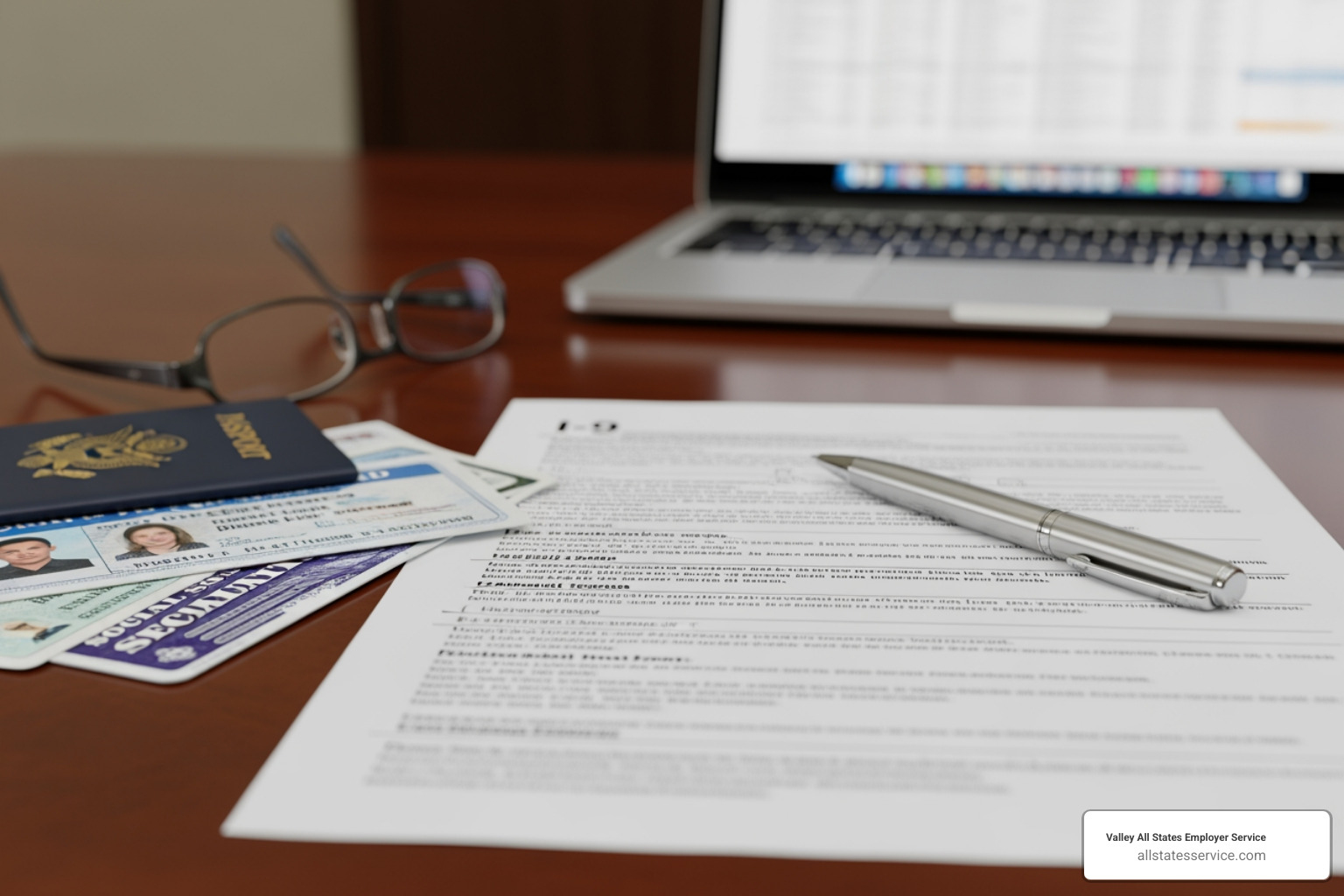
Our role as the employer comes next. Within three business days of the employee’s first day of work, we must complete Section 2. This involves two key parts: examining the employee’s original documents and recording the information.
We must physically examine the original, acceptable, and unexpired documents presented by the employee. These documents must reasonably appear to be genuine and relate to the person presenting them. For most employers, photocopies are not acceptable for this physical examination. However, there’s a significant update for eligible E-Verify employers which we’ll discuss later, allowing for an alternative procedure for remote examination.
After examining the documents, we record the document title, issuing authority, document number, and expiration date in Section 2. Finally, we sign and date this section, certifying that we have reviewed the documents and that the employee appears authorized to work. I-9 Section 2 Complete Guide
Understanding Acceptable Documents and Avoiding Common Pitfalls
Employees have a choice of documents to present. They can provide either:
- One document from List A: These documents establish both identity and employment authorization (e.g., U.S. Passport, Permanent Resident Card).
- One document from List B AND one document from List C: List B documents establish identity (e.g., driver’s license, state ID card), while List C documents establish employment authorization (e.g., Social Security card, birth certificate).
Here are some key points about acceptable documents:
- Unexpired is key: All documents must be unexpired.
- Employee’s choice: We cannot specify which documents an employee must present. They choose from the Lists of Acceptable Documents.
- No over-documentation: We should not ask for more documents than required. If an employee presents a List A document, we cannot ask for List B and C documents.
- Genuineness: We must accept documents that reasonably appear to be genuine and relate to the person presenting them. We are not required to be document fraud experts, but we cannot ignore obvious discrepancies.
A critical update to remember is that the new version of Form I-9 became mandatory for all employers on November 1, 2023. Using an outdated form can lead to compliance issues. If we accidentally used the wrong version, we should staple a blank current version to the completed outdated version with a note explaining the issue. I-9 Acceptable Documents Ultimate Guide
Post-Completion: Retention, Reverification, and Error Correction
Completing the I-9 form is just the beginning. Proper management, including retention, error correction, and reverification, is essential for ongoing I-9 compliance for employers.
I-9 Document Retention and Storage Requirements
Once a Form I-9 is completed, retain it correctly. We must keep completed I-9 forms for a specific period, known as the “3-year/1-year” rule:
- Three years after the date of hire, OR
- One year after the date employment is terminated,
- Whichever date is later.
For active employees, we should retain their I-9s indefinitely. These forms should be stored securely, either in paper format or electronically, separate from an employee’s personnel file to maintain confidentiality and streamline inspection processes. If we choose electronic storage, our system must comply with USCIS guidelines for electronic generation, storage, and retention. Being ready for an inspection means having all forms organized and easily accessible. I-9 Record Keeping
How to Correct I-9 Errors and Omissions
Mistakes happen, but how we correct them makes all the difference. It’s crucial to understand the distinction between technical and substantive errors.
- Technical Errors: These are minor omissions or mistakes, like a missing A-number or an incomplete field. If ICE notifies us of technical errors, we typically have 10 business days to correct them.
- Substantive Errors: These are more significant issues, such as an unsigned Section 1, an incorrect status box, or a missing Section 2. Substantive errors cannot be corrected retroactively and may trigger fines, as they indicate a failure to properly verify employment eligibility.
Our correction protocol is simple but strict:
- Do not erase or use white-out. This can look suspicious.
- Draw a single line through the incorrect information.
- Enter the correct information next to it.
- Initial and date the change.
- If an error in Section 1 is found, the employee must make the correction, not us, and then initial and date it.
- For extensive errors or if the wrong version of Form I-9 was used, it’s often best to complete a new, current Form I-9 and attach it to the original, along with a written explanation of why the new form was completed.
Prompt and proper correction demonstrates good faith and can mitigate penalties during an audit.
When and How to Reverify Employment Authorization
Reverification is a key part of ongoing I-9 compliance for employers, ensuring that employees with temporary work authorization remain eligible.
We must track the expiration dates of work authorization documents and reverify employment eligibility before they expire. This is typically necessary if an employee initially presented:
- An employment authorization document (List A) with an expiration date.
- A document from List C with an expiration date.
However, reverification is NOT required for:
- U.S. citizens
- Noncitizen nationals
- Lawful permanent residents (green card holders)
- Documents from List B (identity only documents)
When reverification is needed, we use Supplement B (Reverification and Rehire) of Form I-9. The employee presents a new document showing continued work authorization, and we record the details in Supplement B. This same supplement is also used when rehiring an employee within three years of their initial Form I-9 completion. I-9 Process for Rehires
Advanced I-9 Compliance for Employers: Audits, Remote Hires, and E-Verify
Beyond the basics, there are advanced considerations that can significantly impact our I-9 compliance for employers strategy, especially in today’s dynamic work environment.
Preparing for and Handling an I-9 Audit
An I-9 audit, often initiated by Immigration and Customs Enforcement (ICE) through a Notice of Inspection (NOI), can be a daunting experience. However, with proper preparation, we can steer it smoothly.
Here’s how we prepare:
- Internal Self-Audits: We strongly recommend conducting regular internal audits of our I-9 forms. This isn’t legally required, but it helps us identify and correct errors before an official audit. When performing these, we must use neutral, non-discriminatory criteria for selecting forms to review. Guidance for Employers Conducting Internal Audits
- Organization is Key: Ensure all I-9 forms are accurately completed, stored correctly, and readily accessible.
- Correction Protocol: Make sure any corrections follow the proper initial-and-date procedure.
During an audit:
- Response Time: We typically have three business days to present our I-9 forms to ICE after receiving an NOI.
- Potential Penalties: An incomplete or incorrect I-9 can result in fines ranging from hundreds to thousands of dollars per form. Paperwork violations can reach $2,861 per violation, and if unauthorized workers are found, fines can soar up to $28,619 per unauthorized worker.
Being proactive and having a clean set of I-9s is our best defense. I-9 Audit Services
Navigating Remote I-9 Verification
The world shifted, and so did I-9 verification. While COVID-19-related flexibilities for remote I-9 completion ended on July 31, 2023, a new alternative procedure is now available for certain employers.
The New Alternative Procedure:
- Eligibility: This procedure is available only to employers who are enrolled in E-Verify and are in good standing.
- Process: For these eligible employers, the physical document examination requirement can be satisfied remotely via live video interaction. The employee must transmit a copy of their document(s) to the employer, and then the employer must examine the document(s) during a live video call.
- Physical Inspection Mandate: Employers who were not eligible for this new alternative procedure, but completed remote I-9 forms during the pandemic flexibilities, were required to complete physical inspections for those forms no later than August 30, 2023.
For us, this means understanding if we qualify for the remote alternative and adhering to its specific requirements. If we don’t, the traditional physical examination is still the rule. I-9 Verification Remote Complete Guide
How E-Verify and I-9 Compliance Work Together
E-Verify is an internet-based system operated by USCIS that allows employers to confirm the employment eligibility of their newly hired employees. It works in conjunction with the information provided on Form I-9.
Key aspects of E-Verify:
- Integration: After completing Form I-9, employers submit the employee’s information from Section 1 and Section 2 into the E-Verify system.
- Mandates: While E-Verify is voluntary for most employers, it is mandatory for some federal contractors and in certain states, including Maryland for specific public works contracts or state agencies.
- Case Creation: An E-Verify case must be created within three business days after the employee’s first day of employment. There have been instances, like a government shutdown, where specific grace periods were granted for case creation. For example, after a past system outage, employers had until October 14, 2025, to create cases for employees hired during that specific downtime.
- Tentative Nonconfirmation (TNC): If an employee’s information doesn’t match government records, they receive a TNC. The employee must be given an opportunity to contest and resolve this with the relevant agency (SSA or DHS). We cannot take adverse action against an employee solely based on a TNC while they are contesting it.
E-Verify adds another layer of verification, enhancing our I-9 compliance for employers. As a provider of outsourced E-Verify services, Valley All States Employer Service specializes in navigating these complexities for our clients, ensuring expert, impartial, and efficient processing. E-Verify and I-9
Best Practices for Bulletproof I-9 Compliance
Achieving and maintaining I-9 compliance for employers isn’t a one-time task; it’s an ongoing commitment. By implementing these best practices, we can build a robust system that minimizes errors and protects our organization.
Create a Consistent Onboarding Process
The hiring process is hectic, but a consistent approach to I-9 completion is crucial.
- Integrate I-9: Make I-9 completion an integral, non-negotiable part of our new employee onboarding checklist.
- Checklists: Use detailed checklists to ensure every field is completed and every step is followed.
- Automated Reminders: Leverage HR software or internal systems to set automated reminders for Section 2 completion deadlines and upcoming reverifications. This helps us avoid missing critical timelines, which is a common cause of penalties. I-9 Training for Employers
Conduct Regular Internal Audits
Proactive self-assessment is key to catching errors before they become costly.
- Neutral Criteria: When conducting internal audits, always select I-9 forms for review using neutral, non-discriminatory criteria. This prevents any appearance of bias.
- Document Corrections: Carefully document all corrections made during an audit, following the initial-and-date protocol.
- Consistency: Ensure that I-9 processes are applied consistently across all new hires and locations, including in Maryland and Lutherville MD. This helps us maintain fairness and compliance. I-9 Self Audit
Leverage Technology and Automation
Technology can be our best friend in I-9 compliance.
- Electronic I-9 Solutions: Consider using electronic I-9 systems. These solutions often include built-in error-checking features that flag incomplete fields or incorrect information, significantly reducing manual mistakes.
- Digital Storage: Secure digital storage and retrieval systems make it easier to manage forms, track retention periods, and prepare for audits.
- E-Verify Integration: Many electronic I-9 platforms integrate seamlessly with E-Verify, streamlining the process and ensuring timely case creation. This not only improves accuracy but also reduces the administrative burden on our HR team. Electronic I-9 Solutions
Conclusion: Simplify Your I-9 and E-Verify Process
Navigating the complexities of I-9 compliance for employers can feel like a full-time job. From understanding deadlines and acceptable documents to correcting errors and preparing for audits, the stakes are undeniably high. Our goal is always to maintain a legal workforce, avoid costly fines, and protect our business from legal complications.
We understand that for many businesses, especially small to medium-sized enterprises, dedicating extensive internal resources to mastering every nuance of I-9 and E-Verify compliance simply isn’t feasible. That’s where expertise comes in.
At Valley All States Employer Service, we specialize in providing outsourced E-Verify workforce eligibility verification. Our unique selling point is expert, impartial, and efficient E-Verify processing, minimizing errors and administrative burden for our clients. We offer the peace of mind that comes from knowing your I-9 and E-Verify processes are handled by professionals who stay current with the latest regulations and best practices.
Don’t let the intricacies of I-9 compliance keep you up at night. Partner with us to ensure your hiring practices are not just compliant, but seamless and secure.
Streamline your hiring with expert I-9 document verification services