
E-Verify manual for federal contractors: Master 2025
Why Federal Contractors Must Master the E-Verify System
The e-verify manual for federal contractors is your roadmap to meeting mandatory employment eligibility verification requirements under the Federal Acquisition Regulation (FAR). If you hold a federal contract awarded after September 8, 2009, with the FAR E-Verify clause, you must use E-Verify to verify both new hires and existing employees assigned to covered contracts.
Quick Access to Key E-Verify Resources:
- Official User Manual: E-Verify User Manual (M-775)
- Federal Contractor Supplemental Guide: Supplemental Guide for Federal Contractors
- Enrollment Portal: E-Verify Enrollment Application
- Handbook for Form I-9: Handbook for Employers (M-274)
- Required Posters: Available in the E-Verify Essential Resources
A presidential Executive Order and subsequent FAR rule transformed E-Verify from a voluntary program into a mandatory requirement for most federal contractors. The rule reinforces the federal government’s policy of doing business only with organizations that maintain a legal workforce.
Yet many HR managers find themselves overwhelmed by the complexity of these requirements. Between understanding which employees to verify, managing timelines, handling Tentative Nonconfirmations (TNCs), and avoiding discrimination claims, compliance becomes a significant administrative burden.
This guide breaks down everything you need to know about the e-verify manual for federal contractors. You’ll learn your specific obligations, critical deadlines, step-by-step verification procedures, and how to access the official resources that keep you compliant. Whether you’re new to E-Verify or already enrolled, this comprehensive overview will help you steer federal contractor requirements with confidence.
Understanding the Mandate: Why E-Verify is a Must for Federal Contractors
If you’re working with the federal government, E-Verify isn’t something you can choose to skip. It’s a mandatory requirement that stems from Executive Order 12989, which made it crystal clear that federal agencies should only work with contractors who employ a legal workforce. Think of it as the government’s way of ensuring everyone plays by the same rules.
This executive order was backed up by a Federal Acquisition Regulation (FAR) rule that became effective on September 8, 2009. From that date forward, any federal contract containing the FAR E-Verify clause requires participation in the E-Verify system. No exceptions, no wiggle room.
The logic behind this mandate is straightforward. The federal government wants to ensure every dollar spent on contracts goes to organizations that maintain a legal workforce. To make this happen, they partnered the Department of Homeland Security (DHS) with the Social Security Administration (SSA) to create a reliable verification system. For a deeper dive into these regulations and how they’ve evolved, check out our page on Federal E-Verify Rules.
What is E-Verify?
E-Verify is an internet-based system that makes employment eligibility verification surprisingly simple. When you use it, you’re comparing the information from an employee’s Form I-9 against government records maintained by the SSA, DHS, and the U.S. Department of State. The system cross-checks this data to confirm whether someone is authorized to work in the United States.
The best part? E-Verify is completely free for employers. No hidden fees, no subscription costs. The government provides this tool at no charge because they want to make compliance as accessible as possible. Most employers find the process straightforward once they get the hang of it. If you’re just getting started and want to understand the basics, our guide on What is E-Verify walks you through everything step by step.
The FAR E-Verify Clause
Here’s where things get specific. The FAR E-Verify clause is the key trigger that determines whether you must participate in E-Verify. If this clause appears in your contract (or in a prime contract above you), compliance becomes mandatory. This applies to contracts awarded and solicitations issued after September 8, 2009.
And it’s not just prime contractors who need to pay attention. If you’re a subcontractor working under a prime contract that includes the FAR E-Verify clause, you’re also covered. Specifically, subcontracts exceeding $3,500 for commercial or non-commercial services or construction will typically carry this requirement. The e-verify manual for federal contractors makes this chain of responsibility clear, so both prime contractors and their subs understand their obligations.
Understanding exactly who must use E-Verify can feel confusing at first, but it’s crucial for staying compliant. For more details on which employers fall under this mandate, visit our comprehensive resource on What Employers Are Required to Use E-Verify.
Core Requirements, Roles, and Exemptions
Understanding what you’re required to do as a federal contractor, and who needs to do it, is the foundation of solid E-Verify compliance. It’s not just about running verifications. It’s about knowing your specific obligations, understanding which contracts or employees might be exempt, and making sure everyone on your team knows their role. Let’s walk through what this really means for your organization.

Your Specific Obligations as a Federal Contractor
When you’re a federal contractor subject to the FAR E-Verify clause, your responsibilities go further than most employers using E-Verify voluntarily. You’ll need to verify all newly hired employees, regardless of whether they’ll be working on the federal contract itself. This is a requirement that catches many contractors off guard.
But here’s the part that really sets federal contractors apart: you must also verify existing employees who are assigned to work on the covered federal contract within the United States. This means employees already on your payroll, potentially people who’ve been with your company for years, need to go through E-Verify if they’re going to touch that federal contract work. It’s a significant undertaking, and our guide on E-Verify for Existing Employees can help you steer this requirement.
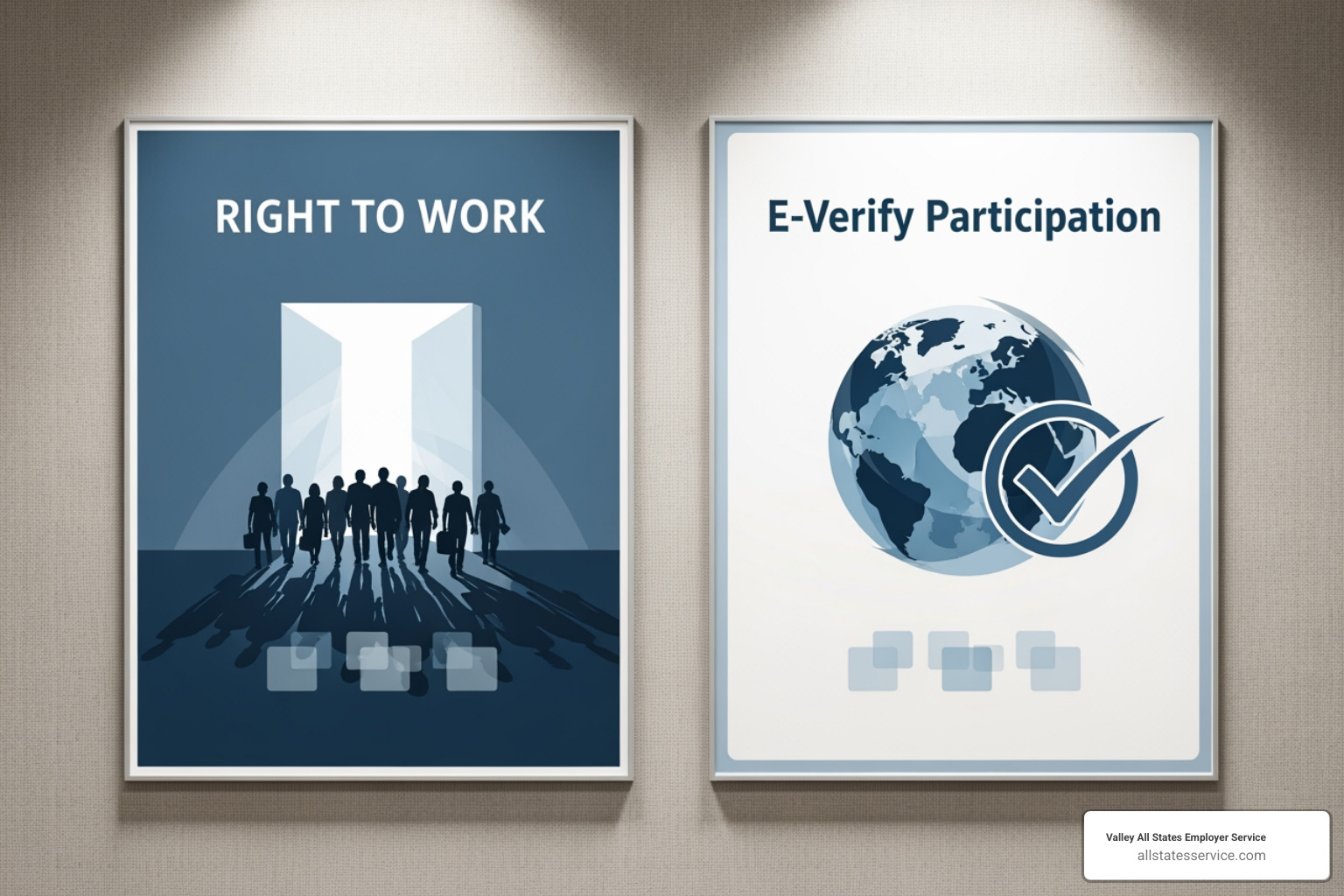
Beyond the actual verification process, you’re responsible for displaying the required posters. The “Notice of E-Verify Participation” and “Right to Work” posters must be visible in your workplace, in both English and Spanish, where employees can easily see them. These aren’t optional decorations. They’re mandatory notices that inform your workforce of their rights.
You also need to maintain strict Form I-9 compliance, since E-Verify builds directly on the I-9 foundation. Every E-Verify case starts with a properly completed Form I-9, and any mistakes there will cascade into your E-Verify verification. Our E-Verify I-9 Compliance resource covers this critical connection in detail.
Record retention is another key obligation. You must keep all E-Verify records, including the case verification numbers that you’ll note on the Form I-9 or attach as printouts. These records prove your compliance if you’re ever audited.
The consequences of non-compliance aren’t minor inconveniences. We’re talking about contract termination, substantial fines, and debarment from future federal contracts. That’s why following the e-verify manual for federal contractors isn’t just bureaucratic box-checking. It’s protecting your ability to do business with the federal government.
Who is Exempt from the Federal Contractor Rule?
The good news is that not every contract or employee falls under the federal contractor E-Verify requirement. Understanding these exemptions can save you significant time and effort.
Contracts under 120 days or valued at $150,000 or less may not trigger the E-Verify requirement, though you should always check your specific contract language. Similarly, contracts for commercial off-the-shelf products, those everyday items you can buy without modification, are typically exempt.
Here’s an exemption that surprises many contractors: employees with certain security clearances don’t need to be verified in E-Verify. If your employee holds a valid confidential, secret, or top-secret security clearance, or has completed an HSPD-12 background investigation, you’re not required to run them through E-Verify, though you certainly can if you choose. Just remember that interim security clearances don’t count for this exemption.
Institutions of higher learning, state and local governments, and federally recognized Indian tribes have special rules and verification options that differ from standard federal contractors. If your organization falls into one of these categories, you’ll want to review the specific requirements carefully.
For the complete picture of what might exempt your contracts or employees, the official Exemptions and Special Rules page provides authoritative guidance.
Roles, Responsibilities, and Privacy
E-Verify compliance works best when everyone knows their part. Within your organization, you’ll typically have Program Administrators who manage your E-Verify account, register new users, update company information, and serve as the compliance champions. These are the people who keep the whole system running smoothly.
You’ll also have General Users, the team members who actually create and manage E-Verify cases for individual employees. They need solid training on both the general E-Verify process and the specific federal contractor requirements that make your obligations different.
If you’re a prime contractor, you have an additional responsibility: ensuring that all subcontractors at every tier incorporate the FAR E-Verify Clause 52.222-54 into their subcontracts, as long as those subcontracts meet the value and service criteria. If you’re a subcontractor receiving a contract with this clause, you must use E-Verify for employees working on that subcontract. Our E-Verify for Contractors page explores these relationships in more depth.
Some contractors work with an E-Verify Employer Agent to handle verification. If that’s your situation, your agent must update your client profile to designate you as a “Federal Contractor with FAR E-Verify clause” within 30 days of your contract award. After this update, all users accessing E-Verify must complete a federal contractor-specific tutorial and pass a knowledge check. The details are covered at For E-Verify Employer Agents of Federal Contractors.
Finally, safeguarding Personally Identifiable Information isn’t just good practice, it’s a requirement. Only authorized users should access E-Verify. Protect passwords like you would any sensitive credential. Store employee information securely, both physical documents and electronic records. Discuss E-Verify results privately with employees, never in public spaces. E-Verify itself helps by automatically disposing of records over 10 years old annually, but day-to-day privacy protection is your responsibility.
Enrollment and Critical Timelines
Getting enrolled in E-Verify and staying on top of its deadlines is where many federal contractors stumble. It’s not just about creating an account, it’s about setting it up correctly and knowing exactly when you need to verify each employee. Miss a deadline, and you could face serious compliance issues.
Step-by-Step Enrollment Process
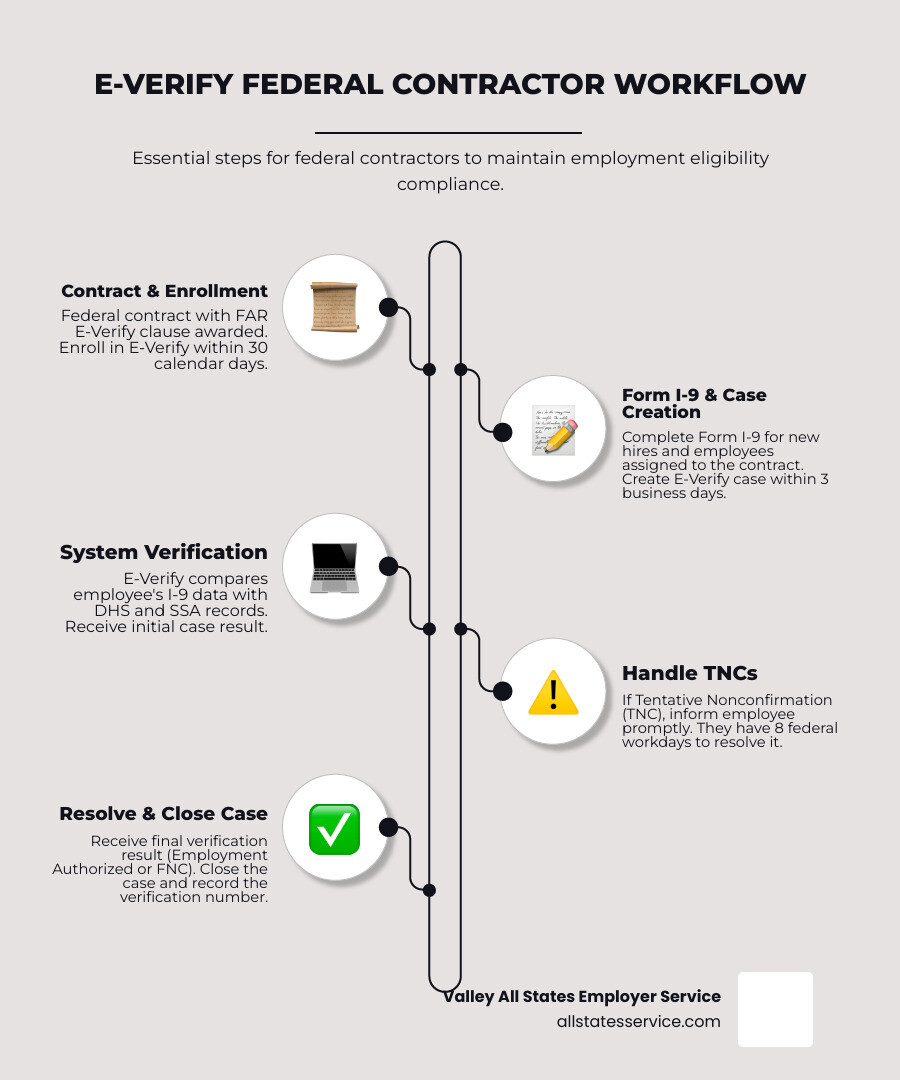
The moment your organization receives a federal contract with the FAR E-Verify clause, the clock starts ticking. You have 30 calendar days from the contract award date to complete your E-Verify enrollment. That might sound like plenty of time, but gathering information and navigating the system can take longer than you’d expect.
Before you begin, make sure you have your Employer Identification Number (EIN), Unique Entity Identifier (UEI, which replaced the old DUNS number), and your North American Industry Classification System (NAICS) code ready. These are essential pieces of information you’ll need to complete enrollment.
Head over to the official E-Verify Enrollment Application to get started. During the enrollment process, you’ll need to choose your access method. This is critical: select “Federal Contractor with FAR E-Verify Clause” as your designation. This selection open ups specific functionalities you’ll need, particularly the ability to verify existing employees who are assigned to your federal contract, not just new hires.
Next, you’ll complete the Memorandum of Understanding (MOU). Think of this as your official agreement with the government, outlining all your responsibilities and the terms of participation. After your enrollment is finalized, there’s one more crucial step: every Program Administrator and General User in your organization must complete a federal contractor-specific tutorial and pass a knowledge test. This ensures everyone understands the unique requirements that come with being a federal contractor under the e-verify manual for federal contractors.
Already enrolled in E-Verify but just now subject to the FAR E-Verify clause? You’re not off the hook. You must update your existing company profile to reflect the “Federal Contractor with FAR E-Verify Clause” designation within 30 days of your contract award. This update is what activates your ability to verify existing employees, a requirement that doesn’t apply to standard E-Verify participants.
Once you’re enrolled, the verification deadlines become your new reality. For new hires, you must create an E-Verify case within 90 calendar days of enrollment or within 30 days of assigning that employee to a qualifying federal contract, whichever date comes later. For existing employees who are assigned to work on a covered federal contract, the same 90-day or 30-day rule applies.
If you decide to verify your entire workforce, which is optional but can simplify your compliance efforts, you have 180 calendar days from enrollment to create cases for all existing employees. This approach means you won’t need to track which employees are working on federal contracts versus other projects.
These timelines aren’t suggestions, they’re requirements. Keeping track of enrollment dates, contract award dates, and employee assignment dates is a fundamental part of staying compliant. For more guidance on streamlining this initial phase, our E-Verify Onboarding Process resource can walk you through each step with clarity.
The Step-by-Step e-verify manual for federal contractors
Now we’re getting to the heart of the matter: actually using E-Verify day-to-day. This is where the e-verify manual for federal contractors becomes your daily companion. You’ll be managing Form I-9 procedures, verifying both newly hired and existing employees, and navigating the occasionally tricky waters of Tentative Nonconfirmations (TNCs) and Final Nonconfirmations (FNCs). The good news? Once you understand the process, it becomes straightforward. The official Supplemental Guide For Federal Contractors is an excellent resource to keep bookmarked for detailed guidance.
Verifying Employees: A Core Component of the e-verify manual for federal contractors
Everything in E-Verify starts with Form I-9, the Employment Eligibility Verification form. Think of Form I-9 as the foundation, and E-Verify as the verification layer built on top of it. Every single new hire must complete a Form I-9, whether they’ll be working on a federal contract or not.
Here’s how the process flows. On their very first day of employment for pay, your new employee fills out Section 1 of Form I-9. We then have exactly three business days from that first day to complete Section 2, where we examine their documents and verify their identity and employment eligibility. This “three-day rule” isn’t flexible, it’s a firm deadline. For comprehensive guidance on all things I-9, the Handbook for Employers (M-274) is your best friend.
As an E-Verify participant, there’s one special requirement to remember: any List B identity document must contain a photograph. If an employee presents a List B document without a photo, you’ll need to politely ask for a different document that includes one, unless they have a religious objection to being photographed. This photo requirement is unique to E-Verify participation.
We also have specific document copying rules. You must make and retain copies of certain documents, specifically List A documents (like a U.S. Passport or Employment Authorization Document) or List C documents (like a Social Security card or birth certificate), and keep them with the employee’s Form I-9. These copies serve as your backup documentation. Our Employer I-9 Verification Guide walks you through these nuances in detail.
Once Form I-9 is properly completed, we create an E-Verify case. This must happen no later than the third business day after the employee starts work for pay. If your new hire doesn’t have a Social Security number yet, you note that on the I-9, allow them to start working, and create the E-Verify case once they obtain their SSN.
Verifying new hires versus existing employees is where federal contractors face a unique situation. For newly hired employees, the process is straightforward: complete the I-9, create the E-Verify case. But because we’re federal contractors with the FAR E-Verify clause, we also have the ability to verify existing employees who are assigned to qualifying federal contracts. This functionality only becomes available after our company profile is updated to “Federal Contractor with FAR E-Verify Clause.” For these existing employees, we create an E-Verify case based on their previously completed Form I-9. You can learn more about this specific requirement on our E-Verify for Existing Employees page.
Handling Discrepancies: The e-verify manual for federal contractors on TNCs and FNCs
Most E-Verify cases return an “Employment Authorized” result within seconds, which is wonderful. But sometimes, the system can’t immediately confirm employment eligibility, and that’s when we encounter a Tentative Nonconfirmation, or TNC. Think of a TNC as a question mark, not a red flag. It simply means the information provided didn’t match government records, and it needs to be resolved.
When an employee receives a TNC, we have very specific responsibilities. First, we must notify the employee privately and promptly. Privacy is crucial here. We provide them with a printed Further Action Notice directly from E-Verify, which explains what the mismatch is about and exactly how they can resolve it. For more insights on navigating this situation, see our guide on E-Verify Tentative Nonconfirmation.
Here’s what’s absolutely critical: the employee has the right to contest the TNC. During this resolution period, we cannot take any adverse action against them. That means we can’t refuse to assign them to a federal contract, remove them from work, or terminate their employment. This protection is a cornerstone of the E-Verify process and helps prevent discrimination.
The employee has eight federal government workdays to resolve the issue. If it’s an SSA TNC, they need to visit a Social Security Administration field office. These typically involve discrepancies with their name, date of birth, or Social Security number. If it’s a DHS TNC, they’ll contact the Department of Homeland Security, often dealing with immigration status or photo mismatches.
If the employee chooses not to contest the TNC, or if they contest it but the discrepancy can’t be resolved within the timeframe, the case moves to a Final Nonconfirmation, or FNC. An FNC is the final determination that E-Verify could not confirm employment eligibility. At this point, after receiving the FNC result, we may terminate the employee’s employment without facing civil or criminal liability under immigration law.
Finally, every E-Verify case must be closed properly. After receiving a final result, whether it’s Employment Authorized, an FNC, or another outcome, we select the appropriate case closure statement in the E-Verify system. We then record the case verification number on the employee’s Form I-9, or attach a printout of the case results. This documentation is essential for demonstrating compliance and maintaining proper records, as outlined in E-Verify I-9 Compliance guidelines.
Essential Resources and Anti-Discrimination Rules
Staying compliant with E-Verify isn’t a one-time checkbox. It’s an ongoing commitment that requires access to the right resources and a genuine dedication to fair employment practices. We’ve found that the most successful federal contractors are those who make learning and ethical hiring a priority.
Official Government Guides
The most reliable information about E-Verify comes straight from the source: the federal government. Think of these resources as your compliance lifeline. The comprehensive E-Verify User Manual walks you through every aspect of the system, from creating your first case to handling complex scenarios. It’s detailed, thorough, and absolutely worth bookmarking.
For federal contractors specifically, the Supplemental Guide For Federal Contractors addresses the unique requirements that apply to your situation. This guide covers everything from verifying existing employees to understanding your specific timeline obligations under the FAR E-Verify clause.
USCIS also hosts regular webinars designed to help employers steer E-Verify successfully. These sessions provide valuable insights and give you a chance to hear directly from program experts. The E-Verify for Federal Contractors Webinar is specifically designed for contractors like you. These webinars often include real-world examples and Q&A sessions that can clarify tricky situations.
Avoiding Discrimination
Here’s something critical: E-Verify is a powerful tool for workforce verification, but it can become a legal liability if misused. The e-verify manual for federal contractors emphasizes that fair treatment isn’t optional. It’s the law, and it’s the right thing to do.
Never use E-Verify to pre-screen job applicants. Cases should only be created after someone accepts a job offer and completes their Form I-9. Using E-Verify before this point is prohibited and discriminatory.
Don’t tell employees which documents to present for Form I-9 verification. Employees have the legal right to choose from the Lists of Acceptable Documents. Whether someone presents a passport, driver’s license with Social Security card, or any other valid combination is their choice, not yours.
Remember the TNC rule: You cannot take adverse action against an employee who receives a Tentative Nonconfirmation. This means you can’t refuse to assign them to a federal contract, reduce their hours, or terminate them while they’re working to resolve the mismatch. They have eight federal government workdays to address the issue, and they must be allowed to work during this period.
If you have questions about immigration-related employment discrimination, the Department of Justice’s Immigrant and Employee Rights Section (IER) is there to help. Visit the IER Website for guidance and support. For broader employment discrimination concerns, the Equal Employment Opportunity Commission (EEOC) at EEOC Website provides comprehensive resources.
Following these anti-discrimination principles isn’t just about avoiding penalties. It’s about creating a fair workplace and building a reputation as an ethical employer. Our guide on E-Verify Best Practices offers additional strategies for maintaining compliance while treating every employee with dignity and respect.
Conclusion: Simplify Your Federal Contractor Compliance
Managing the e-verify manual for federal contractors requires constant attention to detail. You’re juggling mandatory enrollment deadlines, Form I-9 precision, verification timelines for both new and existing employees, TNC resolution procedures, and anti-discrimination protections. It’s a lot to keep straight, especially when your primary focus should be delivering exceptional work on your federal contracts.
The stakes are high. Non-compliance can result in contract termination, substantial fines, or even debarment from future federal opportunities. Yet for many contractors, especially small to mid-sized businesses, dedicating staff to master every nuance of E-Verify compliance pulls resources away from your core mission.
This is exactly why many federal contractors choose to partner with specialists who live and breathe E-Verify every day. At Valley All States Employer Service, we’ve built our entire business around expert E-Verify processing. We know the federal contractor requirements inside and out because that’s all we do. Our team stays current on every regulatory update, timeline change, and best practice so you don’t have to.
When you work with us through our E-Verify Outsourcing services, you’re getting more than just case processing. You’re getting a dedicated partner who minimizes errors, handles TNCs with precision, maintains meticulous records, and ensures your compliance is airtight. We take the administrative burden off your plate entirely.
Your federal contracts are too important to risk compliance issues. Let us handle the E-Verify complexities while you focus on what you do best: delivering outstanding results for your federal clients.
Ready to simplify your compliance? Learn more about our dedicated E-Verify for Contractors services and find how we can support your business today.