
Navigating the Maze: An Introduction to Compliance Outsourcing
Outsourcing compliance solutions means delegating your regulatory, legal, and operational compliance tasks to external experts who specialize in keeping your business on the right side of the law. Here’s what you need to know:
Key Benefits of Outsourcing Compliance:
- Cost savings: Reduce compliance costs by up to 30% compared to in-house teams
- Expert access: Tap into specialized knowledge without hiring full-time staff
- Risk reduction: Companies that outsource are 50% less likely to face regulatory fines
- Efficiency gains: 85% of businesses report improved operational efficiency
- Stay current: Providers monitor and implement regulatory changes for you
Common Outsourced Functions: HR compliance, payroll, tax filings, data protection (GDPR, CCPA), industry-specific regulations (FINRA, HIPAA), and AML screening.
The regulatory landscape has become a maze that grows more complex every year. If you’re an HR manager juggling E-Verify requirements, I-9 forms, ever-changing labor laws, and state-specific regulations, you already know this truth: compliance work never stops, and the penalties for mistakes keep getting steeper.
Here’s the challenge. Your business needs to stay compliant to avoid fines, lawsuits, and reputational damage. But building an in-house compliance team means recruiting specialized talent, paying competitive salaries, investing in training, and purchasing expensive compliance software. For many mid-sized businesses, that’s simply not feasible.
That’s where outsourcing compliance solutions comes in. The global compliance outsourcing market was valued at $12.1 billion in 2022 and is projected to reach $27.5 billion by 2030, growing at 10.8% annually. Why? Because businesses have finded that partnering with external compliance experts isn’t just about saving money. It’s about accessing specialized knowledge, reducing risk, and freeing your internal team to focus on what actually grows your business.
This isn’t a trend that’s going away. By 2025, an estimated 70% of businesses will use some form of outsourced compliance services. The companies making this move aren’t doing it because they’re struggling. They’re doing it because they’re smart.
In this guide, we’ll walk you through everything you need to know about outsourcing compliance. You’ll learn what tasks you can hand off, how to choose the right partner, and how to build a relationship that transforms compliance from a burden into a competitive advantage.
Basic outsourcing compliance solutions terms:
What is Compliance Outsourcing?
Compliance outsourcing is the practice where a company delegates its regulatory, tax, and legal obligations to external professionals. Essentially, it means handing over the intricate, time-consuming, and often complex tasks of meeting legal and industry requirements to a team of outside specialists. This can range from managing human resources compliance to handling tax filings and adhering to global privacy laws.
For us, this means leveraging a dedicated external partner to ensure every detail, from employment verification to I-9 compliance, is handled correctly and efficiently. This approach allows businesses to maintain strict adherence to regulations without the overhead of an internal department dedicated solely to these functions.
Why is it More Important Than Ever?
The regulatory landscape is constantly shifting, making it a challenge for any business to keep up. We’re seeing an explosion of new laws and amendments, especially in areas like data privacy and employment law. This constant evolution means that what was compliant yesterday might not be today. This dynamic environment is a primary reason why outsourcing compliance solutions are becoming indispensable.
For businesses operating in the United States, particularly in states like Maryland, keeping abreast of both federal and state-specific regulations can be a full-time job. Expanding operations, even within the country, can introduce new layers of complexity. The insights from Deloitte’s Global Outsourcing Survey highlight that businesses are increasingly turning to external partners to steer this complexity, reduce operational risk, and free up internal resources to focus on their core business activities. It’s about being proactive rather than reactive, ensuring compliance becomes a growth enabler, not a bottleneck.
The Strategic Payoff: Key Benefits of Outsourcing Your Compliance

Choosing to outsource your compliance functions isn’t just about offloading tasks; it’s a strategic move that delivers significant benefits across your organization. It transforms compliance from a necessary evil into a competitive advantage, allowing us to focus on innovation and growth.
Access Specialized Expertise on Demand
One of the most compelling reasons to accept outsourcing compliance solutions is the immediate access to specialized expertise. Building an in-house team with deep knowledge across all compliance domains can be incredibly expensive and time-consuming. Imagine trying to hire experts in federal employment law, state-specific regulations, E-Verify protocols, and data privacy all under one roof. It’s a tall order.
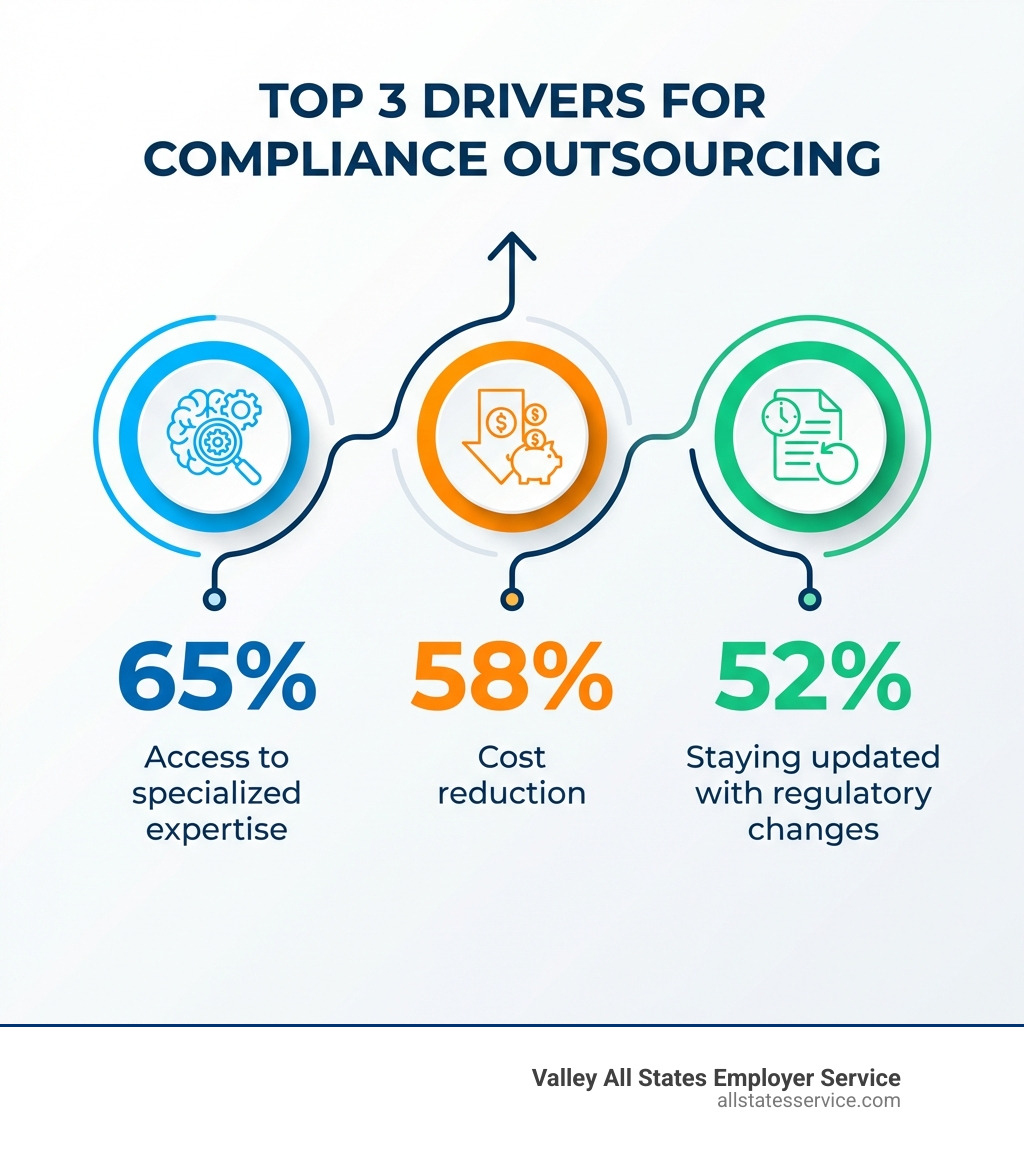
When you outsource, you tap into a pool of certified professionals who live and breathe compliance. These experts are constantly updated on the latest regulatory changes, often before they even take effect. This means your business benefits from their deep industry knowledge without the costs associated with recruitment, training, and ongoing professional development. This access to specialized skills is a primary driver for 65% of companies that choose to outsource their compliance needs, according to recent statistics. It’s like having a top-tier legal and regulatory team on retainer, ready to steer the most complex laws with ease. For more insights on how expert guidance can help, explore our HR Compliance Consulting services.
Achieve Significant Cost Savings and Efficiency
Let’s talk numbers. Outsourcing compliance can lead to cost savings of up to 30% compared to maintaining an in-house team. How? By eliminating the need for salaries, benefits, office space, training programs, and expensive compliance software. Instead, you adopt a pay-for-service model, paying only for the expertise and support you actually need. This resource optimization is a key benefit, cited by 58% of businesses as a primary driver for outsourcing.
Beyond direct cost savings, outsourcing dramatically improves efficiency. With external experts handling the intricacies of compliance, your internal teams are freed from administrative burdens. They can reallocate their valuable time and energy to core business activities—those tasks that directly contribute to revenue and growth. In fact, 85% of companies believe that outsourcing compliance improves their overall efficiency. This leads to streamlined operations, faster processing times, and a more productive workforce. We believe in helping you improve HR efficiency and streamline HR processes so your business can thrive.
Fortify Your Risk Management Strategy
The cost of non-compliance can be catastrophic, including hefty fines, legal battles, and severe reputational damage. Companies that outsource compliance are 50% less likely to face regulatory fines. This statistic alone highlights the power of expert-led compliance in mitigating risk. External providers offer proactive monitoring, ensuring your business stays ahead of potential issues before they escalate.
They implement robust controls, conduct thorough audits, and ensure accurate reporting, significantly reducing your exposure to penalties and legal issues. Furthermore, reputable outsourcing partners invest heavily in advanced data security measures, often exceeding what individual businesses can afford, enhancing the confidentiality and protection of your sensitive information. This comprehensive approach contributes to a 40% reduction in compliance-related risks, safeguarding your business’s bottom line and reputation. For a detailed look at how to protect your organization, consider our HR Compliance Risk Assessment.
What Can You Hand Off? Common Tasks for Compliance Outsourcing

When considering outsourcing compliance solutions, many businesses wonder exactly which tasks can be effectively delegated. The good news is that a wide array of compliance functions, from the routine to the highly specialized, are commonly outsourced, allowing your internal teams to focus on strategic initiatives.
Human Resources and Employment Compliance
For many businesses in the United States, especially those struggling with the complexities of federal and state labor laws, HR and employment compliance is a prime candidate for outsourcing. These tasks are critical but can be incredibly time-consuming and prone to error if not handled by specialists.
Common outsourced HR compliance tasks include:
- Payroll Processing: Ensuring accurate and timely payment, tax withholdings, and reporting.
- Benefits Administration: Managing employee benefits plans in accordance with ERISA and other regulations.
- I-9 Compliance: Meticulous completion and retention of employment eligibility verification forms. Our I-9 Compliance Management Complete Guide provides further detail.
- E-Verify Processing: As experts in this area, we provide impartial and efficient E-Verify workforce eligibility verification, minimizing errors and administrative burden.
- Employee Handbooks and Policies: Developing and updating handbooks to reflect current federal and state laws.
- Employment Verification: Handling requests to verify current and past employment, as detailed in our Employment Verification Services Complete Guide.
- Federal and State Law Adherence: Ensuring your business complies with all applicable labor laws, from FLSA to ADA, as highlighted in our resources on Federal Employment Compliance.
By entrusting these functions to an external provider, you ensure that your HR operations are always compliant, reducing the risk of audits, fines, and legal challenges.
Financial and Regulatory Reporting
Beyond HR, financial and regulatory reporting presents another significant area where outsourcing compliance solutions can be highly beneficial. This includes a broad spectrum of activities that demand precision and adherence to strict deadlines.
Key outsourced financial compliance tasks often include:
- Tax Filings: Managing corporate income tax, sales tax, and other necessary filings.
- Anti-Money Laundering (AML) Checks: Performing due diligence, sanctions screening, and customer identification programs (CIP) to prevent illicit financial activities. This is particularly crucial for financial services firms, and it’s worth noting that the compliance date for AML obligations is January 1, 2026.
- SEC Reporting: For publicly traded companies or those in regulated financial sectors, preparing and submitting reports to the Securities and Exchange Commission.
- Audit Preparation: Organizing and presenting financial records and compliance documentation to external auditors.
Staying on top of these complex financial regulations, which are constantly evolving, requires specialized knowledge that outsourcing partners possess. For a comprehensive overview, refer to our Regulatory Compliance Solutions Complete Guide.
Data Protection and Industry-Specific Rules
Data protection is paramount, and non-compliance can lead to severe penalties and reputational damage. While GDPR is a European regulation, its principles often influence data privacy practices globally, and US states like California with CCPA (California Consumer Privacy Act) have enacted robust data protection laws.
Beyond general data privacy, many industries have their own unique and stringent compliance requirements:
- HIPAA (Health Insurance Portability and Accountability Act): Essential for healthcare providers and related entities in the United States, governing the privacy and security of patient health information.
- FINRA (Financial Industry Regulatory Authority): Critical for broker-dealers and other financial service firms in the US, regulating securities firms and brokers.
- Environmental Standards: For businesses with environmental impact, adhering to regulations set by agencies like the EPA.
Outsourcing helps your business steer these industry-specific labyrinths, ensuring that your operations, data handling, and reporting meet all necessary legal and ethical standards.
Your Blueprint for Success: Choosing and Managing an Outsourcing Partner
Entering into an outsourcing partnership requires careful consideration and a clear strategy. It’s not just about finding someone to do the work; it’s about establishing a collaborative relationship that supports your business goals.
When is the Right Time to Outsource?
Deciding when to engage outsourcing compliance solutions can be a pivotal moment for your business. There are several key indicators that it might be the right time:
- Rapid Growth or Scaling: As your business expands, especially into new markets or states, the volume and complexity of compliance tasks can quickly overwhelm an internal team.
- Entering New Markets: Each new jurisdiction, whether a new state or a new product offering, often brings a fresh set of regulations that require specialized knowledge.
- Lacking In-House Expertise: If your current team doesn’t have the specific knowledge for certain compliance areas (e.g., E-Verify updates, new federal employment laws), outsourcing provides immediate access to that expertise.
- Facing an Audit: An impending audit can highlight gaps in your compliance efforts and signal a need for external, expert support to quickly get your house in order.
- Overwhelming Administrative Burden: When non-revenue-generating tasks, like meticulous I-9 form management or constant regulatory monitoring, consume too much of your team’s time, it’s time to consider offloading.
For small businesses, in particular, the burden of compliance can be disproportionate to their resources. Our guide on HR Compliance for Small Business offers more custom advice. Proactive outsourcing, rather than waiting for a crisis, is a strategic tool for achieving business goals.
Key Factors for Choosing the Right Outsourcing Compliance Solutions Partner
Selecting the right partner is crucial for the success of your outsourcing compliance solutions strategy. This decision should be based on thorough due diligence and alignment with your business needs.
Here are the key factors to consider:
- Industry Experience: Look for a partner with a proven track record in your specific industry and a deep understanding of the regulations that apply to your business in your operating locations (e.g., federal and Maryland state employment laws).
- Technology and Platforms: A modern compliance partner should leverage advanced technology, including AI-driven tools, automation, and robust platforms, to improve efficiency and accuracy. Inquire about the systems they use and how they integrate with your existing processes.
- Scalability and Flexibility: Your partner should be able to scale services up or down as your business needs change, whether you’re experiencing rapid growth or adjusting operations.
- Security Certifications: Data security is non-negotiable. Ensure your partner holds globally recognized certifications like SOC 2 and ISO 27001, demonstrating their commitment to protecting your sensitive data.
- Clear Communication: A strong partnership relies on transparent and regular communication. Look for a provider that offers dedicated account management and clear reporting structures.
You’re not just hiring a vendor; you’re forming a partnership. For guidance on evaluating potential partners, our insights on Employee Outsourcing Companies can be helpful.
Mitigating Risks and Building a Strong Relationship
While the benefits of outsourcing compliance solutions are substantial, acknowledge and mitigate potential risks. A well-managed outsourcing relationship is built on transparency, clear expectations, and continuous oversight.
Here’s a table outlining common risks and mitigation strategies:
| Risk | Mitigation Strategy |
|---|---|
| Data Security & Privacy | Ensure the partner has robust security protocols, encryption, and certifications (SOC 2, ISO 27001). Include strict data protection clauses in contracts. |
| Loss of Control | Define clear objectives, Service Level Agreements (SLAs), and reporting requirements. Maintain oversight through regular reviews and an internal liaison. The final decision-making authority remains with your business. |
| Quality Control | Establish clear performance metrics and key deliverables in the SLA. Conduct thorough due diligence on the partner’s expertise and track record. Implement ongoing audits and quality checks. |
| Vendor Dependency | Avoid over-reliance by maintaining some internal knowledge. Diversify tasks across providers if appropriate. Ensure clear exit strategies and knowledge transfer plans are in place. |
| Integration Challenges | Choose a partner whose technology can integrate seamlessly with your existing systems, or one that provides clear guidance on integration. Plan for a phased implementation. |
| Hidden Costs | Ensure contracts are transparent with no hidden fees. Clarify the scope of work and what is included in the pricing model. |
| Regulatory Updates | Verify the partner’s process for monitoring and adapting to new regulations, especially those specific to federal and Maryland state laws. Ensure they provide proactive alerts and guidance. |
Building a strong, collaborative relationship involves:
- Defining Clear Objectives: What do you expect to achieve by outsourcing? Be specific.
- Appointing an Internal Liaison: Designate a point person within your organization to communicate with the outsourcing partner.
- Scheduling Regular Reviews: Hold periodic meetings (e.g., quarterly) to review performance, discuss challenges, and adjust strategies.
- Ensuring Data Protection Clauses: Your contract must explicitly detail how your data will be handled, protected, and returned/destroyed upon termination.
By proactively addressing these areas, you can transform a vendor relationship into a true partnership that strengthens your overall compliance posture. For best practices in managing your workforce and external partners, refer to our Workforce Management Best Practices.
Frequently Asked Questions about Outsourcing Compliance Solutions
We understand that you might have questions about making such a significant shift in your business operations. Here are some of the most common inquiries we receive about outsourcing compliance solutions.
What is the biggest advantage of outsourcing compliance?
The biggest advantage by far is gaining access to specialized expertise that would be too expensive or difficult to maintain in-house. This expert knowledge directly translates into reduced risk of non-compliance, fewer penalties, and improved operational efficiency. By entrusting compliance to specialists, your internal team is freed up to focus on core business activities, innovation, and revenue generation. It allows you to leverage top-tier talent without the associated recruitment and retention costs.
Is outsourcing compliance safe for my company’s sensitive data?
Yes, when done correctly and with the right partner, outsourcing compliance can be very safe, often even safer than managing data internally for many businesses. Reputable providers of outsourcing compliance solutions invest heavily in robust security protocols, advanced encryption techniques, and state-of-the-art data centers. They adhere to strict confidentiality agreements and often hold globally recognized security certifications like SOC 2 and ISO 27001. These certifications demonstrate their commitment to protecting sensitive information, often exceeding the security capabilities that a smaller business could afford or implement on its own. It’s crucial to perform thorough due diligence on your chosen partner’s security measures.
How much does it cost to outsource compliance?
The cost of outsourcing compliance solutions can vary widely depending on the scope of services, the complexity of your business, and the specific regulations you need to adhere to. However, many businesses find that outsourcing leads to significant cost savings—up to 30% compared to hiring a full-time, in-house compliance team. This is because you eliminate expenses like salaries, benefits, training, and software licenses. Outsourcing typically operates on a pay-for-service model, meaning you only pay for the specific expertise and tasks you need, making it a highly cost-effective solution for managing compliance without breaking the bank.
Take the Next Step Towards Effortless Compliance
As we’ve explored, compliance is complex and ever-changing, but it doesn’t have to be a burden. Embracing outsourcing compliance solutions is a strategic imperative that offers profound benefits, from significant cost savings and unparalleled access to expertise to fortified risk management and improved operational efficiency. It’s about future-proofing your business, allowing your valuable internal resources to concentrate on growth and innovation.
By partnering with an expert provider like Valley All States Employer Service, you can transform compliance from a source of stress into a seamless, competitive advantage. We specialize in areas like E-Verify and I-9 compliance, ensuring your employment verification processes are not just compliant, but also efficient and error-free. Don’t let regulatory complexities hold your business back.
Ready to simplify your compliance strategy? Explore our Outsourced Compliance Solutions and find how we can help your business thrive with confidence.