
Why Regulatory Compliance Is the Foundation of Business Stability
Regulatory compliance solutions are comprehensive systems that combine technology, policies, and processes so businesses can meet legal and regulatory obligations with less stress and guesswork. These solutions automate monitoring, streamline documentation, and reduce the risk of costly violations.
What Regulatory Compliance Solutions Include:
- Regulatory Intelligence: Real-time tracking and alerts for changing laws and regulations
- Policy Management: Centralized creation, distribution, and updates of compliance policies
- Risk Assessment: Tools to identify, evaluate, and prioritize compliance risks
- Communication Archiving: Secure storage and retrieval of business communications for audits
- Automated Workflows: Streamlined processes for approvals, certifications, and incident reporting
- Audit Trails: Detailed documentation of all compliance activities and decisions
- Employee Training: Ongoing education programs to maintain regulatory awareness
If you are an HR manager navigating the maze of employment regulations, you already know the pressure. One day it is E-Verify requirements. The next, it is updated HIPAA rules or new financial reporting standards. The regulatory landscape shifts constantly, and falling behind is not just stressful, it is expensive.
Companies face penalties that can reach millions of dollars for non-compliance. Beyond fines, there is reputational damage, operational disruption, and even personal liability for executives. The stakes are real.
The positive news is that you do not have to manage compliance alone. Modern regulatory compliance solutions bring together people, policies, and technology so you can turn a chaotic challenge into a manageable system. They help businesses in regulated industries like finance, healthcare, and employment services stay ahead of changes, reduce risk, and focus on what they do best.
Organizations using comprehensive compliance solutions report impressive results, such as an 80% reduction in audit time, 25% improvement in task efficiency, and a 98% decrease in audit findings. These numbers translate into fewer sleepless nights and more confidence in your compliance posture.
Whether you run a small business that must prioritize limited resources or a mid-sized company that is scaling quickly, the right compliance solution adapts to your needs. It centralizes your obligations, automates repetitive tasks, and gives you a clear, real-time view of where you stand.
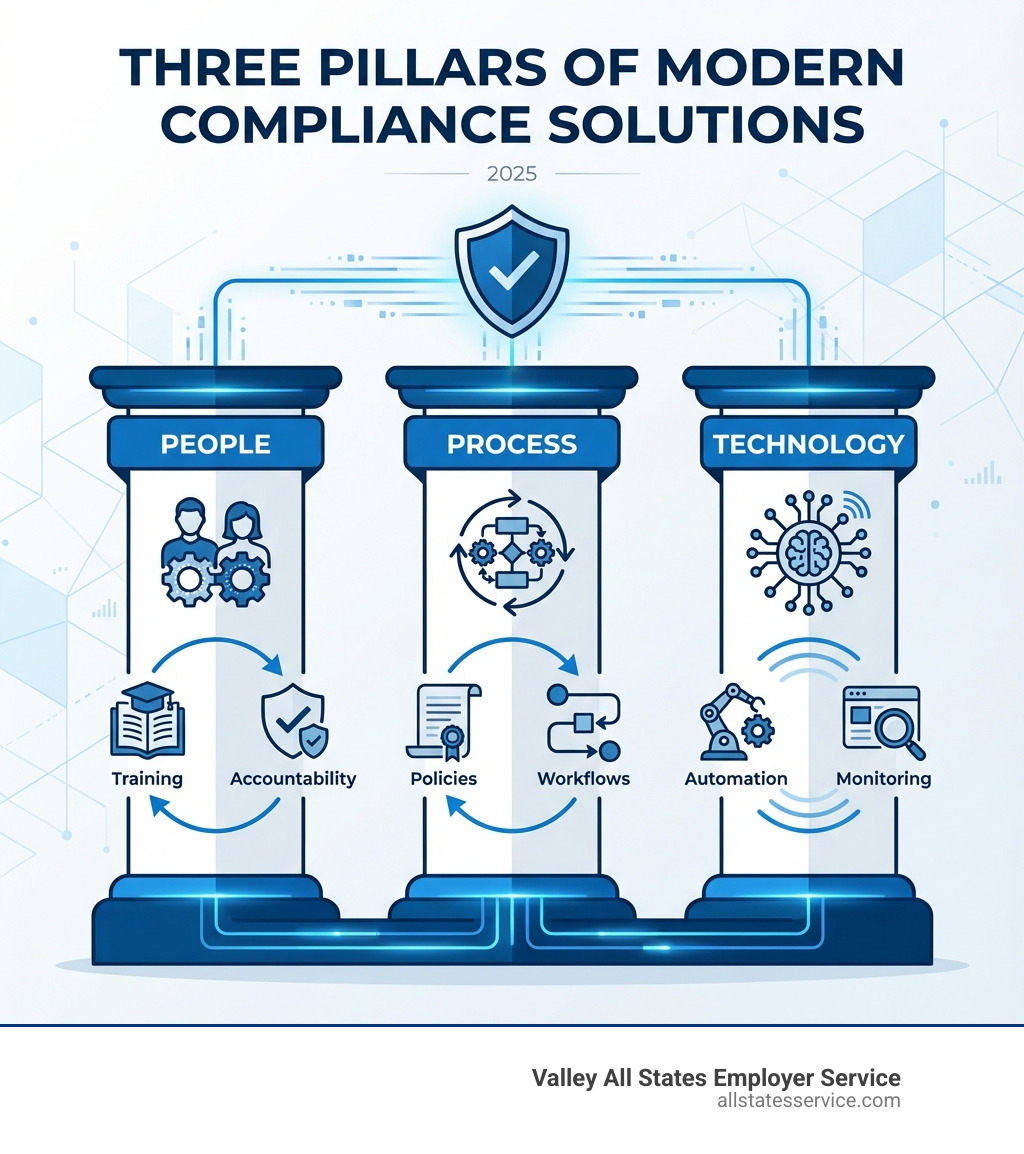
Basic Regulatory compliance solutions glossary:
The High Stakes: Understanding the Risks of Non-Compliance
Imagine the relief of knowing your business is fully compliant and protected from unexpected penalties. Now consider the alternative. The consequences of non-compliance reach far beyond a single fine and can affect every part of your operation. For businesses operating in the United States, including those in Maryland, overlooking regulatory requirements can lead to severe and long-lasting repercussions.
The primary risks include:
- Hefty Financial Penalties: Regulatory bodies do not hesitate to impose significant fines. Companies can face financial penalties that climb into the millions of dollars in some cases. These fines can cripple a business, especially small and medium-sized enterprises.
- Reputational Damage: News of a compliance failure spreads quickly. A single incident can tarnish your brand, erode customer trust, and make it harder to attract new business or retain existing clients.
- Business Disruption: Non-compliance can trigger operational stoppages, audits, and investigations that pull valuable resources away from core business activities. This disruption often leads to lost productivity and missed opportunities.
- Loss of Revenue: Beyond fines, non-compliance can result in contractual breaches, loss of licenses, or even being barred from operating in certain markets. All of these outcomes have a direct impact on your bottom line.
- Legal Action: Regulatory violations can open the door to lawsuits from affected parties. This often means additional financial strain, prolonged legal battles, and further reputational damage.
- Personal Liability for Executives: In some situations, executives and compliance officers can face personal legal consequences, including fines or even imprisonment, if they are found negligent in their duty to ensure compliance.
Navigating this complex landscape creates understandable stress. It is important to remember that compliance is not only about avoiding penalties. It is also about showing a clear commitment to values and ethics. This mindset becomes a strategic advantage and helps foster long term trust and stability for your business.

Anatomy of Effective Regulatory Compliance Solutions
So what exactly makes a regulatory compliance solution effective in the real world? It is a blend of robust processes, intelligent technology, and well-informed people working together with a clear goal. At its core, an effective solution should offer a centralized approach to managing your compliance obligations so you are not chasing scattered spreadsheets and emails.
Key components typically include:
- Centralized GRC Platforms: These platforms act as a single source of truth for all compliance activities. They help streamline processes and provide a clear view of your compliance posture across the organization.
- Policy Management: Effective solutions make it easier to create, distribute, and regularly revise internal policies. This keeps everyone in the organization aligned with current regulations and clear about their responsibilities.
- Risk Assessment: Identifying, assessing, and mitigating regulatory risks is essential. Solutions provide tools to evaluate potential risks, assign financial and operational impact, and prioritize actions so you can address vulnerabilities before they grow.
- Control Implementation: Once risks are identified, solutions help implement and monitor controls designed to mitigate those risks. This includes tracking how effective each control is and making adjustments when needed.
When we talk about managing compliance in a structured way, we are really talking about a Compliance Management System that brings all these elements together.
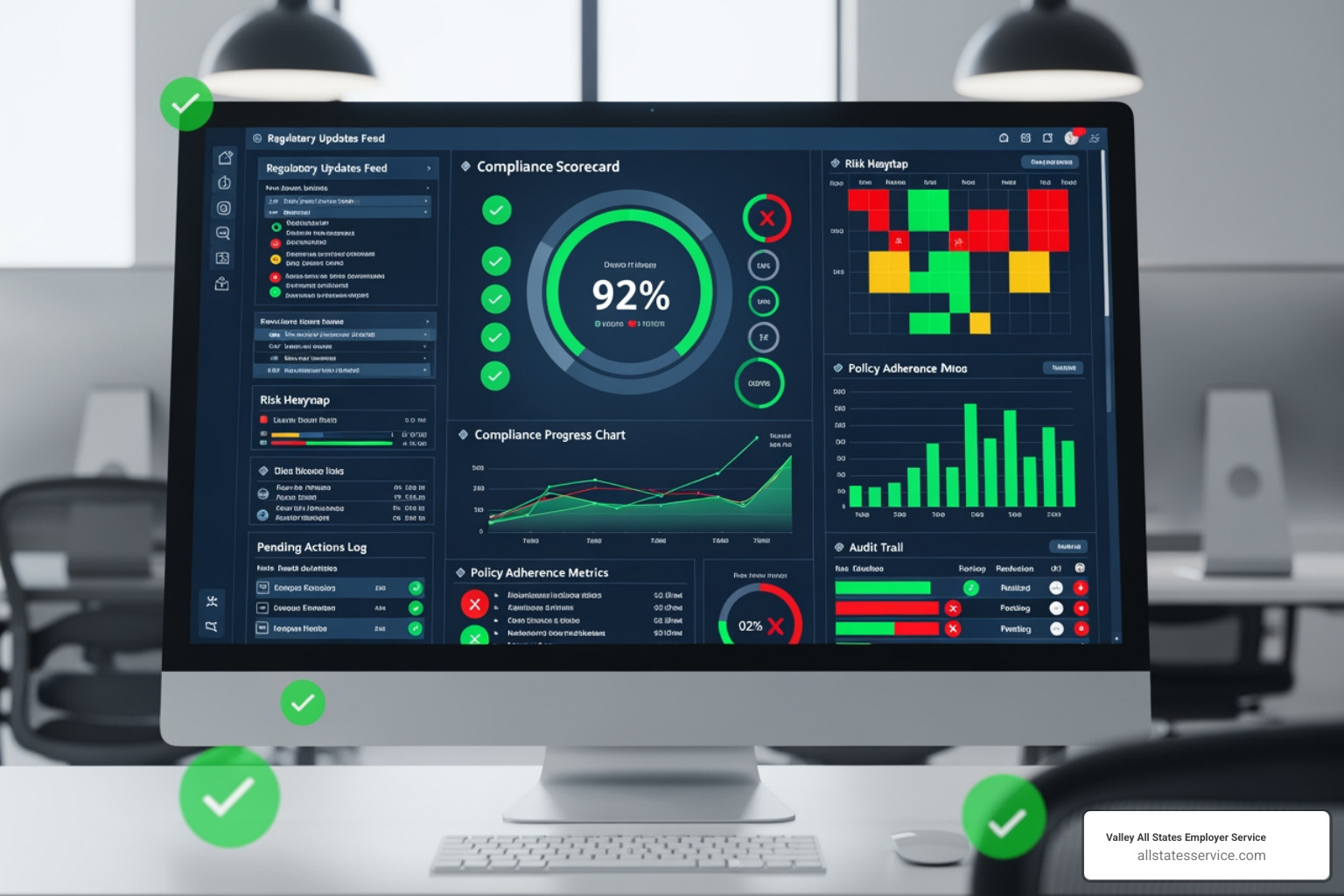
How Technology is Revolutionizing Compliance
Technology has transformed the compliance landscape and made it possible to manage complex regulations with far greater efficiency. Modern regulatory compliance solutions use tools like Artificial Intelligence (AI), Machine Learning (ML), and Natural Language Processing (NLP) to automate and streamline key activities.
- AI and NLP for Regulatory Tracking: Imagine having a system that can read and interpret thousands of regulatory updates every day, then flag the ones that actually matter to your business. AI and NLP make this possible by tracking changes in laws and guidelines, sending timely alerts, and translating complex legal language into actionable steps. This sharply reduces the manual effort required to stay informed.
- Automation for Tasks: Repetitive compliance tasks, such as evidence collection, assessments, audits, and reporting, can be automated. Automation saves time and reduces human error. It also ensures that routine checks are completed consistently and on schedule.
- Data Analytics for Insights: Compliance solutions collect large volumes of data. Advanced analytics tools process this information to identify trends, highlight areas of non-compliance, and provide real-time insight into your organization’s compliance health. These insights support better decisions and proactive risk management.
The impact of these technological advances is measurable. Organizations that use robust compliance technology often report an 80% reduction in time to complete audits, +25% task efficiencies gained, and a 98% decrease in audit findings. That means less time spent scrambling for documentation and more confidence in your audit readiness.
For example, when dealing with complex data privacy regulations like GDPR, the principles of data impact assessments are now relevant for organizations of all sizes. Technology assists in performing and documenting Privacy Impact Assessments (PIAs) as guided by the Article 29 Working Party, which helps identify and reduce privacy risks in data processing operations. You can learn more about these guidelines and their importance in managing data processing impacts here.
The Role of Regulatory Intelligence and Monitoring
The regulatory environment constantly evolves. New laws are enacted, existing ones are amended, and official interpretations can shift without much warning. Because of this dynamic nature, simply complying today is not enough, you must be prepared for tomorrow. This is where regulatory intelligence and monitoring become essential parts of effective regulatory compliance solutions.
- Staying Ahead of Changes: Regulatory intelligence involves active monitoring of legislative and regulatory developments. Advanced solutions are designed to keep you ahead of the game with alerts so you receive timely notifications when relevant regulatory changes are coming.
- Real-time Alerts: Imagine receiving an alert the moment a new employment law is passed in Maryland that affects your hiring practices, or a change in E-Verify requirements is announced. Real-time alerts help your business react quickly and maintain compliance.
- Adapting to New Laws: Solutions track updates to applicable regulations, standards, or corporate policies and help teams stay current. This support makes it easier to adjust your compliance strategy without starting from scratch.
- Regulatory Horizon Scanning: Beyond immediate changes, some solutions offer horizon scanning capabilities and can highlight likely regulatory trends and potential impacts. This allows for proactive planning and smarter resource allocation so potential compliance risks become manageable adjustments instead of emergencies.
These capabilities are vital for any business that wants a stable compliance posture, especially those operating in highly regulated sectors in the United States.
Core Functions: From Policy to Communication Archiving
Effective regulatory compliance solutions do more than react to rules. They help you build a structured, proactive environment where compliance is part of everyday operations. This involves several core functions that keep your activities aligned with legal and ethical standards.
- Policy Lifecycle Management: Policies are not static documents. They need to be created, approved, shared with employees, acknowledged, and updated on a regular basis. Solutions centralize this lifecycle so your internal policies, directives, and sustainability initiatives stay current, accessible, and aligned with external regulations.
- Risk Control Mapping: This step involves identifying specific regulatory obligations and mapping them to internal controls and processes. It ensures that for every identified risk there is a clear control in place, and that each control is managed and monitored effectively.
- Communication Archiving: In many industries, including finance and healthcare, proper archiving of business communications is a strict regulatory requirement. Modern solutions emphasize secure storage and easy retrieval of messages sent by email, SMS, messaging apps, or voice. This ensures that communications are auditable and available for legal reviews or investigations and supports compliance with rules from regulators such as the SEC or HIPAA.
- Data Management and Security: Effective solutions provide strong data management capabilities, which means compliance data is securely stored, searchable, and protected from unauthorized access. This also includes version control for documents and assessments so you can prove exactly what was in place at a specific point in time.
- Audit Trails: Every action taken within the compliance system, from policy updates to risk assessment results, is recorded. These detailed audit logs provide a clear record for regulators and demonstrate due diligence and transparency.
- Employee Training Modules: Compliance is a shared responsibility. Many solutions include modules for ongoing employee training and awareness so your team understands their regulatory responsibilities and the importance of following internal policies.
A Look at the Compliance Solution Landscape
The market for regulatory compliance solutions is diverse and offers a wide range of tools and services to match different business needs. From comprehensive software platforms to specialized consulting, businesses in the United States, including those in Maryland, have many options to choose from.
- GRC Platforms: These are integrated software solutions that manage governance, risk, and compliance activities across an organization. They focus on automating regulatory monitoring, change management, and audit readiness, and they support numerous security and privacy frameworks. Some platforms are custom to specific industries, such as financial services, and handle preclearance, trade monitoring, and conflicts of interest.
- Consulting Services: Many businesses rely on expert guidance from large or boutique consulting firms. These firms offer practical regulatory compliance consulting across a variety of sectors and bring deep knowledge of complex regulatory environments. For highly specialized needs, some firms provide custom consulting for specific industries and rely on experienced compliance officers.
- Specialized Software: Some solutions focus on particular aspects of compliance. For instance, certain tools emphasize holistic compliance with a strong focus on communication archiving, while others offer cloud-based services that integrate standards conformity, regulatory requirements, and corporate policy compliance, often with ESG metrics built in.
We have compiled a brief comparison of different compliance models:
| Model | Pros | Cons |
|---|---|---|
| In-house Compliance | Full control, deep institutional knowledge, immediate response. | High cost (staff, technology), resource intensive, risk of internal bias, expertise limitations. |
| Outsourced Compliance | Access to specialized expertise, cost effective, reduced administrative burden, impartial perspective. | Less direct control, potential for less integrated knowledge, vendor dependency. |
| Hybrid Model | Balances control with expert support, leverages internal strengths with external specialization. | Requires careful coordination, potential for overlapping responsibilities. |
Industry-Specific Regulatory Compliance Solutions
Compliance is rarely a one size fits all effort. Different industries face unique regulatory landscapes that require custom regulatory compliance solutions. For businesses in the United States, particularly those operating in Maryland, understanding these distinctions is essential.
- Financial Services Regulations: This sector is heavily regulated to protect investors and support market stability. Solutions address requirements from bodies like the SEC, FINRA, CFPB, FDIC, and state regulators. Some platforms offer features such as preclearance for trades, monitoring employee activity, and managing conflicts of interest for RIAs, wealth managers, and investment banks. These tools also support a wide set of financial regulations including GLBA and PCI DSS.
- Healthcare Compliance: The healthcare industry must follow strict regulations on patient data privacy and security. The most prominent in the US is HIPAA regulations, which govern the protection of sensitive patient health information. Compliance solutions here focus on secure data handling, communication archiving, and audit trails to protect patient confidentiality and data integrity.
- Life Sciences Rules: Companies in pharmaceuticals, medical devices, and biotechnology must follow rigorous standards from the FDA and other authorities. Specialized solutions and consulting services support processes such as EPA pesticide and FDA CVM new animal drug applications, which demonstrates how specialized compliance in this field can be.
- Employment Law: For organizations that focus on employment compliance and HR services, this area is especially important. Businesses must manage a complex web of federal and state laws that cover hiring, onboarding, employee rights, and termination. This includes regulations such as E-Verify, which confirms workforce eligibility. Services like outsourced E-Verify verification directly address these needs, help employers minimize errors and reduce administrative burden, and provide an impartial review of documentation. For a deeper look at these requirements, explore the Employment Compliance Guide 2025.
How to Choose the Right Solution for Your Business
Selecting the right regulatory compliance solution is a key decision that affects your business stability and growth. The goal is not simply to find the tool with the longest feature list, it is to find the one that fits your specific needs, industry, and size.
Here is a practical way to approach this choice:
- Assess Specific Needs: Begin by clearly defining your compliance challenges and requirements. Which regulations are most important for your business in Maryland or elsewhere in the US? Are you struggling with policy management, risk assessments, communication archiving, or employment verification? Knowing your pain points quickly narrows your options.
- Scalability for Growth: Your business will change over time, and your compliance needs will change with it. Choose a solution that can scale. Ask whether it can handle more employees, new regulations, or entry into new markets.
- Integration Capabilities: Compliance does not exist in a vacuum. Your chosen solution should integrate with your existing systems, such as HR platforms, financial software, or communication tools. This reduces data silos and improves workflows.
- User Experience: A powerful solution only works if your team can use it without frustration. Look for intuitive interfaces, clear dashboards, and straightforward reporting. A good user experience supports higher adoption and less training time.
- Vendor Reputation and Support: Review the vendor’s track record, customer feedback, and support services. Ask about onboarding timelines and what kind of ongoing support and training are available. A reliable long term partner is just as important as the technology.
- Cost-Benefit Analysis: Beyond the initial price, consider the total cost of ownership, including implementation, training, and maintenance. Compare this with the potential savings from fewer penalties, greater efficiency, and a stronger reputation.
For many businesses, especially small and mid-sized companies, outsourcing specific compliance functions is often a smart choice. The Outsourced HR Compliance Ultimate Guide provides useful detail on how this model can support your team.
Implementing Your Compliance Strategy for Success
Implementing a strong compliance strategy with the right regulatory compliance solutions goes far beyond simply avoiding fines. It is about building a resilient, reputable, and efficient business that can grow with confidence. When compliance is handled well, the benefits touch almost every part of your operations.
- Improved Reputation and Trust: When you actively show a commitment to ethical practices and regulatory requirements, your reputation improves. Customers, partners, and investors are more likely to trust and work with a business that is known for integrity. Many industry experts note that compliance is not only about penalties, it is also a visible reflection of an organization’s values.
- Operational Efficiency: Automation and streamlined workflows reduce manual tasks, remove duplicate efforts, and free your team to focus on strategic work. This can lead to significant gains in productivity and cost savings, with some businesses reporting more than 25% efficiency improvements.
- Improved Decision-Making: With real-time data, clear reports, and insight into your compliance posture, leaders can make smarter, more strategic decisions. Effective solutions support better decision-making by helping organizations identify and prioritize compliance requirements.
- Gaining Customer Trust: In today’s market, customers pay close attention to how businesses handle data and behave ethically. Demonstrating strong compliance, especially with data privacy and employment rules, builds confidence and loyalty in your brand.
- Competitive Advantage: A proactive and visible commitment to compliance can set you apart from competitors. It signals reliability and trustworthiness, which can be a powerful selling point in a crowded market.
By integrating effective regulatory compliance solutions, you can transform compliance from a burden into an asset that supports growth and stability.
Regulatory Compliance Solutions for Small Businesses
Small businesses, including those that operate only in Maryland, often face unique compliance challenges. They may have fewer resources than large corporations, but the obligation to comply with regulations is just as real. The good news is that regulatory compliance solutions are not limited to large enterprises.
- Cost-Benefit Analysis: For small businesses, every investment matters. It is important to perform a careful cost-benefit analysis. While the initial investment in a compliance solution might seem high, compare it with the possible costs of non-compliance such as fines, legal fees, and reputational damage. In many cases a well chosen solution becomes a significant cost saver over time.
- Prioritizing Key Risks: Small businesses should focus on the regulations that pose the highest risk to their operations. If you have employees, for example, employment compliance, including E-Verify requirements in the US, should be a top priority. Solutions can help you identify and mitigate these critical risks without overloading a small team.
- Leveraging Outsourced Solutions: This is where many small businesses find real peace of mind. Outsourcing specific compliance functions, such as HR compliance or E-Verify verification, allows you to access expert knowledge and advanced technology without building an in-house department. Providers that specialize in these services offer efficient and impartial processing. The HR Compliance for Small Business guide explains this approach in more detail.
- Scalable and User-Friendly Options: Many modern compliance platforms offer tiered services or modular solutions that can grow with your company. Look for user friendly interfaces that do not require extensive training so your team can quickly adopt and use the tools.
Ensuring Audit Readiness and Effective Reporting
The real test of any regulatory compliance solution comes during an audit. Being audit ready means having documentation, processes, and evidence organized and accessible at all times. Well designed solutions are built with this need in mind.
- Detailed Audit Trails: Every action, decision, and approval within the compliance system is logged. This creates an accurate and detailed audit trail that shows your adherence to regulations and internal policies. It is invaluable when regulators review your operations, because it demonstrates due diligence and transparency.
- Centralized Documentation: There is no need for frantic searching through scattered files. Solutions centralize all compliance related documents, policies, risk assessments, and training records. This makes audit preparation much faster and less stressful and allows you to show your compliance status at any point in time.
- Automated Reporting Capabilities: Generating thorough reports for internal reviews or external regulators can take a lot of time if done manually. Compliance solutions automate much of this work and allow you to create customized reports that highlight your compliance status, risk mitigation efforts, and control effectiveness.
- Corrective Action Plans: When non-compliance issues are identified, solutions support the creation and tracking of corrective action plans. This ensures that problems are addressed quickly and effectively and reduces the chance of repeated issues.
For specific areas such as employment eligibility, having strong systems for managing documents like I 9 forms is essential. The I-9 Audit Complete Guide offers detailed information on how to keep your records accurate and ready for review.
Conclusion: Turn Compliance from a Burden into an Asset
The journey through complex regulations, from federal mandates to Maryland specific employment laws, can easily feel overwhelming. With the right regulatory compliance solutions, that same journey becomes a structured, manageable path that supports long term growth.
A proactive approach, supported by smart technology and experienced guidance, helps you reduce risk, protect your reputation, and improve operational efficiency. It is about more than avoiding penalties, it is about building a foundation of integrity and trust that supports your team, your customers, and your plans for the future.
For businesses in the United States that focus on employment compliance, outsourcing specific functions such as E-Verify workforce eligibility verification to experts like Valley All States Employer Service can make a real difference. Our team brings impartiality, efficiency, and deep experience to every case, which helps minimize errors and administrative burdens so you can focus on running your business.
Ready to simplify your compliance strategy and turn it into a competitive advantage? Explore our Compliance Outsourcing Solutions today and move one step closer to real peace of mind.