
Managed Payroll Services: Outsource Your Payroll to the Pros
Why So Many Businesses Are Choosing to Outsource Payroll Services in 2026
Thinking about whether to outsource payroll services for your business? Here’s a quick answer:
Top reasons businesses outsource payroll:
- Save time – Nearly two-thirds of businesses spend 11+ hours per week on HR administration alone
- Reduce errors – Automated systems catch mistakes before they become costly IRS penalties
- Stay compliant – Providers track federal, state, and local tax law changes for you
- Cut costs – Typical pricing runs $30 to $100 per employee per month
- Improve data security – Reputable providers use enterprise-grade encryption and access controls
Running payroll sounds simple. Until it isn’t.
Between calculating withholdings, tracking multi-state tax rules, filing quarterly returns, and managing garnishments, payroll quietly becomes one of the most time-consuming tasks in your business. And the stakes are high. The IRS assessed $26.8 billion in civil penalties on employment tax returns in fiscal year 2024 alone.
It’s not just about the money, either. A 2023-2024 SHRM study found that 57% of HR professionals are already working beyond capacity, leading to burnout and higher turnover on the very teams responsible for keeping your people paid and compliant.
For HR managers at mid-sized companies especially, this pressure is real. You’re juggling onboarding, compliance, benefits, and employee questions, all while trying to make sure payroll goes out accurately and on time, every single time.
That’s exactly why more businesses are handing payroll off to the pros.
Key terms for outsource payroll services:
- accounting and payroll services for small business
- outsourced payroll solutions for accounting firms
- global payroll solution
What is Payroll Outsourcing and How Does It Work?
Payroll outsourcing is when a business hires an external specialist to handle the administrative and compliance tasks associated with paying employees. Instead of calculating hours, tracking tax rates, and writing checks yourself, you delegate these tasks to a dedicated service provider.
This third-party processor takes care of everything from wage calculations and tax withholdings to direct deposit transfers and court-ordered garnishments. This means you do not have to worry about missing a regulatory deadline or miscalculating a tax rate.
By handing over these repetitive tasks, your internal team can step away from the administrative grind. To learn more about how this system transforms your daily operations, read about Why an External Payroll System is Your New Best Friend.
The Mechanics of How to Outsource Payroll Services
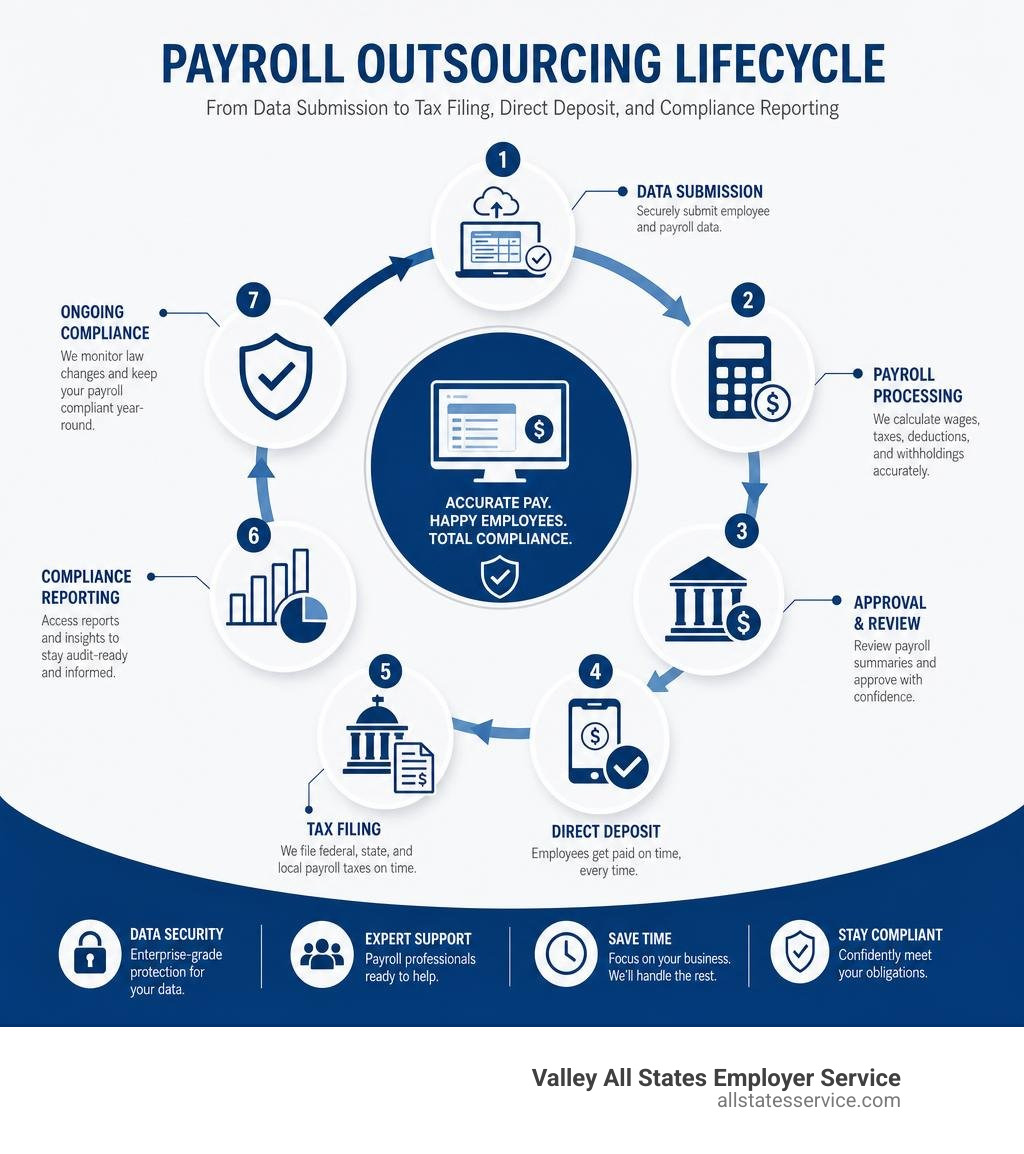
The actual process of working with an outsourced payroll provider is remarkably straightforward. It generally follows a simple, repeatable cycle every pay period.
First, you submit your employees’ basic time and attendance data. This can be done by uploading a digital spreadsheet, syncing an integrated time-tracking app, or quickly reviewing hours in an online portal.
Once the provider receives this data, their automated systems calculate gross pay, subtract pre-tax and post-tax deductions, and determine the exact tax withholdings. The provider then executes direct deposits, prints physical checks if needed, and files the necessary payroll taxes with federal, state, and local agencies.
Finally, your employees gain access to a self-service portal where they can view their pay stubs, update tax forms, and download their year-end W-2s. This self-service model drastically reduces the number of administrative questions your HR team has to answer every week.
In-House vs. Outsource Payroll Services: A Direct Comparison
Many business owners wonder if keeping payroll in-house is more cost-effective than outsourcing. While managing payroll yourself might seem cheaper on the surface, the hidden costs of software licenses, manual errors, and lost productivity tell a very different story.
| Feature | In-House Payroll | Outsourced Payroll Services |
|---|---|---|
| Cost Structure | High internal labor costs plus ongoing software subscription fees | Predictable monthly or per-run fee, usually $30 to $100 per employee |
| Time Investment | Hours spent every week on calculations, entry, and filing | Minutes spent reviewing and approving pre-calculated runs |
| Compliance Risk | High risk, as internal staff must track every local and state tax change | Minimal risk, as dedicated specialists monitor and update tax rules |
| Error Rates | Higher due to manual data entry and spreadsheet limitations | Extremely low due to automated validations and professional review |
When you manage payroll internally, your team has to handle the burden of constant tax updates. If you are ready to move away from manually entering data, you can read about how to Stop the Spreadsheet Madness with a Modern Outsourced Payroll Solution.
Key Benefits of Outsourcing Payroll for Modern Businesses
Outsourcing payroll is not just about offloading a tedious task, it is a strategic move that helps secure long-term business growth. When you partner with a professional provider, you gain access to enterprise-grade technology that would be too expensive to build in-house.

With a modern digital dashboard, you can view real-time labor costs, track employee benefits, and monitor tax compliance across all your business locations. This level of visibility makes it easier to make informed decisions about hiring, budgeting, and scaling your operations.
Reclaiming Time and Reducing Administrative Burnout
With 57% of HR professionals reporting that they are working beyond capacity, administrative burnout is a major threat to employee retention. HR managers should be focusing on recruiting top talent, designing training programs, and improving company culture, not spending hours calculating payroll taxes.
When you outsource payroll services, you immediately reclaim those lost hours. This allows your leadership team to focus on strategic initiatives that actually drive revenue and growth. To see how other businesses have successfully made this shift, check out our guide on Outsourced Payroll Solutions: How US Businesses Reclaim Their Time.
Mitigating Costly Tax Penalties and Compliance Risks
Tax compliance is incredibly complex, especially if you employ remote workers in different states. Each state has its own unique withholding tables, State Unemployment Insurance rates, and local tax jurisdictions.
For example, if your business is based in Maryland, you have to navigate both state taxes and local county tax rates, which vary significantly between places like Lutherville, Towson, and Baltimore. You can find more details on local tax rates through the Comptroller of Maryland website. Professional payroll providers specialize in managing these regional nuances, ensuring that your local tax filings are completely accurate and submitted on time.
What Services Are Included in Managed Payroll?
Managed payroll is much more than just calculating paychecks. A comprehensive service provider handles the entire lifecycle of employment administration.
Standard managed payroll packages typically include:
- Full-cycle processing: Calculating gross-to-net pay for hourly, salaried, and contract workers.
- Tax withholding and filing: Managing federal, state, and local tax deposits, as well as filing quarterly Form 941s and annual Form 940s.
- Benefits and deduction administration: Managing health insurance premiums, 401(k) retirement contributions, and HSA or FSA deductions.
- Garnishment administration: Calculating and executing court-ordered wage garnishments in compliance with state laws.
- Year-end reporting: Preparing, printing, and electronically filing W-2 forms for employees and 1099-NEC forms for independent contractors.
By bundling these tasks together, you create a seamless workflow where data flows directly from time-tracking systems into tax reports. To explore the full range of options available, take a look at The Complete Guide to Employee Payroll Solutions.
Evaluating the Top Payroll Outsourcing Providers
When you begin evaluating different payroll providers, it is important to look beyond basic processing. You need a partner that can support your business as it grows and integrates with your existing technology stack.
You should assess potential providers based on their software proficiency, their compliance record, and the quality of their customer support. To help you narrow down your options, we have compiled a resource on Choosing Your Payroll Partner: The Definitive List of Processing Firms.
Personalized Support vs. Automated Call Centers
One of the biggest complaints businesses have about massive payroll corporations is the lack of personalized support. When a payroll error occurs, the last thing you want is to be stuck in an automated phone tree or waiting days for a response to an email support ticket.
This is why many businesses prefer working with providers that offer a dedicated account manager. Having a single point of contact who understands your business, your industry, and your local state regulations makes a massive difference. For businesses in Maryland, utilizing regional expertise can be incredibly valuable to ensure compliance with local county tax rules and state-specific employment laws.
Scalability and Integration Capabilities
Your payroll system should not operate in a silo. It needs to connect seamlessly with your accounting software, your time-tracking tools, and your employee onboarding systems.
Additionally, modern hiring compliance requires robust verification systems. For example, verifying employment eligibility is a critical step in the onboarding process. At Valley All States Employer Service, we provide expert, impartial, and efficient E-Verify workforce eligibility verification services. By outsourcing your E-Verify processing to us, you can ensure complete compliance while keeping your onboarding workflow fast and error-free.
Understanding the Costs, Pricing Models, and Risks
Before you sign a contract with a payroll provider, it is essential to understand how they charge for their services. Most providers use one of three main pricing structures.
The most common model is the Per Employee Per Month fee, where you pay a flat base fee plus a set rate, usually between $30 and $100, for each active employee. Other providers charge a Per Payroll Run fee, which is ideal if you have a stable workforce and pay on a monthly or bi-weekly schedule. Some providers also offer flat monthly fees or tiered packages based on the level of HR support you need.
While outsourcing payroll is highly secure and efficient, there are still risks to keep in mind. The biggest risk is vendor reliability. Under IRS guidelines, the employer remains ultimately responsible for all employment tax deposits, even if you have forwarded those funds to a third-party processor.
To mitigate this risk, you should always register for the Electronic Federal Tax Payment System. This allows you to independently verify that your payroll provider is making timely tax payments on your behalf. If you are looking for cost-effective options that do not compromise on security, read more about our Affordable Payroll Services.
Frequently Asked Questions About Managed Payroll
How quickly can my business switch to a new payroll provider?
The transition to a new payroll provider typically takes between two to four weeks. During this time, your new provider will migrate your historical employee data, set up tax accounts, and run parallel payrolls to ensure everything calculates perfectly before going live. If you are feeling overwhelmed by your current setup, learn Why You Should Outsource Payroll Before You Lose Your Mind.
Is it secure to outsource payroll services for employee data?
Yes, reputable payroll outsourcing providers use advanced security measures that often exceed what a typical business can maintain in-house. Look for providers that operate within SOC-compliant environments, utilize 256-bit encryption, and require multi-factor authentication for all users. For more details on modern security standards, explore the benefits of a Web-Based Payroll Service.
Who is ultimately liable for payroll tax errors?
As the employer, you remain ultimately liable for the deposit and payment of federal, state, and local tax liabilities. Even if your payroll provider makes a mistake, the IRS will hold your business responsible for any unpaid taxes or late penalties. This is why it is so critical to partner with a trusted, experienced provider and to regularly monitor your tax deposits through official government portals.
Summary of Next Steps
Deciding to outsource payroll services is one of the most effective ways to reduce administrative friction and protect your business from costly compliance errors. By transitioning these complex tasks to dedicated professionals, you can give your HR team the freedom to focus on what matters most, your people.
At Valley All States Employer Service, we specialize in helping businesses simplify their employment compliance. Alongside your payroll outsourcing strategy, we can handle your E-Verify workforce eligibility verification with absolute precision, minimizing errors and taking the administrative burden completely off your plate.
Ready to simplify compliance? Simplify your compliance with our comprehensive payroll outsourcing solutions today.