
Syncing E-Verify with Your HR Tech Stack the Easy Way
Why Manual Verification Is Costing Your HR Team More Than You Think
E-Verify integration HR systems is the process of connecting the federal employment eligibility verification program directly into your existing HR software, so new hire data flows automatically from Form I-9 completion into E-Verify without manual re-entry.
Here’s a quick breakdown of how it works and why it matters:
- What it is: A direct connection between your HRIS, ATS, or onboarding platform and the DHS E-Verify system
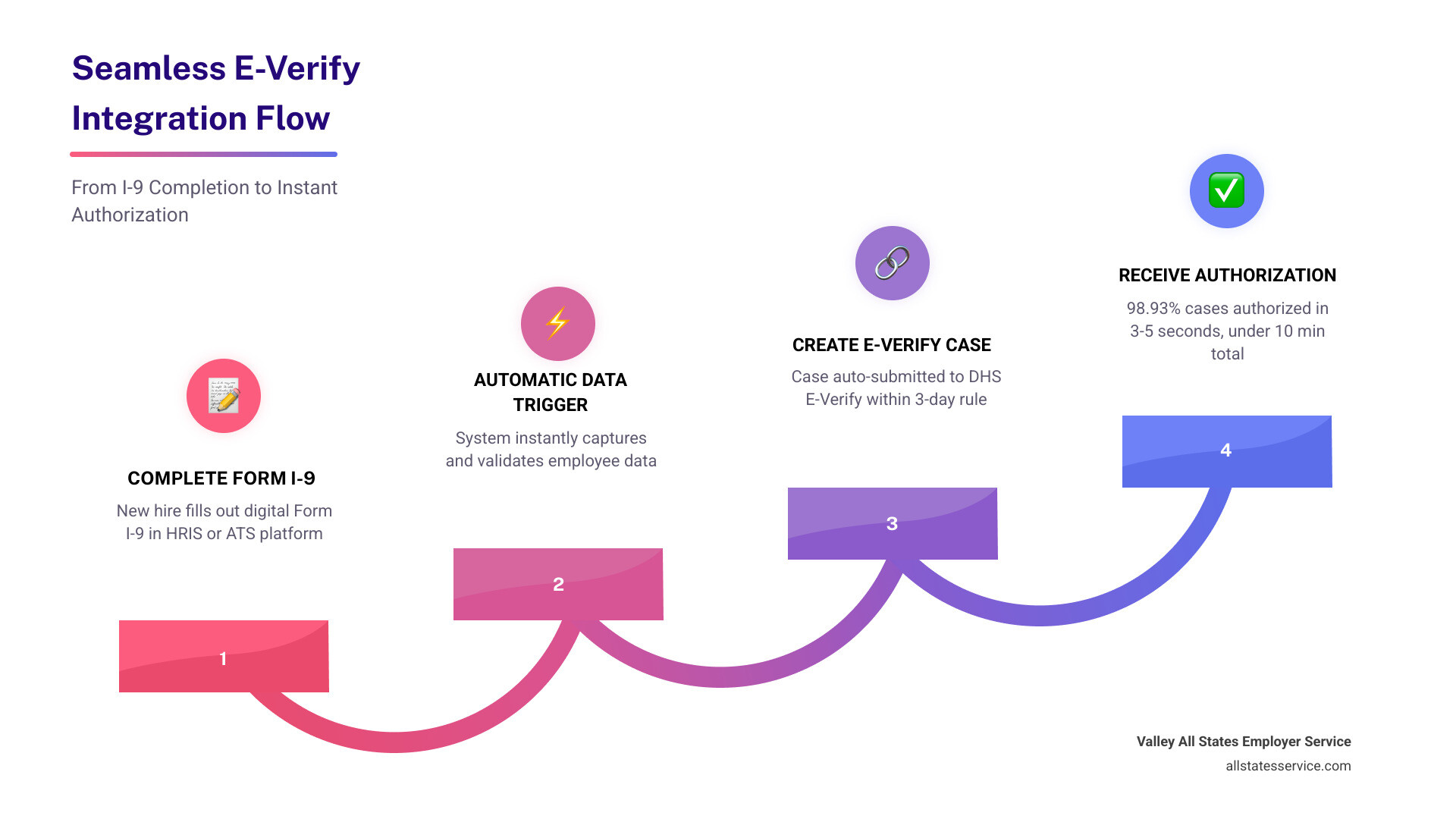
- How it works: Once a new hire completes their I-9, the system automatically triggers an E-Verify case using that same data
- Why it matters: 98.93% of cases receive automatic work authorization within 3 to 5 seconds, and processing times drop to under 10 minutes per employee
- Who needs it: Over 500,000 employers already use E-Verify, and six states require it for all employers
If you’re an HR manager juggling onboarding, compliance deadlines, and a growing team, you already know the pain of logging into a separate system, re-typing the same information you just collected, and hoping nothing was entered wrong.
That’s not a process. That’s a liability.
Manual verification creates gaps. Typos, missed deadlines, and lost case records are all too common when your team is copying data between systems by hand. The 3-day rule, which requires E-Verify cases to be created within three business days of a new hire’s start date, leaves very little room for error.
The good news is that modern HR platforms have made integration far more accessible, even for smaller teams without a dedicated IT department.
Why E-Verify integration HR systems Are Essential for Modern Compliance
In HR, compliance is often seen as a “check-the-box” activity, but when it comes to employment eligibility, the stakes are much higher. Integrating your E-Verify verification system directly with your HR tech stack turns a clunky administrative chore into a streamlined, secure workflow.
When you use E-Verify integration HR systems, you aren’t just saving time. You are building a digital fortress around your hiring process. Modern systems provide a centralized compliance dashboard where you can see the status of every new hire at a glance. Instead of digging through paper files or separate logins, everything is right there in your HRIS or ATS.
The statistics speak for themselves. According to USCIS data, 98.93% of E-Verify cases receive automatic work authorization within 3 to 5 seconds. When your systems are synced, that result is pulled directly into the employee’s record. This eliminates the “double-entry” trap where a typo in a Social Security number could trigger a false mismatch.
Furthermore, integration helps you stay on the right side of the law regarding the “3-day rule.” Federal law requires that you create an E-Verify case no later than the third business day after the employee starts work for pay. Automated triggers ensure that as soon as the E-Verify and I-9 forms are approved by your team, the case is sent to the Department of Homeland Security (DHS) and Social Security Administration (SSA) immediately.
For a deeper dive into how these two processes work together, check out our I-9 E-Verify Ultimate Guide. This level of automation provides “audit peace of mind,” as every action is timestamped and recorded, creating a clean trail for any future inspections.
| Feature | Manual Data Entry | Integrated Automation |
|---|---|---|
| Data Entry | Re-typing I-9 info into E-Verify | Automatic sync from I-9 |
| Speed | 20-30 minutes per hire | Under 10 minutes |
| Error Risk | High (typos, missed dates) | Low (validation at source) |
| Status Tracking | Manual log or spreadsheet | Real-time dashboard alerts |
| Audit Readiness | Scattered records | Centralized digital trail |
To learn more about the basics of the system, you can register for an E-Verify Overview webinar provided by USCIS.
Technical Approaches to E-Verify integration HR systems
Not all integrations are created equal. Depending on the size of your organization and your technical resources, you might choose a different path to get synced up.
The most robust method is using a Web Services API. This is a direct “handshake” between your HR software and the government’s servers. It requires an Interface Control Agreement (ICA) and ongoing compliance with DHS technical specifications. For most businesses, you won’t build this yourself. Instead, you’ll use an HR platform that has already done the heavy lifting. You can learn more about this technical side through the E-Verify for Web Services Users resources.
Another popular option is partnering with an E-Verify Employer Agent. This is where we come in. As an agent, we act on your behalf, managing the technical integration and the actual case processing. This is a great choice for companies that want to offload the E-Verify employer responsibilities entirely to experts who live and breathe compliance.
Finally, some smaller businesses still use browser-based access, which is the traditional way of logging into the government portal. While this works, it lacks the data-syncing benefits of a true integration.
Measuring the ROI of E-Verify integration HR systems
Is the investment in integration worth it? For most HR teams, the answer is a resounding yes. When we talk about ROI, we look at three main areas: time, money, and risk.
First, consider processing times. Without integration, an HR staffer might spend 30 minutes per employee managing the I-9 and E-Verify process. With E-Verify integration HR systems, that time drops to under 10 minutes. If you hire 100 people a year, that is over 30 hours of administrative work saved. For many, E-Verify for Small Businesses is the only way to stay lean while growing.
Second, think about time-to-hire. In a competitive job market, every second counts. Integrated systems allow you to verify eligibility almost instantly, meaning your new hire can get to work faster. Platforms like BambooHR even offer specific BambooHR Help Articles to help users maximize these efficiency gains.
Lastly, there is the cost of non-compliance. Fines for I-9 errors or failing to use E-Verify where required can reach thousands of dollars per violation. By E-Verify outsourcing or using an integrated system, you significantly reduce the chance of a costly mistake.
Step-by-Step Roadmap to Implementing Your Integration
Ready to make the leap? Implementing E-Verify integration HR systems isn’t as daunting as it sounds if you follow a logical path. We recommend a phased approach to ensure nothing gets missed.
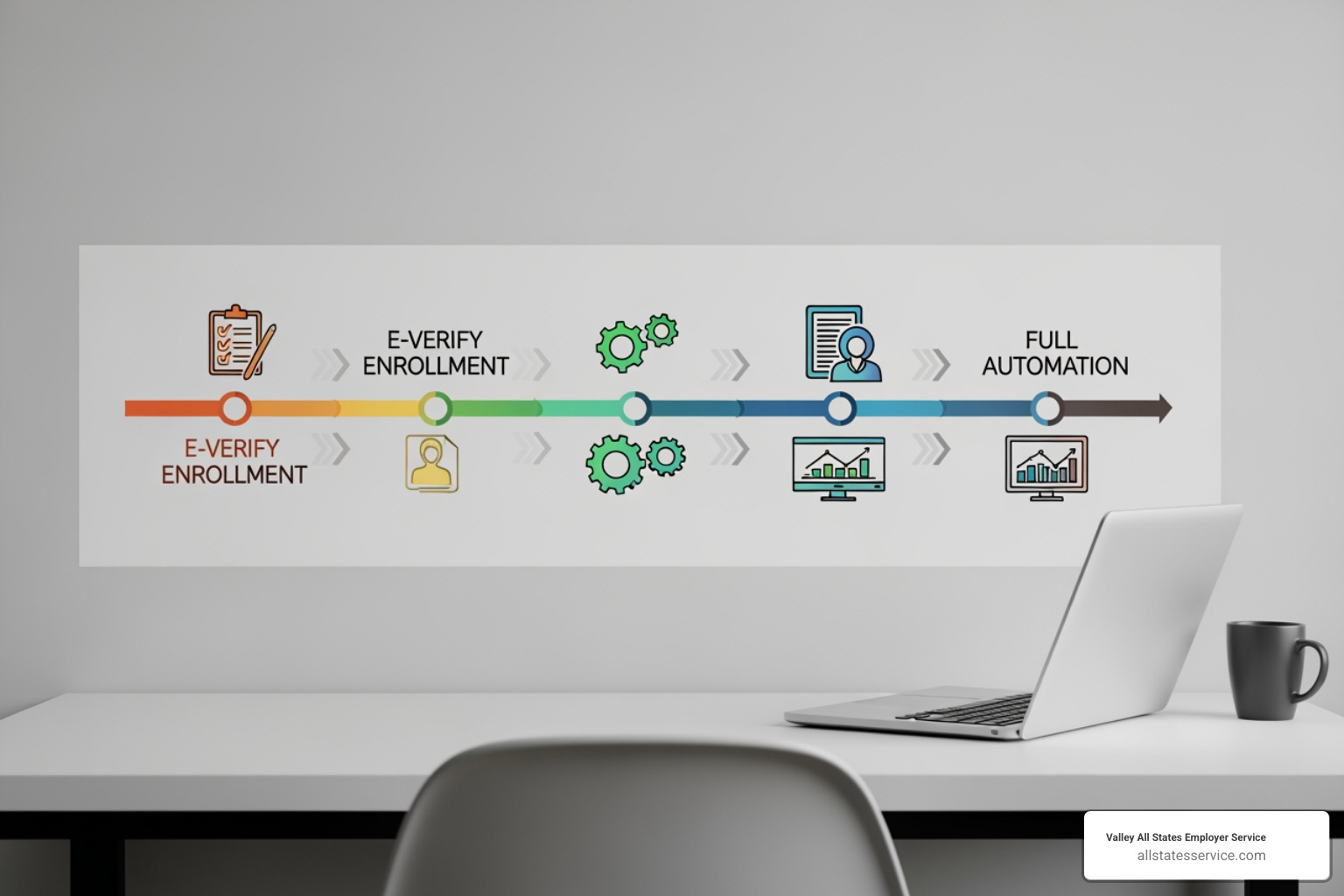
- Enrollment and Credentials: Before you can sync anything, you must be enrolled in E-Verify. You’ll need your Federal Employer Identification Number (EIN) and your North American Industry Classification System (NAICS) code. You can find more on this in our E-Verify Employer Requirements guide.
- Designate Roles: Decide who will be your Program Administrator. This person manages the account and user permissions. You will also need a “Signatory” to sign the Memorandum of Understanding (MOU) with the DHS.
- Choose Your Integration Method: Will you use your existing HRIS’s built-in tool, or will you work with an E-Verify Employer Agent?
- Map Your Workflow: This is the most important step. You need to decide exactly when the E-Verify case should be triggered. Most companies choose to trigger it immediately after the I-9 Section 2 is completed. You can see the technical steps for this in the How To Create a New Form I-9 documentation.
- Training: Ensure your HR team understands the rules. This includes the 3-day rule, how to handle photo matching, and what to do if a case isn’t instantly authorized. Our E-Verify Program Complete Guide is a great resource for this.
Configuring Your HRIS and ATS Platforms
Once you have your roadmap, it is time to get under the hood of your software. Most modern platforms like BambooHR, iCIMS, and Viewpoint Vista have dedicated modules for this.
For example, iCIMS users can Reduce I-9 Workloads by using their integrated connectors. These tools allow for “automated triggering,” where the software detects a completed I-9 and sends the data to E-Verify without a single human click.
If you use Mitratech or EMP Trust, the configuration usually involves entering your E-Verify credentials into the platform settings and mapping the data fields. This ensures that the “Employee ID” and “Work Location” in your HR system match what E-Verify expects. To make sure your team is ready to handle the documents correctly during this process, consider Form I-9 Document Training.
Navigating TNCs and Compliance in an Automated Environment
Even with the best E-Verify integration HR systems, you will occasionally run into a “Tentative Nonconfirmation” (TNC). A TNC means that the information entered didn’t immediately match government records. It does not mean the employee isn’t authorized to work, it just means more steps are needed.
In an integrated environment, handling a TNC is much easier. The system will typically flag the record and generate a “Further Action Notice” automatically. You must provide this notice to the employee in private. They then have 10 federal government working days to take action.
Compliance also means keeping up with state laws. While E-Verify is voluntary at the federal level for most, it is E-Verify mandatory in states like Florida and Arizona. In Florida, for instance, private employers with 25 or more employees must use E-Verify for all new hires. An integrated system helps you manage these regional differences without having to remember the rules for every state.
Data privacy is another huge factor. When you sync systems, you are moving sensitive info like Social Security numbers. Integrated systems use encrypted connections and role-based access to ensure only authorized people see that data. Also, remember the E-Verify Records Retention rules. E-Verify records are generally purged after 10 years, so having a digital system that tracks these dates is a lifener.
For more on staying compliant across the board, check out our I-9 E-Verify Compliance Guide.
The Future of Verification: E-Verify+ and Beyond
The world of employment verification is changing fast. The newest innovation is E-Verify+. This is a service that streamlines the process even further by allowing employees to create a secure personal account.
With E-Verify+, the employee takes more control of their data. They can upload their documents directly and carry their “portable credentials” from one employer to the next. This reduces the burden on HR and makes the process much faster for the worker. We are already seeing how this supports remote hiring, as it integrates seamlessly with secure video verification.
We are also looking ahead to “E-Verify NextGen,” which aims to combine the I-9 and E-Verify into a single, truly digital experience. As these technologies evolve, our E-Verify Services will continue to adapt to ensure our clients are always using the latest and most efficient tools.
If you are curious about the core of the program, you can always go back to the basics with What is E-Verify? or Visit I-9 Central for the latest government updates.
Frequently Asked Questions
How does automated case creation work?
Automated case creation is the “magic” of E-Verify integration HR systems. When an employee finishes Section 1 of the I-9 and the employer finishes Section 2, the HR software detects that the form is “complete and approved.”
The system then takes that data and instantly triggers a case submission to the DHS. Because the data is pulled directly from the digital I-9, the chance of a manual entry error is almost zero. You get an instant result back in the system, often within seconds. For a full breakdown, see our E-Verify I-9 Verification Complete Guide.
What are the federal requirements for integrated systems?
Federal requirements remain strict even when automated. You must still adhere to the 3-day rule and ensure you are not discriminating against employees based on their citizenship status. You also must display the required E-Verify and Right to Work posters in a place where prospective employees can see them.
If you are a federal contractor, the rules are even more specific. You might be required to verify your entire existing workforce, not just new hires. Our E-Verify Federal Contractors Ultimate Guide covers these nuances. You can also compare the two main requirements in our E-Verify vs I-9 Guide.
How do integrated systems handle remote hiring?
Remote hiring has become the norm, and integrated systems have evolved to match. Many platforms now allow for secure document uploads and digital signatures. During emergencies, such as being Affected by Hurricanes or Emergencies?, the government often provides flexible guidance that integrated systems can quickly implement.
Mobile-friendly forms allow new hires to complete their paperwork on their phone, and HR can use secure video links to perform the required document inspection. This is all tracked within the integrated system to maintain a perfect audit trail. For a broader look at business compliance, read our HR Compliance Complete Guide Businesses.
Final Thoughts on Streamlining Your Compliance
At Valley All States Employer Service, we believe that compliance shouldn’t be a headache. By leveraging E-Verify integration HR systems, you can transform your onboarding from a manual slog into a high-speed, high-accuracy machine.
Whether you choose to manage the integration yourself or look into our Outsourced HR Compliance Ultimate Guide, the goal is the same: reducing risk and saving time. Our expert processing and impartial oversight ensure that your business stays compliant without the administrative burden.
If you’re ready to see how much easier your hiring could be, we invite you to explore our HR Outsourcing Solutions Ultimate Guide. We’re here to help you navigate the complexities of DHS and SSA requirements so you can focus on what you do best: growing your business.
Ready to simplify your hiring process? Explore our I-9 Compliance Services Complete Guide.