
Why Compliant Hiring Practices Matter Now More Than Ever
Compliant hiring practices are the policies and procedures that ensure your recruitment process follows federal, state, and local employment laws while treating all candidates fairly. They protect your business from costly discrimination claims, legal penalties, and reputational damage while helping you build a stronger, more diverse team.
Here’s what compliant hiring practices include:
- Following anti-discrimination laws like Title VII, ADA, and ADEA at every hiring stage
- Creating job postings that avoid biased language and meet salary transparency requirements
- Asking only legal interview questions that relate directly to job duties
- Using standardized processes for screening, interviewing, and selecting candidates
- Conducting background checks in compliance with FCRA and Fair Chance laws
- Verifying employment eligibility through proper Form I-9 and E-Verify procedures
- Maintaining thorough documentation of all hiring decisions and accommodations
Hiring a new employee should be exciting. But one wrong question during an interview, an inconsistent screening process, or a poorly worded job posting can trigger discrimination claims that cost your company hundreds of thousands of dollars. According to the EEOC, employers can face penalties up to $100,000 per violation for certain immigration and refugee protection violations.
The challenge? Employment law is complex and constantly changing. What was acceptable five years ago may now be illegal. States and cities are adding new requirements for salary disclosure, AI use transparency, and criminal history inquiries. And if you’re hiring remotely or across borders, you’re navigating multiple jurisdictions with different rules.
The good news: Building a compliant hiring process doesn’t have to be overwhelming. This guide breaks down the essentials into practical, actionable steps. You’ll learn what questions you can and can’t ask, how to write job postings that attract diverse talent without legal risk, when and how to conduct background checks, and how to properly verify work authorization.
Whether you’re a small business hiring your first employee or an HR manager streamlining processes for a growing team, this guide will help you hire with confidence.
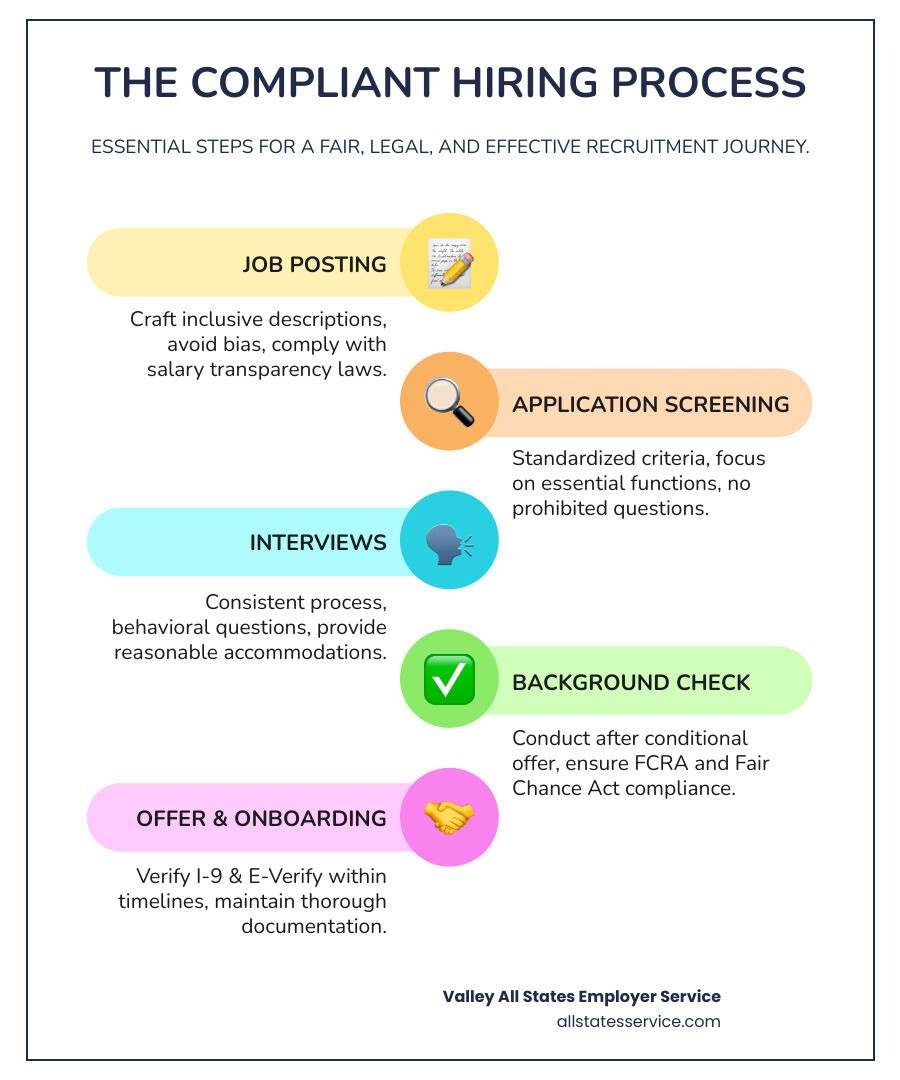
Compliant hiring practices vocabulary:
The Foundation: Understanding U.S. Anti-Discrimination Laws
Imagine a set of scales, perfectly balanced, representing fairness in the workplace. On one side are the employer’s rights, and on the other, employee protections. In the United States, federal agencies like the Equal Employment Opportunity Commission (EEOC) work tirelessly to keep those scales level. The EEOC enforces laws that prohibit discrimination against a job applicant or employee based on certain characteristics. These are known as protected characteristics or protected grounds.

What are these protected grounds? Federal laws generally prohibit discrimination based on:
- Race and Color: This includes traits commonly associated with race, like hair texture or skin color.
- Religion: Discrimination based on religious beliefs or practices, including lack of religious belief.
- Sex (including pregnancy, sexual orientation, and gender identity): This is covered by Title VII of the Civil Rights Act of 1964 and includes pregnancy, childbirth, and related medical conditions, as well as sexual orientation and transgender status.
- National Origin: Discrimination based on a person’s country of origin, ethnicity, or accent.
- Age (40 or older): The Age Discrimination in Employment Act (ADEA) specifically protects individuals aged 40 and over.
- Disability: The Americans with Disabilities Act (ADA) prohibits discrimination against qualified individuals with disabilities and requires reasonable accommodations.
- Genetic Information: This includes family medical history.
These protections apply to all aspects of employment, from job advertisements and interviews to promotions, pay, and even termination. It’s crucial for employers, especially small businesses, to understand these laws to avoid costly pitfalls. For more details on your obligations, check out our guide on HR Compliance for Small Business.
Beyond direct discrimination, known as disparate treatment, employers must also be wary of disparate impact. This occurs when a seemingly neutral employment policy or practice disproportionately affects a protected group, even if the intent wasn’t discriminatory. For example, a physical agility test might disproportionately screen out women. If that test isn’t proven to be job-related and necessary, it could lead to a discrimination claim. This is why understanding Prohibited Employment Policies/Practices is so vital.
Building a Compliant Hiring Process, Step-by-Step
A strong house needs a solid foundation, and so does a compliant hiring practices process. Let’s walk through each stage of recruitment to ensure you’re building fairly and legally.
Crafting Compliant Job Postings
Your job posting is often the first impression a candidate has of your company, and it’s also the first place where discrimination can inadvertently creep in. The language you use matters immensely.
First, focus on the essential functions of the job. What are the core duties that a person must be able to perform, with or without reasonable accommodation? This helps ensure your requirements are truly job-related. Avoid generic or overly broad duties that aren’t truly critical.
Next, steer clear of biased language. Terms like “young and energetic” can be seen as age discrimination, while “native English speaker” might suggest national origin discrimination. Instead, describe the skills and experience needed, such as “strong communication skills” or “ability to work in a environment.” If a qualification might seem discriminatory but is genuinely necessary for the job, it might fall under a Bona Fide Occupational Qualification (BFOQ). This is a very narrow exception, so tread carefully and consult legal counsel if you think it applies.
Salary transparency laws are also increasingly prevalent across the U.S., with some states and cities requiring salary ranges to be included in job postings. While Maryland doesn’t currently have a statewide salary range disclosure law for job postings, local ordinances or future legislation could change this. Always check local laws where you operate. These laws aim to reduce pay disparities and promote fairness. For a deeper dive into Maryland-specific regulations, consult our Employment Law Maryland Complete Guide.
Conducting Fair and Legal Interviews
The interview is where you get to know your candidates, but it’s also a hotbed for potential legal missteps. The golden rule: focus your questions solely on the candidate’s ability to perform the job’s essential functions.
Here’s a list of prohibited interview topics that you should generally avoid asking directly or indirectly:
- Age: “When did you graduate high school?” or “Are you planning to retire soon?”
- Marital Status/Family Plans: “Are you married?” “Do you have children?” or “Are you planning to start a family?”
- Religion: “What church do you attend?” or “What holidays do you observe?”
- National Origin/Ancestry: “Where are you originally from?” or “What is your native language?” (unless language proficiency is a job requirement, then ask about fluency).
- Disability/Health: “Do you have any health conditions we should know about?” or “Have you ever filed for worker’s compensation?”
- Race/Ethnicity: Questions about racial background or physical appearance.
- Arrest Records: In many jurisdictions, you cannot ask about arrest records, only convictions (and even then, with restrictions).
- Financial Status: “Do you own your home?” or “Do you have any debts?” (unless directly relevant to a financial position).
Instead, focus on behavioral questions that explore past performance and future potential. For example, instead of “Do you work well under pressure?” try “Tell me about a time you had to manage a challenging deadline. What was the outcome?”
Crucially, employers have a duty to accommodate during the hiring process. If a candidate requests a reasonable accommodation for a disability or a need related to another protected ground (like a religious observance), you are legally obligated to provide it unless it causes “undue hardship” to your business. This could mean providing a sign language interpreter for an interview or rescheduling due to a religious holiday. Documenting these requests and your responses is vital. Consistent application of your interview process across all candidates is key to demonstrating compliant hiring practices. We cover this and more in our Human Resources Compliance resources.
Using AI and Automated Tools Responsibly
The rise of artificial intelligence (AI) and automated tools in hiring offers incredible efficiencies, but it also introduces new risks for discrimination. These tools, if not carefully designed and monitored, can inadvertently perpetuate or even amplify existing biases, leading to algorithmic bias.
For instance, an AI programmed to analyze resumes might inadvertently screen out candidates who attended certain schools or have employment gaps, which could disproportionately affect older workers, parents, or individuals from disadvantaged backgrounds. This can create adverse impact even if the AI’s developers had no discriminatory intent.
The Consumer Financial Protection Bureau (CFPB) has recently clarified that the Fair Credit Reporting Act (FCRA) can apply to AI-driven scores and assessments, especially when generated by third-party providers. If an AI tool creates a “risk” score based on a candidate’s online activity or a “productivity” score from tracked data, and that score influences an employment decision, it might be considered a “consumer report.” This means employers must adhere to FCRA requirements like providing notice, getting consent, and allowing candidates to dispute inaccuracies.
Your responsibility as an employer is to:
- Audit screening tools: Regularly review any automated tools or AI used in your hiring process for potential biases and adverse impact on protected groups.
- Ensure transparency: Understand how these tools work and what data they use.
- Validate their effectiveness: Just like traditional tests, AI tools should be validated to ensure they are job-related and necessary. The Uniform Guidelines on Employee Selection Procedures provide a framework for this, emphasizing the need to document impact and validity evidence.
Before implementing any AI-driven screening, consider the potential for bias and ensure you have a plan to mitigate it. For more on pre-employment screening, refer to our Background Check Pre-Employment Screening guide.
Making the Offer and Conducting Background Checks
You’ve found your ideal candidate, and it’s time to extend a job offer! This is usually done as a conditional job offer, meaning employment is contingent upon passing certain checks, like a background check or drug screening. This timing is critical for compliance.
When it comes to criminal history checks, the Fair Chance Act (often called “Ban the Box” legislation) has gained traction. Federally, the Fair Chance to Compete for Jobs Act of 2019 prohibits federal agencies and contractors from requesting criminal history information until after a conditional job offer has been made. Many states and localities, including some in Maryland, have similar “Ban the Box” rules that delay criminal history inquiries until later in the hiring process. These laws are designed to give individuals with criminal records a fair chance to demonstrate their qualifications before their past is considered.
If you conduct background checks, you must comply with the Fair Credit Reporting Act (FCRA). This federal law governs how consumer reporting agencies (CRAs) collect and use consumer information, including criminal records, credit history, and driving records, for employment purposes. FCRA compliance means:
- Disclosure and Authorization: You must provide a clear, written disclosure to the applicant that you intend to obtain a consumer report for employment purposes and get their written authorization.
- Pre-Adverse Action Notice: If you intend to take an adverse action (like not hiring someone) based on information in the background check, you must first give the applicant a copy of the report and a summary of their FCRA rights. This gives them a chance to review and dispute any inaccuracies.
- Adverse Action Notice: After a reasonable waiting period (typically 5 business days), if you still decide not to hire them, you must send a final adverse action notice.
Even after receiving background check results, you can’t automatically disqualify a candidate based on criminal history. You must conduct an individualized assessment to determine if the conviction is job-related and consistent with business necessity. Factors to consider include the nature and gravity of the offense, the time that has passed since the conviction or completion of the sentence, and the nature of the job held or sought. For comprehensive guidance on this, our Company Background Verification Process can help.
Post-Hire Essentials: Employment Eligibility Verification
Congratulations, you’ve made a hire! But your compliant hiring practices journey isn’t over yet. A crucial post-hire step is verifying your new employee’s legal right to work in the United States. This is where Form I-9 and E-Verify come into play.
Understanding Form I-9 and E-Verify
Form I-9, Employment Eligibility Verification, is a U.S. Citizenship and Immigration Services (USCIS) form that all employers must complete for every new hire, regardless of their citizenship status. Its purpose is to verify the identity and employment authorization of individuals hired for employment in the United States. We have a dedicated guide to answer the question, What is an I-9?.
Completing Form I-9 involves two main parts:
- Employee Section (Section 1): The employee completes this section on or before their first day of employment, providing personal information and attesting to their employment authorization status.
- Employer Section (Section 2): As the employer, you must complete this section within three business days of the employee’s first day of employment. This involves physically examining original documents presented by the employee from the List of Acceptable Documents (found on the form) to establish identity and employment authorization.
Understanding the document requirements is paramount. Employees must provide one document from List A (establishes both identity and employment authorization) or one document each from List B (establishes identity) and List C (establishes employment authorization). You cannot specify which documents an employee must present. Our I-9 Document Requirements Complete Guide provides all the details you need.
E-Verify is an internet-based system operated by USCIS that allows employers to electronically confirm the employment eligibility of their newly hired employees. While not all employers are required to use E-Verify, many federal contractors and some states (like Maryland for certain employers) mandate its use. Even if not required, E-Verify is a powerful tool to improve your compliant hiring practices. To learn more, see What is E-Verify?.
When using E-Verify, you submit information from the employee’s Form I-9 to the system, which then compares it against records available to the U.S. Department of Homeland Security (DHS) and the Social Security Administration (SSA). This process helps ensure accuracy and reduces the risk of hiring unauthorized workers.
Navigating Remote Hires and Record-Keeping
The rise of remote work has changed many aspects of HR, including I-9 verification. While the general rules for Form I-9 remain, the “physical examination” requirement for Section 2 posed a challenge. USCIS has adapted, allowing for more flexibility in remote I-9 verification. Employers can designate an authorized representative (which can be anyone, including a notary, family member, or friend, as long as they are not the employee themselves) to complete Section 2 on your behalf. This representative physically examines the documents and completes the form, then returns it to you. For comprehensive guidance on this, our Remote I-9 Verification guide is invaluable.
Proper document retention rules are also a cornerstone of compliant hiring practices. You must retain completed Forms I-9 for all active employees for as long as they are employed. After an employee’s separation, you must retain their Form I-9 for either three years from the date of hire or one year after the date employment ends, whichever is later. This is crucial for potential audits. We detail these requirements in our I-9 Record Keeping article.
For employers utilizing E-Verify for remote hires, there are specific guidelines to follow to maintain compliance. Our E-Verify Remote Hiring Complete Guide provides step-by-step instructions and best practices to ensure your remote onboarding process is legally sound.
Best Practices for Maintaining Compliance and Avoiding Claims
Being proactive is your best defense. By implementing sound compliant hiring practices, you not only avoid legal headaches but also cultivate a reputation as a fair and desirable employer.
Why Documentation and Consistency Are Your Best Friends
When it comes to hiring, if it wasn’t documented, it didn’t happen. Thorough documentation and consistent processes are your shield against discrimination claims.
Here’s why:
- Standardized Interview Scorecards: Develop and use consistent scorecards for all candidates for the same position. These should be based on job-related criteria and allow interviewers to objectively rate candidates. This ensures fairness and helps you compare applicants equitably.
- Documenting Hiring Decisions: Keep detailed notes on why each candidate was selected or not selected. These notes should directly reference the job requirements and the candidate’s qualifications, avoiding any mention of protected characteristics. Justifying selections with objective, job-related reasons is critical.
- Record Retention Policies: Maintain all job applications, resumes, interview notes, background check reports, and I-9 forms according to federal and state record retention laws. For instance, many federal laws require keeping applications and interview notes for at least one year. Proper HR Compliance Audit Guide 2025 can help you set up robust policies.
Consistency in your processes—from how you advertise a job to how you interview and make offers—demonstrates your commitment to fair practices. It helps prevent claims that one candidate was treated differently than another.
The High Cost of Non-Compliance
Ignoring compliant hiring practices can lead to severe consequences for your business. The costs aren’t just financial; they can also damage your reputation and morale.
- EEOC Investigations and Discrimination Lawsuits: If an applicant or employee believes they’ve been discriminated against, they can file a charge with the EEOC. This can lead to lengthy investigations, requiring you to produce extensive documentation. If the EEOC finds reasonable cause, they may sue you, or the individual can file their own discrimination lawsuit. These lawsuits can result in significant legal fees, back pay awards, compensatory and punitive damages, and even court-ordered changes to your hiring practices.
- Fines and Penalties: Beyond discrimination claims, non-compliance with specific regulations carries its own penalties. For instance, errors or omissions on Form I-9 can lead to substantial fines from Immigration and Customs Enforcement (ICE). Our I-9 Audit Penalties Complete Guide details how costly these can be. Penalties for immigration and refugee protection regulations can reach up to $100,000 per violation.
- Reputational Damage: News of discrimination lawsuits or non-compliant practices can spread quickly, especially in today’s digital age. This can make it difficult to attract top talent, alienate customers, and harm your brand image.
- Loss of Morale and Productivity: A workplace perceived as unfair or discriminatory can lead to low employee morale, decreased productivity, and increased turnover.
To mitigate these risks, many businesses find value in outsourcing their compliance needs. Services like ours can help Reduce HR Compliance Risk by Outsourcing, ensuring expert handling of complex regulations.
Conclusion
Staying on top of compliant hiring practices is not just about avoiding legal trouble; it’s about building a stronger, more diverse, and more effective team. The rules can be intricate, especially when it comes to post-hire steps like employment eligibility verification. Navigating these requirements, particularly for Work Authorization Verification, can be a significant administrative burden. Valley All States Employer Service simplifies this critical part of the process, ensuring your onboarding is as compliant as your hiring. Ready to streamline your I-9 and E-Verify compliance? Explore our I-9 & E-Verify Ultimate Guide.