
What the USCIS I-9 Form Is and Why Every Employer Must Get It Right
The uscis i 9 form is the federal document every U.S. employer must complete for each new hire to verify their identity and legal right to work in the United States.
Here’s the short answer if you need it fast:
How to complete Form I-9 (quick steps):
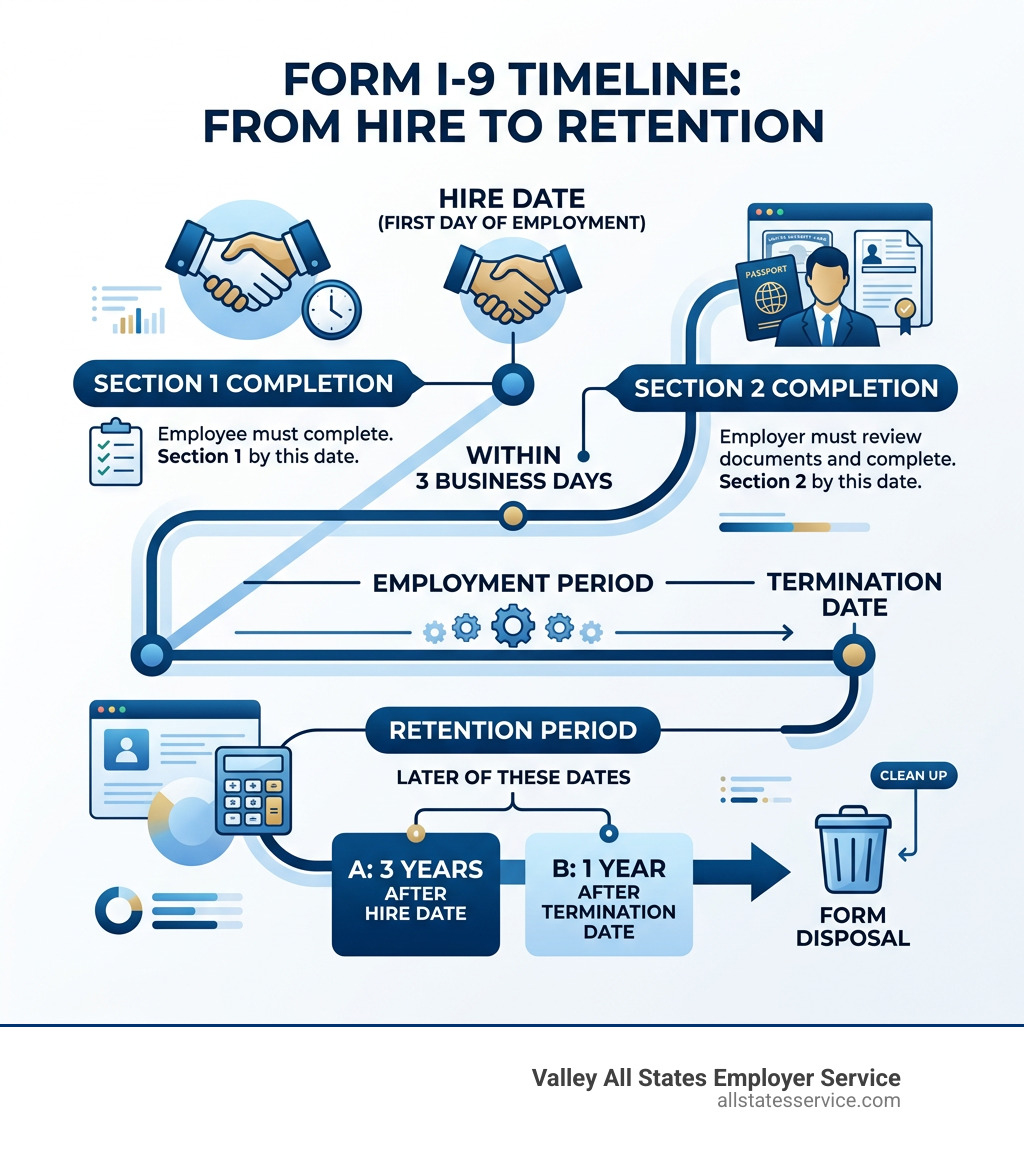
- Employee completes Section 1 on or before their first day of work
- Employer completes Section 2 within 3 business days of the employee’s first day
- Examine original, unexpired documents from List A, or one each from List B and List C
- Retain the completed form for 3 years after the hire date or 1 year after termination, whichever is later
- Use Supplement B for any rehires or reverification needs
This requirement has applied to every person hired for pay in the U.S. since November 6, 1986. No exceptions for U.S. citizens, no skipping steps for short-term hires.
And yet, mistakes happen constantly. Wrong edition dates, missing signatures, documents accepted from the wrong list, late completions. Each one can trigger fines during a government audit.
If you manage hiring at a mid-sized company, you’re probably juggling a dozen onboarding tasks at once. Form I-9 is easy to deprioritize until it isn’t. An ICE audit or a DOL inspection can surface paperwork errors from years back, and the penalties add up fast.
This guide walks you through every section of the form, every document list, and every rule, so your team gets it right every time.
Essential Requirements for the USCIS I-9 Form
When we talk about employment compliance, the uscis i 9 form sits at the very center of the conversation. Since the Immigration Reform and Control Act of 1986, it has been illegal for employers to knowingly hire individuals who are not authorized to work in the United States. To enforce this, the government created a standardized way to check every single person’s work authorization.
The rules are strict but straightforward. We must complete this form for every person hired for employment in the U.S. after November 6, 1986, provided they are working for pay or other compensation. It doesn’t matter if the person is a family member, a part-time student, or a high-level executive. If they are on the payroll, they need an I-9.
Understanding what is an i9 is the first step toward total compliance. It isn’t just a “HR thing” to file away, it is a legal attestation that you have done your due diligence. If you’re still wondering what is i-9 form in a broader legal context, think of it as your shield against federal penalties.
Who Must Complete the Form
Every new hire must participate in this process. This includes:
- U.S. Citizens
- Noncitizen nationals (individuals born in American Samoa or certain other territories)
- Lawful permanent residents (Green Card holders)
- Noncitizens authorized to work (such as those on work visas or with TPS)
There are very few exceptions. For instance, if you are hiring independent contractors (1094-MISC/NEC workers) who are truly self-employed, you generally do not need to complete an I-9 for them. However, for everyone else, completing Form I-9 | USCIS guidelines state that the responsibility falls squarely on the employer to ensure the form is filled out correctly.
Current Edition and Validity
One of the most common mistakes we see is using an outdated version of the form. USCIS updates the uscis i 9 form every few years to improve fraud detection and streamline the process.
Currently, the most recent edition is dated 01/20/25. You can find this date at the bottom of the form. While there is often a grace period for older versions, the 08/01/23 edition is generally valid until May 31, 2027, depending on specific electronic system updates. However, it is always best practice to use the newest version available to stay ahead of i-9 form updates.
Even if the form itself expires, the information on it remains valid for your records. You don’t need to fill out a new form for existing employees just because a new version was released, unless you are performing a reverification.
Step-by-Step Guide to Completing the Form Sections
The form is divided into distinct sections, each with its own deadline and responsible party. Getting the timing right is just as important as getting the information right. If you want to dive deep into the mechanics, our i-9 form completion guide offers a granular look at every box.
Section 1: Employee Information and Attestation
The employee is responsible for completing Section 1. This must be done no later than the first day of employment. They can actually complete it any time after they have accepted a job offer, but never before.
In this section, the employee provides their full legal name, address, and date of birth. They must also attest to their citizenship or immigration status. While providing a Social Security Number is generally voluntary, it becomes mandatory if your company participates in E-Verify.
If the employee needs help because of a language barrier or physical disability, a preparer or translator can assist. In these cases, the helper must complete Supplement A, Preparer and/or Translator Certification. This is a separate page that stays with the form. For a detailed walkthrough on this part of the process, check out our guide on filling out employment eligibility verification.
Section 2: Employer Review and Verification of the USCIS I-9 Form
This is where we, as employers, take the lead. We must complete Section 2 within three business days of the employee’s first day of work. For example, if an employee starts on Monday, Section 2 must be finished by Thursday.
Our job is to physically examine the original documents the employee presents. We aren’t expected to be forensic experts, but we must determine if the documents reasonably appear to be genuine and relate to the person standing in front of us. We then record the document title, issuing authority, number, and expiration date.
Many employers choose to designate an “authorized representative” to fill this out, especially for remote hires. Just be careful, as the employer is still legally liable for any mistakes that representative makes. You can find more details in our form i-9 section 2 breakdown.
Navigating the Lists of Acceptable Documents
The “Lists of Acceptable Documents” can feel like a puzzle, but it follows a simple logic. The employee must prove two things: who they are (identity) and that they are allowed to work (authorization).
| List A (Identity + Authorization) | List B (Identity Only) | List C (Authorization Only) |
|---|---|---|
| U.S. Passport or Passport Card | Driver’s License | Social Security Card (Unrestricted) |
| Permanent Resident Card (Form I-551) | School ID with photo | Birth Certificate (Original/Certified) |
| Employment Authorization Document (I-766) | Voter’s registration card | Consular Report of Birth Abroad |
| Foreign Passport with I-551 stamp | Military ID card | Native American tribal document |
Employees can choose to present one document from List A OR one document from List B AND one from List C. We cannot tell them which documents to bring, as that could be considered discriminatory. For more technical details, refer to the E-Verify Handbook for Employers M-274.
List A: Identity and Employment Authorization
List A documents are the “all-in-one” solution. A U.S. Passport or a filling out i9 with permanent resident card (Green Card) covers all the bases.
One interesting fact: USCIS redesigns Permanent Resident Cards and Employment Authorization Documents every 3 to 5 years to stay ahead of counterfeiters. The most recent redesign was launched on January 30, 2023. Even if your employee has an older design, it is still valid as long as it hasn’t expired.
List B and List C: Identity and Authorization
If an employee doesn’t have a List A document, they’ll need a “combo.” List B establishes identity (like a driver’s license), and List C establishes work rights (like a Social Security card).
A crucial tip for List C: We cannot accept Social Security cards that have restrictions printed on them, such as “NOT VALID FOR EMPLOYMENT” or “VALID FOR WORK ONLY WITH DHS AUTHORIZATION.” These cards do not prove employment eligibility on their own for I-9 purposes.
Compliance Rules and Remote Hires
The world of work has changed, and the uscis i 9 form has had to change with it. Managing paper forms for a distributed workforce is a challenge, which is why i-9 form management has become a specialized field.
How to Handle Remote Verification for the USCIS I-9 Form
For a long time, physical examination meant being in the same room. However, DHS now allows an alternative procedure for employers in good standing who use E-Verify.
Under this rule, you can examine documents via a live video interaction. You must still see the original documents, but you do it over the screen. You must also retain clear copies of the documents. This has been a game-changer for remote onboarding. If you’re looking to implement this, our uscis i 9 remote verification guide covers the specific boxes you need to check on the form to stay compliant.
Retention and Penalties
Once the form is done, the clock starts on retention. You must keep the uscis i 9 form for:
- 3 years after the date of hire, OR
- 1 year after the date employment ends, whichever is later.
If you’re ever audited, you usually have three days to produce these forms for inspection by DHS, the Department of Labor, or the Department of Justice. Missing forms or “paperwork violations” (like a missing date) can result in fines ranging from a few hundred to several thousand dollars per form. Serious “knowing hire” violations can lead to even steeper penalties and even criminal charges in extreme cases. Staying on top of i-9 form processing is the only way to sleep soundly at night.
Conclusion
Mastering the uscis i 9 form doesn’t have to be a source of stress for your HR team. By following the timelines, using the correct edition, and carefully reviewing acceptable documents, you create a culture of compliance that protects your business from unnecessary risks.
At Valley All States Employer Service, we specialize in taking this burden off your shoulders. We provide expert, impartial, and efficient E-Verify workforce eligibility verification for employers across the United States. Our goal is to minimize errors and reduce the administrative heavy lifting, allowing you to focus on growing your team rather than worrying about paperwork audits.
Whether you are in Lutherville, MD, or anywhere else in the country, our team is ready to help you navigate the complexities of employment eligibility.
Ready to simplify compliance? Explore our I-9 Compliance Services Complete Guide