Employment eligibility services: 2025 Confidence Guide
Why Employment Eligibility Verification Matters for Every U.S. Employer
Employment eligibility services help U.S. employers verify that every new hire is legally authorized to work, ensuring compliance with federal law and protecting businesses from costly penalties.
Quick Answer: What Are Employment Eligibility Services?
Employment eligibility services provide employers with tools and support to:
- Complete and manage Form I-9 for every new employee
- Verify work authorization through the E-Verify system
- Store and track verification documents securely
- Stay compliant with federal regulations and avoid penalties
- Streamline onboarding with automated workflows and expert guidance
Every U.S. employer faces the same challenge: making sure every person you hire is legally allowed to work in the United States. It’s not optional. Federal law requires you to verify identity and employment authorization for every single employee through Form I-9, and in many cases, through the E-Verify system as well.
But here’s the reality: these requirements are complex, constantly changing, and easy to get wrong. A small mistake on a form, a missed deadline, or an improper document check can lead to government audits, financial penalties, and serious legal trouble.
That’s where employment eligibility services come in. These services take the burden off your HR team by handling the verification process from start to finish. They help you complete forms correctly, manage E-Verify cases, store records securely, and stay ahead of regulatory changes. For busy HR managers juggling dozens of priorities, this support can be the difference between a smooth onboarding process and a compliance nightmare.
Whether you’re hiring your first employee or your hundredth, understanding how employment eligibility verification works and how professional services can help is essential for protecting your business and building a legal, compliant workforce.
Related content about Employment eligibility services:
The Core Components: Understanding Form I-9 and E-Verify
Navigating employment eligibility verification starts with two fundamental pieces: Form I-9 and E-Verify. Let’s break down what each one entails and how they work together.
What is Form I-9 and what are an employer’s responsibilities?
Form I-9, officially known as the Employment Eligibility Verification form, is a crucial document for every U.S. employer. It’s how we verify the identity and employment authorization of individuals hired for employment in the United States. Think of it as the bedrock of your hiring compliance.
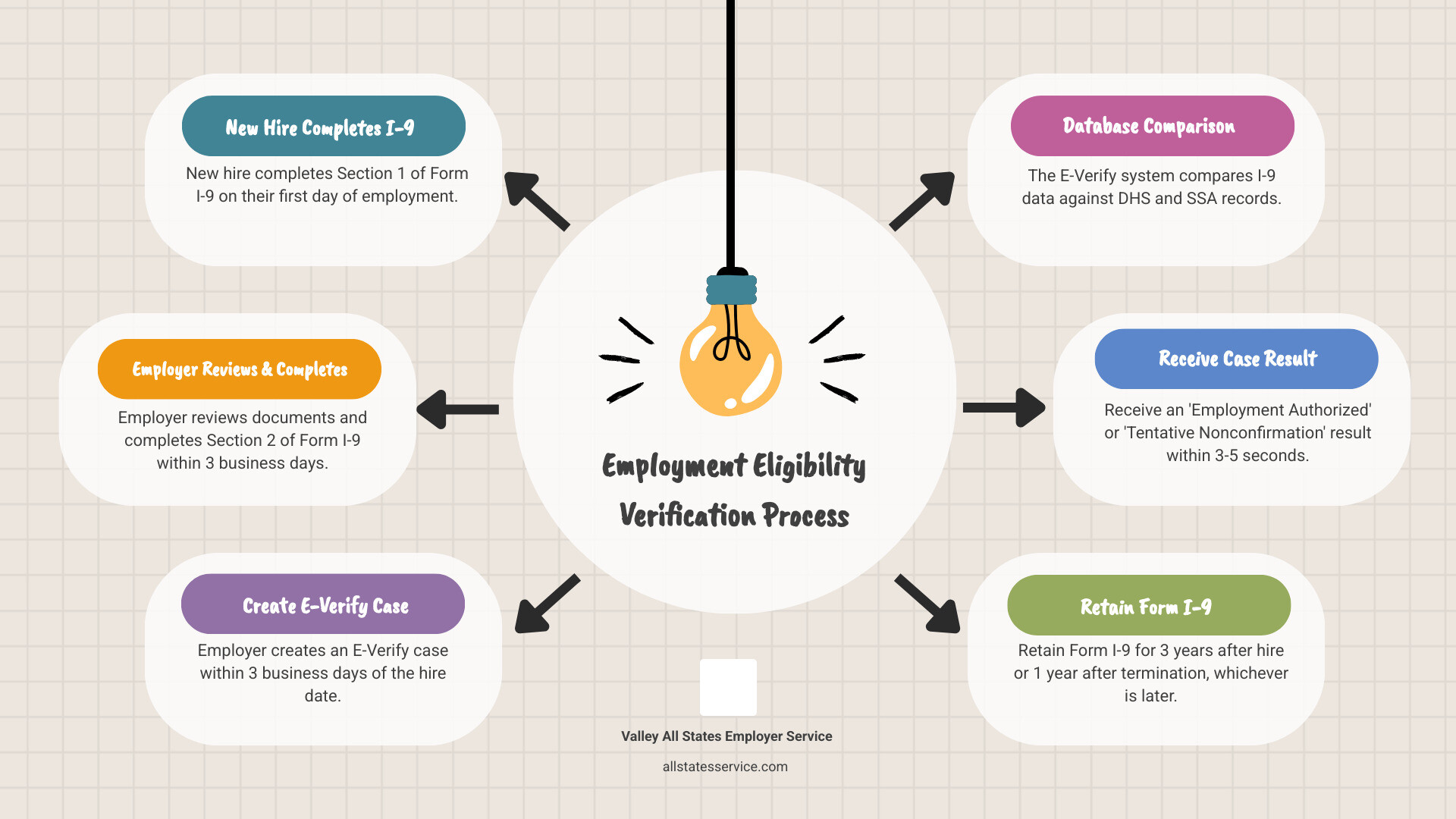
Our responsibilities as employers regarding Form I-9 are clear and non-negotiable. First, we must ensure every new hire completes and signs Section 1 of the form on or before their first day of employment. This section requires the employee to attest to their employment authorization status and provide personal information.
Next, within three business days of the employee’s first day of employment, we must physically examine the original documents presented by the employee from the List of Acceptable Documents (found on the back of the form). Based on these documents, we complete Section 2 of the Form I-9, documenting the identity and work authorization. It’s vital that we do not dictate which documents an employee can present, as long as they are from the acceptable lists. For a deeper dive, check out our guide on What is an I9?.
After completion, we don’t file Form I-9 with USCIS or ICE. Instead, we must retain and store the form for a specific period: either three years after the date of hire or one year after employment is terminated, whichever date is later. This retention is critical because authorized U.S. government officials from the Department of Homeland Security (DHS), Department of Labor (DOL), or Department of Justice (DOJ) can inspect these forms upon request. Failing to produce properly completed and retained forms during an ICE audit can lead to significant penalties. Our I-9 Record Keeping article provides more detail on this.
It’s also worth noting that the form itself undergoes updates. The current edition date for Form I-9 is 01/20/25. While previous editions, like one with an 08/01/23 edition date, might still be valid for a period, it’s always best practice to use the most current version. If we use an electronic version, we must ensure our systems are updated by the required deadlines, typically when a previous edition expires. For comprehensive details on document requirements, refer to our I-9 Document Requirements Complete Guide.
How does the E-Verify system work?
E-Verify is an internet-based system that takes employment eligibility verification a step further. It’s operated by the U.S. Department of Homeland Security (DHS) in partnership with the Social Security Administration (SSA). While Form I-9 is where the employee provides their information and documents, E-Verify is the system that electronically checks if that information matches government records.
Here’s how it works: Once an employee has completed Form I-9, we, as the employer, take the information they provided in Section 1 and 2 and enter it into the E-Verify system. E-Verify then electronically compares this data against millions of records available to the SSA and DHS. The goal is to confirm that the individual is authorized to work in the United States.
The beauty of E-Verify is its speed. In most cases, we receive a case result within 3 to 5 seconds. The most common result is “Employment Authorized,” meaning the employee’s information matched government records, and no further action is needed. However, sometimes a “Tentative Nonconfirmation” (TNC) occurs. A TNC simply means there was a mismatch between the information entered and government records. It does not mean the individual is unauthorized to work.
When a TNC occurs, the employee has the right to challenge it. We must inform them of the TNC and give them the opportunity to resolve the mismatch with the appropriate agency (SSA or DHS). It’s crucial that we do not take any adverse action against an employee, such as terminating them, solely because of a TNC if they choose to contest it. For a complete understanding of the system, visit An overview of the E-Verify program or our own What is E-Verify? page. You can also explore our E-Verify Employment Verification service to see how we assist employers with this process.
What are the key differences between Form I-9 and E-Verify?
While Form I-9 and E-Verify are both integral to employment eligibility, they serve distinct roles and have key differences. Understanding these distinctions is vital for proper compliance.
| Feature | Form I-9 | E-Verify |
|---|---|---|
| Purpose | Document employee’s identity and work authorization. | Electronically confirm work authorization based on Form I-9 data. |
| Requirement | Mandatory for all U.S. employers for every new hire. | Mandatory for federal contractors and in some states/localities, voluntary for others. |
| Nature | Paper or electronic form completed by employee and employer. | Internet-based system that uses Form I-9 data for database comparison. |
| Verification Method | Employer physically examines documents. | System compares data with DHS and SSA records. |
| Result | Completed form, signed by employee and employer. | Electronic case result (Employment Authorized, TNC, Final Nonconfirmation). |
| Speed | Dependent on employee document presentation and employer completion. | Typically 3-5 seconds for initial result. |
| Storage | Retained by employer for specific periods. | Electronic record within the E-Verify system. |
As you can see, Form I-9 is the initial document where the employee attests to their eligibility and presents proof. E-Verify then acts as an electronic verification system, using the information from that Form I-9 to cross-reference with government databases. It’s not a replacement for the I-9, but rather a complementary tool that provides an additional layer of verification.
For federal contractors, E-Verify participation is typically mandatory due to the Federal Acquisition Regulation (FAR) clause. Many states, including Maryland, also have E-Verify mandates for certain employers or state contracts. For more on how these two critical components work together, our I-9 E-Verify Ultimate Guide and E-Verify and I-9 resources offer comprehensive insights.
How Professional Employment Eligibility Services Streamline Compliance
Managing Form I-9s and E-Verify cases can be a significant administrative burden, especially for growing businesses. That’s where professional employment eligibility services come in. They transform a potentially complex, error-prone task into a seamless, compliant part of your onboarding process.
What types of employment eligibility services are available?
Professional employment eligibility services offer a range of solutions designed to simplify compliance. These often come from third-party providers or E-Verify employer agents, like us at Valley All States Employer Service.
Here are some common types of services you’ll find:
- Electronic I-9 Solutions: These services provide user-friendly software platforms that guide employees and employers through the Form I-9 completion process. They often include built-in error checks, ensuring all required fields are filled out correctly and documents are properly recorded.
- Remote I-9 Verification: With the rise of remote work, verifying documents for employees who aren’t physically present can be tricky. Services offer compliant methods for remote I-9 verification, including the use of authorized representatives or leveraging new alternative procedures for remote examination introduced by DHS. Our Electronic I-9 Solutions page has more on this.
- E-Verify Employer Agent Services: Companies like Valley All States Employer Service act as authorized E-Verify employer agents. This means we manage the entire E-Verify process on your behalf, from submitting cases to resolving Tentative Nonconfirmations, reducing your administrative workload and ensuring accuracy. PSI Background Screening, for instance, is also an authorized E-Verify service provider.
- Audit and Remediation: Should you face an ICE audit, these services can help you prepare, review existing I-9 forms for errors, and assist with corrective actions.
- Compliance Consulting: Expert consultants provide guidance on complex immigration scenarios, changing regulations, and best practices to maintain ongoing compliance.
- Integrated Background Screening: Many providers, like HireRight, offer comprehensive background screening packages that include U.S. Employment Eligibility Verification (Form I-9 and E-Verify) alongside other checks like criminal records and global employment verification. HireRight emphasizes an easy and efficient online solution for managing US employment eligibility.
For a deeper look into outsourcing these tasks, explore our Outsourced Employee Verification Complete Guide.
How do these services help employers ensure compliance?
The primary goal of professional employment eligibility services is to ensure your business remains compliant with federal hiring laws, protecting you from potential penalties and legal issues. But how do they actually achieve this?
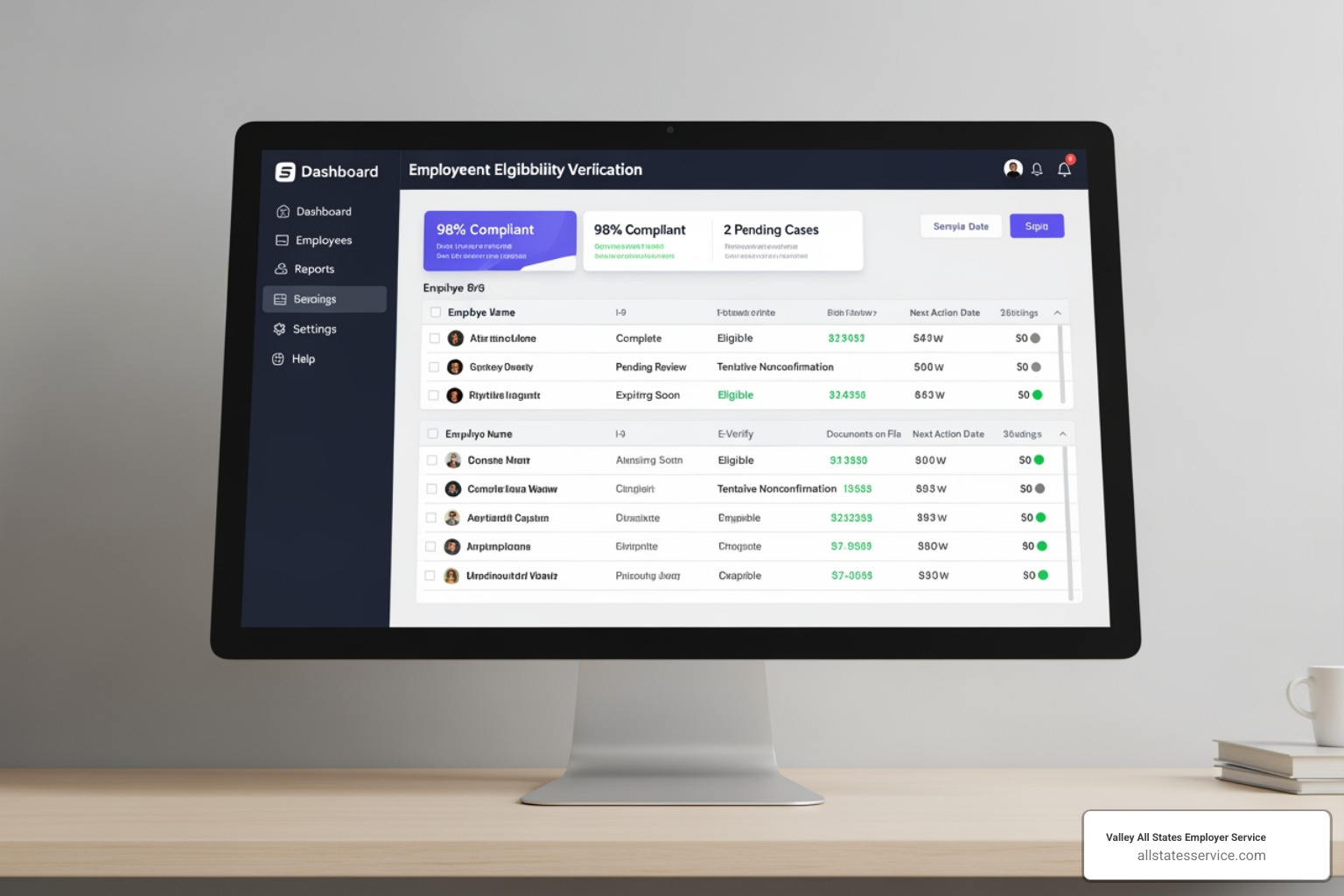
- Error Reduction: Human error is a significant cause of I-9 compliance issues. Automated workflows and smart form technology within these services minimize mistakes by guiding users step-by-step, flagging incomplete fields, and ensuring correct document entry. This reduces the risk of even unknowing errors that could lead to fines.
- Automated Workflows: From sending I-9 completion reminders to employees to automatically initiating E-Verify cases, these services automate tedious administrative tasks. This frees up your HR team to focus on more strategic initiatives.
- Secure Digital Storage: Gone are the days of overflowing filing cabinets. Services provide secure, digital storage for all I-9 forms and supporting documentation, making them easily accessible for audits while protecting sensitive employee data.
- Reminder Systems: Never miss a re-verification deadline again. Automated reminder systems alert you when an employee’s temporary work authorization is about to expire, ensuring timely action and continuous compliance.
- Audit Trail: Every action taken within the system, from form completion to E-Verify case results, is logged, creating an immutable audit trail. This transparency is invaluable during a government inspection, demonstrating your good faith efforts toward compliance.
- Expert Support: Perhaps most importantly, these services come with expert support. When you have a question about a complex document or a tricky E-Verify case, you have a team of specialists ready to provide accurate guidance. This expert knowledge mitigates risk and ensures you’re always following the latest regulations.
By leveraging these features, we can significantly reduce our exposure to government audits and mitigate legal and financial consequences. It’s about taking a proactive approach to Human Resources Compliance and truly Reducing HR Compliance Risk by Outsourcing. For a comprehensive overview, see our Employment Compliance Solutions Complete Guide.
How do these services benefit candidates?
While the direct benefits for employers are clear, professional employment eligibility services also offer significant advantages for candidates during the hiring process. A smooth verification process contributes to a positive first impression and sets the stage for a great employee experience.
- Positive Onboarding Experience: Let’s face it, paperwork can be daunting. When a candidate encounters a streamlined, user-friendly digital system for their I-9, it reflects positively on your organization. It shows you value their time and are organized, making their first interactions with your company pleasant and efficient.
- Simplified Process: Instead of wrestling with paper forms or confusing instructions, candidates are guided through a clear, intuitive digital interface. This reduces anxiety and the likelihood of errors on their part, ensuring their information is captured accurately from the start.
- Clear Instructions: Good services provide straightforward instructions on what information is needed and what documents are acceptable. This clarity helps candidates gather the necessary materials quickly and correctly, avoiding delays or multiple trips to the HR office.
- Faster Verification: Automated systems and expert processing mean that their employment eligibility can be verified more quickly. This means less waiting time for the candidate and a faster transition into their new role.
- Professionalism: A well-managed and technologically advanced verification process projects an image of professionalism and efficiency. It signals to new hires that they are joining a modern, well-run organization that values compliance and uses best practices.
A smooth onboarding process, facilitated by efficient employment eligibility services, contributes to higher candidate satisfaction and can even impact retention rates. We want new employees to feel welcomed and confident, not burdened by bureaucracy. Our guides on Streamline Onboarding Process Complete Guide and New Employee Onboarding dig into creating these positive experiences.
Navigating the Risks and Future of Verification
Staying compliant in employment eligibility verification isn’t just about filling out forms, it’s about understanding the serious risks of non-compliance and keeping an eye on the evolving landscape of regulations and technology.
What are the consequences of non-compliance?
Ignoring or improperly handling employment eligibility services can lead to severe consequences for employers. The U.S. government, particularly Immigration and Customs Enforcement (ICE), takes I-9 compliance very seriously.

Here’s a look at what can happen if we fail to comply:
- Financial Penalties: This is often the most immediate and tangible consequence. Fines for I-9 violations can range from hundreds to thousands of dollars per form, depending on the nature of the violation (e.g., paperwork errors vs. knowingly hiring unauthorized workers) and whether it’s a first offense. These fines can quickly accumulate, especially for businesses with many employees.
- Government Audits and ICE I-9 Inspections: ICE regularly conducts I-9 audits, and the number of these inspections has been on the rise. An audit can be triggered by various factors, and once initiated, it requires us to produce all I-9 forms for inspection, along with supporting documentation. This can be a stressful and time-consuming process. Our ICE I-9 Audit guide offers more information.
- Criminal Charges: For serious offenses, particularly for knowingly hiring or continuing to employ unauthorized workers, employers can face criminal charges. This can result in significant fines, imprisonment, or both. It’s unlawful in the U.S. to knowingly employ unauthorized individuals.
- Debarment from Government Contracts: If your business holds federal contracts, non-compliance with I-9 and E-Verify requirements can lead to debarment, meaning you’ll be prohibited from bidding on or receiving future government contracts. This can be a devastating blow for many companies.
- Reputational Damage: Beyond the legal and financial repercussions, non-compliance can severely damage our business’s reputation. Public perception, employee morale, and customer trust can all suffer, impacting our ability to attract talent and clients.
The Immigration Reform and Control Act (IRCA) makes it clear: employers must authenticate new hire eligibility. Even unintentional errors can lead to penalties, making robust employment eligibility services not just a convenience, but a necessity. For a detailed breakdown of potential fines, see our I-9 Compliance Penalties article.
How do global employment eligibility services differ from those in the U.S.?
When we talk about employment eligibility services, our focus is primarily on U.S. federal requirements like Form I-9 and E-Verify. However, for U.S. employers who hire internationally or have global workforces, the landscape of eligibility verification changes dramatically. Each country has its own unique set of laws and processes, making global compliance a complex challenge.
Unlike the standardized Form I-9 and E-Verify system in the U.S., global employment eligibility services must contend with a patchwork of country-specific laws. This means:
- Country-Specific Laws: Each nation has its own legal framework for verifying a person’s right to work. There isn’t a universal “Form I-9” equivalent. Employers must be intimately familiar with the local labor and immigration laws of every country where they operate.
- Right-to-Work Checks: Instead of I-9 verification, other countries have their own “right-to-work” checks, which involve examining specific national identification documents, passports, visas, or residency permits. The acceptable documents and the verification process can vary widely.
- Visa and Permit Verification: For foreign nationals, verifying the validity and conditions of their work visas or permits is paramount. These often come with specific restrictions on the type of work, employer, or duration of employment.
- Data Privacy Laws: International operations also bring stringent data privacy laws, such as GDPR in Europe, which dictate how employee information can be collected, stored, and processed. This adds another layer of complexity to verification efforts.
While Valley All States Employer Service specializes in U.S. compliance, we understand that employers with global aspirations need to adapt. This means either building in-house expertise for each country or partnering with international providers who specialize in global employment eligibility services. It’s a stark reminder that what works in Maryland, U.S., won’t necessarily work in other parts of the world.
What are the latest trends in eligibility verification?
The world of employment eligibility services is constantly evolving, driven by technological advancements, changes in work arrangements, and shifts in government policy. Staying informed about these trends is key to maintaining proactive compliance.
One of the most significant recent trends has been the remote I-9 verification. The COVID-19 pandemic accelerated the need for remote solutions, leading DHS to introduce temporary flexibilities for physically examining documents. While those temporary flexibilities have ended, DHS has introduced alternative procedures for remote document examination for employers enrolled in E-Verify and in good standing. This allows for virtual inspection of documents, which is a game-changer for remote and hybrid workforces. Our I-9 Remote Verification Extension and Virtual I-9 Process articles cover these developments.
Another key trend is the continuous update and refinement of government systems. The new Form I-9 versions are regularly released, reflecting changes in regulations or improvements in clarity. Staying on top of these updates is crucial for compliance, as using an outdated form can lead to violations. Our I-9 Form Updates resource keeps you informed.
Looking ahead, we’re seeing an increase in increased automation and the development of mobile-friendly solutions within employment eligibility services. This means more intuitive apps and platforms that simplify the process for both employees and employers, making it easier to complete forms, upload documents, and manage E-Verify cases from anywhere.
Finally, DHS is exploring future improvements to the E-Verify system, such as E-Verify+, which aims to bring innovation, protection, convenience, transparency, and efficiency to streamline the employment eligibility verification process even further. These advancements promise to make compliance more seamless and efficient for everyone involved.
These trends highlight a clear direction: leveraging technology and expert services to make employment eligibility services more accessible, accurate, and less burdensome, ensuring that employers can continue to verify with confidence.
Simplify Your Hiring and Stay Compliant
Ensuring every employee is legally authorized to work is non-negotiable, but it doesn’t have to be a burden on your HR team. By understanding the roles of Form I-9 and E-Verify and leveraging professional employment eligibility services, you can protect your business from risk and create a more efficient onboarding process. Companies like Valley All States Employer Service act as expert E-Verify Employer Agents, taking the complexity out of compliance so you can focus on hiring with confidence. We are dedicated to minimizing errors and administrative burden, allowing you to build a legal and productive workforce right here in the U.S., including Maryland and Lutherville MD.
Ready to master your I-9 and E-Verify compliance? Dive deeper with our Form I-9 Ultimate Guide.