
E-Verify Lutherville MD: Secure 2025 Compliance
Why E-Verify Matters for Lutherville Employers
E-Verify Lutherville MD is a critical compliance topic for businesses in the area, whether you’re a federal contractor, a small business owner, or an HR manager trying to stay on the right side of employment law. At its core, E-Verify is a free, web-based system run by the Department of Homeland Security (DHS) and the Social Security Administration (SSA) that helps you confirm whether your new hires are legally authorized to work in the United States.
Here’s what you need to know:
- What it is: E-Verify compares information from an employee’s Form I-9 against federal databases to verify employment eligibility.
- Who must use it: Federal contractors and subcontractors with the FAR E-Verify clause are required to use it. For most other Maryland employers, it’s voluntary.
- Key benefits: It provides a “good faith” defense against knowingly hiring unauthorized workers and helps reduce I-9 compliance risks.
- Major challenges: The system has an accuracy rate of approximately 94-97%, meaning errors can occur. Employers must follow strict anti-discrimination rules and handle Tentative Nonconfirmations (TNCs) carefully.
- 2025 updates: Starting June 23, 2025, E-Verify stopped issuing automatic alerts for revoked work authorizations. Employers must now proactively generate and review Status Change Reports.
Maryland doesn’t currently mandate E-Verify for all employers, but if you work with the federal government or choose to enroll voluntarily, understanding the rules is essential. Nearly 1 million employers at over 2.4 million hiring sites nationwide use E-Verify, and the system is constantly evolving.
This guide will walk you through everything you need to know about E-Verify in Lutherville, MD, from the basics of how it works to the latest regulatory changes and best practices for staying compliant without adding unnecessary burden to your hiring team.
What is E-Verify? A Breakdown for Maryland Employers
Think of E-Verify as your digital partner in making sure everyone you hire has the legal right to work in the United States. It’s not a mysterious government black box, it’s actually a straightforward, free web-based tool that helps you confirm your new employees are authorized to work.
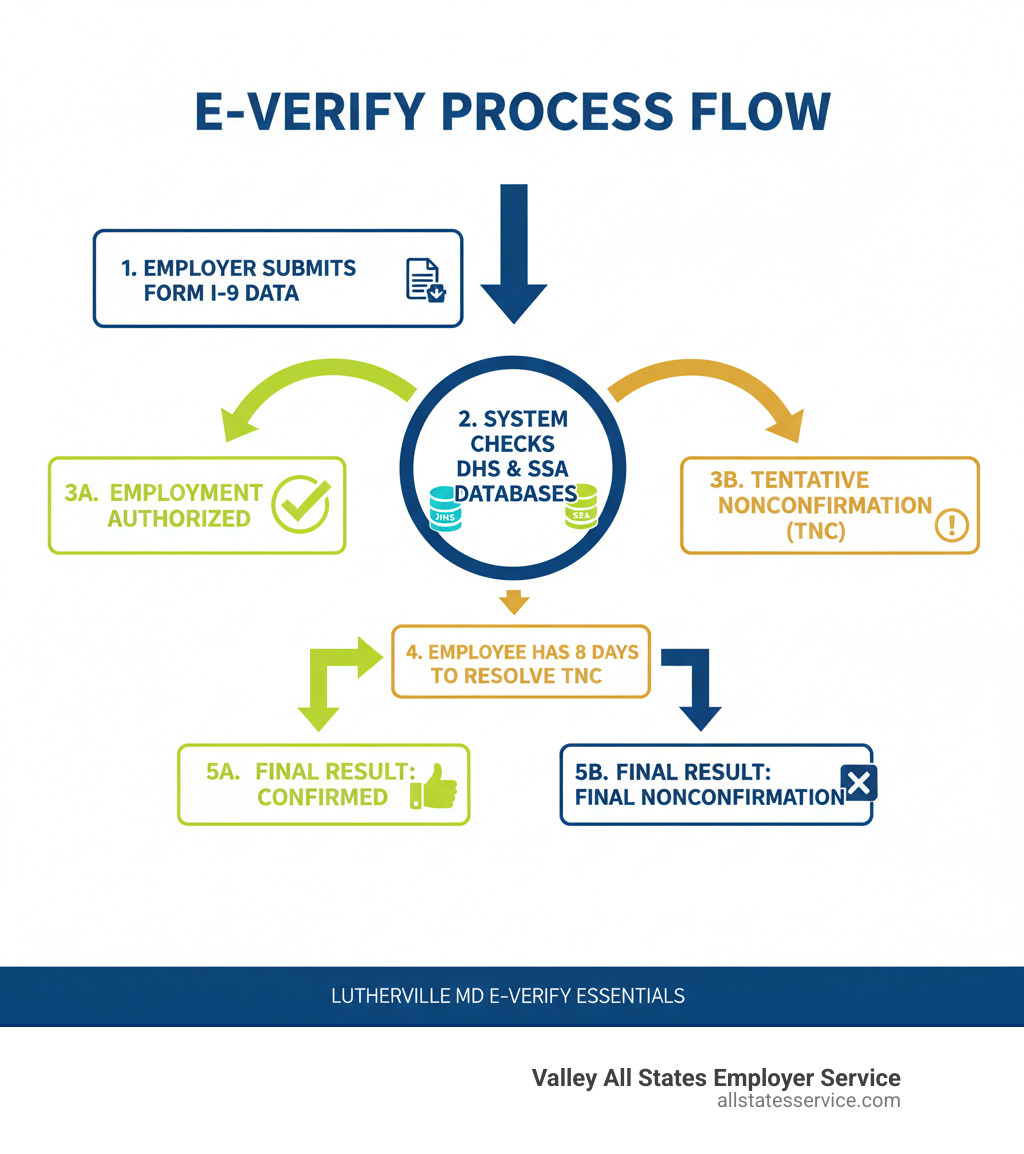
E-Verify is run jointly by the Department of Homeland Security (DHS) and the Social Security Administration (SSA). These two agencies work together to provide a system that cross-checks the information you collect on Form I-9 against their massive government databases. When everything matches up, you get peace of mind. When it doesn’t, you get clear next steps.
For E-Verify Lutherville MD employers, understanding this system isn’t just about checking a compliance box. It’s about protecting your business and building a workforce you can count on. The system integrates directly with Form I-9, the employment eligibility verification form you’re already required to complete for every new hire. Want to explore the fundamentals in more depth? Check out our guide on What is E-Verify, or visit the official E-Verify program website for government resources.

How the Verification Process Works
Here’s how the process actually unfolds in your Lutherville office. You hire someone new, and within three business days of their first day on the job, you complete Form I-9 with them. They show you their documents, you verify they look genuine, and you fill out the form together. So far, this is standard procedure you’d follow whether or not you use E-Verify.
The E-Verify step comes next. You log into the system and enter the I-9 data you just collected. The system takes that information and runs it through government databases maintained by DHS and SSA. Most of the time, within seconds, you’ll see an “Employment Authorized” result. That’s it. Your employee is verified, and you can move on with onboarding.
But sometimes you’ll get a different result: a Tentative Nonconfirmation, or TNC. Don’t panic when this happens. A TNC simply means there’s a mismatch between what you submitted and what’s in the government records. Maybe the employee’s name changed after marriage, or there’s a typo in the Social Security database. A TNC is not a final decision that someone can’t work.
When you receive a TNC, you must notify the employee right away and give them a Further Action Notice. They then have eight federal business days to contact DHS or SSA and sort out the discrepancy. During this time, you cannot fire, suspend, or take any negative action against them based solely on the TNC. They’re working through the employee resolution process, and the law protects them while they do. For more details on how E-Verify and Form I-9 work together, take a look at our article on E-Verify and I-9.
The Role of DHS and SSA
Behind the scenes, E-Verify relies on a powerful partnership between two federal heavyweights: the Department of Homeland Security and the Social Security Administration. Each agency brings its own piece of the puzzle.
DHS maintains immigration records for everyone who isn’t a U.S. citizen. This includes green card holders, people with work visas, and anyone holding an Employment Authorization Document (EAD). When you submit an E-Verify case for a non-citizen employee, the system checks their immigration status and work authorization against DHS records.
Meanwhile, SSA handles identity records, primarily for U.S. citizens. They verify that the Social Security number your employee provided actually belongs to them and matches their name and date of birth. This database collaboration is what makes E-Verify work. One agency confirms identity, the other confirms work authorization, and together they give you a complete picture.
When a TNC pops up, these agencies also provide TNC resolution support. If the issue is with Social Security records, the employee contacts SSA. If it’s an immigration record problem, they reach out to DHS. Both agencies have dedicated processes to help employees correct errors and update their information. The system operation depends on this back-and-forth, and it’s designed to protect both employers and workers.
Understanding how DHS and SSA work together gives you confidence in the results E-Verify provides. For a deeper look at the federal framework behind all this, explore our Federal E-Verify Program Complete Guide.
E-Verify Lutherville MD: Understanding Your Legal Obligations
If you’re running a business in Lutherville, MD, you’ve probably heard whispers about E-Verify in break rooms or at Chamber of Commerce meetings. But here’s the thing: while employment law can feel like a maze of regulations that keeps growing more complicated, your E-Verify Lutherville MD obligations are actually more straightforward than you might think.
Maryland takes a different approach than many other states. Unlike Arizona or South Carolina, which require every employer to use E-Verify, Maryland doesn’t have a blanket mandate. For most private businesses in Lutherville, participation is entirely voluntary. You can choose to use E-Verify as a best practice, but you’re not legally required to do so.
However, there’s one major exception that could change everything for your business: federal contractors and subcontractors. If your company holds a federal contract that includes the Federal Acquisition Regulation (FAR) E-Verify clause, then E-Verify becomes mandatory. You’ll need to verify employment eligibility for all new hires and, in many cases, existing employees working on those federal contracts. This isn’t a suggestion or a recommendation. It’s a legal requirement that comes with serious teeth.
Even if you’re voluntarily enrolled in E-Verify, you still need to follow all the proper procedures. The government doesn’t give you credit for good intentions if you’re not following the rules correctly. That’s where our Maryland Employment Law Compliance Guide becomes invaluable. And if you’re worried about what happens during an audit, our I-9 Audit Penalties Complete Guide walks through the potential consequences in plain English.

Who is Required to Use E-Verify in Maryland?
Let’s cut through the confusion and get specific about who actually needs to use E-Verify in Lutherville. The short answer? It depends on your relationship with the federal government.
Federal contractors and subcontractors are the primary group that must use E-Verify in Maryland. If your company has a federal contract containing the FAR E-Verify clause, you’re required to verify all new hires. Often, you’ll also need to verify existing employees assigned to work on that federal contract. This ensures that taxpayer dollars aren’t going toward employing unauthorized workers.
For everyone else, E-Verify is a choice, not a mandate. This puts Maryland in a different category than states with universal requirements. Think of it this way: in Arizona, Mississippi, and Rhode Island, every employer uses E-Verify, period. In Colorado, Georgia, and Utah, public employers and those with state contracts must participate. Maryland keeps it simpler. If you’re not working with federal contracts, you get to decide whether E-Verify makes sense for your business.
Many Lutherville employers choose to participate anyway. Why? Because it offers a good faith defense against allegations of knowingly hiring unauthorized workers, and it can streamline your overall I-9 compliance efforts. If you’re trying to figure out whether your business falls into the required category, check out What Employers Are Required to Use E-Verify. And if you’re definitely a federal contractor, our E-Verify Supplemental Guide for Federal Contractors will become your new best friend.
Consequences of Non-Compliance
Here’s where things get real. Ignoring E-Verify requirements, whether you’re mandated to use it or you’ve voluntarily enrolled, can create problems that ripple through every corner of your business.
Let’s start with the financial hit. Fines for I-9 errors can add up fast. Since E-Verify builds directly on the I-9 process, mistakes in either system can trigger penalties. These fines vary depending on how many violations you have and whether they appear to be pattern violations, but they’re substantial enough to hurt.
For federal contractors, the stakes are even higher. Non-compliance can result in debarment from federal contracts. Imagine losing your ability to bid on or win federal work, possibly for years. That’s not just losing one contract. It’s potentially losing an entire revenue stream that might be keeping your doors open.
In serious cases, particularly when there’s evidence that an employer knowingly hired unauthorized workers, you could face criminal penalties. We’re talking about potential jail time for company officers, not just fines.
Beyond the legal and financial consequences, there’s something equally damaging: reputational harm. News of an immigration raid or a high-profile compliance lawsuit spreads quickly in a community like Lutherville. Your customers start asking questions. Your employees get nervous. Potential hires think twice about applying. The damage to your reputation can outlast any fine you pay and can be incredibly difficult to repair.
Finally, once you’re on the radar, expect increased scrutiny from federal agencies. One audit often leads to more audits. One investigation can trigger reviews of other aspects of your business. To understand what you might face during an immigration audit, take a look at our detailed breakdown of the ICE I-9 Audit process. Being prepared isn’t paranoia. It’s smart business.
The Pros, Cons, and Best Practices of Using E-Verify
Deciding whether to use E-Verify, especially when it’s not universally mandated in Maryland, involves weighing its advantages against its potential drawbacks. Like any powerful tool, E-Verify Lutherville MD employers should understand that the system comes with its own set of benefits and challenges. Let’s explore them honestly.
On the positive side, E-Verify offers significant advantages. It provides a good faith defense against knowingly hiring unauthorized workers, which can be a game-changer if Immigration and Customs Enforcement (ICE) comes knocking. You’ll also reduce the risk of unauthorized employment in your workforce, which protects your business from fines and legal headaches. The system generally improves your overall I-9 compliance by forcing you to be more systematic about the verification process. Plus, enrolled employers get access to the photo matching tool, which helps you compare the photo on certain documents to the one in government databases.
However, there are real drawbacks to consider. The system’s accuracy rate hovers around 94-97%, which sounds impressive until you realize that 3-6% of cases may generate errors. These errors often manifest as Tentative Nonconfirmations (TNCs), which require time and effort to resolve. There’s also the very real concern about discrimination. Advocacy groups have long warned that E-Verify can lead to unfair treatment of foreign-born workers or employees who “look” or “sound” foreign. Some employers, either out of fear or misunderstanding, may treat employees with TNCs differently, which violates federal law.
The system also depends on the accuracy of government databases, which aren’t perfect. Name changes from marriage or divorce, typos in Social Security records, or outdated immigration information can all trigger false TNCs. For a more detailed look at what works well, check out our guide on Benefits of E-Verify. And if you’re ready to implement it the right way, our E-Verify Best Practices resource is essential reading.
Benefits for Lutherville Employers
For businesses in Lutherville, MD, the benefits of E-Verify can be particularly compelling. First and foremost is the good faith defense. If you use E-Verify in good faith and follow all the rules, you gain a rebuttable presumption that you didn’t knowingly hire unauthorized workers. This legal protection can be invaluable during an ICE audit or investigation.
You’ll also see a reduction in unauthorized employment. While no system is perfect, E-Verify significantly decreases the likelihood that you’ll inadvertently hire someone without work authorization. This protects your business from the substantial fines and penalties that come with I-9 violations.
Another major benefit is improved I-9 compliance overall. When you enroll in E-Verify, you’re committing to a more rigorous process. This discipline often spills over into better record-keeping, more careful document examination, and a stronger compliance culture within your HR department. You’re not just checking a box; you’re building a system that protects your business.
Finally, there’s the photo matching tool. For documents that include photos, such as Permanent Resident Cards, Employment Authorization Documents, and U.S. passports, E-Verify allows you to compare the photo on the physical document to the photo in DHS or State Department records. This adds an extra layer of verification that can catch fraudulent documents. Small businesses, in particular, can benefit from this added security. For more insights custom to smaller operations, explore our guide on E-Verify for Small Businesses.
Challenges and How to Mitigate Them
Let’s be real about the challenges. The Tentative Nonconfirmation (TNC) process is the biggest headache for most employers using E-Verify Lutherville MD. A TNC doesn’t mean your employee isn’t authorized to work; it just means there’s a mismatch somewhere in the government’s records. However, TNCs disproportionately affect foreign-born workers and employees who have recently changed their names. Studies show that naturalized citizens and lawful permanent residents are more likely to receive TNCs than native-born citizens.
When a TNC is issued, you must notify the employee promptly and give them the Further Action Notice. The employee then has eight federal business days to contact DHS or SSA to resolve the discrepancy. During this time, you cannot take any adverse action against them. You can’t fire them, suspend them, or delay their training. This waiting period can be frustrating, especially if you’re trying to staff a project quickly.
Database errors are another real concern. The SSA and DHS databases, while extensive, are not infallible. A simple typo when a Social Security card was issued decades ago can trigger a TNC today. Name changes due to marriage, divorce, or court order may not be immediately reflected in the system. Immigration records can be outdated, especially for individuals who recently adjusted their status.
There’s also the issue of employee rights. Federal law is very clear: you cannot use E-Verify to discriminate or to take adverse action based solely on a TNC. Yet, some employers, either through ignorance or intent, treat employees with TNCs differently. This can lead to discrimination lawsuits and penalties from the Department of Justice’s Civil Rights Division.
How do you mitigate these challenges? First, train your HR staff thoroughly. Make sure everyone who touches E-Verify understands the TNC process, the timelines, and the anti-discrimination rules. Second, communicate clearly with employees. When a TNC is issued, explain what it means and what the employee needs to do. Reassure them that it’s not a firing offense and that you’re committed to working through the process. Third, document everything. Keep detailed records of when you received the TNC, when you notified the employee, and what steps were taken to resolve it. For a comprehensive look at handling TNCs, read our article on E-Verify Tentative Nonconfirmation.