
E-Verify Supplemental Guide for Federal Contractors 1st
Why Federal Contractors Must Master E-Verify Compliance
The e verify supplemental guide for federal contractors is a critical USCIS document outlining how to comply with the E-Verify Federal Contractor Rule. If you hold a federal contract, the stakes are high. The Federal Acquisition Regulation (FAR) E-Verify rule requires you to electronically verify employment eligibility, reinforcing the government’s policy of working only with companies that maintain a legal workforce.
Here’s a quick overview of the guide:
- Official Source: Get it from the USCIS E-Verify website.
- Who Needs It: Federal contractors whose contracts include the FAR E-Verify clause.
- What It Covers: Enrollment, verifying new and existing employees, exemptions, and subcontractor rules.
- Key Deadlines: 30 days to enroll, 90 days to verify employees on a new contract.
- Critical Info: Form I-9 rules, Photo Matching, and handling Tentative Nonconfirmations.
Compliance is uniquely complex for federal contractors. You must often verify existing employees, manage exemptions, oversee subcontractors, and meet strict timelines. A single misstep can lead to penalties, back pay, or even loss of E-Verify access.
This is why the E-Verify Supplemental Guide for Federal Contractors is so essential. It’s the official roadmap for avoiding costly mistakes. We’ll break down the guide into clear, actionable steps to help you confidently manage your E-Verify obligations.
What is the E-Verify Federal Contractor Rule?
The E-Verify Federal Contractor Rule stems from a Federal Acquisition Regulation (FAR) final rule that enacted Executive Order 12989. The order established a clear policy: federal agencies should only do business with contractors who have a legally authorized workforce. To enforce this, the government requires contractors to use E-Verify, the online system that checks employment eligibility against federal databases.
Effective September 8, 2009, any federal contract containing the FAR E-Verify clause requires you to verify employees assigned to that contract. Importantly, if your contract lacks this clause, you are prohibited from using E-Verify on existing employees under that specific contract. This detail is a common point of confusion.
For more on the legal framework, see our guide on Federal E-Verify Rules.
Who is Affected by the Rule?
The rule applies based on specific contract thresholds. You are likely covered if you are a:
- Prime contractor with a contract awarded after September 8, 2009, lasting at least 120 days, valued over $150,000, and performed in the U.S.
- Subcontractor for services or construction with a subcontract valued over $3,500.
The key trigger is the presence of the FAR E-Verify clause in your contract documents. If you’re unsure whether it applies, your government contracting official has the final say, not the E-Verify program.
For a broader look at E-Verify requirements, visit What Employers Are Required to Use E-Verify.
Understanding the E-Verify Supplemental Guide for Federal Contractors
To simplify this complex process, USCIS created the E-Verify Supplemental Guide for Federal Contractors. This practical, step-by-step resource is designed to make compliance manageable.
The guide clarifies the Federal Contractor Rule and covers essential topics like:
- Enrollment procedures for federal contractors.
- Verification processes for both new and existing employees.
- Rules for completing a new Form I-9 for a current employee.
- Photo Matching requirements and handling Tentative Nonconfirmations.
- Employee and contract exemptions.
You can access the official guide on the USCIS E-Verify website. It’s your go-to source for accurate information to stay compliant.
Key Requirements and Deadlines for Federal Contractors
Once your contract includes the FAR E-Verify clause, the clock starts ticking. Understanding and meeting your deadlines is crucial for compliance. Here are the key timelines you must follow.
Enrollment and Designation
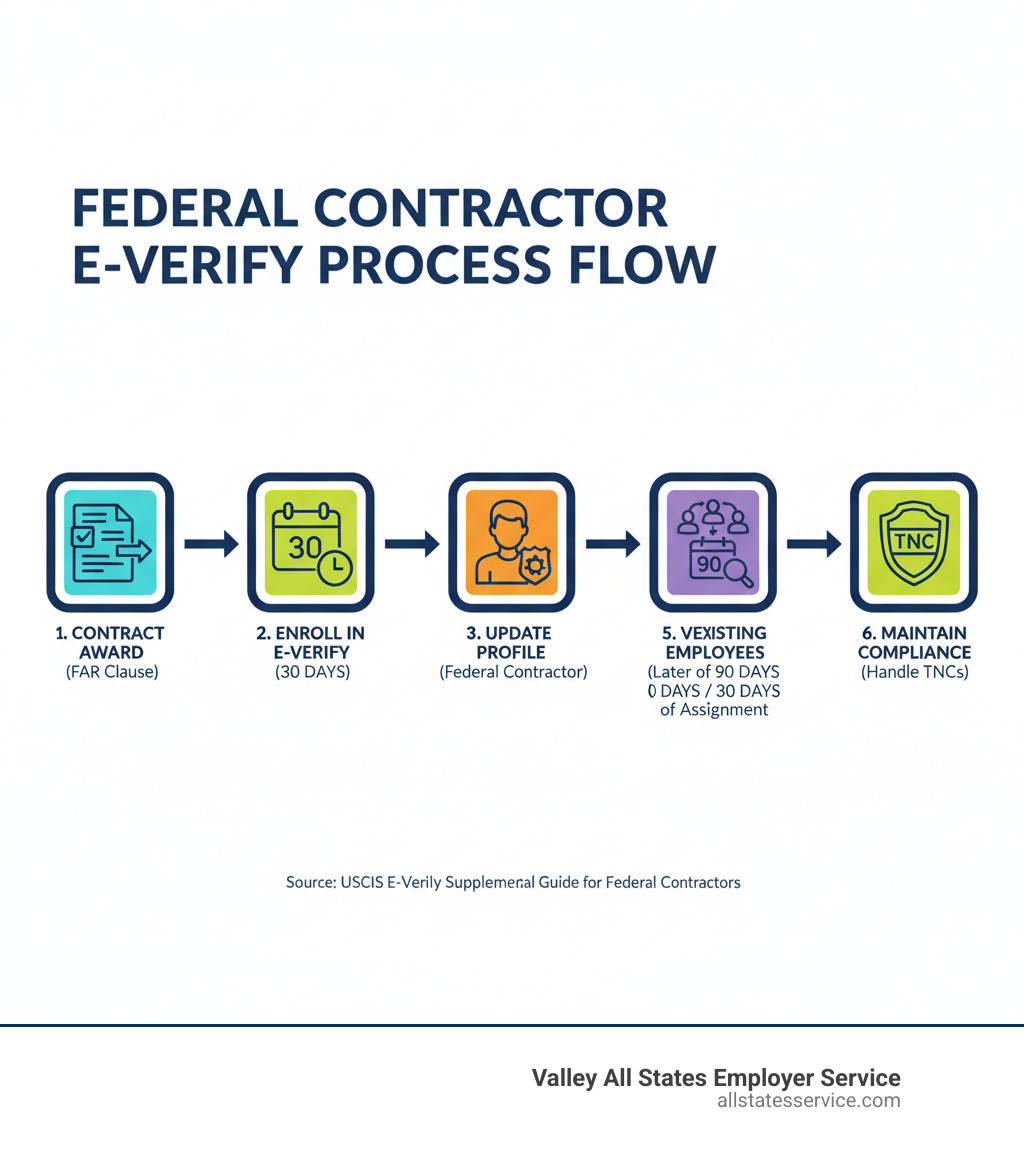
Your first step is enrolling in E-Verify. You have 30 calendar days from the contract award date to do so.
If you’re already enrolled in E-Verify, you must update your company profile to ‘Federal Contractor with FAR E-Verify Clause’ within the same 30-day window. This change open ups features needed for federal contractor compliance, like verifying existing employees.
After enrolling or updating, you must provide proof to your contracting officer (or prime contractor if you’re a subcontractor). A screenshot of your ‘Maintain Company’ page in E-Verify is sufficient documentation.
For a complete overview of your duties, see our E-Verify Employer Requirements page.
Verification Timelines
The e verify supplemental guide for federal contractors details specific timelines for verifying your workforce.
- New Hires: You must create an E-Verify case within three business days of their start date. Federal contractors have a 90-day grace period from enrollment to begin this process.
- Existing Employees: You must verify existing employees assigned to a covered contract. Cases must be created within 90 calendar days of enrollment or within 30 calendar days of the employee’s assignment to the contract, whichever is later. This 30-day assignment rule is critical to track.
- Entire Workforce (Optional): You can choose to verify all existing, non-exempt employees. If you select this option, you have 180 calendar days from enrollment to create all cases. This policy must be applied uniformly across your organization to avoid discrimination claims.
These deadlines are mandatory. Our E-Verify Onboarding Process guide can help you manage these timelines effectively.
The E-Verify Supplemental Guide for Federal Contractors: Step-by-Step Verification
The e verify supplemental guide for federal contractors provides a detailed walkthrough of the verification process. E-Verify compares Form I-9 information with government records to confirm employment eligibility. While the general process is standard, federal contractors face extra requirements for documents, photo matching, and verifying existing employees.
Understanding the interplay between E-Verify and Form I-9 is crucial. Our E-Verify and I-9 guide offers more insight.
Verifying New Hires
For every new hire, you must complete Form I-9 within three business days of their start date. Then, you must create an E-Verify case no later than the third business day after their first day of employment.
Federal contractors have two additional rules:
- Photo on List B Documents: If a new hire presents a List B identity document (like a driver’s license), it must contain a photograph, unless a religious objection is stated. This is stricter than general I-9 rules.
- Document Retention for Photo Matching: You must copy and retain any U.S. Passport, Passport Card, Permanent Resident Card (Form I-551), or Employment Authorization Document (Form I-766) an employee presents. You will need this copy to compare with the photo displayed during the E-Verify Photo Matching step.
Ensure the data you enter into E-Verify exactly matches the Form I-9 to avoid errors. Learn more at our New Hire Eligibility page.
Verifying Existing Employees: A Key Focus of the E-Verify Supplemental Guide for Federal Contractors
Verifying existing employees is a unique and complex requirement for federal contractors. The e verify supplemental guide for federal contractors provides detailed instructions for this process.
First, decide your approach. You can either verify only existing employees assigned to the contract or verify your entire non-exempt workforce. If you choose the latter, you must apply the policy consistently to avoid discrimination.
Next, you need a valid Form I-9 for each employee being verified. The supplemental guide clarifies when to update an old form versus completing a new one.
- Update an existing Form I-9 if it is complete and accurate, but minor information (like a name change or new alien registration number) needs to be added.
- Complete a new Form I-9 if the employee’s previous documents are expired, their original List B document lacked a photo, or their old I-9 is missing key information. Many employers complete new Forms I-9 for all existing employees to ensure consistency and accuracy.
In most cases, an expired document requires a new Form I-9 with current, valid documentation before you can create an E-Verify case. For more guidance on this challenge, visit our E-Verify for Existing Employees resource.
Navigating Exemptions, Exceptions, and Subcontractor Rules
Not every contract or employee falls under the E-Verify rule. The e verify supplemental guide for federal contractors details important exemptions that can save you time and resources by helping you focus your verification efforts where they are required.
Exemptions for Contracts and Employees
Certain contracts are exempt from E-Verify requirements, including those:
- Valued at $150,000 or less.
- Lasting fewer than 120 days.
- Performed entirely outside the United States.
- Involving only commercially available off-the-shelf (COTS) items.
Even on a covered contract, some employees are exempt from verification, such as those:
- Hired on or before November 6, 1986 (with continuous employment).
- Who hold an active security clearance (confidential, secret, or top secret).
- Who have an HSPD-12 credential (like a PIV card).
- Who were previously verified in E-Verify and remain with the same employer.
- Who perform support work with no substantial duties on the contract.
For more guidance, visit our E-Verify for Contractors page.
Special Rules for Certain Organizations
Institutions of higher education, state and local governments, and governments of federally recognized Indian tribes have a more limited scope. They are only required to verify new hires and existing employees who are working directly on a covered federal contract.
Prime Contractor and Subcontractor Obligations
The E-Verify rule flows down the supply chain. As a prime contractor, you must include the FAR E-Verify Clause 52.222-54 in any subcontract for services or construction valued at more than $3,500.
While you don’t verify your subcontractor’s employees, you are responsible for general oversight. If you knowingly work with a non-compliant subcontractor, you can face penalties. To ensure compliance, require subcontractors to provide proof of their E-Verify enrollment.
Independent contractors are generally not considered employees and are not verified through E-Verify. However, if they function as a subcontractor with their own employees, the rule applies to them. Our guide on HR Compliance for Small Business can help steer these relationships.
Ensuring Compliance and Finding Support
The stakes for E-Verify compliance are high. Getting it wrong can lead to serious consequences for your business, your employees, and your ability to secure future federal contracts.
Non-Compliance Consequences
Failing to comply with the E-Verify rule can result in:
- Civil penalties and substantial fines.
- Loss of E-Verify access, blocking you from federal contracts.
- Back pay obligations if you take adverse action against an employee during a TNC.
- Contract termination for persistent non-compliance.
- Anti-discrimination violations and lawsuits.
Understanding HR Regulatory Compliance is essential for protecting your business.
Handling Tentative Nonconfirmations (TNCs)
A Tentative Nonconfirmation (TNC) occurs when Form I-9 data doesn’t match government records. It is not a final determination of ineligibility; it is a mismatch that requires resolution.
When a TNC occurs, the employee has the right to contest it. During the resolution period, you are legally prohibited from taking any adverse action. This means you cannot fire, suspend, delay training, or otherwise penalize the employee. They must be allowed to continue working as normal. Violating this rule can lead to fines and discrimination lawsuits.
Most TNCs result from simple errors and are fixable. The key is to handle the process correctly and consistently. Our E-Verify Tentative Nonconfirmation guide provides a step-by-step walkthrough.
Official Resources and Help
You don’t have to steer this alone. Several official resources are available:
- E-Verify Contact Center: For technical and policy questions about the system.
- Handbook for Employers (M-274): The definitive guide for Form I-9 compliance.
- Immigrant and Employee Rights Section (IER): For questions about immigration-related employment discrimination. Visit them at DOJ IER.
- Equal Employment Opportunity Commission (EEOC): For broader employment discrimination issues. Visit them at EEOC.
Our team also offers expert assistance. Visit our E-Verify Customer Support page to connect with specialists who can lift the administrative burden from your shoulders.
Simplify Your Federal E-Verify Compliance
The e verify supplemental guide for federal contractors is an essential resource, but implementing its requirements can be complex. Juggling deadlines, Form I-9 rules, new and existing employee verifications, and subcontractor oversight demands meticulous attention to detail.
A single mistake can lead to audits, penalties, or even contract termination, jeopardizing your ability to secure future federal work. Protecting your business requires flawless execution, which consumes valuable time and resources.
This is where expert assistance is a strategic advantage. At Valley All States Employer Service, we specialize in outsourced E-Verify workforce eligibility verification for federal contractors. We live and breathe the e verify supplemental guide for federal contractors, staying current on every rule so you don’t have to.
Our team provides expert, impartial, and efficient E-Verify processing that minimizes errors and lifts the administrative burden from your HR staff. We handle the nuances of verifying existing employees, managing exemptions, and resolving TNCs with the precision federal contracts demand. Partner with us to gain a compliance ally dedicated to protecting your business.
Ready to reduce your compliance risks and reclaim your time? Let us handle the complexity.