E Verification USCIS: Simplify 2025 Compliance
Why E-Verification USCIS Matters for Every Employer
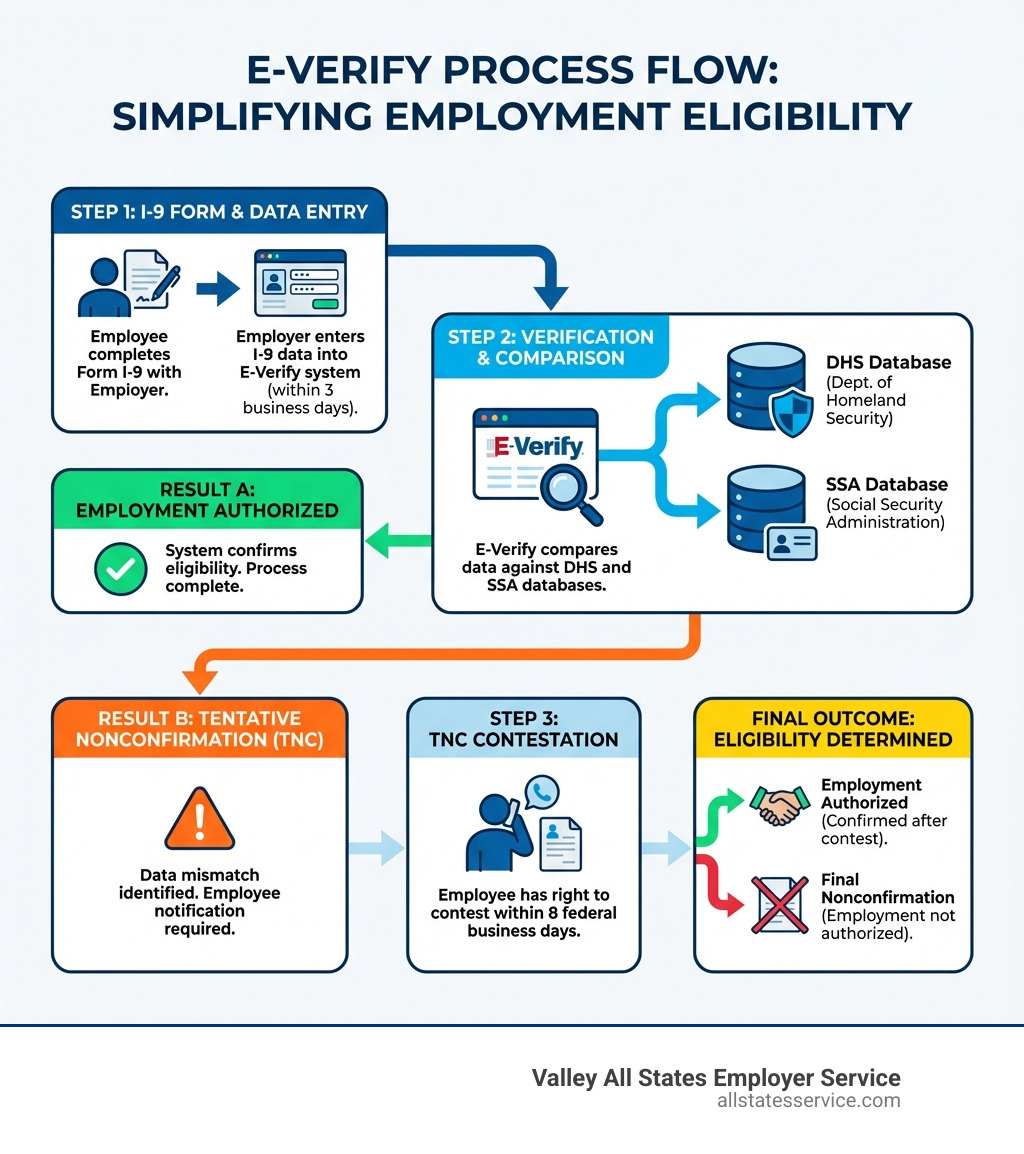
When you hear e verification USCIS, you are really hearing about E-Verify, a web-based system that confirms whether new hires are authorized to work in the United States. It does this by comparing information from Form I-9 against federal databases maintained by the Department of Homeland Security (DHS) and the Social Security Administration (SSA).
Quick Answer: What You Need to Know About E-Verification USCIS
- What it is: A free, voluntary federal program, mandatory for some employers, that verifies employment eligibility
- Who operates it: U.S. Citizenship and Immigration Services (USCIS), part of DHS
- How it works: After completing Form I-9, employers create an E-Verify case that checks employee information against government records
- Results: Employment Authorized, Tentative Nonconfirmation (TNC), or Final Nonconfirmation
- Who must use it: Federal contractors with FAR clauses, employers in certain states, and companies sponsoring STEM OPT students
- Cost: Free to all participating employers
When someone starts a new job in the United States, they must submit documents that prove both identity and work eligibility. Since 1986, Form I-9 has been the foundation of this process. A paper form alone, however, can leave gaps and room for errors.
E-Verify fills those gaps by adding an electronic layer of verification. It does not replace Form I-9, it supports it. For employers, this can mean fewer hiring mistakes and stronger compliance. For employees, it usually means faster confirmation of their right to work.
The challenge is that E-Verify rules keep changing. Federal contractors face different requirements than small businesses. Some states mandate E-Verify for all employers, while others do not require it at all. New features like E-Verify+ and remote inspection options add more moving parts to track.
As one HR manager put it in a recent compliance webinar, employers are facing increasing complexity in verifying workforce authorization. That complexity only grows when you factor in Tentative Nonconfirmations, records disposal deadlines, and potential system outages.
This guide is designed to cut through that confusion. You will see how E-Verify works, who must use it, what to do when cases do not match, and how to keep your process compliant in 2025 and beyond.
Essential e verification uscis terms:
What is E-Verify and How Does It Connect to Form I-9?
At its core, E-Verify is an Internet-based system that allows employers to electronically confirm the employment eligibility of their newly hired employees. It’s a critical tool in maintaining a legal workforce in the United States. Operated by U.S. Citizenship and Immigration Services (USCIS), part of the Department of Homeland Security (DHS), in partnership with the Social Security Administration (SSA), E-Verify provides a quick and efficient way to verify work authorization. You can learn more about What is E-Verify on our site.
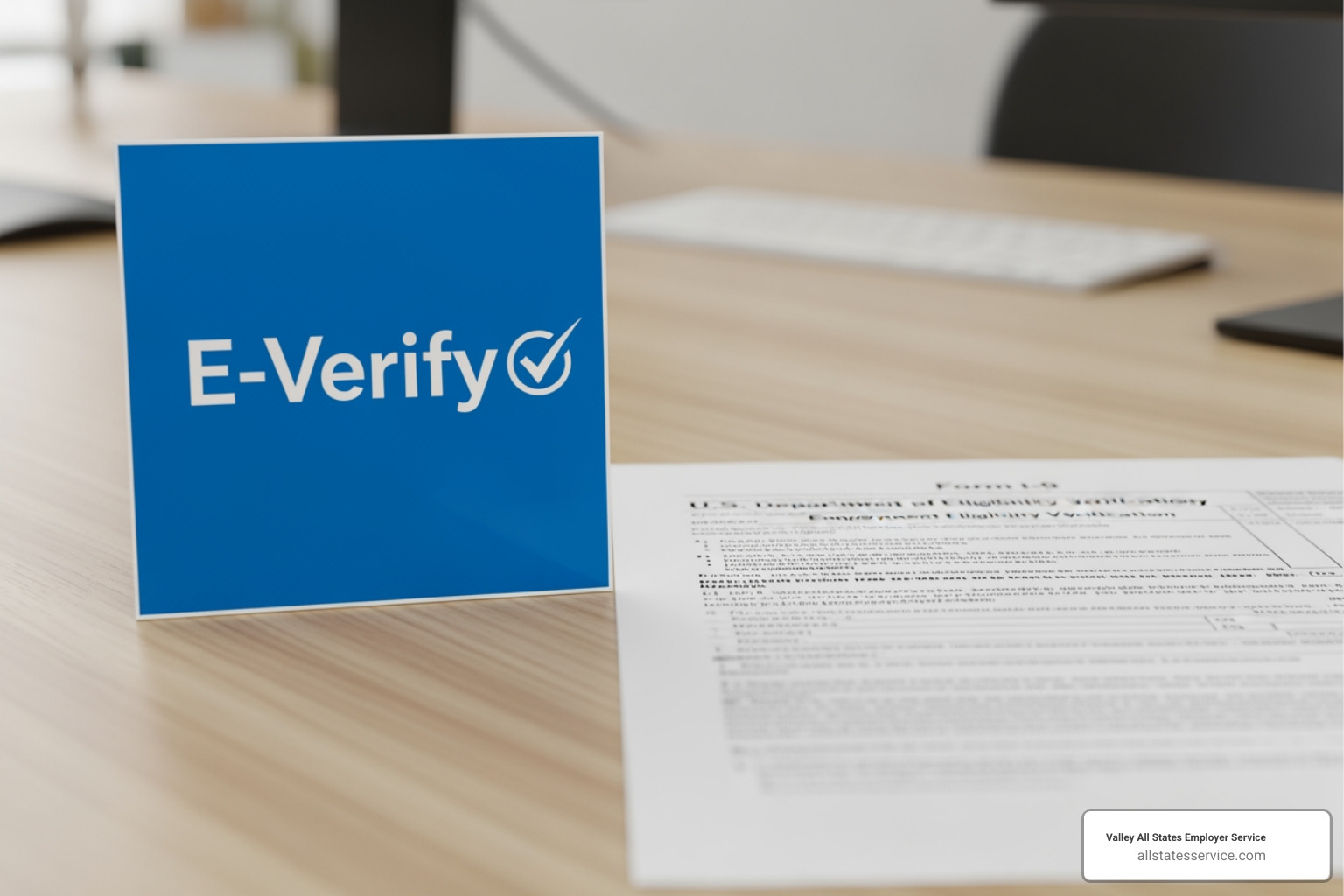
The foundation of employment eligibility verification in the U.S. remains the Form I-9. Since 1986, this form has been essential for employers to document that every new hire is authorized to work. E-Verify doesn’t replace Form I-9; instead, it acts as its electronic companion. Once an employee completes their Form I-9 and provides the necessary documents, the employer uses that information to create a case in the E-Verify system.
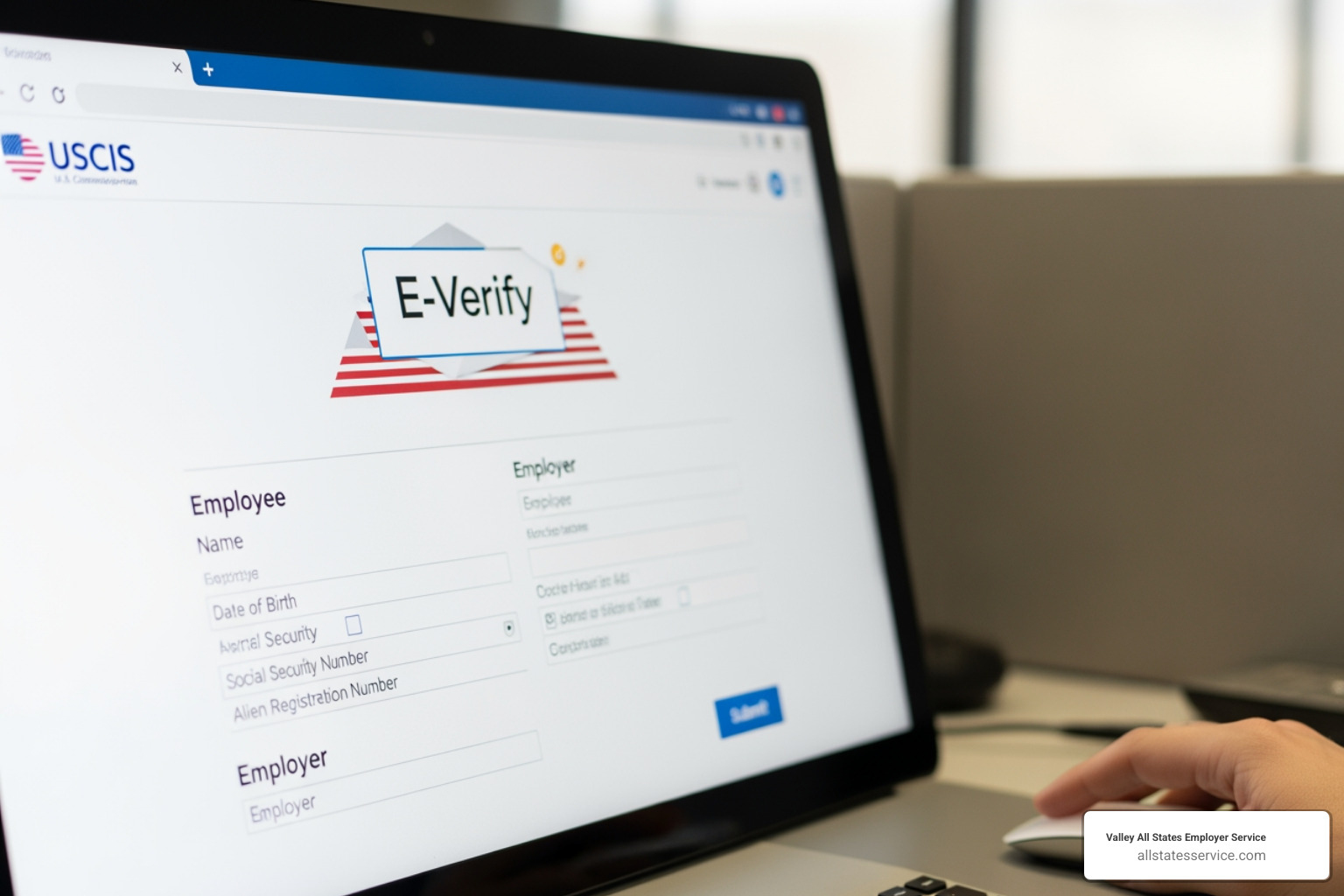
Here’s how the data comparison process works: The information from the employee’s Form I-9, such as their name, date of birth, and Social Security number, is submitted to E-Verify. The system then electronically compares this data against records held by the SSA and DHS. This cross-referencing quickly determines if the information matches and if the employee is authorized to work in the U.S.
One of the great benefits of E-Verify is that it’s a free federal program, available to participants in all 50 states, the District of Columbia, Puerto Rico, Guam, the U.S. Virgin Islands, and the Commonwealth of the Northern Mariana Islands. This accessibility makes it a powerful tool for employers nationwide. For a deeper dive into how these two crucial components work together, explore our guide on E-Verify and I-9.
Understanding E-Verify Case Results and Employee Rights
When you submit an E-Verify case, there are several possible outcomes, each with its own implications. Understanding these results and the rights associated with them is crucial for both employers and employees. You can track your E-Verify cases and their statuses through our E-Verify Case Status resources.
The most straightforward result is Employment Authorized. This means the employee’s information matched government records, and they are authorized to work. Employers can then close the case and proceed with confidence.
However, sometimes the system returns a Tentative Nonconfirmation (TNC). A TNC, also sometimes called a mismatch, indicates that the information entered into E-Verify does not immediately match government records. A TNC does not mean the employee is unauthorized to work. It simply means there’s a discrepancy that needs to be resolved. For more details on this, see our article on E-Verify Tentative Nonconfirmation.
As an employer, your responsibilities during a TNC are clear:
- You must notify the employee of the TNC and provide them with a “Further Action Notice” that explains the discrepancy and how to resolve it.
- You cannot take any adverse action against the employee, such as terminating them, reducing their hours, or delaying training, based solely on the TNC. This is often referred to as the “no adverse action rule.”
- You must give the employee the opportunity to contest the TNC within eight federal government working days.
Employees have significant rights during this process. They have the right to contest the TNC and contact the appropriate agency (DHS or SSA) to resolve the mismatch. They also have the right to continue working while they attempt to resolve the TNC. The USCIS Employee Rights Toolkit provides comprehensive information on these protections. If the employee successfully resolves the discrepancy, the E-Verify case will typically update to “Employment Authorized.”
If an employee chooses not to contest a TNC, or if they contest it but the discrepancy cannot be resolved, the case will result in a Final Nonconfirmation. This indicates that the employee is not authorized to work in the U.S. and, at that point, the employer may take appropriate employment actions, including termination.
Who Must Use E-Verify? Federal, State, and Special Requirements
While e verification USCIS is a powerful tool, whether an employer must use it varies significantly. For many private employers, participation is voluntary. However, for others, it’s a mandatory requirement. Understanding your obligations is key to compliance. To determine your specific requirements, we recommend reviewing our guide on What Employers Are Required to Use E-Verify?.
Federal Contractor Mandates (FAR Clause)
One of the most significant mandates for E-Verify comes from the federal government. If you are a federal contractor or subcontractor with a contract that contains the Federal Acquisition Regulation (FAR) E-Verify Clause, then participation is mandatory. This clause typically applies to contracts that exceed a certain threshold (currently $150,000) and have a performance period of 120 days or more.
For these federal contractors, the requirements go beyond just new hires. You are generally required to verify the employment eligibility of:
- All new hires, regardless of whether they are assigned to a federal contract.
- All existing employees (with some exceptions) who are directly performing work in the United States under a covered federal contract.
This dual requirement makes compliance more complex for federal contractors, necessitating careful tracking and adherence to specific E-Verify procedures. Our resources on E-Verify for Contractors and the E-Verify Supplemental Guide for Federal Contractors provide essential guidance for this group.
A Look at State-Specific E-Verify Laws
Beyond federal mandates, state-specific E-Verify laws create a patchwork of requirements across the country. While our home state of Maryland currently does not have a statewide mandate for all private employers, other states do. These state laws can vary widely, sometimes requiring E-Verify for:
- All employers within the state, often with criteria based on company size.
- Public employers (state, county, and municipal agencies).
- Public contractors as a condition of receiving state contracts or incentives.
For instance, in 2025, we’re seeing updates like those in Illinois. Effective January 1, 2025, Illinois improves its protections under the Right to Privacy in the Workplace Act details. While E-Verify remains voluntary for most employers in Illinois, those who choose to use it must notify employees about TNCs and provide instructions to contest findings. They also need to certify compliance with training and posting requirements.
It’s crucial for employers, especially those operating across state lines or considering expansion, to be aware of these varying mandates. Our comprehensive E-Verify State Requirements Guide 2025 provides detailed insights into these state-by-state differences and helps you steer your obligations wherever you operate within the United States.
Special Cases: STEM OPT Students and E-Verification USCIS Rules
Another important area where e verification USCIS becomes mandatory involves certain nonimmigrant students. Specifically, F-1 students who wish to participate in the STEM Optional Practical Training (OPT) extension must ensure their prospective employer is enrolled in the E-Verify program.
This means that if you’re an employer considering hiring an F-1 student for a STEM OPT extension, you must be an E-Verify participant. This requirement helps ensure that these students, who are critical to our innovation economy, are working for employers who are compliant with federal employment verification standards. Employers can find information on how to enroll in the program directly on the E-Verify program enrollment page. Even for E-Verify for Small Businesses, this specific requirement applies if you wish to sponsor STEM OPT students.
Key 2025 Updates and Modernizing Your E-Verification USCIS Process
The landscape of e verification USCIS is constantly evolving, with new regulations, system improvements, and critical deadlines emerging. Staying on top of these changes isn’t just good practice; it’s essential for maintaining compliance and avoiding potential penalties. Our I-9 E-Verify Compliance Guide offers valuable insights into navigating this dynamic environment.
Critical Deadline: E-Verify Records Disposal
One of the most pressing updates for employers in 2025 concerns E-Verify records retention. Starting January 6, 2025, USCIS will permanently delete E-Verify cases updated before December 31, 2014. This means any cases created and updated over a decade ago will be purged from the system.
Why does this matter to you? For audit preparedness. Employers are legally required to retain records related to employment eligibility verification. If you have E-Verify cases from before December 31, 2014, you must download your Historic Records Reports and pair them with the corresponding Forms I-9. Failing to do so could leave you vulnerable during an audit, as you won’t have the necessary documentation to demonstrate compliance. Don’t wait until it’s too late; review the E-Verify records disposal notice and take action now.
The Future is Here: E-Verify+ and Remote I-9 Inspection
Innovation is also shaping the future of e verification USCIS. We’re seeing the introduction of E-Verify+, designed to bring more innovation, protection, convenience, transparency, and efficiency to the employment eligibility verification process. While details are still emerging, E-Verify+ aims to modernize the system for today’s workplace, potentially offering streamlined onboarding experiences and improved data security.
Another significant development is the alternative procedures for examining Form I-9 documentation, particularly relevant for remote hiring. Effective August 1, 2023, DHS issued a final rule allowing the Secretary to authorize these alternative procedures. This means that employers enrolled in E-Verify can now conduct remote examination of I-9 documents, moving beyond the requirement for physical inspection. This is a game-changer for businesses with distributed or remote workforces, offering flexibility while maintaining compliance. For a comprehensive overview, consult our E-Verify Remote Hiring Complete Guide.
Staying Compliant During System Outages
Even the most robust systems can experience interruptions. System interruptions, such as those during federal government shutdowns, can temporarily suspend E-Verify operations and create unique challenges for employers. For example, during the extended shutdown in late 2018 and early 2019, E-Verify was unavailable for over a month. Employers who hired staff during this period could not create cases.
Once the system was restored, USCIS provided a grace period for employers to catch up, instructing them to select “Other” as the reason for the delay and enter “E-Verify not available” in the comment field. The key takeaway here is the importance of documenting everything. If E-Verify is unavailable, continue to complete Form I-9, save supporting documents, and clearly record the reasons for any delays in creating E-Verify cases. USCIS provides specific Guidance for emergencies and unforeseen circumstances to help employers steer these situations. Proactive documentation and a swift response once the system is back online are paramount.
Empowering Your Team with myE-Verify and Best Practices
While much of the focus on e verification USCIS is on employer compliance, there are also powerful tools and best practices that empower employees and streamline the overall verification process. Understanding these can lead to a smoother, more transparent experience for everyone involved. Exploring the Benefits of E-Verify can show you how.
What is myE-Verify?
myE-Verify is a free, online portal designed for individuals, allowing them to take an active role in managing their employment eligibility information. It’s an official website of the U.S. Department of Homeland Security and the Social Security Administration, emphasizing its reliability and security. You can access it directly at the myE-Verify portal.
myE-Verify offers several key features for individuals:
- Self-Check: This feature allows individuals to proactively confirm that their government records are accurate. By using Self-Check, you can verify your employment eligibility status before even applying for a job, and learn how to make updates if a mismatch occurs.
- Self-Lock: A powerful tool for identity protection, Self-Lock enables individuals to lock their Social Security number (SSN) in the E-Verify system. This helps protect against employment-related identity fraud by preventing unauthorized use of your SSN in E-Verify.
- Case Tracker: For employees whose employers have initiated an E-Verify case, the Case Tracker allows them to view their E-Verify case history, track open cases, and even upload necessary documents if a TNC occurs. This transparency empowers employees to participate directly in resolving any issues.
These features provide individuals with greater control and insight into their employment eligibility, promoting accuracy and protecting against fraud.
Employer Best Practices for Smooth Verification
For employers, navigating the complexities of e verification USCIS requires more than just knowing the rules; it demands strategic implementation and ongoing vigilance. Here are some best practices to ensure a smooth verification process:
- Comprehensive Staff Training: Regularly train your HR personnel and anyone involved in the hiring process on E-Verify procedures, employee rights, and anti-discrimination policies. This includes understanding state-specific laws, like those in Maryland, and how to properly handle TNCs. Our E-Verify Best Practices guide offers further insights.
- Consistent Application: Apply E-Verify consistently to all new hires, or all employees as required by federal or state mandates. Selective use can lead to accusations of discrimination.
- Avoid Discrimination: E-Verify must never be used to discriminate against employees based on their national origin, citizenship status, or any other protected characteristic. Employers cannot pre-screen job applicants using E-Verify or terminate an employee solely because they received a TNC.
- Accurate Data Entry: The most common reason for TNCs is simple data entry errors. Double-check all information from Form I-9 before submitting an E-Verify case.
- Leverage Technology and Expertise: Consider utilizing platforms that integrate with E-Verify to streamline the process, reduce errors, and maintain diligent records. For many businesses, partnering with an E-Verify Employer Agent like Valley All States Employer Service can be invaluable. We act as your trusted third-party administrator, ensuring expert, impartial, and efficient processing, minimizing your administrative burden and maximizing compliance.
Conclusion: Simplify Your E-Verify Compliance
The world of e verification USCIS is dynamic and essential for any employer in the United States. From understanding the intricate dance between Form I-9 and E-Verify to navigating federal and state mandates, and keeping up with 2025 updates like records disposal and E-Verify+, the task can seem daunting. We’ve explored the critical aspects, from employee rights during a TNC to the powerful tools available through myE-Verify, all designed to ensure a legal and compliant workforce.
The complexity of these requirements, especially for businesses operating across multiple states or those with specific federal contracts, underscores the need for expert guidance. Our mission is to simplify this process for you. By leveraging our expertise, you can ensure your employment verification procedures are not just compliant, but also efficient and seamless.
Ready to streamline your E-Verify process and ensure your business stays ahead of regulatory changes? Streamline your E-Verify process with Valley All States Employer Service today. We’re here to help you steer the complexities, minimize risks, and focus on what you do best: building your business.