Automated eligibility verification system aevs: 2 Essential
The Critical Role of Verification in Today’s World
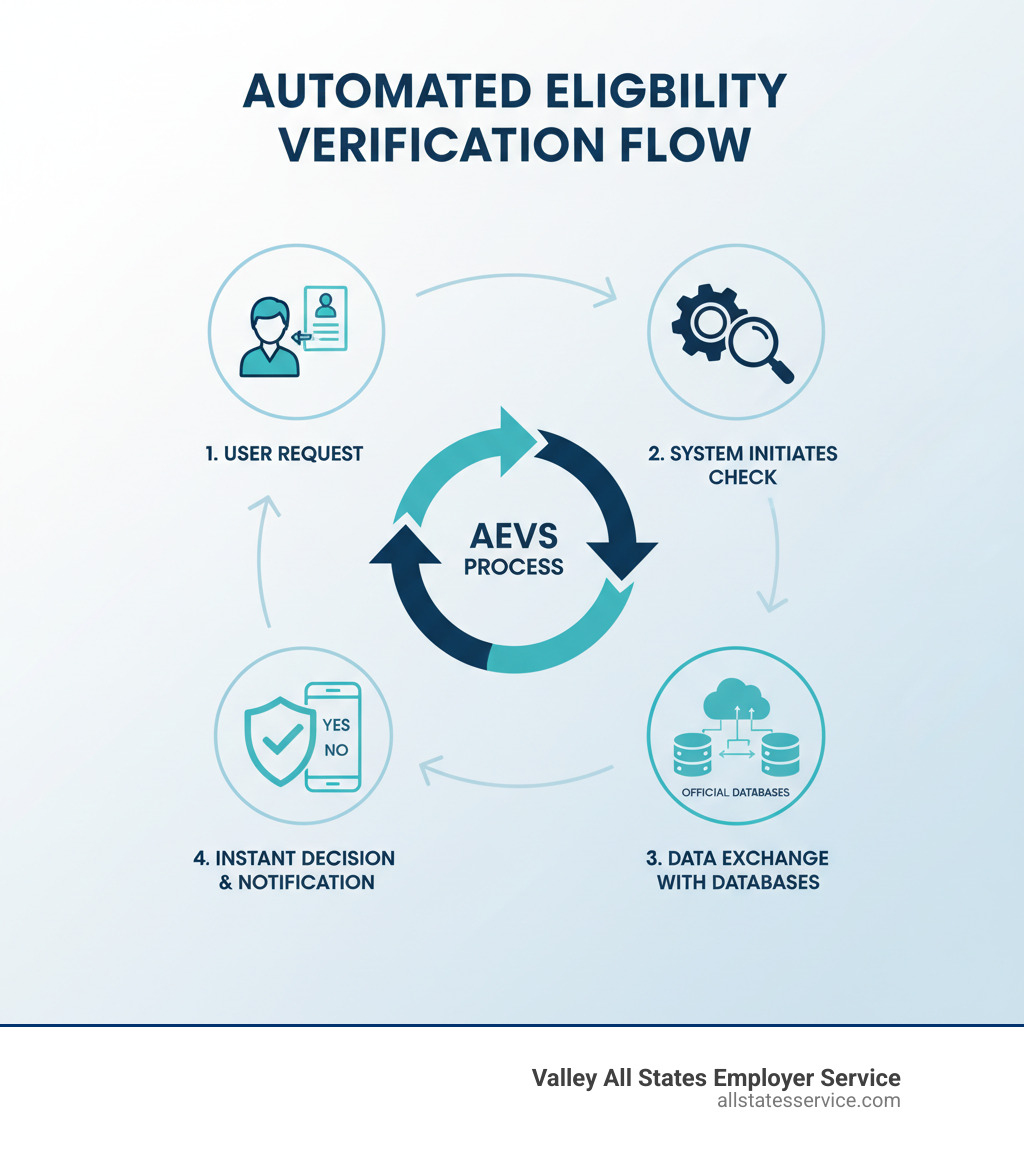
An automated eligibility verification system (AEVS) is a powerful tool that checks if someone meets the requirements for a service, benefit, or job. It connects to official databases to give you fast, accurate answers. This helps businesses and organizations avoid errors, save time, and stay compliant with important rules.
- What is it? An electronic system that automatically confirms eligibility.
- Primary Purpose: Reduces manual verification, improves accuracy, and ensures compliance.
- How it Works: Connects to government and other official databases for quick information retrieval.
- Key Applications:
- Healthcare: Verifies patient insurance, program eligibility (like Medi-Cal), and out-of-pocket costs.
- Employment: Confirms a new hire’s legal right to work in the United States (like E-Verify).
In today’s world, navigating the complexities of compliance and eligibility can feel like a maze. That’s where an automated eligibility verification system (AEVS) steps in. It’s a powerful tool designed to cut through red tape. It ensures that individuals meet necessary criteria for services, benefits, or employment.
For busy HR managers and healthcare providers, manual checks mean wasted time and increased risk. Errors can lead to penalties and significant financial losses. An AEVS streamlines these critical checks. It brings accuracy, efficiency, and peace of mind to your daily operations.
While the term “AEVS” covers various applications, it’s most commonly discussed in two key areas. These are verifying eligibility in healthcare programs and confirming employment authorization. Understanding how these systems work is crucial for any organization aiming for smooth, compliant operations.
What is an Automated Eligibility Verification System (AEVS)?
Think of an automated eligibility verification system (AEVS) as your organization’s always-on fact-checker. It’s a sophisticated digital platform that confirms whether someone qualifies for a specific program, benefit, or status, and it does this in seconds rather than hours or days.
The primary purpose? To free you from the tedious, error-prone world of manual verification. Instead of sorting through paper trails and making endless phone calls, an AEVS handles the heavy lifting automatically. This core function means you can make confident, informed decisions quickly, without second-guessing whether you’ve missed something important.
For public assistance agencies and healthcare providers, the benefits are game-changing. Efficiency skyrockets because the system eliminates mountains of paperwork and reduces the administrative burden that typically slows everything down. Accuracy improves dramatically since the system pulls information directly from authoritative databases, cutting out the human errors that plague manual processes. This naturally leads to significant cost reduction by streamlining operations and preventing payments to ineligible recipients.
Perhaps most importantly, an AEVS serves as a powerful shield against fraud detection. It spots inconsistencies and red flags that might slip past even the most careful human reviewer. This protection is crucial for maintaining the integrity of public assistance programs and healthcare systems.
When you accept an automated eligibility verification system aevs, you’re taking a significant step toward helping your organization Streamline HR Processes and Improve HR Efficiency across every department.
How do these systems work?
The real power of an AEVS comes from its ability to connect with multiple authoritative data sources simultaneously. These systems integrate with government databases like the Social Security Administration, Department of Homeland Security, or state health and human services departments. When you submit a verification request, the system queries these sources in real-time through secure API (Application Programming Interface) connections.
The beauty is in the flexibility. You might access an AEVS through a simple web portal where you type in the information you need to verify. Some systems offer interactive voice response (IVR) systems that you can use over the phone, perfect when you’re away from your desk. More sophisticated setups integrate directly with your existing software, creating a seamless workflow that barely requires a second thought.
No matter which access method you use, the goal stays the same: getting you a quick, reliable answer about eligibility. Managing these complex integrations is an essential part of any robust Compliance Management System.
The Role of AEVS in Fraud Prevention
Here’s where an automated eligibility verification system aevs really earns its keep. By cross-referencing data from multiple sources simultaneously, the system can catch anomalies and inconsistencies that would be nearly impossible to spot manually. This isn’t just about checking boxes on an eligibility form. It involves sophisticated data analysis and sometimes even predictive analytics to flag high-risk cases before they become problems.
For public assistance programs, this capability is invaluable. It ensures that benefits reach the people who genuinely need and qualify for them, while protecting taxpayer funds and maintaining public trust. Research like Modernizing Public Assistance: The Impact of Electronic Income Verification Systems shows how these systems are changing public assistance programs. They’re not just checking eligibility anymore. They’re improving accuracy, boosting efficiency, ensuring compliance, and simultaneously reducing administrative costs and fraud.
The result? Programs that work better for everyone involved, from the administrators managing them to the individuals who depend on them.
AEVS in Healthcare: A Look at the Medi-Cal System
When we talk about how an automated eligibility verification system (AEVS) truly shines, healthcare is a perfect example. While our team at Valley All States Employer Service specializes in helping businesses with employment verification, understanding how a system like Medi-Cal’s AEVS works gives us great insight into the power and necessity of these tools. Many other states, like Maryland, also use similar systems to manage their healthcare programs effectively. Take a look at Maryland’s Eligibility Verification System for another example.
So, what’s the big deal in healthcare? Simply put, an AEVS helps confirm if a patient qualifies for services under a specific health plan, like Medi-Cal. This is super important because programs such as Medi-Cal are often the “payer of last resort.” This means they only step in to cover costs after any other health insurance a patient might have has already been used up. Healthcare providers have a clear responsibility to verify eligibility. This ensures proper billing and keeps everything compliant.
Providers can typically access these healthcare AEVS systems in a few ways. You might use a phone-based interactive voice response (IVR) system, which is like talking to an automated menu. Or, many systems offer a secure web portal for direct access. For instance, the Medi-Cal AEVS is available almost all the time – seven days a week, from 2 a.m. to midnight. This lets providers check eligibility for today, or even for any time in the past 12 months for a patient.
Understanding AEVS Responses and Statuses
When a provider uses an automated eligibility verification system aevs, it doesn’t just say “yes” or “no.” It gives clear signals about a patient’s status. Think of it like a traffic light:
- A Green Signal usually means the patient is eligible with no immediate problems. For Medi-Cal, this might mean they are “eligible with no Share of Cost (SOC).” Easy peasy!
- A Yellow Signal is a heads-up, suggesting you need to look a bit closer. This could mean the patient is in another managed care plan, has other health insurance (OHI), or has an unmet Share of Cost. If there’s OHI, the system might even give you basic details about who else might be responsible for medical expenses.
- A Red Signal typically means the patient isn’t eligible for the service date you asked about, or there was a mistake when you entered the information. Time to recheck!
Once a successful check is done, the AEVS often gives you an Eligibility Verification Confirmation (EVC) number. This is usually a 10-character code. This EVC number acts as proof that you checked eligibility. It’s super helpful for claims processing, even if it’s not always required when you submit a claim.
Limitations and Considerations
Even though an automated eligibility verification system (AEVS) is incredibly powerful, it’s good to know its limits. It’s important to remember a few things:
- It’s Not a Guarantee of Payment: Getting an EVC number or a “green light” doesn’t mean your claim will definitely be paid. Other factors still matter, like if the service was medically necessary, if you got prior approval, and if your coding is correct.
- Watch Out for Time and Error Limits: For phone-based systems, you often have to respond quickly to prompts (maybe within 5 seconds!). There might also be limits on how many mistakes you can make (like 3 attempts) before the call ends.
- Inquiry Limits Are a Thing: To keep the system running smoothly, some systems put a cap on how many checks you can do in one call. For example, some Medi-Cal AEVS implementations limit you to 10 inquiries per phone call.
- Data Isn’t Always Instant: While the data in an AEVS is comprehensive, it’s not always updated every single second. For instance, the Medi-Cal AEVS data is typically updated once a month. This means very recent changes might not show up immediately.
For all the nitty-gritty details and operational instructions, providers often turn to thorough guides, like the General Instructions for AEVS. It’s always best to be informed!
The Premier Automated Eligibility Verification System AEVS for Employment: E-Verify
When we shift our focus to employment, the conversation about an automated eligibility verification system (AEVS) centers on one key player: E-Verify. This is the U.S. government’s online system that confirms whether newly hired employees are legally authorized to work in the United States. It’s run by the Department of Homeland Security (DHS) working hand-in-hand with the Social Security Administration (SSA). For employers who want to build and maintain a legal workforce, E-Verify is an essential tool.
Here at Valley All States Employer Service, we specialize in providing outsourced E-Verify services for employers across the United States. This system is your frontline defense for maintaining workforce authorization compliance. While E-Verify participation is voluntary for most private employers, certain situations make it mandatory. Federal contractors with contracts that include the Federal Acquisition Regulation (FAR) E-Verify Clause must use the system. Additionally, many state mandates require specific employers to participate. Different states have different rules, and staying on top of these requirements can feel like a full-time job on its own. For a comprehensive look at how this system operates, check out What is E-Verify?.
How does the E-Verify automated eligibility verification system aevs work?
The E-Verify process is designed to be straightforward, though it requires attention to detail. It all starts after a new employee completes Section 1 of the Form I-9, Employment Eligibility Verification. This is where the employee attests to their work authorization status. Next, the employer (or an authorized agent like us) completes Section 2 of the I-9, reviewing the employee’s documentation.
Once the I-9 is properly completed, the employer enters the employee’s information into the E-Verify system. This is where the cross-referencing happens. The system checks the data against federal databases from both the SSA and DHS. Within seconds, you’ll receive one of three responses.
The first is Employment Authorized, which is exactly what it sounds like. The employee is cleared to work in the U.S., and you can proceed with confidence. The second response is a Tentative Nonconfirmation (TNC). This means the information didn’t match what’s in government records. A TNC is not a final decision. It simply means there’s a discrepancy that needs to be resolved. Employees have the right to contest a TNC and work with the SSA or DHS to clear things up. As an employer, you must inform employees of their rights during this process and give them the opportunity to resolve the issue. The third possible response is a Final Nonconfirmation. This occurs when an employee either chooses not to contest a TNC or is unable to resolve the discrepancy. It means the employee is not authorized to work in the U.S.
Understanding how E-Verify and I-9 work together is fundamental for staying compliant and avoiding costly mistakes.
Why E-Verify is Essential for Modern HR Compliance
For any business operating in today’s regulatory environment, using an automated eligibility verification system aevs like E-Verify isn’t just smart. It’s essential. The system plays a critical role in reducing unauthorized employment, which protects your business from potential legal troubles and financial penalties that can be substantial.
E-Verify significantly improves I-9 compliance. When you use the system, you’re prompted to double-check the accuracy of the data you’re entering from the Form I-9. This helps catch errors early, before they become bigger problems. Think of it as a safety net that ensures you’re doing things right from the start. This proactive approach not only safeguards your company’s reputation but also minimizes the risk of penalties if you face an I-9 audit. We’ve seen how much peace of mind this brings to busy HR teams.
In today’s complex world of employment law, maintaining robust compliance isn’t optional. It’s a core part of running a responsible business. E-Verify fits into the bigger picture of HR Compliance Complete Guide Businesses and is a key component of overall HR Regulatory Compliance. When you get E-Verify right, you’re not just checking a box. You’re building a foundation of trust and integrity for your entire workforce.
Mastering E-Verify: Best Practices for Employers
Getting started with E-Verify is one thing. Using it effectively is another. Think of it like learning to drive: passing your test doesn’t automatically make you a great driver. The same principle applies here. Implementing this automated eligibility verification system aevs requires genuine commitment to practices that keep you compliant, efficient, and fair to your employees.
Staff training is your foundation. Everyone involved in hiring and onboarding needs thorough training on E-Verify procedures, employee rights, and how to properly handle Tentative Nonconfirmations. This isn’t a one-and-done situation either. Regular training updates keep your team sharp and aware of any system changes. When your staff understands the process inside and out, errors drop dramatically.
Timely case creation is absolutely critical. You must create an E-Verify case for each new hire within three business days of their first day of employment. Not four days. Not when you get around to it. Three business days. Missing this window can trigger compliance issues that nobody wants to deal with. Set reminders, create checklists, or better yet, partner with a third-party agent who tracks these deadlines for you.
Your record keeping needs to be meticulous. Maintain all E-Verify documentation, including the case verification number, with the corresponding Form I-9. Here’s something urgent: USCIS will permanently delete E-Verify cases updated before December 31, 2014, starting January 6, 2025. If you have historic cases, you need to download those Historic Records Reports now and retain them. Don’t wait on this one.
Consistency protects you from discrimination claims. Apply E-Verify uniformly to all new hires, or if you’re a federal contractor, to all new hires working on covered federal contracts. Playing favorites or applying different standards to different employees is a fast track to legal trouble.
For comprehensive guidance on implementing these practices, check out our detailed E-Verify Best Practices. We also help ensure your E-Verify Onboarding Process runs smoothly from day one.
The Role of a Third-Party Agent in the automated eligibility verification system aevs
Let’s be honest: navigating E-Verify can feel like a full-time job, especially if you’re running a business with high turnover or a lean HR team. You’re already juggling payroll, benefits, employee relations, and a dozen other priorities. Adding E-Verify compliance to that list can quickly become overwhelming.
This is exactly where a third-party agent like Valley All States Employer Service becomes your secret weapon. We simplify the entire process for you. Instead of your HR team spending hours learning the system’s quirks and staying current with policy changes, we handle it all.
Our expertise reduces your administrative burden significantly. We take care of the entire verification process from start to finish. You don’t need to worry about training staff, tracking deadlines, or figuring out complex TNC procedures. We’ve got it covered.
We also minimize errors through our meticulous review process. Our team reviews I-9 forms carefully before entering data into the system. We catch mistakes before they become problems. Our efficient processes mean faster turnaround times and fewer headaches for you.
Perhaps most importantly, we provide expert guidance when you need it most. Complex cases? We handle them. TNCs that need resolution? We guide you through the process. Preparing for an audit? We help you get ready. Having a dedicated E-Verify Third Party Agent means you’re never alone in managing compliance. Consider us as your partner for comprehensive Outsourced Compliance Solutions.
Integrating E-Verify with Your HR Workflow
The real magic happens when you integrate E-Verify seamlessly into your existing HR workflow. Many modern HR information systems (HRIS) and applicant tracking systems (ATS) now offer direct integration capabilities with E-Verify. This connection eliminates the need for duplicate data entry, which is where many errors creep in.
When your systems talk to each other, data flows automatically from the Form I-9 directly into the E-Verify system. This saves time, ensures consistency, and reduces the chance of typos or transcription errors. Your onboarding process becomes smoother, faster, and more reliable.
Effective I-9 Form Management is already crucial for compliance. When you integrate it with E-Verify, you create a powerful, streamlined system that works for you rather than against you. Everything stays organized, accessible, and audit-ready.
For the most current information on integration options, system updates, and best practices, always refer to the Official E-Verify website. The system evolves, and staying informed keeps you ahead of potential issues.
Ready to simplify your E-Verify compliance? Let’s talk about how we can take this burden off your plate.
Frequently Asked Questions about Automated Eligibility Verification
Is using an automated eligibility verification system mandatory?
Whether you need to use an automated eligibility verification system (AEVS) really depends on your specific situation. The requirements vary quite a bit across industries and states.
If you’re a federal contractor, E-Verify is typically mandatory for your new hires. Similarly, if you’re a healthcare provider participating in programs like Medi-Cal, you’ll find that using their AEVS is required to verify patient eligibility before providing services. These aren’t optional, they’re part of your compliance obligations.
For many private employers, though, E-Verify remains voluntary. That said, the landscape is changing. More and more states are enacting their own mandates, requiring certain employers to participate. Maryland, for instance, has specific requirements for public employers and contractors.
The best approach? Check both federal requirements and your specific state laws to understand what applies to your business. When in doubt, we’re here to help clarify your obligations.
How accurate is the data in an AEVS?
The data in an automated eligibility verification system aevs is generally very accurate because it comes straight from authoritative government databases. These aren’t third-party sources or estimates, they’re official records.
E-Verify, for example, checks directly against records from the Social Security Administration and the Department of Homeland Security. Healthcare AEVS platforms pull from state health program databases. These are the most reliable sources available.
That said, accuracy also depends on the integrity of the source data itself. Government records are updated regularly, but they’re not perfect. The Medi-Cal AEVS, for instance, updates monthly, which means very recent changes might not show up immediately. Human error in data entry can also cause temporary mismatches.
This is why having clear procedures for resolving discrepancies is so important. If you receive a Tentative Nonconfirmation in E-Verify, for example, the employee has the right to contest it and work with the appropriate agency to fix any errors. The system is accurate, but it’s not infallible. That’s why due process matters.
Can I verify eligibility for past dates?
Yes, many automated eligibility verification system (AEVS) platforms let you verify eligibility for past dates, though how far back you can go varies by system.
The Medi-Cal AEVS, for example, allows providers to verify a beneficiary’s eligibility for the current month and up to 12 months prior. This is incredibly helpful for billing adjustments, claims processing, or when you need to verify coverage for services already provided.
E-Verify works differently, though. It’s specifically designed for new hires only. You use it to confirm employment authorization at the time of hire, not to run retroactive checks on your existing employees. That’s not what the system is for, and it’s not how it’s meant to be used.
Always check the specific guidelines and capabilities of the AEVS you’re working with. Each system has its own rules about historical data access, and understanding these limitations helps you use the tool effectively.
Conclusion: Streamline Your Compliance with Confidence
The world of eligibility verification can feel overwhelming. Whether you’re a healthcare provider verifying patient benefits or an HR manager confirming employment authorization, the stakes are high. That’s exactly why the automated eligibility verification system (AEVS) has become such a game-changer. These systems deliver remarkable accuracy, boost efficiency, and dramatically reduce risk. They turn what used to be a tedious, error-prone process into something manageable and reliable.
When you accept automation, you’re not just saving time. You’re actively protecting your organization from fraud, ensuring you stay compliant with ever-changing federal and state regulations, and freeing up your team to focus on what truly matters. The administrative burden that once weighed you down becomes far lighter.
Of course, the value you get depends on choosing the right system and, just as importantly, the right partner. That’s where we come in. At Valley All States Employer Service, we specialize in providing outsourced E-Verify services for employers across the United States. We understand the intricacies of workforce eligibility verification because it’s what we do every single day. Our approach is simple: we offer expert, impartial, and efficient E-Verify processing that minimizes errors and takes the weight off your shoulders.
We know you have a business to run. You shouldn’t have to become a compliance expert just to stay out of trouble. Let us handle the verification complexities while you focus on growing your company and serving your customers.
Ready to simplify your verification processes and strengthen your compliance framework? Get started with our Automated Eligibility Verification System services today. We’re here to help you open up the full power of AEVS for your organization, with confidence and peace of mind.