Unlock Efficiency: How Compliance-Driven Scheduling Transforms Your Workforce
Why Compliance-Driven Workforce Scheduling Solutions Are Essential for Today’s Businesses
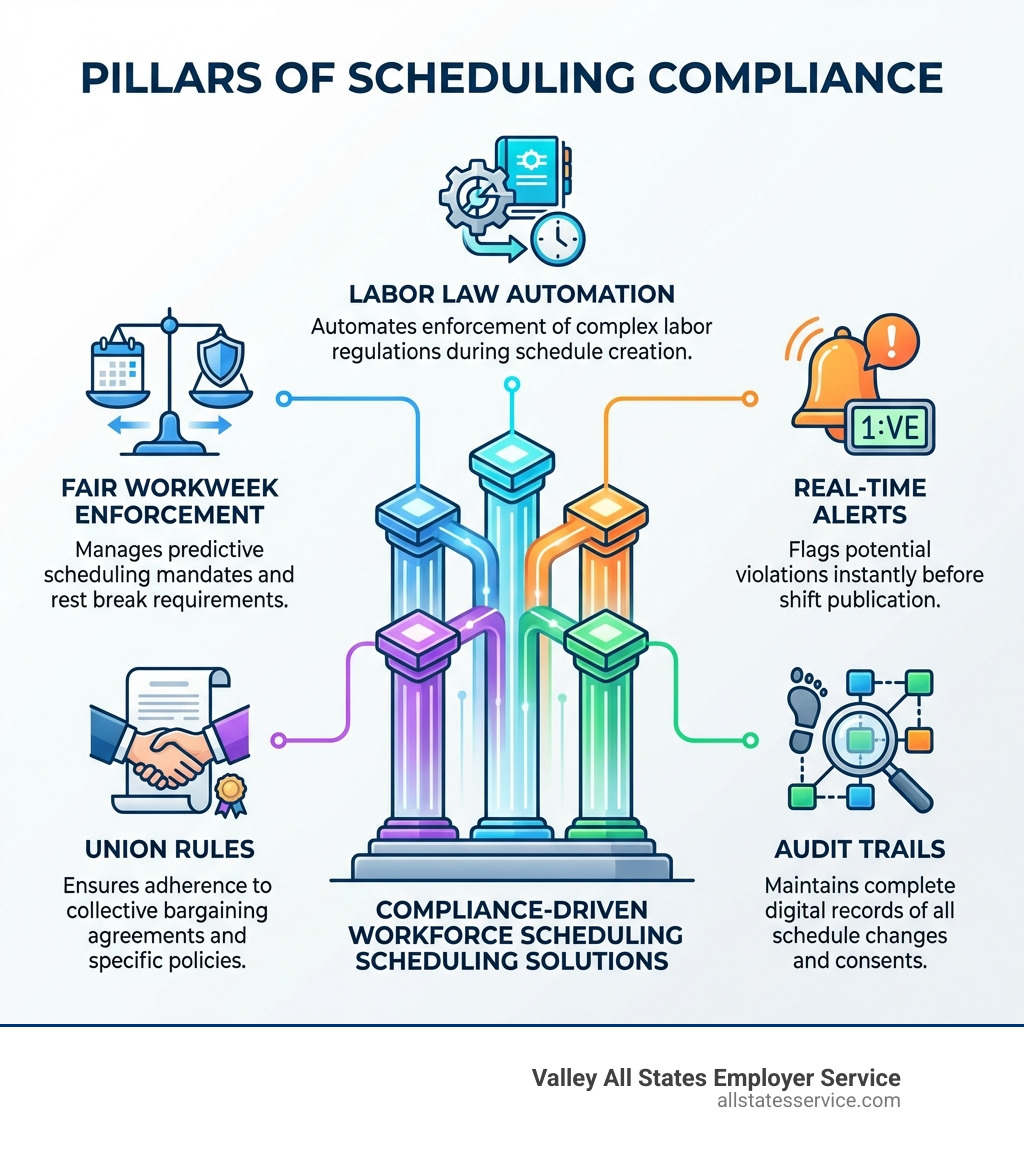
Compliance-driven workforce scheduling solutions are software platforms that automatically build, enforce, and document work schedules in line with labor laws, union agreements, and company policies, so your business avoids costly violations before they happen.
Here’s what these solutions do, at a glance:
- Automate labor law enforcement at the moment a schedule is built
- Flag violations in real time before a shift is ever published
- Track rest breaks, overtime, minor work rules, and Fair Workweek requirements automatically
- Maintain a complete digital audit trail for every schedule change and consent
- Integrate with payroll and HR systems to close the gap between scheduling and pay accuracy
If you manage a workforce of hourly or shift-based employees, scheduling is one of your biggest compliance risks. And it’s not a small one.
Franchise operators have been fined over $2 million for scheduling minors beyond permitted hours. Others have faced hundreds of thousands in penalties for predictive scheduling violations and missed break rules. These weren’t rogue operators, they were businesses using manual or semi-automated scheduling that simply couldn’t keep up with the complexity of today’s labor regulations.
The problem is real, and it’s growing. Fair workweek laws, predictive scheduling mandates, and state-specific break rules are tightening across the U.S. Staying compliant manually is becoming nearly impossible, especially across multiple locations.
The good news? The right scheduling software turns compliance from a constant fire drill into a built-in, automated process.
Compliance-driven workforce scheduling solutions terminology:
The High Cost of Manual Errors in Workforce Management

When we look at how businesses manage their teams, many still rely on spreadsheets or basic calendars. While these might seem “free,” the hidden costs are staggering. Relying on manual memory to track labor laws is a recipe for disaster.
The financial penalties for getting it wrong are no longer just a slap on the wrist. For instance, Northeast Foods LLC, which operates several Burger King franchises, was recently fined over $2 million for labor law violations. These included scheduling minors for more hours than legally permitted and failing to pay workers on time. Similarly, Popeyes locations in Massachusetts faced over $200,000 in fines for scheduling minors during prohibited hours and denying sick leave.
Beyond the checks you have to write to the government, there is the massive hit to your reputation. News of child labor violations or “clopenings” (where an employee works a late night and an early morning shift back-to-back) spreads quickly. This makes it harder to hire quality talent and can drive away customers who prefer to shop at ethical businesses.
If you want to protect your bottom line, you need to move toward professional workforce compliance services. These services ensure that your operations aren’t just efficient, but also legally sound.
Core Features of Compliance-Driven Workforce Scheduling Solutions
So, what makes a scheduling tool “compliance-driven”? It isn’t just a digital calendar. It is a smart engine that understands the rules of your specific industry and location. Modern compliance-driven workforce scheduling solutions act as a 24/7 digital supervisor.
One of the most powerful features is real-time monitoring. Instead of catching a mistake after the week is over, the software flags a conflict while the manager is still dragging and dropping shifts. If a manager tries to schedule a high school student past 9:00 PM on a school night, the system can block the action or send an immediate alert.
Another essential component is a robust compliance management system. These systems allow for deep rule customization. You can set shift duration caps, mandatory rest periods between shifts, and even skill-based requirements. For example, platforms like Inflection HR allow you to ensure that every shift has a certified first-aid responder or a licensed supervisor on-site.
Finally, an immutable audit trail is your best friend during a labor audit. These tools log every edit, every request, and every employee consent. If an auditor asks why a schedule was changed last minute, you have the digital proof that it was done according to the law.
Automating Fair Workweek with Compliance-Driven Workforce Scheduling Solutions
Fair Workweek laws are becoming a major hurdle for retail and hospitality businesses. These laws require employers to provide advance notice of schedules, usually 14 days out. If you change a shift last minute, you often have to pay a “premium” or a penalty to the employee.
Using compliance-driven workforce scheduling solutions like Quinyx or Harri can drastically reduce these costs. These platforms use agreement-based schedule validation to check every roster against local predictive scheduling rules.
Harri has helped some operators reduce Fair Workweek penalties from 1.3% of their weekly payroll down to just 0.28%. By automating the “Access to Hours” provision, which requires offering open shifts to existing part-time staff before hiring new people, these tools keep you on the right side of the law without the manual headache.
Managing Union Rules via Compliance-Driven Workforce Scheduling Solutions
If your workforce is unionized, scheduling becomes even more complex. You aren’t just following state laws, you are following a Collective Bargaining Agreement (CBA). These agreements often have strict rules about seniority fairness and fatigue management.
Solutions like Logile and Shiftboard are designed to handle these intricate details. These systems provide fair, compliant schedules by design, which helps eliminate perceptions of favoritism. The software can automatically assign shifts based on seniority or rotation rules defined in your contract.
Shiftboard users have reported an 88% higher shift coverage rate because the system understands exactly who is eligible and available for a shift based on union rules, preventing grievances before they are even filed.
How AI and Automation Power Modern Scheduling
The “secret sauce” in modern scheduling is Artificial Intelligence (AI). We are moving past simple templates and into the era of predictive labor optimization. AI doesn’t just look at who is available, it looks at your business data to predict how many people you actually need.
Workday and Legion WFM are leaders in this space. Workday uses machine learning to forecast demand based on historical data, upcoming promotions, and even weather patterns. This prevents overstaffing, which wastes money, and understaffing, which leads to burnout and compliance risks like missed breaks.
Following workforce management best practices means using these tools to empower your managers. Legion WFM has shown a 13x ROI for large companies, with nearly 30% of those savings coming directly from improved manager productivity. Instead of spending hours playing “Tetris” with a paper schedule, managers can spend that time on the floor helping customers and training staff.
Industry-Specific Compliance Challenges
Every industry has its own “compliance personality.” What works for a warehouse won’t work for a hospital or a boutique.
- Retail and Hospitality: These industries struggle most with Fair Workweek laws and minor labor rules. Compliance-driven workforce scheduling solutions must be able to sync with school calendars to ensure students aren’t working when they should be in class.
- Manufacturing: Here, the focus is often on safety and fatigue management. Working too many hours in a row in a high-risk environment isn’t just a labor violation, it is a massive safety hazard.
- Healthcare: Compliance here involves tracking certifications. You cannot schedule a nurse for a specialized unit if their specific certification has expired.
Our HR compliance guide for 2026 highlights that as regulations become more localized, having a system that can handle “geo-fenced” rules (rules that change based on the specific city or county of the location) is vital.
Staying Audit-Ready with Digital Record Keeping
The scariest words a business owner can hear are, “We’re here for an audit.” However, if you use digital compliance-driven workforce scheduling solutions, you can breathe easier.
Modern software maintains detailed event logs. These logs track every time a shift was offered, who accepted it, and when the schedule was published. This is particularly important because of new guidance from the Consumer Financial Protection Bureau (CFPB).
According to CFPB Circular 2024-06, worker tracking technology and AI scores may now fall under the Fair Credit Reporting Act (FCRA). This means you need to be transparent about how you use data to make employment decisions.
By using a secure system like Humanity Schedule, you create a “single source of truth.” If an employee disputes their hours or claims they weren’t given their required rest period, you have a time-stamped record to resolve the issue quickly. Many businesses choose to reduce HR compliance risk by outsourcing these technical tasks to experts who can ensure the data is stored and managed correctly.
Frequently Asked Questions about Workforce Compliance
What is compliance-driven scheduling?
It is the practice of using technology to prioritize legal and regulatory requirements in your shift planning. It ensures that every shift follows labor standards, local legislation, and your own company policies automatically, rather than relying on a manager to remember every rule.
How does scheduling software reduce overtime costs?
The software provides real-time OT alerts. If a manager tries to assign a shift to someone who is already at 38 hours for the week, the system will flag it. It can also suggest alternative employees who have the same skills but haven’t reached their overtime threshold yet, helping you stay within your labor budget.
Can these tools handle complex union agreements?
Yes. Leading compliance-driven workforce scheduling solutions are highly configurable. You can input specific rules from your Collective Bargaining Agreement, such as seniority-based bidding, mandatory “rest between shifts” rules, and fatigue management protocols. The system then enforces these rules during the schedule creation process.
Transform Your Operations Today
At the end of the day, compliance isn’t just about avoiding fines. It is about building a better workplace. When schedules are fair, predictable, and follow the law, employee satisfaction goes up. When employees are happy, turnover goes down, which saves you a fortune in hiring and training costs.
At Valley All States Employer Service, we understand that managing a workforce is about more than just a calendar. We specialize in helping businesses stay compliant from the very start of the employee journey. Our expert E-Verify processing ensures that your workforce is eligible and documented, minimizing your administrative burden and protecting you from federal errors.
Ready to simplify your operations and protect your business? Ready to simplify compliance? Contact our team today. Let’s work together to make your workforce management as efficient and compliant as possible.