
Why E-Verify Government Contractors Face Unique Compliance Challenges
E-Verify government contractors must steer one of the most complex employment verification mandates in federal contracting. If your company holds or pursues federal contracts, understanding these requirements isn’t optional—it’s a condition of doing business with the U.S. government.
Quick Answer: E-Verify Requirements for Government Contractors
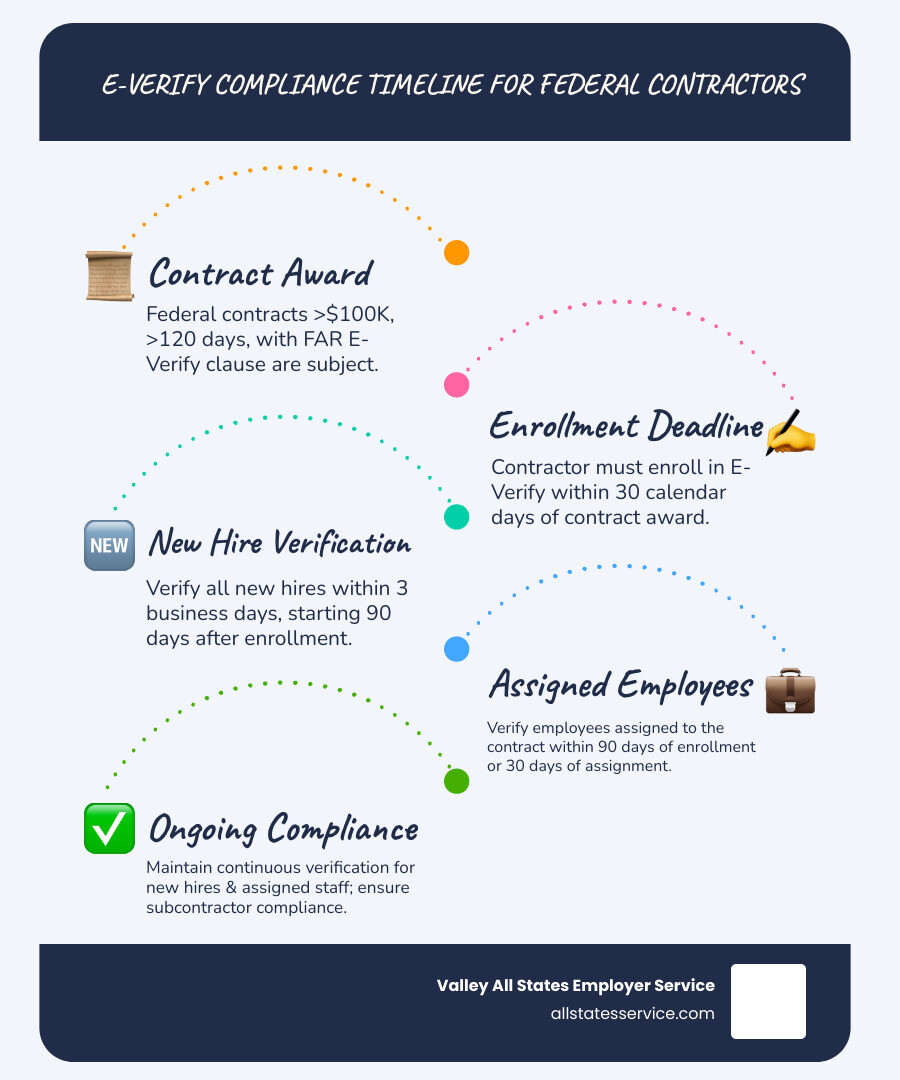
- Who must comply: Federal contractors awarded contracts on or after September 8, 2009, that include the FAR E-Verify clause
- Which contracts: Prime contracts over $100,000 with performance periods longer than 120 days; subcontracts for services or construction over $3,000
- Enrollment deadline: Within 30 calendar days of contract award
- Verification requirements:
- All new hires: within 3 business days after hire date (starting 90 days after enrollment)
- Employees assigned to the contract: within 90 days of enrollment or 30 days of assignment, whichever is later
- Optional full workforce: within 180 days of enrollment
- Key exemptions: Contracts under 120 days, COTS items, work performed outside the U.S., certain government entities
The E-Verify Federal Contractor Rule reinforces a simple policy: the federal government does business only with organizations that maintain a legal workforce. More than 96 percent of E-Verify verification cases receive a result of “Employment Authorized,” making it an efficient tool when implemented correctly.
Yet many contractors struggle with the practical details. When must you enroll? Which employees need verification? What happens during a government shutdown? How do you ensure subcontractor compliance?
The stakes are high. Non-compliance can lead to contract termination, suspension and debarment from future federal work, and significant civil penalties. For busy HR managers already juggling multiple priorities, adding E-Verify compliance to the mix can feel overwhelming.
This guide cuts through the complexity. We’ll walk you through exactly what the E-Verify mandate means for government contractors, from initial enrollment to ongoing verification, so you can maintain compliance without the headaches.
E-Verify government contractors glossary:
Understanding the E-Verify Federal Contractor Rule
Navigating federal contracts brings a unique set of responsibilities, and for E-Verify government contractors, one of the most significant is the E-Verify Federal Contractor Rule. This rule isn’t just a suggestion; it’s a mandatory requirement designed to ensure that federal work is performed by a legally authorized workforce. Let’s break down what this means for your business.
What is the Rule and Who Must Comply?
The E-Verify Federal Contractor Rule stems from the Federal Acquisition Regulation (FAR) and specifically the FAR E-Verify clause. This clause mandates that certain federal contractors use the E-Verify system to confirm the employment eligibility of their employees. It’s a critical component of the federal government’s commitment to only doing business with organizations that employ a legal workforce.
This rule primarily affects federal contractors who were awarded a new contract on or after September 8, 2009, and whose contract explicitly includes the FAR E-Verify clause. Some existing federal contracts might also be bilaterally modified to include this clause, so it’s always wise to review your contract terms carefully.
So, who exactly must comply? We’re talking about prime contracts that meet specific criteria:
- They must have a period of performance longer than 120 days.
- Their value must exceed the simplified acquisition threshold, which is currently $100,000.
If your contract fits this description and contains the FAR E-Verify clause, your company is generally subject to these requirements. You can learn more about these specific Federal E-Verify Rules and federal contractor requirements directly from E-Verify.
Core Requirements for E-Verify Government Contractors
Once you’re identified as an E-Verify government contractor, certain obligations kick in regarding employee verification. These requirements are designed to be comprehensive, covering both new hires and employees assigned to federal projects.
Here’s a breakdown of the core requirements:
- Verify New Hires: For all new employees hired in the United States, you must initiate E-Verify verification within three business days after their date of hire. This applies once your company has been enrolled in E-Verify for at least 90 days as a federal contractor.
- Verify Employees Assigned to the Contract: For any employees, whether new or existing, who are directly working on a covered federal contract, verification must be initiated. This needs to happen within 90 calendar days after your company enrolls in E-Verify, or within 30 calendar days of the employee’s assignment to the contract, whichever date is later.
- Optional Full Workforce Verification: While not always mandatory, many contractors choose to verify their entire existing workforce. If you opt for this, all employees hired after November 6, 1986 (or November 27, 2009, in the CNMI), must be verified within 180 calendar days of your enrollment or your decision to exercise this option. This can simplify compliance by applying a single standard across your organization.
Understanding these specific guidelines is crucial for any E-Verify government contractor. For more detailed guidance, check out our insights on Do Federal Contractors Have Specific Guidelines for E-Verify?.
Subcontractor Obligations
The E-Verify Federal Contractor Rule doesn’t just stop at the prime contractor; it “flows down” to subcontractors as well. If your prime contract includes the FAR E-Verify clause, you, as the prime contractor, are generally responsible for ensuring that your subcontractors also comply with E-Verify when applicable.
Specifically, the E-Verify requirement extends to subcontracts that meet these conditions:
- They are for services or construction.
- Their value is above $3,000.
- They flow from a prime contract that includes the E-Verify clause.
- The services or construction are performed in the United States.
As a prime contractor, you play a vital role in ensuring this compliance. This typically involves including a flow-down clause in your subcontracts that requires your subcontractors to adhere to the federal contractor/E-Verify regulation. You might also consider requiring subcontractors to provide proof of their E-Verify registration or printouts of E-Verify confirmations for employees assigned to the contract. This proactive approach helps protect both parties from potential compliance issues. Find out more about E-Verify for Contractors.
Key Exemptions and Exceptions
While the E-Verify Federal Contractor Rule is broad, there are specific exemptions and exceptions that can apply. It’s important to understand these to avoid unnecessary compliance burdens or, conversely, to ensure you don’t mistakenly assume an exemption applies when it doesn’t.
Here are some key situations where the E-Verify mandate may not apply:
- Contracts Lasting Fewer Than 120 Days: If your prime contract has a period of performance of 120 days or less, it’s generally exempt.
- Contracts Valued at $150,000 or Less: While the general threshold for applicability is $100,000, some exemptions refer to contracts valued at $150,000 or less, especially concerning certain services. Always check the specific FAR clause.
- Commercially Available Off-the-Shelf (COTS) Items: Contracts exclusively for COTS items (like certain agricultural or petroleum products) are often exempt. However, be aware that services related to COTS items might still be subject to the rule.
- Work Performed Outside the U.S.: The E-Verify requirement generally applies to work performed within the United States, which includes the 50 States, the District of Columbia, Puerto Rico, Guam, the Commonwealth of the Northern Mariana Islands, and the U.S. Virgin Islands. If the entire contract is performed outside these areas, it may be exempt.
- Certain Institutional Contractors: Institutions of higher education, state or local governments, or governments of federally recognized Indian tribes may have a special exception. They can choose to verify only employees assigned to the contract, rather than all new hires.
- Employees with Security Clearances: Employees who hold a valid U.S. Government security clearance or an HSPD-12 credential may be excluded from re-verification through E-Verify.
It’s crucial to consult the official Exemptions and Special Rules on the E-Verify website for the most accurate and up-to-date information regarding your specific situation.
The E-Verify Process for E-Verify Government Contractors
Once you’ve determined your status as an E-Verify government contractor, the next step is understanding the practicalities of the E-Verify process itself. This includes everything from initial enrollment to the ongoing verification of your workforce.
Enrollment and Setup: Your First Steps
Enrolling in E-Verify is a straightforward process, but it requires careful attention to detail. If you’re awarded a federal contract that includes the FAR E-Verify clause and you’re not already enrolled, you must do so within 30 calendar days of the contract award.
Here’s what the enrollment and setup generally entail:
- Access the E-Verify Website: The process begins by accessing the official E-Verify website.
- Select Employer Type: You’ll need to select “Federal Contractor with FAR E-Verify Clause” as your employer category.
- Complete the Enrollment: This involves providing information about your company.
- Sign the Memorandum of Understanding (MOU): This is a critical step. The MOU is a legally binding agreement between your company, the Department of Homeland Security (DHS), and the Social Security Administration (SSA), outlining your responsibilities and the terms of using E-Verify.
- Designate Your Company Profile: Once enrolled, you must designate your company as a Federal contractor with the FAR E-Verify clause by updating your company profile. This ensures your E-Verify account is correctly linked to your federal contracting obligations.
For direct access to enrollment, you can visit the E-Verify website. We also offer a comprehensive guide on the E-Verify Registration Process to help you through each step.
Critical Timelines You Can’t Miss
For E-Verify government contractors, adhering to specific timelines is not just good practice—it’s mandatory. Missing these deadlines can lead to compliance issues, so let’s lay them out clearly.
Here’s a quick overview of the key timelines:
| Action | Timeline | Details |
|---|---|---|
| Enrollment | Within 30 calendar days of contract award | You must enroll in E-Verify as a “Federal Contractor with FAR E-Verify Clause.” |
| Verify New Hires | Within 3 business days of their start date | This applies to all new hires, starting 90 days after your enrollment. |
| Verify Existing Employees Assigned to Contract | Within 90 calendar days of enrollment or 30 calendar days of assignment, whichever is later | This applies to current employees who are newly assigned to a federal contract. |
| Optional: Verify Entire Existing Workforce | Within 180 calendar days of enrollment | If you choose this option, you must verify all existing employees not previously verified. |
For more detailed information, always refer to the official Federal contractor compliance guidelines on E-Verify.gov.
Verifying New and Existing Employees
The verification process for E-Verify government contractors is directly tied to the Form I-9, Employment Eligibility Verification. It’s crucial to remember that E-Verify supplements the Form I-9; it does not replace it. Your foundational compliance always begins with the accurate and timely completion of Form I-9.
Here’s how the verification procedure typically works:
- Complete Form I-9 First: Before you create an E-Verify case, you must ensure that your new hire has completed Section 1 of the Form I-9 on their first day of employment, and you, as the employer, have completed Section 2 within three business days of their hire. The information from the Form I-9 is what you will use to create the E-Verify case.
- E-Verify Case Creation: Once the Form I-9 is complete, you will log into your E-Verify account and create a case using the information provided by the employee on their Form I-9.
- New Hires: For new hires, the E-Verify case must be created within three business days after the employee’s first day of employment.
- Existing Employees Assigned to a Contract: For employees already on your payroll but newly assigned to a covered federal contract, the E-Verify case must be initiated within 90 calendar days after your company’s E-Verify enrollment, or within 30 calendar days of the employee’s assignment to the contract, whichever is later.
- Understanding Tentative Nonconfirmation (TNC): Sometimes, E-Verify might issue a Tentative Nonconfirmation (TNC), also known as a mismatch. This means the information submitted doesn’t immediately match records at DHS or SSA. A TNC is not a final determination of ineligibility.
- Resolving Mismatches: If an employee receives a TNC, they have the right to contest it and must be given the opportunity to resolve the discrepancy with the relevant agency (DHS or SSA). During this resolution process, as a federal contractor, you cannot take any adverse action against the employee. This means you cannot refuse to assign them to a federal contract, remove them from a contract, delay training, change shifts, or withhold wages simply because of the TNC. They must be allowed to continue working while they resolve the case. More details on handling E-Verify for Existing Employees and the interplay between E-Verify and I-9 are available.
Navigating Compliance and Special Scenarios
Compliance for E-Verify government contractors isn’t a one-time task; it’s an ongoing commitment that requires vigilance and adaptability. Understanding potential pitfalls and how to steer unexpected situations is key to maintaining a strong, compliant workforce.
Consequences of Non-Compliance
For E-Verify government contractors, the stakes of non-compliance are incredibly high. The federal government takes these mandates seriously, and failure to adhere to the E-Verify Federal Contractor Rule can lead to severe repercussions for your business.
Here are some of the potential consequences:
- Contract Termination: One of the most immediate and impactful consequences is the termination of your federal contract. This can disrupt operations and lead to significant financial losses.
- Suspension and Debarment: Beyond a single contract, non-compliance can result in your company being suspended or debarred from future federal contracts. This means you could be blocked from bidding on or receiving any new federal work for a specified period, effectively cutting off a significant revenue stream. This process often involves a referral to a suspending and debarring official.
- Civil Penalties: You could face substantial civil penalties, which are financial fines imposed for violations of E-Verify requirements. These can accumulate quickly and severely impact your bottom line.
- Loss of E-Verify Access: The government may terminate your company’s access to the E-Verify program. This makes it impossible to comply with future federal contracts requiring E-Verify, effectively preventing you from pursuing new federal business.
- Reputational Damage: Beyond the legal and financial penalties, non-compliance can severely damage your company’s reputation, making it harder to attract new talent and clients.
Given these serious risks, proactive HR Compliance Risk Assessment is not just recommended, it’s essential.
What to Do During a Government Shutdown
One of the unique challenges for E-Verify government contractors is navigating the impact of a federal government shutdown. As we’ve seen in the past, a shutdown can temporarily suspend E-Verify operations, creating a tricky situation for employers who still need to hire and verify new staff.
Here’s what you need to know and do during such an event:
- System Suspension: When a government shutdown occurs, E-Verify typically goes offline. This means you cannot create new cases, enroll in the program, update accounts, or resolve Tentative Nonconfirmations (TNCs).
- Form I-9 Remains Mandatory: This is critical: Form I-9 requirements do not change during a government shutdown. You must continue to complete Form I-9s for all new hires within the standard timelines (Section 1 by the first day of employment, Section 2 within three business days). E-Verify is a supplement to the I-9, not a replacement, and the I-9 remains your anchor for compliance.
- E-Verify Case Backlog: Once E-Verify resumes operations, there will be a grace period to create cases for employees hired during the shutdown. You should note “E-Verify not available” as the reason for the delay on the Form I-9. It’s vital to track all hires made during the shutdown and be ready to process their E-Verify cases promptly once the system is back online.
- Contacting Contracting Officers: As a federal contractor, your E-Verify deadlines are mandated by your contract. During a shutdown, these deadlines may technically slip. It’s crucial to contact your contracting officers directly to discuss potential extensions or revised timeframes. They are your primary point of contact for navigating such situations.
- Document Everything: Maintain meticulous records of all hiring activity during the shutdown, including I-9 completions, and any attempts to access E-Verify. Document all communications with your contracting officers. This demonstrates good-faith compliance and helps protect your organization.
Understanding these steps can help mitigate the impact of unforeseen events and keep you in compliance.
Record-Keeping and Audits
Effective record-keeping is a cornerstone of compliance for all employers, and especially for E-Verify government contractors. The ability to produce accurate and complete documentation quickly is essential, particularly during audits.
Here are key aspects of record-keeping and audit preparedness:
- USCIS Record Disposal Policy: E-Verify cases are not kept indefinitely. USCIS periodically purges E-Verify records that are more than 10 years old. This policy highlights the need for employers to proactively manage their own records.
- Downloading Historic Reports: To prepare for potential data purges, employers should regularly download Historic Records Reports from E-Verify. These reports serve as your official record of past E-Verify inquiries.
- Retaining Records with Form I-9: It is absolutely critical to retain these downloaded E-Verify records with their corresponding Form I-9s. The Form I-9 and its supporting documentation, including E-Verify results, must be kept for specific periods: either three years from the date of hire or one year after employment termination, whichever is later. These documents are often the first things requested during an audit.
- Audit Preparedness: Beyond federal mandates, having a robust system for managing I-9s and E-Verify records is essential for any potential audit by agencies like Immigration and Customs Enforcement (ICE). A well-organized, accessible record system can significantly reduce stress and potential penalties during an audit. Our I-9 Audit Complete Guide provides further insights into preparing for and navigating these audits.
Frequently Asked Questions about E-Verify for Government Contractors
We understand that the E-Verify Federal Contractor Rule can raise many questions. Here, we address some of the most common inquiries we hear from E-Verify government contractors like you.
Can we verify all our employees, not just those on the contract?
Yes, absolutely! While the E-Verify Federal Contractor Rule specifically mandates verification for new hires and employees assigned to covered federal contracts, you have the option to verify your entire existing workforce.
If you choose this route, you must do so within 180 calendar days of your enrollment in E-Verify or your decision to exercise this option. Many contractors find that verifying their entire workforce simplifies their internal processes and ensures a consistent approach to employment eligibility across the organization. It can also provide an added layer of assurance that all your employees are legally authorized to work in the United States.
What happens if an employee gets a Tentative Nonconfirmation (TNC)?
A Tentative Nonconfirmation (TNC), or mismatch, means that the information entered into E-Verify from the employee’s Form I-9 does not match records available to the Social Security Administration (SSA) or the Department of Homeland Security (DHS). This can happen for various reasons, including data entry errors, name changes, or citizenship/immigration status issues.
Here’s what’s crucial for E-Verify government contractors to remember:
- Employee Rights: The employee has the right to contest the TNC. They must be given a “Further Action Notice” and time to contact the appropriate agency (SSA or DHS) to resolve the discrepancy.
- Cannot Take Adverse Action: This is a critical protection for employees. As a federal contractor, you are strictly prohibited from taking any adverse action against an employee solely because they received a TNC and are in the process of resolving it. This includes refusing to assign them to a federal contract, removing them from a federal contract, delaying training, changing shifts, or withholding wages. The employee must be allowed to continue working while they resolve their case.
- Resolution Process: If the employee chooses to contest, you must refer the case to the appropriate agency and follow their instructions. If the TNC is resolved, E-Verify will issue a “Employment Authorized” status. If it’s not resolved or the employee chooses not to contest, a “Final Nonconfirmation” will be issued.
It’s vital to handle TNCs carefully and in full compliance with E-Verify rules to avoid penalties and uphold employee rights.
Does E-Verify replace the Form I-9?
No, E-Verify does not replace the Form I-9. This is a common misconception, but understand their distinct roles.
- Form I-9 is the Foundation: The Form I-9, Employment Eligibility Verification, is a mandatory federal document that all U.S. employers must complete for every new hire, regardless of whether they use E-Verify. It serves as the primary record of an employee’s identity and work authorization.
- E-Verify is a Supplement: E-Verify is an internet-based system that supplements the Form I-9 process. It takes the information from a completed Form I-9 and electronically compares it against government databases (DHS and SSA records) to confirm employment eligibility. It adds an extra layer of verification but does not negate the need for the I-9.
Think of it this way: the Form I-9 is the physical documentation of identity and work authorization, while E-Verify is the electronic check of that information against federal records. You must always complete the Form I-9 first, and then use that information to create an E-Verify case. The E-Verify Federal Contractor Rule interacts with the Form I-9 by adding an additional, mandatory step to the employment eligibility verification process for covered contractors.
Simplify Your Compliance Journey
Staying compliant with the E-Verify mandate for E-Verify government contractors requires diligence and a deep understanding of complex rules. From enrollment deadlines to subcontractor oversight, the administrative burden can be significant. For companies seeking to minimize risk and ensure accuracy, partnering with an expert can be a strategic advantage. Valley All States Employer Service offers dedicated E-Verify Employer Agent Services to manage the entire process for you. Ready to streamline your workforce eligibility verification? Explore our comprehensive E-Verify Services.