
Outsourced compliance management: Master 2025
Why Compliance Feels Like a Full-Time Job (And How to Fix It)
Keeping up with shifting regulations, new policies, and endless administrative tasks can feel like a marathon with no finish line. For busy HR managers, juggling E-Verify, I-9 audits, and changing state laws is a major drain on resources. In fact, 38% of companies are already outsourcing parts of their compliance just to keep up.
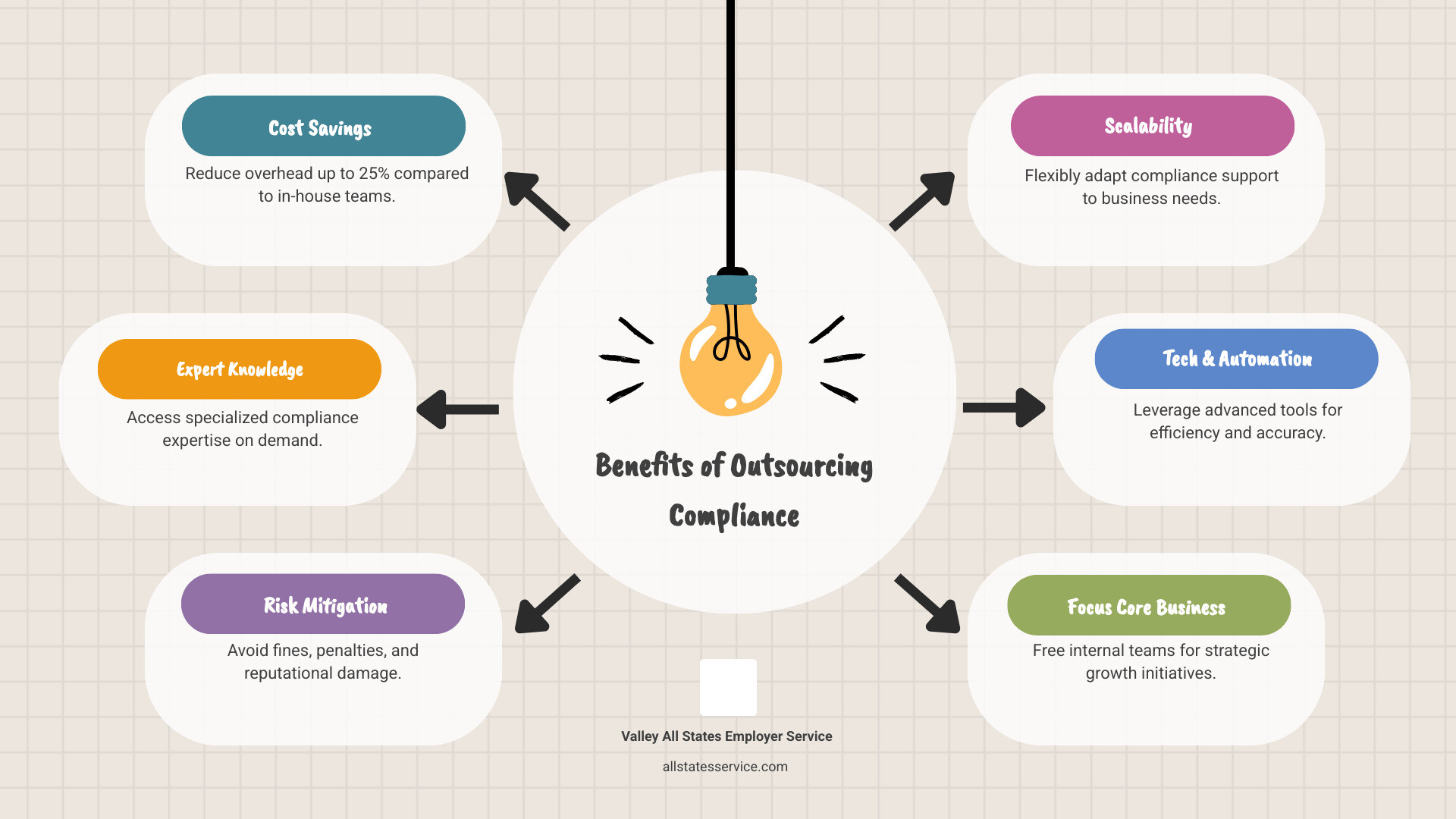
This is where outsourced compliance management comes in. It’s the practice of hiring a third-party company to handle your regulatory requirements, from workforce eligibility to risk assessments. Businesses choose this solution to:
- Access specialized expertise on demand
- Reduce overhead costs
- Stay current with changing regulations
- Scale support based on business needs
- Minimize the risk of fines and penalties
- Free internal teams to focus on strategic work
Outsourcing isn’t about losing control, it’s about gaining a strategic advantage. You tap into specialized knowledge and advanced technology, ensuring your business stays compliant without diverting your team’s energy from what they do best.
What is Outsourced Compliance Management and Why is it Booming?
Outsourced compliance management means bringing in outside experts to handle your regulatory headaches. Instead of hiring a full-time team or piling work onto your HR staff, you partner with specialists who live and breathe compliance. They have the knowledge and tools to keep you on the right side of the law while you focus on running your business.
Today’s regulatory landscape is constantly shifting. New federal rules appear, states like Maryland roll out their own employment laws, and industry standards evolve. For small to medium-sized businesses, keeping up can feel impossible.
That’s why this field is seeing explosive growth. The compliance outsourcing market is set to grow significantly, with a forecasted compound annual growth rate of 12.3% from 2021 to 2028. This reflects a fundamental shift in how smart businesses handle regulatory requirements. Companies realize that outsourcing specialized tasks frees up their people to drive strategy and innovation.

Understanding the Different Models
Outsourcing isn’t an all-or-nothing decision. You have options to find the right fit.
- Full outsourcing: Hand over complete responsibility for a specific function, like your entire I-9 program, to an external provider for maximum relief.
- Co-sourcing: A collaborative approach where your provider works alongside your in-house team, handling routine tasks or providing specialized knowledge.
- Project-based support: Get help for a specific need, like an internal I-9 audit or setting up a new compliance framework, without a long-term commitment.
- Managed services: A comprehensive partnership where a provider manages a full suite of compliance services, often using integrated technology for continuous monitoring and reporting.
The right model depends on your business size, resources, and biggest compliance challenges.
Key Services Offered by Compliance Providers
Compliance providers offer practical solutions to daily business challenges.
- Regulatory monitoring: Providers actively track legislative changes and alert you to what matters, which is essential for HR Regulatory Compliance.
- Policy development: Experts draft, review, and implement compliance policies custom to your business operations and risks.
- Risk assessments and audits: Providers conduct thorough reviews to find problems before they find you. Services like I-9 Audit Services catch errors that could lead to hefty fines.
- Employee training: Ensure your team understands their roles and responsibilities in following compliance policies.
- Workforce eligibility verification: This crucial service includes managing Form I-9 completion, storage, and re-verification, plus E-Verify Outsourcing to confirm new hires are legally authorized to work.
The Strategic Advantages: Unpacking the Benefits of Outsourcing Compliance
Choosing outsourced compliance management is a strategic decision that transforms how your business operates. You’re not just handing off paperwork, you’re gaining specialized expertise, reducing financial strain, and building a stronger defense against regulatory risks.
Every hour your team spends on compliance is an hour they aren’t spending on hiring, development, or improving company culture. Outsourcing provides tangible advantages in cost-effectiveness, risk mitigation, scalability, and business continuity.
Boost Your Bottom Line and Reallocate Resources
Businesses can achieve up to 25% savings by outsourcing compliance compared to maintaining an in-house team. The math is simple: building an internal team involves salaries, benefits, training, and recruitment. These fixed costs add up quickly.
Outsourced providers spread their costs across multiple clients, so you get top-tier expertise for a predictable fee with no recruitment costs and reduced overhead. More importantly, you free up your internal teams to focus on strategic work that moves your business forward. That’s how you Improve HR Efficiency in a way that creates lasting value.
Strengthen Risk Management and Ensure Regulatory Adherence
The regulatory landscape is a minefield where one misstep can lead to thousands in fines or reputational damage. Outsourced compliance management acts as your shield by providing access to specialists who are immersed in federal and state laws, including Maryland-specific requirements.
A Deloitte survey shows that 60% of companies outsource at least one compliance function because staying current with changing laws requires dedicated focus. When E-Verify rules or I-9 requirements are updated, your provider is already on top of it. This proactive approach helps you avoid fines and penalties, letting you move forward with confidence. It’s the smart way to Reduce HR Compliance Risk by Outsourcing.
Business Growth and Scalability Support
Compliance can either fuel your growth or strangle it. When you expand into new markets or hire rapidly, compliance requirements multiply. If your internal team is already stretched, growth becomes a bottleneck.
Outsourced compliance management offers the flexibility to match your business rhythm. Providers scale services up during rapid growth or adjust for seasonal fluctuations. This scalability means you can seize opportunities without hesitation, knowing your compliance infrastructure can grow as fast as your ambitions. Compliance becomes a facilitator of growth, not an impediment.
In-House vs. Outsourced Compliance: A Head-to-Head Comparison
Deciding whether to keep compliance in-house or partner with an external team is a pivotal choice for your business. An in-house team offers direct, hands-on control and deep company knowledge, but this familiarity comes at a steep price.
Building an internal team means high fixed costs like salaries, benefits, and ongoing training. You also risk knowledge gaps, as a generalist may struggle to keep pace with complex federal and state-specific rules, like those in Maryland. When your business grows or needs change, scaling an in-house team is slow and expensive.
Outsourced compliance management flips this model. You gain access to a broad bench of specialists in areas like HR Regulatory Compliance and E-Verify processing for a lower, more predictable cost. These providers leverage advanced technology, like Electronic I-9 Solutions, that you might not be able to afford internally. This approach significantly lowers your risk profile, as explained in the Outsourced HR Compliance Ultimate Guide.
The trade-off is shifting from direct, day-to-day control to strategic oversight. For many businesses, this is a benefit, as it frees internal teams to focus on core strategic initiatives instead of administrative tasks.
| Feature | In-House Compliance Team | Outsourced Compliance Team |
|---|---|---|
| Cost | High fixed costs (salaries, benefits, training, tech, recruitment). Unpredictable costs for specialized expertise. | Lower, more predictable costs (service fees). Access to expertise without full-time overhead. Often more cost-effective. |
| Expertise | Deep company-specific knowledge. May lack broad industry or specialized regulatory expertise. Training required for new regulations. | Broad, specialized expertise across various industries and regulations (e.g., federal E-Verify, Maryland employment laws). Up-to-date knowledge. |
| Scalability | Difficult and slow to scale up or down. Requires hiring/firing, which is costly and time-consuming. | Highly flexible. Can quickly scale services to match business growth, seasonal demands, or specific project needs. |
| Technology | Requires investment in compliance software, infrastructure, and maintenance. May have outdated systems. | Leverages advanced, often proprietary, RegTech and automation. Providers invest in cutting-edge tools. |
| Risk Profile | Higher risk of non-compliance due to limited resources, lack of specialized knowledge, or oversight. Dependency on a few key individuals. | Lower risk due to dedicated experts, proactive monitoring, and robust systems. Reduced dependency on single individuals. |
| Control | Direct, day-to-day control over processes and personnel. | Strategic oversight, but day-to-day execution handled by external experts. Requires clear communication and SLAs. |
| Focus | Internal teams may be diverted from core business tasks by compliance demands. | Frees internal teams to focus on strategic initiatives and core business operations. |
For most businesses looking to stay nimble and cost-conscious while ensuring rock-solid compliance, outsourcing offers a smarter path forward.
Finding Your Perfect Partner: How to Choose and Implement an Outsourced Solution
Choosing to outsource compliance is like hiring a key leader. You need a partner who understands your business, has the right expertise, and is committed to getting it right. With a thoughtful approach, you can find a partner that transforms your compliance function.

Key Factors for Selecting Your Outsourced Compliance Management Provider
Thorough vetting is essential when choosing a provider. Look for:
- Industry Specialization: Do they have deep experience in your sector and with regulations like E-Verify and I-9 compliance?
- Technology and Automation: Do they use advanced platforms that reduce manual work and provide real-time visibility?
- Scalability and Flexibility: Can the provider grow with you and adapt to your changing business needs?
- Security Protocols: Ensure they have robust safeguards like encryption and regular security audits to protect your sensitive data.
- Proven Track Record: Ask for case studies and references from businesses similar to yours. Look for trusted Compliance Solution Providers.
- Communication and Transparency: A good partner listens, explains things clearly, and offers an unbiased perspective on your compliance gaps.
Best Practices for a Seamless Transition
Once you’ve selected a partner, a smooth transition is key.
- Define a clear scope of work with specific tasks, deliverables, and timelines.
- Establish clear communication channels and a schedule for check-ins.
- Set measurable key performance indicators (KPIs) to track success.
- Facilitate knowledge transfer by providing your provider with all relevant documentation and background.
- Conduct regular monitoring and provide feedback to keep the partnership strong, a core tenet of Workforce Management Best Practices.
- Address technology integrations with your HRIS or payroll software early on.
Addressing Potential Challenges in Outsourced Compliance Management
It’s natural to have concerns. Here’s how to address them:
- Loss of Control: You aren’t giving up control, you’re redirecting it. You set the strategy, and the provider executes. Clear Service Level Agreements ensure you remain in the driver’s seat.
- Data Security: Reputable providers invest heavily in encryption, secure access controls, and regular audits to protect your sensitive information.
- Communication Gaps: Prevent misunderstandings by establishing clear communication protocols and escalation paths from the start.
- Company Culture Alignment: A good provider takes time to understand your values and adapts their approach to become an extension of your team.
- Provider Dependency: Mitigate this risk by choosing a provider with a deep team structure and robust business continuity plans.
Frequently Asked Questions about Outsourcing Compliance
Considering outsourced compliance management? Here are answers to the most common questions we hear.
How does an outsourced provider stay updated on new regulations?
Staying current is their full-time job. Providers use dedicated teams, regulatory monitoring software, and industry networks to track legislative updates in real time. When there’s a new I-9 Form Update or a change in state law, they know immediately and translate what it means for your business.
What is the role of technology in outsourced compliance?
Technology is central to modern outsourced compliance management. Providers use automation to handle routine tasks, reducing human error and saving time. They leverage specialized platforms, like Electronic I-9 Solutions, and even AI to identify risks, giving you more accurate and efficient service than you could likely build in-house.
Can I outsource just one part of my compliance?
Absolutely. Many businesses start by outsourcing a specific pain point, like payroll, benefits administration, or workforce eligibility verification. A focused solution like an E-Verify Employer Agent Service lets you hand off one function while keeping others in-house. You can always expand the partnership later.
How can outsourced compliance services ensure business continuity?
Outsourcing strengthens business continuity by eliminating key person risk. If your internal expert leaves, an outsourced team ensures operations continue smoothly. These providers also have robust, redundant systems and secure data backups. Their proactive monitoring prevents small issues from becoming major disruptions, creating a safety net that keeps your business on solid regulatory footing.
Turn Compliance from a Burden into a Business Asset
Compliance doesn’t have to be a burden. By partnering with the right experts in outsourced compliance management, you can transform it into a strategic advantage. You’re not just avoiding fines, you’re gaining a competitive edge.
This frees your teams to focus on growth and innovation, building a foundation of trust with employees and regulators. It positions your company to adapt and thrive in an ever-changing environment, from federal requirements to evolving Maryland state laws.
The decision to outsource is a strategic one, signaling a commitment to integrity and efficiency. For specialized needs like workforce eligibility verification, expert firms like Valley All States Employer Service provide dedicated solutions. We take the administrative headache out of E-Verify processing with an impartial, efficient approach designed to minimize errors.
Compliance is no longer just about staying out of trouble. It’s about creating a stable environment where your business can flourish. Ready to turn your compliance challenges into opportunities?
Discover our Automated Eligibility Verification System and see how we can help your business thrive.