Most Practical HR Compliance Courses: A Guide for Startups
What Is HR Compliance Training and Why Every Startup Needs It Now
HR compliance training is the structured process of educating employees, managers, and supervisors on the laws, regulations, and workplace policies they must follow, covering everything from harassment prevention and privacy laws to workplace safety and anti-discrimination rules.
If you’re looking for a quick answer on what this training typically includes, here’s a snapshot:
Core HR Compliance Training Topics:
- Harassment and violence prevention (required in most U.S. states and Canadian provinces)
- Workplace safety (WHMIS in Canada; OSHA standards in the U.S.)
- Privacy and data handling (PIPEDA in Canada; HIPAA in the U.S.)
- Accessibility training (AODA in Ontario; ADA in the U.S.)
- Employment law basics (FMLA, equal pay, anti-discrimination)
- I-9 and workforce eligibility verification (U.S. federal requirement)
Most of these courses need to be completed at hire, then refreshed every one to five years depending on the topic and jurisdiction.
Here’s a reality check for startups: 95% of employers who aren’t compliant simply don’t know what their obligations are. That’s not a small problem. Even a single employee complaint can cost thousands of dollars in fines, legal fees, and lost productivity.
And the rules keep changing. In Canada alone, HR laws shift in 250+ ways every year across provinces. In the U.S., federal and state-level requirements layer on top of each other in ways that can catch even experienced HR teams off guard.
For a startup, this is exactly the kind of risk that can derail growth before it even starts.
The good news? Getting your team properly trained doesn’t have to be complicated or expensive. Modern online platforms, SCORM-compatible course files, and automated enrollment tools make it easier than ever to build a compliant training program, even with a lean HR team.
This guide walks you through the most practical HR compliance courses for startups, what’s required in Canada and the U.S., how to implement training efficiently, and what’s changing in 2025.
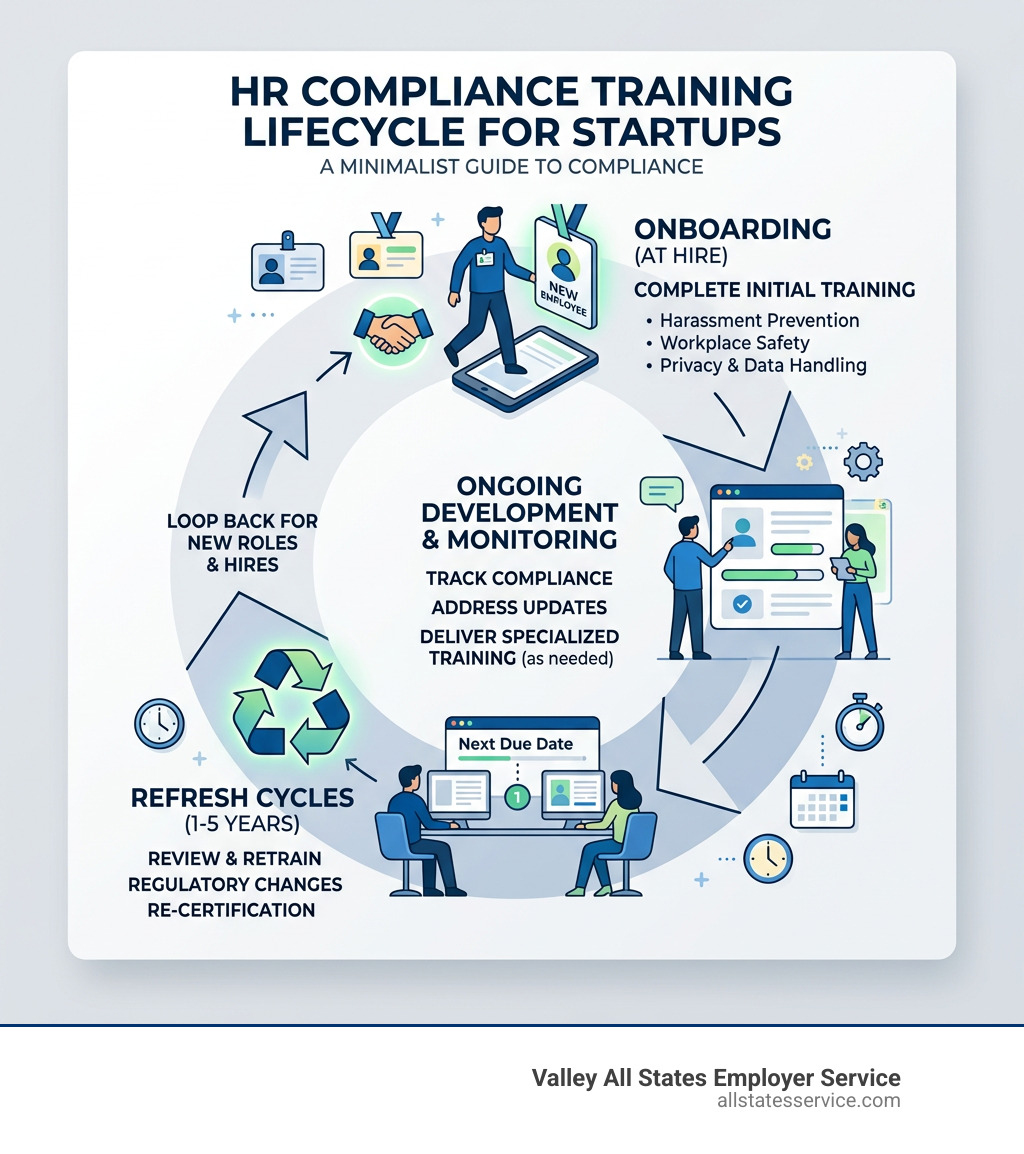
Quick look at hr compliance training:
Why Mandatory Training is the Foundation of Your Business
When you are running a fast paced startup, it is tempting to view training as a “nice to have” or something to tackle once you hit a certain headcount. However, mandatory training is actually your strongest shield against operational disaster. It serves three primary functions: risk mitigation, employee safety, and legal defense.
Think of it this way: a single month of professional compliance support often costs less than 30 minutes of a lawyer’s time. By investing in a solid hr-compliance-guide-2026, you are essentially buying insurance for your company’s reputation. Research shows that 95% of non-compliant employers aren’t trying to break the law, they just don’t know what the laws are.
A proactive hr-compliance-risk-assessment helps you identify where your team is most vulnerable. For example, scientific research on workplace harassment prevention suggests that clear, consistent training significantly reduces the likelihood of toxic behavior taking root. For a startup, where culture is everything, preventing a single harassment claim can save your brand and your bank account from total collapse.
Essential Topics for North American Compliance Programs
Whether you are operating in Maryland or expanding into Ontario, your hr-compliance-training must cover several non-negotiable bases. These topics ensure you meet federal and local standards while keeping your workers safe and respected.
Key areas include:
- Safety Standards: WHMIS in Canada or OSHA in the U.S.
- Accessibility: Ensuring your workplace and services are usable by everyone.
- Harassment Prevention: Mandatory in jurisdictions like New York, California, and all of Canada.
- Data Privacy: Handling sensitive employee and client information correctly.
For those managing smaller teams, a hr-compliance-for-small-business strategy focuses on the highest-impact hr-regulatory-compliance topics first.
[TABLE] Comparing Canadian and US Training Requirements
| Topic | Canada (Federal/Provincial) | United States (Federal/State) |
|---|---|---|
| Safety | WHMIS (Hazardous Materials) | OSHA (Occupational Safety) |
| Accessibility | AODA (Ontario) / Federal Acts | ADA for Supervisors |
| Privacy | PIPEDA / Provincial Privacy Laws | HIPAA (Health) / State Privacy Laws |
| Leave | Employment Standards Acts | FMLA |
| Eligibility | Social Insurance Number Verification | I-9 Compliance |
Key Canadian HR Compliance Training Requirements
In Canada, compliance is a mix of federal laws (like Bill C-65 for federally regulated sectors) and provincial mandates. In Ontario, for instance, Bill 168 and Bill 132 require employers to have robust policies and training regarding workplace violence and sexual harassment.
Furthermore, the Accessibility for Ontarians with Disabilities Act (AODA) requires specific training on how to interact with people with various disabilities. Failure to provide this can lead to significant Ministry of Labour fines. Privacy is also a major pillar, with PIPEDA setting the gold standard for how personal information is collected and used.
Key US HR Compliance Training Requirements
For our U.S. clients, particularly those in Maryland and surrounding states, the focus shifts to federal giants like the Americans with Disabilities Act (ADA) and the Family and Medical Leave Act (FMLA). Managers need to understand the “Duty to Accommodate” to avoid discrimination lawsuits.
One of the most critical administrative hurdles is i-9-compliance-training. Every single hire must have a properly completed Form I-9 to prove they are legally allowed to work in the U.S. Mistakes here are common and expensive, which is why specialized training or outsourcing is often the smartest move for a lean startup.
Implementing Effective Training with LMS and SCORM Technology
Gone are the days of cramming everyone into a windowless breakroom for a four hour PowerPoint presentation. Modern startups use technology to make hr compliance training engaging and trackable.

A Learning Management System (LMS) allows you to host all your courses in one place. If you already have a platform you love, you can often purchase SCORM Files from training providers. These are standardized files that “plug and play” into almost any system, allowing you to keep your training data centralized.
Using an LMS offers several “set it and forget it” benefits:
- Auto-Enrollment: New hires get their mandatory courses assigned the moment they are added to the system.
- Progress Tracking: See exactly who has finished their hr-compliance-assistance modules and who needs a nudge.
- Digital Sign-offs: Capture live signatures to prove employees have read and understood company policies.
Using Job Hazard Analysis to Identify Site-Specific Needs
Not every employee needs the exact same training. A software developer doesn’t face the same risks as a warehouse manager. This is where a Job Hazard Analysis (JHA) comes in. By performing a JHA, you identify the specific hazards associated with a particular role.
Once the hazards are identified, you can use an Employee Health & Safety Checklist to assign role-specific training. This ensures your team isn’t bored by irrelevant content while making sure they are actually prepared for the risks they truly face.
Staying Ahead of 2025 HR Compliance Training Changes
As we look toward 2025, the landscape is shifting toward even more automation and transparency. Governments are becoming stricter about how often training is refreshed and how it is documented.
One major trend for 2025 is the move toward auto-notifications. Many systems are being updated to automatically email employees (and their managers) 30 days before a certification expires. This removes the administrative burden of manual tracking and ensures you never fall out of compliance.
Refresh intervals are also becoming more standardized. While some orientation is “one and done,” most critical courses like Harassment Prevention or Privacy training now require a refresh every 1, 3, or 5 years. Failing to hit these windows can be seen as negligence in a court of law.
Staying proactive with a hr-compliance-review or an hr-compliance-audit-guide-2025 will help you spot these expiring certifications before they become a liability.
Frequently Asked Questions about HR Training
Navigating hr compliance training often brings up the same few questions. Let’s clear up some common myths and concerns.
Myth: “We’re a startup with under 10 people, so these laws don’t apply to us.” Fact: While some specific laws have employee thresholds, many safety, harassment, and privacy laws apply from day one, employee one.
Myth: “If I trained them three years ago, I’m covered forever.” Fact: Laws change and memories fade. Most jurisdictions require periodic refreshers to maintain legal “due diligence.”
How often must employees complete hr compliance training?
The frequency depends entirely on the topic and your location. However, here is a general rule of thumb used by high-compliance organizations:
- Annual Refresh: High-risk topics like HIPAA (privacy) or specific safety certifications.
- 3-Year Cycle: Harassment and violence prevention, AODA/ADA accessibility, and supervisor due diligence.
- 5-Year Cycle: General health and safety awareness or WHMIS.
What are the penalties for failing to provide hr compliance training?
The costs of “winging it” are high. You could face:
- Ministry/Department of Labor Fines: These can range from hundreds to tens of thousands of dollars per violation.
- Legal Liability: If an incident occurs and you can’t prove the employee was trained, your “due diligence” defense vanishes.
- Worker Complaints: Employees who feel unsafe or disrespected are more likely to file formal complaints, triggering expensive audits.
Can startups use online courses for mandatory certifications?
Absolutely. In fact, for most startups, online on-demand learning is the only practical way to stay compliant. Online courses provide digital certificates and automated recordkeeping that are much easier to produce during an audit than a box of paper sign-in sheets.
Building a Compliant Future for Your Startup
Building a startup is hard enough without worrying about a surprise audit or a preventable lawsuit. By setting up a robust hr compliance training program early, you are building a culture of respect and safety that will help you attract and retain top talent.
At Valley All States Employer Service, we specialize in taking the “compliance headache” off your plate. Whether you need expert hr-compliance-assistance or a hr-compliance-complete-guide-businesses to get started, we are here to help.
Our team provides outsourced E-Verify workforce eligibility verification to ensure your U.S. hiring process is flawless and federal-standard compliant. We focus on the technical details so you can focus on scaling your business.
Ready to simplify your workforce eligibility and training? Learn more about our hr-compliance-assistance today and let’s build a compliant future together.