
Federal acquisition regulation far e verify clause: Essential 2025
Why the Federal Acquisition Regulation FAR E-Verify Clause Matters for Your Business
The federal acquisition regulation far e verify clause is a requirement in some federal contracts mandating the use of E-Verify for employment eligibility. For businesses with federal contracts, understanding this clause is a legal obligation that affects your ability to work with the government.
Quick Answer: What You Need to Know
- Location: The FAR E-Verify clause is found at FAR 52.222-54, governed by Subpart 22.18
- Who It Affects: Federal prime contractors and subcontractors with qualifying contracts awarded after September 8, 2009
- Contract Triggers: Contracts exceeding $150,000 with a performance period of 120+ days
- Your Obligations: Enroll in E-Verify within 30 days of contract award and verify new hires plus employees assigned to the contract
- Subcontract Threshold: The requirement flows down to subcontracts over $3,500 for services or construction
- Consequences: Non-compliance can lead to contract termination, suspension, or debarment from federal contracting
Stemming from a 2008 Executive Order, the E-Verify Federal Contractor Rule ensures the government works only with companies that maintain a legal workforce. Unlike the standard Form I-9 process, this clause adds an electronic verification step for federal contractor employees.
For HR managers, the stakes are high. The clause introduces strict timelines, specific verification rules, and serious penalties. Many contractors find these obligations only after winning a contract, leaving little time to prepare.
This guide explains the FAR E-Verify clause, detailing when it applies, your obligations, and how to avoid costly compliance failures.
Understanding the Federal Acquisition Regulation (FAR) E-Verify Clause
The Federal Acquisition Regulation is the government’s rulebook for procurement. A key part is Subpart 22.18 – Employment Eligibility Verification, which ensures federal contractors only hire people legally authorized to work in the U.S.
Subpart 22.18 mandates that contractors use the E-Verify system, run by the Department of Homeland Security (DHS) and U.S. Citizenship and Immigration Services (USCIS). The goal is to uphold immigration laws by ensuring a legal workforce for all federal contractors.
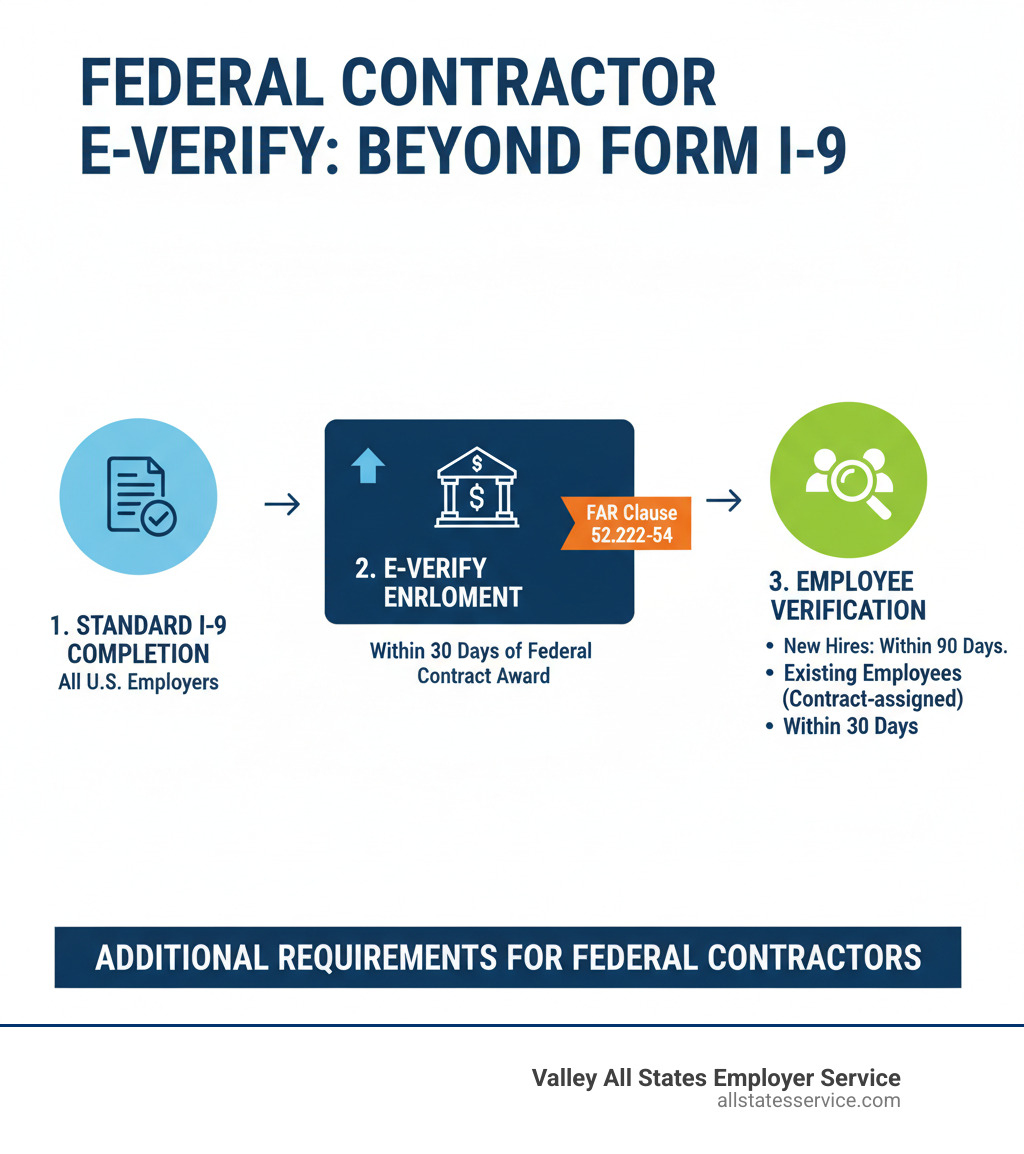
While all U.S. employers must complete Form I-9, the federal acquisition regulation far e verify clause adds another layer for federal contractors. You must use the E-Verify electronic system to cross-check employee information against government databases. Our E-Verify Program Complete Guide offers more detail.
What is the federal acquisition regulation far e verify clause?
The federal acquisition regulation far e verify clause is the contract language in FAR 52.222-54, titled “Employment Eligibility Verification.” When included in your federal contract, it’s a binding obligation requiring you to enroll in and use E-Verify for certain employees.
This clause transforms E-Verify from a voluntary program into a contractual requirement. Think of it as the enforcement mechanism for the government’s policy of only doing business with companies that follow U.S. immigration laws. Understanding the broader context of Federal E-Verify Rules helps you see how this clause fits into the bigger compliance picture.
Key Definitions You Must Know
Getting these definitions right is crucial because they define who gets verified and when.
Employee assigned to the contract refers to any employee performing substantial duties on your federal contract, directly or indirectly. It generally excludes staff in purely administrative or overhead roles unless their work is essential to the contract.
Subcontractor is any supplier, vendor, or firm providing supplies or services to a prime contractor. The FAR E-Verify clause can flow down to subcontractors, making them subject to the same rules.
Commercially Available Off-the-Shelf (COTS) item is a product sold to the general public. Contracts for COTS items are often exempt from E-Verify, though this exemption has limits.
United States, as legally defined by 8 U.S.C. 1101(a)(38), includes the 50 states, D.C., Puerto Rico, Guam, the CNMI, and the U.S. Virgin Islands. This definition determines where the E-Verify rules apply.
Does the FAR E-Verify Clause Apply to You?
Determining if the federal acquisition regulation far e verify clause applies to you is critical. Not all federal contracts trigger E-Verify. The rule targets prime contractors and subcontractors with contracts awarded after September 8, 2009, containing the clause. Existing contracts can also be amended to include it.
Prime contractors should check their contract for FAR clause 52.222-54. For subcontractors, the obligation flows down from the prime contractor under specific conditions. Our guide on What Employers Are Required to Use E-Verify? can clarify your status.
Your contracting officer makes the final determination, but you should understand the criteria to avoid surprises.
Contract Triggers: When the Clause is Included
The federal acquisition regulation far e verify clause is included in contracts based on specific triggers. Knowing these helps you anticipate your obligations.
The clause is triggered if a contract’s value exceeds $150,000 and its performance period is 120 days or longer. Short-term or lower-value contracts are typically exempt.
Additionally, some portion of the work must be performed in the United States, as defined by 8 U.S.C. 1101(a)(38). Contracts performed entirely overseas are exempt.
Contracts solely for commercially available off-the-shelf (COTS) items are generally exempt. This includes slightly modified COTS items and related services. When in doubt, ask your contracting official for confirmation.
How the federal acquisition regulation far e verify clause impacts subcontracts
The federal acquisition regulation far e verify clause extends to subcontractors via a flow-down requirement. If the prime contract has the clause, the prime contractor must pass it to their subcontractors.
This requirement applies to subcontracts that are for services or construction, exceed $3,500 in value, and are performed in the United States. Subcontracts for supplies or below this value are exempt.
This can catch many smaller businesses off guard. That’s why many turn to expert support like our E-Verify for Contractors service to manage these requirements smoothly.
Your Step-by-Step Compliance Checklist
If the federal acquisition regulation far e verify clause applies to you, you need a compliance plan. The requirements are sequential and work with the Form I-9 process. You must still complete a Form I-9 for every hire, then use E-Verify for specific workers.
First, enroll in E-Verify as a federal contractor. This is your top priority if not already done. After enrolling, you must verify all new hires working in the U.S., not just those on the federal contract.
You must also verify existing employees assigned to the federal contract. This includes current staff performing substantial duties for the contract, like engineers or IT specialists. General administrative staff are typically excluded.
Maintaining accurate Form I-9s and E-Verify records is your safety net. Our E-Verify Onboarding Process guide walks through these steps in greater detail.
Key Timelines for Enrollment and Verification
Missing these deadlines can cause serious compliance problems. Build these timelines into your contract management process.
If your contract includes the FAR E-Verify clause, you have 30 calendar days from the award date to enroll in E-Verify. Start immediately, as the process can take time.
For new hires in the U.S., you must create an E-Verify case within 3 business days of their hire date. This applies to all new hires company-wide after you enroll. There is a 90-day grace period after enrollment to implement this.
For existing employees assigned to the contract, you must verify them within 90 calendar days of enrollment or 30 calendar days of their assignment to the contract, whichever is later. These timelines are a key part of E-Verify Employer Requirements.
Managing E-Verify Results: From Confirmation to TNCs
E-Verify returns a result within seconds. An Employment Authorized result means the employee is verified, and the case is closed.
A Tentative Nonconfirmation (TNC) indicates a data mismatch, not illegal work status. It can result from typos, name changes, or outdated records and is often resolvable.
If you receive a TNC, you must immediately give the employee the Further Action Notice. This explains the issue and how to resolve it. The employee has 8 federal government workdays to decide whether to contest it.
You cannot take adverse action against an employee, such as firing or suspending them, while they contest a TNC. This protection ensures they have a fair chance to correct errors. Our E-Verify Tentative Nonconfirmation guide provides more detail.
If an employee contests the TNC, they work with the relevant government agency to resolve it. If they succeed, the result becomes Employment Authorized. If they don’t contest or can’t resolve the issue, it becomes a Final Nonconfirmation.
You may only consider termination after a Final Nonconfirmation, and you should consult legal counsel first. Handling TNCs correctly is crucial for compliance with the federal acquisition regulation far e verify clause and for fair treatment of employees. The official TNC Mismatch Overview offers more guidance.
Navigating Exceptions, Waivers, and Special Cases
Not every federal contract or employee falls under the federal acquisition regulation far e verify clause. Understanding these exceptions saves time and ensures compliance.
General exemptions are straightforward. The clause does not apply to contracts under 120 days, valued at $150,000 or less, performed entirely outside the U.S., or exclusively for commercially available off-the-shelf (COTS) items. If you have existing employees, our guide on E-Verify for Existing Employees can help clarify your obligations.
Who is Exempt from Verification?
Even when the federal acquisition regulation far e verify clause applies, some employees are exempt from verification, usually because they have already been vetted by the government.
Employees with active U.S. Government security clearances (confidential, secret, or top secret) are exempt, as they have already been thoroughly vetted.
Employees holding an HSPD-12 credential are also exempt due to the comprehensive background check required to receive it.
Previously verified employees do not need to be run through E-Verify again for a new contract, unless you believe the prior verification was flawed.
The Exemptions and Exceptions page on the E-Verify website provides additional details on these scenarios.
Special Rules for IDIQ Contracts and Other Scenarios
Certain contracts and entities have special rules under the federal acquisition regulation far e verify clause.
Indefinite-Delivery/Indefinite-Quantity (IDIQ) contracts can be modified to include the clause for future orders. Your 30-day enrollment period begins from the modification date.
Institutions of higher education, state or local governments, and federally recognized Indian tribes can choose to verify only new hires assigned to the federal contract, rather than all new hires.
The Commonwealth of the Northern Mariana Islands (CNMI) has a different effective date for employment authorization requirements: November 27, 2009.
The Stakes are High: Consequences of Non-Compliance
Understanding the consequences of non-compliance with the federal acquisition regulation far e verify clause is essential for protecting your business.

The federal government takes E-Verify compliance seriously. A contract with the FAR E-Verify clause is a binding commitment. Failure to comply can lead to severe consequences beyond a warning letter.
Contract termination is a primary risk. The contracting agency can terminate your contract for default, leading to lost revenue and damaged agency relationships.
Suspension and debarment are more severe. Suspension temporarily bars you from new federal contracts, while debarment excludes you for a specified period, effectively shutting you out of the federal marketplace.
While the clause itself doesn’t impose direct fines, financial penalties arise from disallowed costs, legal fees, and lost revenue from terminated or lost contracts.
A compliance failure causes reputational damage. It can make agencies hesitant to work with you and affect your ability to attract talent, tarnishing your company’s standing.
These are real risks. A robust compliance program is the foundation of sustainable federal contracting. Our Employment Compliance Ultimate Guide provides insights into building systems that protect your business.
What Happens if Your E-Verify MOU is Terminated?
Terminating your E-Verify Memorandum of Understanding (MOU) is a serious issue. The MOU grants you access to the E-Verify system, and without it, you cannot meet your FAR E-Verify obligations.
MOU termination can result from significant rule violations, such as failing to verify employees, pre-screening applicants, or mishandling TNCs. Once initiated by DHS or SSA, the process is swift.
First, your case is referred to the debarring official at the relevant agency for consideration of suspension or debarment.
You then enter an excused obligations period. You are temporarily excused from E-Verify duties because you lack system access, but you are in limbo pending a final decision.
The decision and re-enrollment requirements depend on the debarring official’s conclusion. If suspended or debarred, you cannot use E-Verify for that period. If not, you must re-enroll in E-Verify within 30 days. Once re-enrolled, all obligations under the federal acquisition regulation far e verify clause resume, and you must verify employees missed during the excused period.
Prevention is far better than cure. The stress and business impact of MOU termination far exceed the effort of maintaining compliance from the start. Our I-9 E-Verify Compliance Guide offers best practices to help you avoid this scenario.
Frequently Asked Questions about the FAR E-Verify Clause
The federal acquisition regulation far e verify clause raises many questions. Here are answers to the most common ones we hear from federal contractors.
Can I use E-Verify for all my employees if I have a federal contract?
Yes. If your contract has the FAR E-Verify clause, you can choose to verify all existing employees, not just those assigned to the contract. This option simplifies compliance by creating one consistent policy, reducing the risk of missing an employee. Many contractors find this easier than tracking assignments. Our guide on E-Verify for Existing Employees has more information.
What if my contract doesn’t have the FAR E-Verify clause?
If your contract lacks the federal acquisition regulation far e verify clause (FAR 52.222-54), you are not required to use E-Verify as a federal contractor. However, you may still have obligations under state law. Some states mandate E-Verify for certain employers. Check our guide on What Employers Are Required to Use E-Verify? to see if state laws apply. You can also participate in E-Verify voluntarily.
How does a government shutdown affect my E-Verify obligations?
During a government shutdown, E-Verify services may be suspended. You are typically excused from creating cases during the outage. However, once services resume, you must catch up on all missed cases within a grace period announced by USCIS.
Your action plan during a shutdown should include:
- Document everything: Keep records of hiring dates and attempts to access E-Verify.
- Stay informed: Monitor official USCIS and E-Verify announcements for new deadlines.
- Adjust timelines: Be ready to handle TNCs with updated deadlines once the system is back.
- Communicate: Coordinate with your contracting officer to confirm new timeframes.
Proactive communication and thorough documentation are key during these uncertain periods.
Simplify Your Federal Compliance Journey
The federal acquisition regulation far e verify clause is complex. Juggling eligibility, timelines, and TNCs is a major challenge when you’re focused on delivering great work for your federal contracts.
Small E-Verify mistakes can lead to serious contract issues. The administrative burden can overwhelm your HR team, distracting them from strategic work that grows your business.
That’s why Valley All States Employer Service exists. We specialize in outsourced E-Verify verification for federal contractors. Our team, based in Lutherville, Maryland, serves clients nationwide, expertly handling the FAR E-Verify clause requirements for you.
Partnering with us provides peace of mind. We minimize errors, handle verifications accurately and on time, and free up your HR staff to focus on core business priorities.
We understand that your federal contracts represent significant opportunities. Don’t let E-Verify complexity put those opportunities at risk. Whether you’re a seasoned federal contractor or just won your first qualifying contract, we can help you steer the requirements with confidence.
Ready to take E-Verify off your plate? Explore our E-Verify Employer Agent Service to see how we handle the details for you, or visit our dedicated page to Streamline your federal contractor compliance and get started today.