
How to Master Virtual Employee Verification Services Without Losing Your Mind
The Hidden Risks Making Virtual Employee Verification Services Essential Right Now
Virtual employee verification services are digital tools and platforms that help employers confirm a remote candidate’s identity, employment history, income, and work eligibility, without requiring anyone to be in the same room.
Here’s a quick breakdown of what they cover:
| Verification Type | What It Confirms | Common Tools |
|---|---|---|
| Identity verification | The person is who they claim to be | Biometric checks, liveness detection |
| Employment history | Past job titles, dates, and employers | Industry databases, background check platforms |
| Income verification | Actual earnings from past roles | Payroll APIs, income verification tools |
| I-9 eligibility | Legal right to work in the U.S. | E-Verify, digital I-9 platforms |
Remote work has made hiring faster and more flexible. But it has also opened the door to fraud on a scale that is hard to ignore.
Consider this: 73% of resumes contain false information. Ghost employees, on average, collect more than $50,000 before anyone notices, and they go undetected for 18 months. In 2024 alone, the FTC reported $501 million in losses tied to job scams.
Perhaps most alarming, over 300 U.S. companies, including Fortune 500s, unknowingly hired North Korean IT workers using stolen identities. These workers accessed internal systems remotely, and in at least one documented case, a single infiltrator stole $900,000 and proprietary source code before being caught.
The old way of verifying employees, phone calls, faxes, and paper files, was already slow and error-prone. For remote teams, it is simply not enough anymore.
That’s where virtual employee verification services come in. Whether you manage a distributed team, work with offshore contractors, or simply want to protect your business from costly hiring mistakes, understanding your options is the first step.
Basic virtual employee verification services terms:
- I-9 compliance management
- employment eligibility verification department of homeland security
- employment and income verification services
Understanding the Different Types of Virtual Employee Verification Services
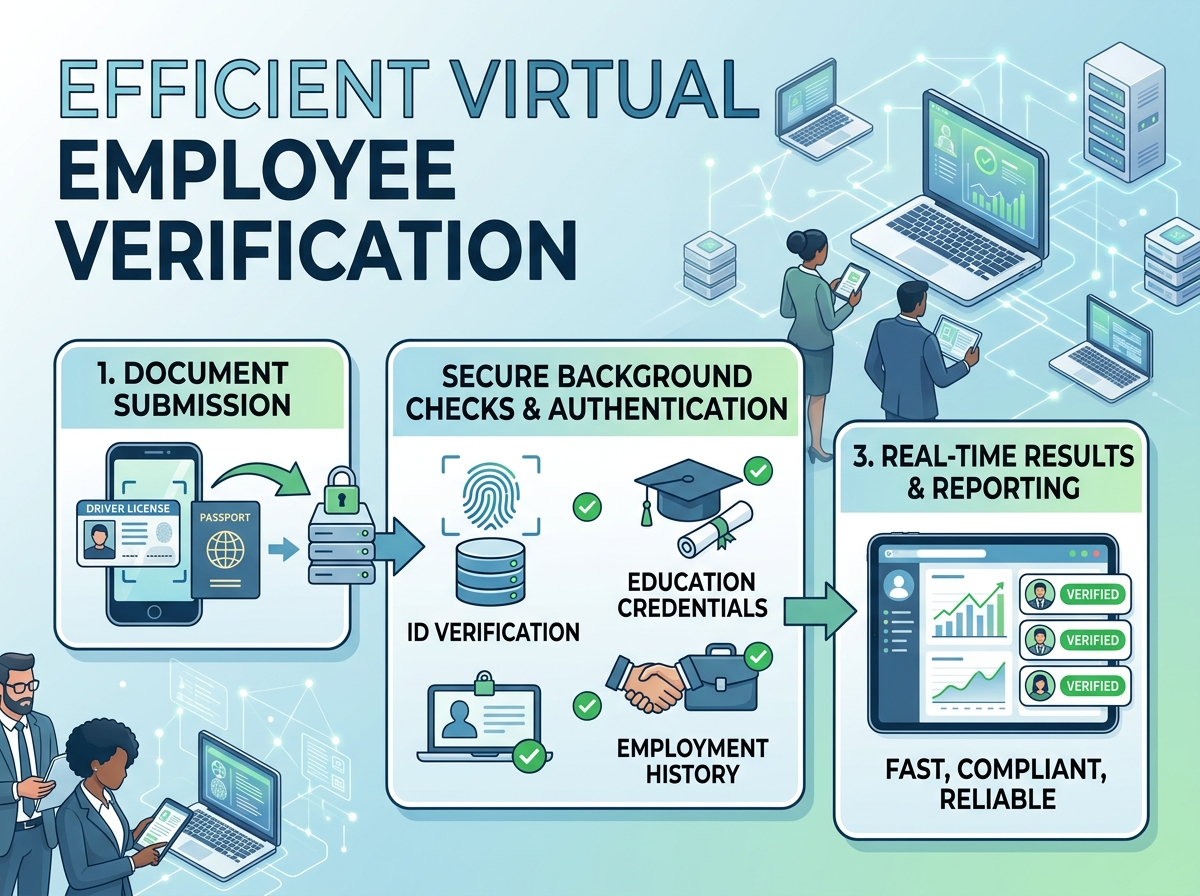
When we talk about virtual employee verification services, we are really looking at a multi-layered shield for your business. It is not just about checking a box, it is about ensuring that the person you are paying is actually who they say they are and has the right to work for you.
Employment History and Income Verification
These services dig into a candidate’s professional past. Large industry databases maintain massive records, currently holding over 800 million employee records, to provide instant proof of where someone worked and what they earned. This is vital for catching the 73% of applicants who might exaggerate their experience.
For specific staffing firms like Doherty Staffing Solutions, the process is streamlined using specific employer codes to give verifiers instant access. Other modern platforms focus on speed, often completing these checks in under 24 hours.
I-9 Eligibility and E-Verify
This is the legal backbone of hiring in the United States. Every employer must complete Form I-9 to verify identity and work authorization. For remote teams, E-Verify acts as a digital cross-check against Department of Homeland Security (DHS) and Social Security Administration (SSA) records.
If you are hiring remotely in Maryland, you need to stay on top of remote I-9 compliance to avoid hefty fines. The DHS now allows an “Alternative Procedure” for E-Verify enrolled employers, which involves a live video call to inspect documents rather than requiring an in-person meeting.
Comparing the Core Checks
To help you visualize how these differ, we’ve put together a quick comparison:
| Feature | Employment Verification | Income Verification | I-9/E-Verify |
|---|---|---|---|
| Primary Goal | Confirm job titles and dates | Confirm salary/earnings | Confirm legal right to work |
| Legal Mandate | Optional (Best Practice) | Optional (Lending/Hiring) | Mandatory for all US hires |
| Data Source | Payroll records/HR databases | Payroll/Tax records | Government databases (DHS/SSA) |
| Remote Method | Digital API/Database | Secure Employee Portal | Virtual I-9 video review |
The Pillars of Effective Virtual Employee Verification
A high-quality virtual employee verification service should do more than just relay data. It needs to be a proactive defense mechanism. If a service takes two weeks to get back to you, you’ve likely already lost your top candidate to a competitor.
Advanced Identity Verification
Traditional background checks look at the past, but modern biometric tools look at the “now.” They use 3D liveness detection to ensure the person on the webcam isn’t a high-tech deepfake or a static photo. Gartner predicts that by 2028, 1 in 4 candidates will be fake, making these biometric matches essential.
Fraud Mitigation and Synthetic IDs
Bad actors often create “synthetic identities” by mixing real Social Security numbers with fake names. Modern virtual employee verification services use AI to flag these anomalies. This prevents “ghost employees,” who, as we noted, can drain a company of $50,000 or more before being detected.
Speed and Integration
We know HR departments are busy. On average, HR spends 15 minutes per manual verification request. Automated platforms reduce this to minutes. By integrating directly with your ATS (Applicant Tracking System) or HRIS (Human Resource Information System), the data flows seamlessly without manual entry.
Compliance Standards for Virtual Employee Verification Services
Staying compliant isn’t just about following rules, it is about protecting your business from audits. For remote employees, the USCIS I-9 remote verification guidelines are the gold standard.
The DHS Alternative Procedure
If your company is enrolled in E-Verify, you can use the virtual document room approach. This requires you to:
- Examine copies of the employee’s documents.
- Conduct a live video interaction with the employee.
- Retain clear copies of all documents used for the I-9.
If you aren’t using the virtual option, you might need to use third-party I-9 verification where an authorized representative meets the employee in person. Some providers have a network of thousands of representatives to facilitate this.
Security and Privacy Certifications
When you use virtual employee verification services, you are handling sensitive PII (Personally Identifiable Information). Look for partners that are SOC 2 Type 2 certified and use FIPS 140-2 encryption. Leading platforms claim to reduce data exposure by 99% by using real-time APIs instead of sending static files back and forth.
Streamlining Verifications for Your Extended Workforce
Hiring doesn’t always stop at the U.S. border. Many companies use staff augmentation models or offshore teams in places like Noida, India. Verifying a “Virtual Employee” or a “Zirtual” assistant requires a global perspective.
Global Source Networks
Specialized services offer coverage in over 200 countries. They can verify international passports, local criminal records, and global sanctions lists. This ensures that your remote developer in Europe or your customer service lead in Asia meets the same rigorous standards as your local hires.
Challenges with Outsourcing
When working with outsourcing companies, it is important to verify the individual, not just the agency. Using outsourced employment verification helps you cut through the noise. Most verifications for international virtual employees are still completed in under 24 hours, ensuring your global pipeline stays moving.
Frequently Asked Questions about Virtual Hiring
How long do virtual employment verifications typically take?
If you go the manual route, expect to wait 3 to 10 days while you play phone tag with HR departments. However, modern virtual employee verification services have flipped the script. Some platforms deliver a portion of their results instantly, and the vast majority are finished within 3 days. Automated services provide data in seconds, provided the employer is in their database.
What are the risks of hiring ghost employees in a remote environment?
The risks are both financial and digital. A ghost employee is someone on your payroll who doesn’t actually exist or isn’t doing the work, often a result of identity theft. They go undetected for 18 months on average. Beyond the $50,000+ in lost wages, these “employees” often serve as a Trojan horse for state-sponsored hackers to exfiltrate proprietary source code or plant ransomware.
How do I verify income for a remote employee without compromising privacy?
The best way is to use a “Salary Key” or a secure employee portal. For example, an employee can generate a six-digit code that gives a verifier one-time access to their income data. Modern services take an “integrity-first” approach, meaning they never sell employee data and only allow access to authorized verifiers. This keeps the employee in control of their sensitive financial information.
Choosing the Right Partner for Your Business
Choosing between different virtual employee verification services comes down to your specific needs. Are you a small business in Maryland looking to stay compliant with Maryland I-9 remote guide rules? Or a large corporation hiring hundreds of people a month?
We at Valley All States Employer Service understand that the administrative burden of E-Verify and I-9 compliance can be overwhelming. By outsourcing these tasks, you don’t just save time, you significantly reduce the risk of errors that lead to government fines.
When evaluating a partner, look for:
- Scalability: Can they handle your growth?
- Integration: Do they play nice with your current HR software?
- Compliance Expertise: Do they stay updated on the latest DHS and USCIS changes?
- Cost-Benefit: Does the fee per check outweigh the 15 minutes of HR time and the risk of a $2,000 fine per incorrect I-9?
Ready to simplify your virtual employee verification process and ensure compliance? Learn more about our comprehensive employment verification services today!