
Why E-Verify Service Maryland Matters for Your Business
E-Verify service Maryland is a critical compliance requirement for employers hiring new employees in the state. While federal law mandates Form I-9 completion for all U.S. employers, Maryland has specific requirements that employers must understand to avoid costly penalties and ensure proper workforce verification.
Quick Answer: E-Verify in Maryland
- Federal Requirement: All Maryland employers must complete Form I-9 for every new hire
- E-Verify Mandate: Maryland employers with more than 10 employees must register with the federal E-Verify system
- Timeline: Submit E-Verify cases within three business days of an employee’s start date
- Reporting: Use the Maryland New Hire Portal to report all new hires within 20 days
- Penalties: Fines up to $10,000 per violation for non-compliance
- Records: Keep I-9 forms for three years and E-Verify records for specified periods
If you’re an HR manager in Maryland, you’re juggling federal Form I-9 requirements, state-specific E-Verify mandates, and the constant worry of making a costly mistake. The stakes are high. One misstep can lead to thousands of dollars in fines, not to mention the time spent responding to audits or investigations.
The good news? Understanding Maryland’s E-Verify requirements doesn’t have to be overwhelming. This guide breaks down exactly what you need to know, from the basics of the Form I-9 process to handling tricky situations like Tentative Nonconfirmations and remote employees.
Maryland’s approach combines federal immigration law with state-level oversight through the Maryland Department of Labor. This means you’re navigating two sets of rules simultaneously. Federal law requires the Form I-9 process for identity and employment authorization verification. Maryland adds its own layer by requiring most employers to use the federal E-Verify system and report new hires through a state portal.
The confusion often starts with a simple question: Is E-Verify mandatory in Maryland? The answer depends on your company size and industry, but for most employers with more than 10 employees, the answer is yes.
Understanding the Basics: E-Verify and Form I-9
Let’s start with the fundamentals. What exactly are E-Verify and Form I-9, and why are they so important for employers in Maryland?
E-Verify is an online system administered by the U.S. Department of Homeland Security (DHS) in partnership with the Social Security Administration (SSA). Its core purpose is to help employers electronically confirm the employment eligibility of their newly hired employees. Think of it as a digital check to ensure that the individuals you hire are authorized to work in the United States.
This system works hand-in-hand with the Form I-9, Employment Eligibility Verification. The Form I-9 is a paper document that all U.S. employers must complete for every new hire, regardless of their citizenship status. This requirement stems from the 1986 Immigration Reform and Control Act, which made it unlawful for employers to knowingly hire or continue to employ individuals not authorized to work in the United States.
So, how does E-Verify supplement the Form I-9? An employee provides their identifying information and documentation on the Form I-9. The employer then takes this information and enters it into the E-Verify system. E-Verify then compares this data against records available to the DHS and SSA. If the information matches, the employer receives confirmation that the employee is eligible to work. It’s a crucial step in ensuring your workforce is compliant.
For a deeper dive into how these two systems integrate, explore More info about E-Verify and I-9.
Federal vs. State Requirements
Here’s where things can get a little tricky, especially when discussing E-Verify service Maryland. Federally, the Form I-9 process is mandatory for all employers nationwide. Every individual hired for employment in the United States, whether a citizen or noncitizen, must have their identity and employment authorization verified with this form.
E-Verify, however, was initially designed as a voluntary program at the federal level. There’s a significant exception, though: federal contractors or subcontractors whose contracts include the Federal Acquisition Regulation (FAR) E-Verify clause are required to use E-Verify for their employees working on those contracts.
States, including Maryland, have the authority to enact their own laws regarding employment eligibility verification, often going beyond federal mandates. This means that while E-Verify might be voluntary for some employers at the federal level, it could be mandatory at the state level. Maryland has taken this step, adding layers of requirements that impact many businesses operating within its borders.
Understanding these state-specific nuances is key to compliance. To learn more about how E-Verify requirements vary across the country, check out More info about E-Verify state laws.
Who Oversees Verification in Maryland?
When it comes to work authorization verification in Maryland, several entities play a role. At the state level, the Maryland Department of Labor is primarily responsible for overseeing and enforcing work authorization laws. Specifically, its Office of Foreign Labor Certification (OFLC) plays a role in verifying employer compliance with employment eligibility laws. If an employee has concerns or wishes to appeal a work authorization decision, they can file a complaint with the Maryland Department of Labor, Licensing and Regulation (DLLR), which will then investigate the matter.
On the federal side, the U.S. Citizenship and Immigration Services (USCIS) administers the E-Verify program. Immigration and Customs Enforcement (ICE) is the primary federal agency responsible for enforcing immigration laws, including those pertaining to employment eligibility. This dual oversight means employers in Maryland must be diligent in adhering to both state and federal regulations.
For comprehensive information about employment laws in Maryland, including those related to work authorization, visit More info about Maryland employment law.
E-Verify Service Maryland: State-Specific Requirements for Employers
Maryland has established clear requirements for employers regarding work authorization verification, building upon federal mandates. Let’s look at what your business needs to do to stay compliant.

Beyond completing the Form I-9, Maryland employers must use the federal E-Verify system for newly hired employees and also report new hires to the state’s New Hire Portal. This layered approach ensures a robust system for verifying employment eligibility. Record-keeping is also paramount, with specific rules dictating how long you must retain I-9 forms and E-Verify results. Some industries might even find themselves subject to additional, more specific requirements.
For a comprehensive look at Maryland’s E-Verify landscape, dig into More info about Maryland E-Verify.
Are All Maryland Employers Required to Use E-Verify?
This is a common question, and the answer, as is often the case with compliance, has some specifics. While federal law requires all employers to complete Form I-9 for every new hire, Maryland adds a specific requirement for E-Verify.
According to Maryland regulations, employers with more than 10 employees must register with the E-Verify Program. This means if your business falls into this category, using the federal E-Verify system is not optional for your newly hired employees. The state requires you to verify the work authorization of all new hires through this system.
This goes beyond simply completing the Form I-9. You must also use the federal E-Verify system to check the employment eligibility of any new hires within three business days of their start date. This is a key distinction from states where E-Verify remains entirely voluntary for private employers. Maryland has made a clear commitment to ensuring a legally authorized workforce.
For further details on when E-Verify becomes mandatory, explore More info about mandatory E-Verify.
How E-Verify Requirements Vary by Industry
While the general requirements for E-Verify service Maryland apply broadly, it’s important to recognize that some industries or sectors might have additional stipulations. For example, certain industries such as nursing and dental care, construction, and janitorial services may require employers to create a “Memorandum of Understanding” (MOU) for verification. These MOUs often outline specific procedures or heightened scrutiny for work authorization within those particular fields.
Beyond state-specific industry rules, federal contractors have a distinct set of obligations. If your business holds federal contracts or subcontracts that include the Federal Acquisition Regulation (FAR) E-Verify clause, you are required to use E-Verify for all employees working under that contract, and sometimes for your entire workforce, depending on the contract terms. These requirements often supersede general state mandates and require careful attention to detail.
It’s always a good idea to consult with legal counsel or HR experts if you operate in a specialized industry or engage in federal contracting to ensure you’re meeting all applicable requirements. To understand the specific E-Verify demands on federal contractors, visit More info about E-Verify for Federal Contractors.
Your Step-by-Step Guide to the Maryland Verification Process
Navigating the work authorization verification process in Maryland involves a few key steps, from the moment an employee accepts an offer to receiving their E-Verify result. Let’s break down this process to ensure a smooth and compliant onboarding experience.

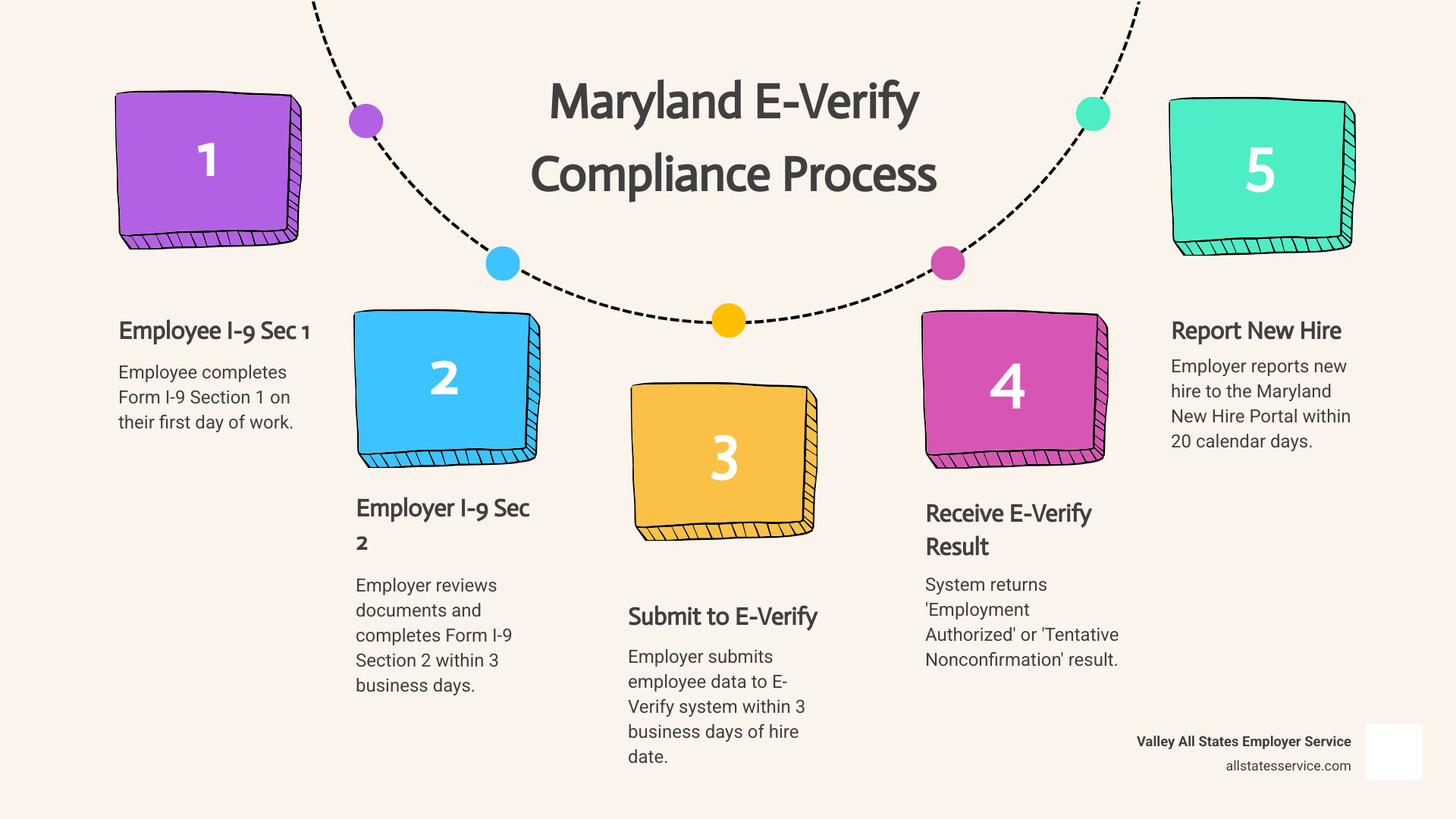
The journey begins with the employee completing Section 1 of the Form I-9 by the end of their first workday. This section gathers essential personal information and an attestation of their work authorization status. Next, the employer steps in, examining the employee’s original, unexpired documents to establish both their identity and eligibility to work. Based on these documents, the employer completes Section 2 of the Form I-9, typically within three business days of the hire date.
Once the Form I-9 is complete, the employer submits the relevant data into the E-Verify system. E-Verify then quickly compares this information with records from DHS and SSA, usually providing a result within 3 to 5 seconds. This result will indicate whether the employee is authorized to work or if there’s a Tentative Nonconfirmation (TNC) that requires further action.
For a detailed walkthrough of the entire new hire verification process, including best practices, refer to More info about the new hire verification process.
Acceptable Documentation for Form I-9
Choosing the right documents for Form I-9 verification is crucial. Employees must present original, unexpired documents that verify both their identity and authorization to work in the U.S. Scans, photocopies, or images of documents are not accepted for this process.
The Form I-9 provides a comprehensive list of acceptable documents, categorized into three lists:
- List A Documents: These documents establish both identity and employment authorization. An employee needs to present only one document from List A. Examples include a U.S. Passport or Passport Card, a Permanent Resident Card (Form I-551), or a Foreign Passport with a temporary I-551 stamp or with an I-94 indicating nonimmigrant status and work authorization.
- List B Documents: These documents establish identity only.
- List C Documents: These documents establish employment authorization only.
If an employee cannot provide a List A document, they must present one document from List B and one document from List C.
Examples of documents commonly seen for verification include:
- Valid driver’s license or state ID (List B)
- Social Security Card (List C)
- Employment Authorization Document (Form I-766) (List A)
- Birth certificate (List C)
For the official and most current list of acceptable documents, we encourage you to View the official List of Acceptable Documents. Additionally, you can find more detailed guidance on acceptable documents through More info about I-9 acceptable documents.
Handling E-Verify Case Results
Once you’ve submitted an employee’s information to E-Verify, you’ll receive a case result. Understanding these results and knowing how to act on them is vital for compliance with E-Verify service Maryland.
The most common and desirable outcome is an Employment Authorized result. This means the information entered matched records available to DHS and SSA, confirming the employee is authorized to work. When you receive this, no further action is typically required, and you can close the case.
However, sometimes E-Verify returns a Tentative Nonconfirmation (TNC), also known as a mismatch. A TNC simply means that the information entered did not immediately match government records. A TNC does not mean the employee is not authorized to work. It merely indicates a discrepancy that needs to be resolved.
When an employee receives a TNC, they have the right to contest it. You, as the employer, must:
- Inform the employee of the TNC.
- Provide them with a “Further Action Notice” that explains the reason for the mismatch and how to resolve it.
- Allow the employee eight federal government working days to contact the relevant agency (DHS or SSA) to resolve the discrepancy.
- You cannot take any adverse action against an employee, such as terminating their employment, shortening their work hours, or delaying training, solely because they received a TNC and are in the process of resolving it.
If the employee chooses not to resolve the TNC, or if they attempt to resolve it but receive a Final Nonconfirmation (FNC), then you may terminate their employment without penalty. A Final Nonconfirmation confirms that the employee is not authorized to work in the U.S.
Navigating TNCs can be complex, and mishandling them can lead to significant penalties. For more in-depth information on managing these situations, refer to More info about E-Verify Tentative Nonconfirmation.
Avoiding Pitfalls: Penalties, Rights, and Special Cases
Compliance with E-Verify service Maryland and Form I-9 requirements isn’t just about following steps; it’s about understanding the serious implications of non-compliance and respecting employee rights. Overlooking these aspects can lead to significant legal and financial repercussions for your business.
From hefty fines to potential criminal penalties, the consequences of failing to meet verification standards are substantial. Moreover, employers must walk a fine line, ensuring verification processes don’t inadvertently lead to discrimination or infringe on employee privacy. Maryland’s legal landscape, like many states, has seen its share of challenges related to immigration and employment verification, highlighting the need for careful adherence to the law.
Penalties for Non-Compliance in Maryland
The state of Maryland, in conjunction with federal regulations, imposes significant penalties on employers who fail to comply with work authorization verification requirements. These penalties are designed to deter non-compliance and can be quite severe, impacting your business financially and legally.
Here’s what you need to know about potential penalties:
- Failure to Enroll or Use E-Verify: If your business has more than 10 employees and you fail to register with the E-Verify Program, or if you enroll but fail to follow the terms of your enrollment (e.g., not verifying new hires within the three-day window), you could face civil and criminal penalties. These can include fines of up to $10,000 for each violation.
- I-9 Paperwork Errors: Even seemingly minor errors on Form I-9 can lead to fines. These can range from hundreds to thousands of dollars per form, depending on the nature and extent of the error and whether it’s a first offense.
- Incorrect Verification or Refusal of Employment: If you incorrectly verify an employee’s work authorization or, conversely, unlawfully refuse employment based on work authorization, you can face severe repercussions. This includes civil fines up to $5,000 per violation, criminal penalties of up to six months in jail, and even private individual lawsuits filed by affected employees.
These penalties underscore the importance of accurate and timely verification. We understand that managing these processes can be daunting, which is why many Maryland businesses seek expert assistance to ensure they’re always on the right side of the law. For a detailed breakdown of I-9 compliance penalties, refer to More info about I-9 compliance penalties.
Balancing Verification with Anti-Discrimination Laws
While verifying work authorization is a legal obligation, employers in Maryland must carefully balance this requirement with anti-discrimination laws. It’s a delicate act, but one that is absolutely crucial to avoid legal challenges and foster an inclusive workplace.
Maryland employers must ensure their verification systems and practices do not discriminate against individuals based on protected characteristics such as national origin or citizenship status. This means:
- No Discriminatory Requests: You cannot ask for or maintain information for discriminatory purposes. For instance, you should not request specific documents from an individual because of their appearance, accent, or perceived national origin.
- Equal Treatment: All employees, regardless of their background, should be treated consistently throughout the verification process. Do not request more documents than necessary or reject valid documents based on discriminatory assumptions.
- Privacy Concerns: Employers must ensure appropriate policies and procedures are in place to protect workers’ personal data collected during the verification process. You must also provide employees with a paper copy of an Employment Verification Report (EVR) generated using the E-Verify system.
Claims of discrimination based on citizenship or national origin have been made in relation to work authorization laws, highlighting the need for vigilance. Employees have the right to appeal or challenge a work authorization verification decision if they believe it was discriminatory or incorrect. They can file a complaint with the Maryland Department of Labor, Licensing and Regulation (DLLR), which will investigate and can order corrective action.
Maintaining robust HR compliance practices is your best defense against such claims. Explore More info about HR compliance to understand how to safeguard your business.
Managing Remote Employees and Other Exceptions
The rise of remote work has added another layer of complexity to work authorization verification. For employers with remote or distributed workforces in Maryland, the obligation to verify employment eligibility remains just as stringent. You must ensure all remote employees are authorized to work in the U.S., maintain accurate I-9 records for them, and properly use E-Verify. Failure to comply can still result in penalties, regardless of an employee’s physical location.
For detailed guidance on how to manage I-9 verification for your remote team, especially with evolving regulations, check out More info about I-9 for remote employees.
Beyond remote workers, Maryland law also provides specific exceptions for certain categories of workers:
- Pre-2017 Hires: Employers are generally not required to verify the work authorization status of employees hired before February 1, 2017. E-Verify typically applies to newly hired employees.
- Independent Contractors, Volunteers, and Unpaid Interns: These individuals are generally exempt from state-level work authorization verification requirements. E-Verify and Form I-9 apply to “employees” in an employment relationship.
- Job Applicants: While applicants provide proof of authorization during the hiring process, they are exempt from the formal E-Verify verification until they become employees.
It’s also important to consider how these requirements impact employees with different immigration statuses. While the system aims to confirm legal eligibility, it can sometimes create delays or errors for those with valid temporary visas (like H-1B or TN visas) if employers are unfamiliar with the specific documentation. This underscores the need for clear communication and accurate processing to avoid misunderstandings or undue hardship for your workforce.
Frequently Asked Questions about E-Verify in Maryland
We know you have questions, and we’re here to provide clear answers regarding E-Verify service Maryland. Let’s address some of the most common inquiries employers have.
What is the deadline for running an E-Verify case for a new hire in Maryland?
For new hires in Maryland, employers must submit their information to E-Verify no later than the third business day after the employee starts work for pay. This timeline aligns with the federal requirement for completing Section 2 of the Form I-9. It’s critical to adhere to this deadline, as delays can lead to penalties for non-compliance. Ensure your internal onboarding processes are streamlined to meet this three-day window consistently.
Can I use E-Verify for existing employees in Maryland?
Generally, E-Verify is designed for newly hired employees only. You should not use E-Verify to reverify the employment eligibility of your current workforce. However, there are limited exceptions where E-Verify might apply to existing employees:
- Federal Contractors: If your business is a federal contractor with the FAR E-Verify clause, you may be required to run E-Verify on existing employees who are directly working on a covered federal contract.
- Audits: In rare cases, if an employer is subject to an audit and there are specific concerns about an existing employee’s work authorization, E-Verify might be used, but this is typically a scenario guided by federal enforcement agencies.
For most standard employment situations in Maryland, E-Verify is not used for employees already on your payroll. For more details on when E-Verify applies to existing employees, consult More info about E-Verify for existing employees.
Where can I find official resources and support?
Staying informed and seeking support when needed is crucial for maintaining compliance with E-Verify service Maryland. Fortunately, several official resources and guidelines are available to help employers and employees steer these requirements:
- Maryland Department of Labor: The official state website provides information on Maryland-specific employment laws and regulations.
- U.S. Citizenship and Immigration Services (USCIS): As the administrator of E-Verify, the USCIS website is your primary federal resource for E-Verify and Form I-9 information.
- I-9 Central: This dedicated USCIS portal offers comprehensive guidance, acceptable documents lists, and FAQs specifically for the Form I-9.
- E-Verify Customer Support: The federal E-Verify program offers customer support services to assist employers with technical issues, case resolution, and policy questions. You can find their contact information on the official E-Verify website.
- Maryland Business Express and Maryland Chamber of Commerce: These organizations often provide state-specific business guidance, including updates on employment compliance.
- DLLR’s Office of Immigration Services: This office may offer additional assistance and resources relevant to work authorization verification in Maryland.
For direct assistance and guidance with E-Verify, you can always rely on More info about E-Verify customer support.
Simplify Your Maryland E-Verify Compliance
Navigating the complexities of E-Verify service Maryland can feel like a full-time job. With constantly evolving laws, the need for meticulous record-keeping, and the serious penalties for non-compliance, employers face a significant administrative burden. Staying informed about changes, like the impending USCIS record disposal or state-specific legislative updates, requires ongoing vigilance.
This is where outsourcing your E-Verify workforce eligibility verification can be a game-changer. Our team at Valley All States Employer Service specializes in providing expert, impartial, and efficient E-Verify processing. We help minimize errors, reduce your administrative load, and ensure your business remains compliant with both federal and Maryland state requirements. By partnering with us, you gain peace of mind, knowing that your verification processes are handled accurately and professionally.
Ready to streamline your compliance and protect your business? Learn more about our Maryland E-Verify services today.