
Maryland employment law: Essential Guide 2025
Why Maryland Employment Law Matters for Your Business
Maryland employment law governs the workplace relationship between employers and employees in the Old Line State. These rules, covering everything from wages to safety, shape business operations and protect worker rights.
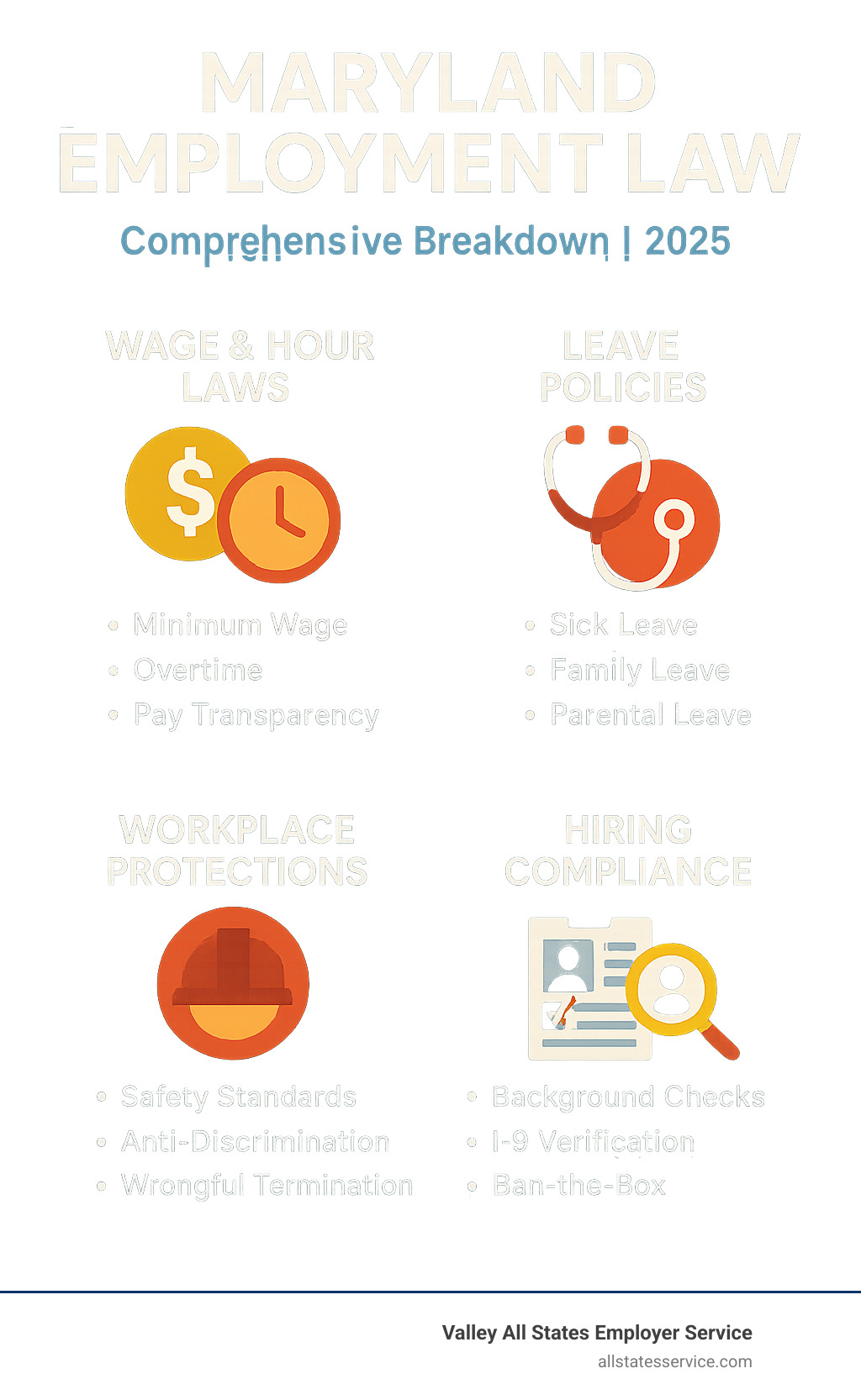
Key Areas of Maryland Employment Law:
- Wages & Hours: Minimum wage ($15/hour for large employers), overtime pay, final paycheck timing
- Leave Requirements: Sick leave, family leave, parental leave, jury duty protections
- Anti-Discrimination: Protected classes include race, sex, age, disability, sexual orientation, military status
- Workplace Safety: MOSH standards, heat stress protection, whistleblower rights
- Hiring Compliance: Ban-the-box laws, credit check restrictions, I-9 verification
- Termination Rules: At-will employment with exceptions, wrongful discharge protections
Maryland operates under an at-will employment system, but numerous laws create exceptions. The state has been active recently, passing new rules for pay transparency, leave benefits, and hiring.
Recent changes include a paid family and medical leave program starting in 2026, new pay stub requirements effective October 2024, and restrictions on non-compete agreements. The Maryland Division of Labor and Industry actively enforces these rules, with penalties including triple damages for wage violations.
Staying current with Maryland’s evolving workplace regulations is essential for HR managers and employees alike. Maryland’s laws often exceed federal minimums, creating extra obligations for local employers.
Understanding Maryland’s Wage and Hour Requirements
Getting paid fairly and on time isn’t just good business practice, it’s the law. Maryland employment law sets clear rules about wages, overtime, and payment schedules that every employer and employee should understand.
Maryland’s minimum wage has a two-tier system. As of January 2024, large employers (15+ workers) must pay $15.00 per hour. Smaller businesses pay $13.40 per hour, with increases to reach $15.00 by July 2026.
For overtime pay, Maryland follows the standard rule: non-exempt employees earn time and a half for hours over 40 in a workweek. Employers must be careful when classifying executive, administrative, and professional employees as exempt.
Maryland requires regular paydays. When an employee leaves, their final paycheck is due by the next scheduled payday.
Maryland’s Wage Payment and Collection Law is serious. If an employer withholds wages in bad faith, they could face triple damages plus attorney fees. This law applies to any work in Maryland, regardless of where the employer is based.
Payroll compliance can be overwhelming for growing businesses. A reliable Web-Based Payroll Service can help streamline these requirements and reduce the risk of costly mistakes.
New Pay Transparency and Pay Stub Rules
Starting October 1, 2024, new Maryland rules increase workplace transparency in job postings and pay information.
The pay transparency law requires employers to include a good-faith wage range and general benefits information in all job postings for positions performed even partially in Maryland. Employers must keep records for three years.
Retaliation for asking about pay ranges is illegal, as these conversations are now protected.
New pay stub requirements also began on October 1, 2024. Employers must provide new hires with written notice of pay rates, paydays, and leave benefits. Each paycheck must then include a detailed statement with:
- Employer information including name, address, and phone number
- Pay period dates and payment date
- Hours worked for non-exempt employees
- All pay rates and gross/net amounts
- Every deduction with clear labels
- Additional pay bases like commissions or bonuses
The Pay Stub/Pay Statement Law FAQ provides detailed guidance, and there’s a helpful Pay Stub Template video to walk you through the requirements.
The Maryland Employment Law on Tipped Employees
Tipped workers like servers and bartenders have special wage rules under Maryland employment law. Understanding these rules is key for both employers and employees.
Maryland’s tipped minimum wage is $3.63 per hour. The tip credit system allows this lower rate only if tips bring the employee’s total earnings up to the full state minimum wage.
If tips fall short, the employer must make up the difference.
Employers must clearly explain the tip credit system and any tip pooling arrangements. If tipped employees spend over 20% of their time on non-tip-generating tasks, they must be paid the full minimum wage for that time.
The Employment Standards Service (ESS) Information page offers comprehensive details about these rules and enforcement procedures. Getting tipped employee wages wrong can lead to serious penalties.
Employee Protections: Leave, Discrimination, and Termination
Maryland employment law provides strong employee protections for leave, discrimination, and termination. While Maryland is an “at-will” employment state, this doesn’t mean employers can fire someone for any reason.
At-will employment means either party can generally end the working relationship at any time. However, significant exceptions protect employees from unfair treatment.
The main exception is “wrongful discharge.” You cannot be fired for exercising your legal rights, such as filing a workers’ compensation claim, serving on a jury, demanding owed overtime, or refusing to perform illegal acts.
As of April 2024, new laws protect “wage whistleblowers” from retaliation for reporting violations of wage, child labor, or equal pay laws. Retaliated employees can file a complaint with the Maryland Department of Labor to potentially recover back pay, fines, triple damages, and attorney’s fees.
Navigating these protections can be complex. Many companies turn to professional HR Compliance Assistance to ensure they handle these situations correctly.
Your Rights to Paid and Unpaid Leave
Maryland is a leader in employee leave rights, offering benefits that often exceed federal law. Understanding these leave types is key to your work-life balance and financial security.
The Maryland Healthy Working Families Act allows most employees to earn sick and safe leave, accruing one hour for every 30 hours worked, up to 40 hours per year. This leave is paid for employers with 15 or more employees and unpaid for smaller ones. It can be used for personal or family illness, medical care, or issues related to domestic violence or sexual assault.
A major change to Maryland employment law is the Family and Medical Leave Insurance (FAMLI) Program. Starting July 1, 2026, eligible employees can take up to 12 weeks of leave with partial wage replacement of up to $1,000 per week.
FAMLI can be used for bonding with a new child, caring for a family member with a serious health condition, your own health issues, or military deployment needs. Maryland’s definition of “family member” is broader than federal law.
The program is funded by employer and employee contributions, with deductions beginning July 1, 2025. To be eligible, you must have worked at least 680 hours in Maryland in the last year. The law has strong anti-retaliation protections. Learn more at the official Family and Medical Leave Insurance (FAMLI) Program website.
Federal FMLA still provides up to 12 weeks of unpaid, job-protected leave for many Maryland employees. When state law offers better benefits, you get the improved protection.
Maryland’s Parental Leave Act gives new parents at companies with 15-49 employees up to six weeks of unpaid leave for childbirth, adoption, or foster care. To qualify, you must have worked for 12 months and 1,250 hours. You are entitled to return to your same or an equivalent job.
The Flexible Leave Act allows employees at companies with 15 or more workers to use existing paid time off for a family member’s illness or for bereavement. You can find more info on the Flexible Leave Act for details.
Maryland also protects your right to time off for jury duty, voting (at least two paid hours if needed), and military deployment.
Preventing Discrimination and Wrongful Termination
Maryland employment law offers some of the nation’s strongest anti-discrimination protections, expanding on federal laws to ensure a workplace free from harassment.

Maryland protects employees from discrimination based on race, color, religion, sex, age, national origin, marital status, disability, sexual orientation, gender identity, genetic information, and military status. Recent expansions explicitly protect sexual orientation and military status.
Since 2019, many anti-discrimination laws apply to businesses with just one or more employees, greatly expanding worker protections.
Harassment protections now cover independent contractors, and the time to file a claim has been extended to two years from 180 days.
If you believe you’ve faced discrimination, you can file a complaint with the federal EEOC or the Maryland Commission on Civil Rights (MCCR). These agencies investigate claims and can pursue remedies like back pay and job reinstatement.
Wrongful termination claims often arise from discrimination or retaliation. While Maryland is an at-will state, firing someone based on a protected characteristic or for reporting illegal activity is against the law.
Workplace Safety, Youth Employment, and Hiring Compliance
A safe and compliant workplace is a legal requirement under Maryland employment law. Rules covering heat stress, youth employment, and fair hiring are essential for success.

Maryland takes workplace safety seriously through the Maryland Occupational Safety and Health (MOSH) program. This state-run plan works with federal OSHA to protect workers. MOSH sets and enforces safety standards.
Every employer must provide a workplace free from recognized hazards. This includes following MOSH standards, providing training and safety equipment, and fostering a culture of safety.
Maryland’s new heat stress standards took effect September 30, 2024. For work environments where the heat index may reach 80 degrees, employers need a written prevention plan. This plan must include access to water, cool rest areas, breaks, and annual training on heat stress dangers.
Employees have the right to report hazards without fear of retaliation. Maryland’s robust whistleblower protections cover employees who report illegal activities, waste, or safety violations. A safe reporting environment benefits everyone.
A Guide to Maryland Employment Law for Minors
Maryland employment law has strict rules to protect young workers. The state prioritizes balancing work with education and safety.
Before any minor under 18 can work, they generally need a Minor Work Permit. This permit ensures the job is safe and won’t interfere with schooling. The Minor Work Permit (online application) system is straightforward.
Age restrictions are key. For example, minors under 16 are prohibited from hazardous jobs like manufacturing or construction due to the high risks involved.
Hour limitations vary by age and whether school is in session. During the school year, minors under 16 have limits on their work hours and times. Minors under 18 must get a 30-minute break for every five consecutive hours of work.
These rules ensure that work experiences are beneficial, not harmful, for young people’s development.
Hiring Compliance and Eligibility Verification
Hiring in Maryland requires navigating compliance rules that protect both applicants and employers. These rules have evolved to promote fairness.
The Job Applicant Fairness Act restricts when employers can run credit checks. Most employers cannot require a credit check before a job offer unless there is a disclosed, job-related reason.
Maryland’s “ban-the-box” laws apply to employers with 15 or more employees. You cannot ask about criminal records until after the first in-person interview. Be aware that local jurisdictions like Baltimore, Montgomery County, and Prince George’s County may have stricter rules.
Statewide, the salary threshold for reporting older adverse information in background checks was raised to $75,000. For jobs paying less, only information from the last seven years can be included.
Once you hire, you must complete Form I-9 for each employee to verify employment eligibility. This federal requirement can be complex. Our I-9 Verification Assistance helps ensure you meet these obligations accurately.
For employers using E-Verify, we provide comprehensive E-Verify Employment Verification services. With the growth of remote work, understanding the rules for I-9 for Remote Employees is essential for compliance.
The Evolving Landscape of Maryland Employment Law
Maryland employment law is constantly changing. Just when you think your policies are set, new legislation can shift the landscape.

Take non-compete agreements, for example. These contracts were once standard, but Maryland has been systematically dismantling them.
As of June 1, 2024, non-compete and conflict of interest clauses are banned for veterinary professionals. Veterinary practices should review their employment contracts.
Starting July 1, 2025, non-competes will also be banned for healthcare professionals earning $350,000 or less. For those earning more, non-competes are limited to one year and a ten-mile radius. These bans do not affect restrictive covenants protecting client lists or proprietary information.
The Federal Trade Commission also finalized a rule in April 2024 to ban most non-competes nationwide. While facing legal challenges, this FTC Non-Compete Rule also targets “stay or pay” training repayment agreements. Only “senior executives” earning over $151,164 annually would be exempt.
Maryland courts have historically used the “magic blue pencil” doctrine to modify, rather than void, overbroad non-competes. However, new state and federal rules are upending this practice.
Then there’s marijuana in the workplace. Maryland legalized recreational cannabis in 2023, but it remains federally illegal. This creates a complex situation for employer drug policies.
Because marijuana is federally illegal, the Americans with Disabilities Act does not require accommodation for its use. Most Maryland employers can maintain drug-free workplace policies. However, the legal landscape is shifting, with the DEA considering reclassifying marijuana, which could impact drug policies, especially in safety-sensitive jobs.
What does this mean for your business? It means employment policy is not something you can set and forget. The regulatory environment is moving fast, and staying compliant requires constant attention. That’s why many of our clients find value in resources like our Outsourced HR Compliance: The Ultimate Guide.
Resources for Maryland Employers and Employees
Navigating Maryland employment law can be challenging, but many state resources are available to help both employers and employees.
Unemployment insurance benefits provide financial support to Maryland workers who lose their jobs through no fault of their own. Eligibility depends on work and wage history, and the application process is relatively straightforward.
Claims are usually filed online with the Maryland Department of Labor’s Division of Unemployment Insurance. If a claim is denied, you have the right to appeal, which often succeeds with additional information.
The Maryland Workforce Exchange is the state’s official job board, offering resume tools and career resources for job seekers and employers.
Knowing the right agency to contact saves time. The Maryland Department of Labor has several specialized divisions:
- The Division of Labor and Industry handles wage, overtime, and leave policy questions through its Employment Standards Service.
- The Maryland Commission on Civil Rights (MCCR) investigates discrimination and harassment complaints.
- Maryland Occupational Safety and Health (MOSH) sets and enforces workplace safety standards.
- The Maryland Workers’ Compensation Commission manages benefits for on-the-job injuries.
- The Governor’s Workforce Development Board connects workforce needs with training opportunities, helping with labor market trends and career development.
Most agencies offer online fact sheets, forms, and direct assistance. They have streamlined their processes to provide quick, clear answers to employment law questions.
The key is knowing where to start. For wage issues, begin with the Employment Standards Service. For discrimination concerns, contact MCCR. For safety problems, reach out to MOSH. Each agency has specialists who understand Maryland employment law and can help you steer your challenge.
Conclusion: Staying Compliant in the Old Line State
Managing Maryland employment law compliance is a constant challenge. As the state updates laws and expands worker protections, businesses have an opportunity to build better, more resilient workplaces.
Maryland consistently pushes beyond federal minimums. The state’s $15 minimum wage, upcoming paid family leave program, and broad anti-discrimination laws reflect a strong commitment to worker rights that all employers must follow.
Recent changes make compliance even more critical. New pay transparency requirements, heat stress standards, and restrictions on non-compete agreements are reshaping business operations and talent retention.
Maryland’s laws are highly interconnected. Wage rules, leave requirements, and hiring practices all link together, demanding a comprehensive approach to compliance.
Proactive compliance is about more than avoiding penalties like triple damages for wage violations. It’s about creating a trustworthy workplace where employees want to stay and grow. Getting ahead of these issues protects your business and builds a stronger team.
The administrative burden can be overwhelming for small businesses. The right partnerships and systems are key. Solutions like a Web-Based Payroll Service, HR Compliance Assistance, or expert employment verification can make all the difference.
Maryland’s employment landscape will continue to evolve with the FAMLI program rollout and potential federal changes like the FTC’s non-compete rule. Staying informed is essential.
Don’t get caught off guard. Build compliance into your regular operations through policy reviews, training, and reliable verification processes. This creates a foundation for long-term success.
Ready to strengthen your compliance foundation? Get help with Employment Verification in Maryland and let us handle the details while you focus on growing your business. In Maryland’s dynamic employment environment, having expert support isn’t just helpful, it’s essential.