
New hire verification: Stop 75% Resume Lies
Your Guide to a Compliant and Confident Hiring Process
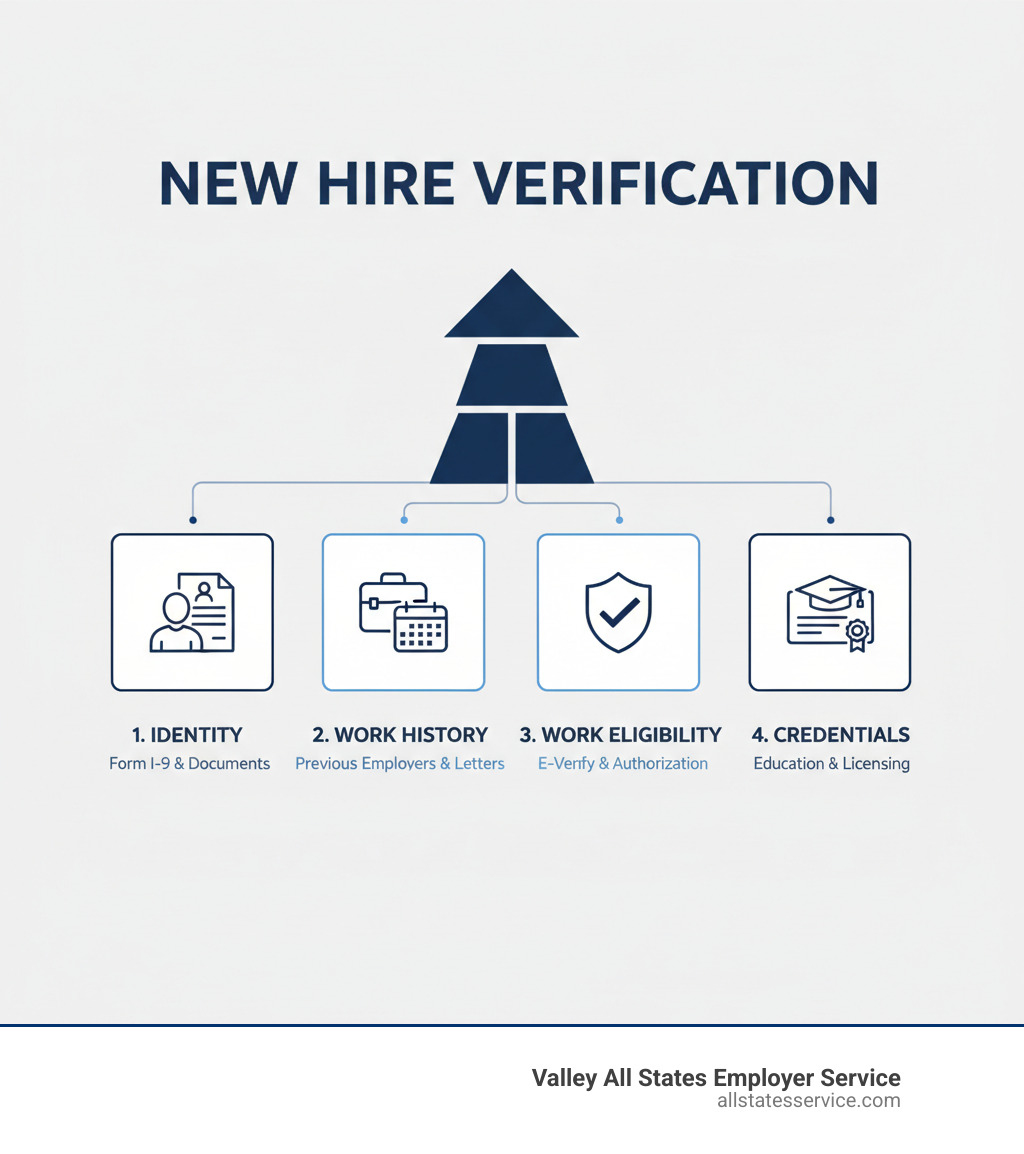
New hire verification is the essential process of confirming a candidate’s identity, work authorization, employment history, and credentials before they start working for your company. Here’s what you need to verify for every new employee:
Core Verification Requirements:
- Identity and Work Authorization: This involves completing Form I-9 and using E-Verify.
- Employment History: You should contact previous employers to confirm job titles and dates.
- Education and Credentials: It’s important to verify degrees, certifications, and professional licenses.
- Background Information: You may need to conduct criminal background checks when legally permitted.
The stakes couldn’t be higher. More than 50% of employers have caught lies on resumes, and failing to properly verify new hires can result in fines of several thousand dollars per violation of I-9 rules.
As Michael Watkins noted, “People are very excited and quite vulnerable when they take new jobs.” This makes it the perfect time for employers to establish trust through proper verification processes.
The verification process typically takes one to three days when done efficiently, but many HR managers struggle with the complexity of compliance requirements, scattered paperwork, and time-consuming manual processes.
Whether you’re handling your first hire or your hundredth, understanding the legal requirements and best practices for new hire verification protects your business from fraud, ensures compliance with federal immigration law, and builds confidence in your workforce from day one.
Why New Hire Verification is a Non-Negotiable First Step
Picture this: you’ve just hired what seems like the perfect candidate. Great interview, impressive resume, glowing references. Three months later, you find their degree is fake and they’ve never actually worked at their “previous” company. Sound like a nightmare? It happens more often than you’d think.
New hire verification serves as your first line of defense against hiring disasters. At its core, verification is about mitigating risk while building a qualified, trustworthy workforce. Every time you bring someone new onto your team, you’re making an investment in your company’s future.
The numbers tell a sobering story. More than 50% of employers have caught a lie on a resume. That means if you hire ten people without proper verification, five of them might be stretching the truth about something important.
Building trust starts from day one. When you thoroughly verify new hires, you’re not just protecting your business from fraud or ensuring work authorization compliance. You’re also showing your existing team that you maintain high standards. Your current employees deserve to work alongside qualified, honest colleagues.
Think of verification as an insurance policy. The small investment of time upfront can save you from costly mistakes, legal troubles, and workplace disruption down the road. Ensuring a qualified workforce isn’t just good business practice, it’s essential for your company’s reputation and success.
The Different Types of Verification Checks
New hire verification encompasses several different types of checks, each designed to paint a complete picture of your potential employee. Let’s break down what each one accomplishes.
Employment history verification involves contacting previous employers to confirm job titles, employment dates, and sometimes salary information. This step helps you spot resume gaps, inflated responsibilities, or completely fabricated work experience. Most former employers will at least confirm basic employment details, even if they have strict reference policies.
Education confirmation goes straight to the source by verifying degrees, diplomas, and certifications with educational institutions. You’d be surprised how many people claim degrees they never earned or from schools that don’t exist. A quick call to the registrar’s office can save you from hiring someone whose qualifications are questionable.
For positions requiring specific expertise, professional license verification becomes crucial. Whether you’re hiring doctors, nurses, contractors, or financial advisors, confirming that licenses are current and in good standing protects both your business and your clients. State licensing boards typically make this information easily accessible.
Criminal background checks require careful handling due to legal restrictions, but they’re valuable when conducted properly and relevant to the job role. These checks help identify potential risks to workplace safety, especially for positions involving financial responsibility, customer interaction, or working with vulnerable populations.
Identity verification forms the foundation of all other checks. After all, you need to confirm you’re actually hiring the person sitting across from you in the interview. This step prevents identity theft and ensures all other verification efforts are checking the right person.
Each type of verification serves a specific purpose in your overall Employee Onboarding Compliance strategy. Together, they create a comprehensive safety net that protects your hiring decisions.
The Role of an Employment Verification Letter
An employment verification letter might seem like a simple document, but it plays a surprisingly important role in the hiring ecosystem. These letters serve as official proof of employment, typically requested by employees for personal financial needs like mortgage applications, rental agreements, or loan approvals.
The purpose of the letter extends beyond just helping your employees. When other employers request verification letters for candidates you’re considering, these documents provide valuable insight into employment history. They offer a formal, documented way to confirm job details without lengthy phone conversations.
Information included in these letters typically covers the basics: your company letterhead, the employee’s name and job title, employment dates, and a confirmation statement. Some letters include salary information, but only with the employee’s written consent and in compliance with state privacy laws. Keep it professional and stick to the facts.
When it’s used varies widely. Your current employees might need verification letters for major purchases, apartment applications, or even visa applications for international travel. Prospective employees might request them from previous employers as part of your hiring process. Having a streamlined system for generating these letters shows professionalism and supports both your current and potential team members.
Ready-made templates can simplify this process significantly. You can Download PDF for Free or Download Word for Free to get started with professional templates that include all the necessary elements while maintaining legal compliance.
The Complete New Hire Verification Process Step-by-Step
Let’s be honest: new hire verification can feel overwhelming when you’re staring at a stack of forms and wondering where to start. The good news? It’s actually pretty straightforward once you break it down into bite-sized steps.
Think of it like following a recipe. You wouldn’t throw all the ingredients into a pot at once and hope for the best. Instead, you follow each step carefully to get the perfect result. That’s exactly how we approach verification, whether you’re handling everything in-house or working with third-party services.
The key is ensuring accuracy while collecting all the right documentation efficiently. You want to be thorough without drowning in paperwork or spending weeks on what should take a few days.
Step 1: Confirming Identity and Work Authorization with Form I-9
Here’s where every new hire verification process begins: Form I-9. This isn’t just paperwork for the sake of paperwork. It’s the law, and it serves a crucial purpose.
Form I-9 does two important things at once. First, it verifies that your new employee is who they say they are. Second, it confirms they’re legally allowed to work in the United States. Every single person you hire needs one, whether they’re a U.S. citizen or not.
The employee section (Section 1) is their responsibility. They fill this out on or before their first day, telling you their employment status and providing basic information like their name, address, and date of birth. It’s essentially them saying, “Yes, I’m authorized to work here.”
The employer section (Section 2) is where you come in. You have exactly three business days after their first day to complete this part. Your job is to physically examine their documents and make sure they look genuine and belong to the person standing in front of you.
Here’s what many employers don’t realize: you cannot tell employees which documents to bring. They get to choose from the acceptable documents list. Some might bring a driver’s license and Social Security card. Others might have a passport or employment authorization document. As long as it’s on the approved list and looks legitimate, you’re good to go.
For detailed guidance on getting this right every time, check out our I-9 Form Completion resource or visit the official I-9, Employment Eligibility Verification page.
Step 2: Leveraging Technology with E-Verify
Once you’ve got that I-9 completed, it’s time to take things digital with E-Verify. Think of E-Verify as your verification assistant that never sleeps and has direct access to government databases.
E-Verify is an internet-based system that takes the information from your completed I-9 and double-checks it against Social Security Administration and Department of Homeland Security records. It’s like having a direct line to confirm what you’ve already documented.
Here’s how simple it is: after completing both sections of the I-9, you enter the employee’s information into E-Verify. Within seconds, the system tells you if everything checks out or if there’s a mismatch that needs resolving.
If you get a “Tentative Nonconfirmation,” don’t panic. It just means there’s a discrepancy that needs to be sorted out. Maybe the employee recently got married and changed their name, or there’s a typo in the government database. The employee gets a chance to fix these issues directly with the appropriate agency.
E-Verify doesn’t replace Form I-9. You still need that physical form for your records. E-Verify simply adds an extra layer of electronic confirmation that streamlines the whole process and gives you greater confidence in your verification.
Want to dive deeper? Our What is E-Verify? guide and E-Verify Onboarding Process resources have everything you need to know.
Step 3: Verifying Past Employment and Credentials
Now comes the detective work: confirming that your new hire actually worked where they said they worked and has the qualifications they claim. This is where new hire verification gets interesting because every company handles reference checks differently.
Contacting previous employers used to be as simple as picking up the phone, but today’s reality is a bit more complex. Some companies will only confirm dates and job titles, while others might share more detailed information about performance and responsibilities. This process can be time-consuming.
Here’s a pro tip: always get phone numbers independently rather than using the ones provided by your candidate. You want to make sure you’re actually talking to the real company, not their helpful friend pretending to be HR.
Third-party verification services can be a game-changer for confirming employment history. These services often have large databases of employment and income data from thousands of employers. Instead of playing phone tag with HR departments, you can often get the verification you need much more quickly. This streamlines the process, though access and cost can vary.
Education verification means going directly to schools and universities to confirm degrees, attendance dates, and any honors or distinctions. Don’t just take that diploma at face value. Academic fraud is more common than you might think.
For roles requiring professional licenses, you’ll need to check with the relevant state boards or professional agencies. A nurse’s license, an engineer’s certification, or a contractor’s permit can all be verified directly with the issuing authority. This isn’t just about qualification; it’s about liability protection.
The whole process might sound time-consuming, but it’s worth every minute. For a comprehensive look at making employment verification work for your business, explore our Employment Verification Services Complete Guide.
Navigating the Legal Maze of Hiring Compliance

Let’s be honest: employment law can feel like trying to solve a puzzle while blindfolded. When it comes to new hire verification, we’re not just talking about smart business practices. We’re dealing with serious legal requirements that can make or break your company if you get them wrong.
Think of compliance as your safety net. It protects your business from hefty fines, keeps you out of legal hot water, and ensures you’re treating all candidates fairly. The good news? Once you understand the key rules, the process becomes much more manageable.
Key Legal Requirements for New Hire Verification
The legal landscape for new hire verification involves several important federal and state laws. Each one serves a specific purpose, and understanding them helps you stay on the right side of the law while building a strong team.
The Fair Credit Reporting Act (FCRA) comes into play whenever you use a third-party company for background checks. Before you can run any screening, you must tell candidates in writing that you plan to check their background. You also need their signed permission before moving forward. If something in that background check makes you decide not to hire them, you have to follow specific steps to let them know why and give them a chance to respond.
Title VII of the Civil Rights Act keeps discrimination out of your hiring process. This law says you can’t make hiring decisions based on someone’s race, color, religion, sex, or national origin. When you’re verifying information, you need to use the same process for everyone. Any information you gather must actually relate to the job they’re applying for.
U.S. immigration law requires every employer to complete Form I-9 for new hires and use E-Verify when required. The government takes this seriously because it prevents companies from hiring people who aren’t authorized to work in the United States. Violating these rules can result in penalties that really add up.
Don’t forget about state-specific laws either. Your state might have its own rules about what you can ask during the hiring process. Some states won’t let you ask about salary history, while others have specific requirements for background checks. You need to know the rules where your business operates.
Our I-9 E-Verify Compliance Guide breaks down these requirements in detail, making compliance much easier to understand and implement.
The High Cost of Non-Compliance
Here’s where things get really serious. Failing to follow new hire verification laws isn’t just a slap on the wrist. The consequences can devastate your business financially and damage your reputation for years to come.
I-9 violations carry fines of several thousand dollars per mistake. That might not sound too scary until you realize these penalties multiply quickly. If you have errors on multiple forms or show a pattern of non-compliance, those fines can reach tens of thousands of dollars in no time.
Civil penalties hit even harder when you knowingly hire unauthorized workers. The government designed these fines to be painful enough that businesses won’t risk it. We’re talking about penalties that can seriously impact your bottom line and cash flow.
In the most serious cases, criminal charges become a possibility. Repeated or intentional violations can lead to criminal fines and even jail time for business owners. Nobody wants to explain to their family why they’re facing criminal prosecution over hiring practices.
For businesses with government contracts, debarment represents a potential death sentence. Get caught violating employment laws, and you could be banned from receiving federal contracts. For many businesses, this means losing a major revenue stream overnight.
Perhaps most damaging of all is the reputation hit your business takes. Word spreads fast when a company gets caught breaking employment laws. Potential employees, customers, and business partners all notice. Once your reputation gets damaged, rebuilding trust takes years of consistent, ethical behavior.
The smart move? Invest in proper Compliance Management Solutions now. It costs far less than dealing with violations later, and it gives you peace of mind knowing your hiring process meets all legal requirements.
Best Practices and Global Considerations
Creating a smooth new hire verification process isn’t just about following the rules. It’s about building systems that work whether you’re hiring someone down the street or managing a fully remote workforce. The modern hiring landscape has changed dramatically, and our verification processes need to keep up.
Let’s be honest: employment verification can feel like navigating through a maze blindfolded. But with the right approach, you can turn what feels like an overwhelming process into a well-oiled machine that protects your business and builds trust with new employees.
Best Practices for Conducting New Hire Verification
Think of these best practices as your roadmap to new hire verification success. They’re not just suggestions, they’re the difference between a smooth onboarding experience and potential legal headaches down the road.
Establishing a consistent policy is your first line of defense against discrimination claims. When you apply the same verification standards to every single new hire, regardless of their name, accent, or appearance, you’re protecting both your business and creating a fair hiring environment. This consistency also makes training easier and reduces the chance of costly mistakes.
Obtaining written consent isn’t just a nice-to-have, it’s the law. Before you start digging into someone’s employment history or running background checks, you need their explicit written permission. This FCRA requirement protects both you and the candidate, and it shows you respect their privacy.
Your verification process should be secure from start to finish. We’re talking about sensitive personal information here. Social Security numbers, addresses, employment history. This data needs protection through encrypted platforms, limited access controls, and secure storage systems. A data breach during the hiring process is not the first impression you want to make.
Training your HR team thoroughly pays dividends. Everyone involved in hiring needs to understand not just the what, but the why behind each verification step. Our guide on E-Verify Employer Responsibilities can help your team understand their role in the process.
Here’s something many employers overlook: documentation is your best friend. Keep records of everything. Every form completed, every document reviewed, every phone call made to verify employment. If an audit comes knocking or a legal challenge arises, these records become your shield.
Finally, communicate clearly with your new hires about what’s happening and why. Nobody likes surprises, especially when it involves their personal information. When you explain the verification process upfront, you build trust instead of anxiety.
How Verification Differs: USA vs. Canada
If your business operates across the US-Canada border, you’ve probably noticed that each country has its own way of handling new hire verification. The goals are similar, but the paperwork tells a different story.
In the United States, our verification world revolves around Form I-9. Every single new hire, citizen or not, must complete this form to prove they’re authorized to work. Then there’s E-Verify, the electronic system that double-checks this information against government databases. While it’s optional for most employers, federal contractors don’t have a choice. The Social Security Number ties everything together for tax and identification purposes.
Cross the border into Canada, and the landscape shifts. The Social Insurance Number (SIN) takes center stage as Canada’s equivalent to the SSN. Employers must collect the SIN within three days of the employee’s start date. If that SIN starts with ‘9’, it signals a temporary worker, and you’ll need to verify their work authorization separately.
Canadian employees also complete TD1 Forms for both Federal and Provincial tax purposes. These forms determine how much income tax, Canadian Pension Plan contributions, and Employment Insurance premiums get deducted from paychecks. It’s the employer’s legal responsibility to get these deductions right.
Understanding these differences isn’t just helpful, it’s essential for any business with cross-border operations.
Handling Remote Employee Verification
Remote work has turned traditional new hire verification on its head. Remember when you had to physically examine every I-9 document in person? Those days are largely behind us, thanks to new regulations that recognize our digital reality.
The Department of Homeland Security introduced virtual I-9 inspection rules that allow eligible employers to examine documents through live video calls. If you’re enrolled in E-Verify and in good standing, you can have employees show their documents to you via video conference. It’s like having a face-to-face meeting, just through a screen.
Not eligible for virtual inspections? No problem. You can use authorized representatives to handle the physical document review. This can be anyone you trust, from a notary public to a family friend, as long as it’s not the employee themselves. They complete Section 2 of the I-9 form and send it back to you.
Secure document upload systems have become essential for remote hiring. Your new employees need a safe way to transmit copies of their identification documents, and you need a secure platform to receive and store them. This protects everyone involved and creates a clear paper trail.
The remote verification landscape continues to evolve, and staying current with the latest procedures is crucial. Our resources on Remote Form I-9 and Can I-9 Verification Be Done Remotely? provide detailed guidance on navigating these changing requirements.
Remote hiring doesn’t have to mean compromised verification. With the right tools and processes, you can maintain the same level of thoroughness and compliance, regardless of where your new employees are located.
Simplify Your Verification and Onboard with Confidence
Think of new hire verification like building a house. You wouldn’t skip the foundation just because it’s not the most exciting part, right? The same goes for hiring. All the steps we’ve covered, from Form I-9 completion to background checks, create that solid foundation your business needs.
Compliance isn’t just a checkbox activity. It’s your shield against costly fines, legal headaches, and the kind of reputation damage that keeps business owners awake at night. With federal regulations like FCRA and Title VII, plus state-specific requirements that change faster than fashion trends, staying compliant can feel overwhelming.
But here’s the thing about efficiency: it doesn’t have to be complicated. Manual verification processes eat up your HR team’s time like a hungry teenager raids the refrigerator. Meanwhile, smart technology solutions like E-Verify and automated document management can transform your onboarding from a dreaded paperwork marathon into a smooth, professional experience.
That’s exactly where Valley All States Employer Service steps in. We’ve made it our mission to take the headache out of E-Verify processing. Our team provides expert, impartial, and efficient E-Verify processing that minimizes those costly errors and frees up your administrative resources. Think of us as your compliance safety net, catching problems before they become expensive mistakes.
When you partner with us, you’re not just getting a service provider. You’re getting peace of mind. We handle the technical details so you can focus on what really matters: building your team, growing your business, and creating the kind of workplace culture that attracts top talent.
Ready to turn your new hire verification process from a source of stress into a competitive advantage? Your next great hire is waiting, and we’re here to help you onboard them with complete confidence.
Explore Our Complete Guide to Employment Verification Services Today!