
Maryland E-Verify Pilot: 1 Essential Guide
Understanding E-Verify Requirements for Maryland Businesses
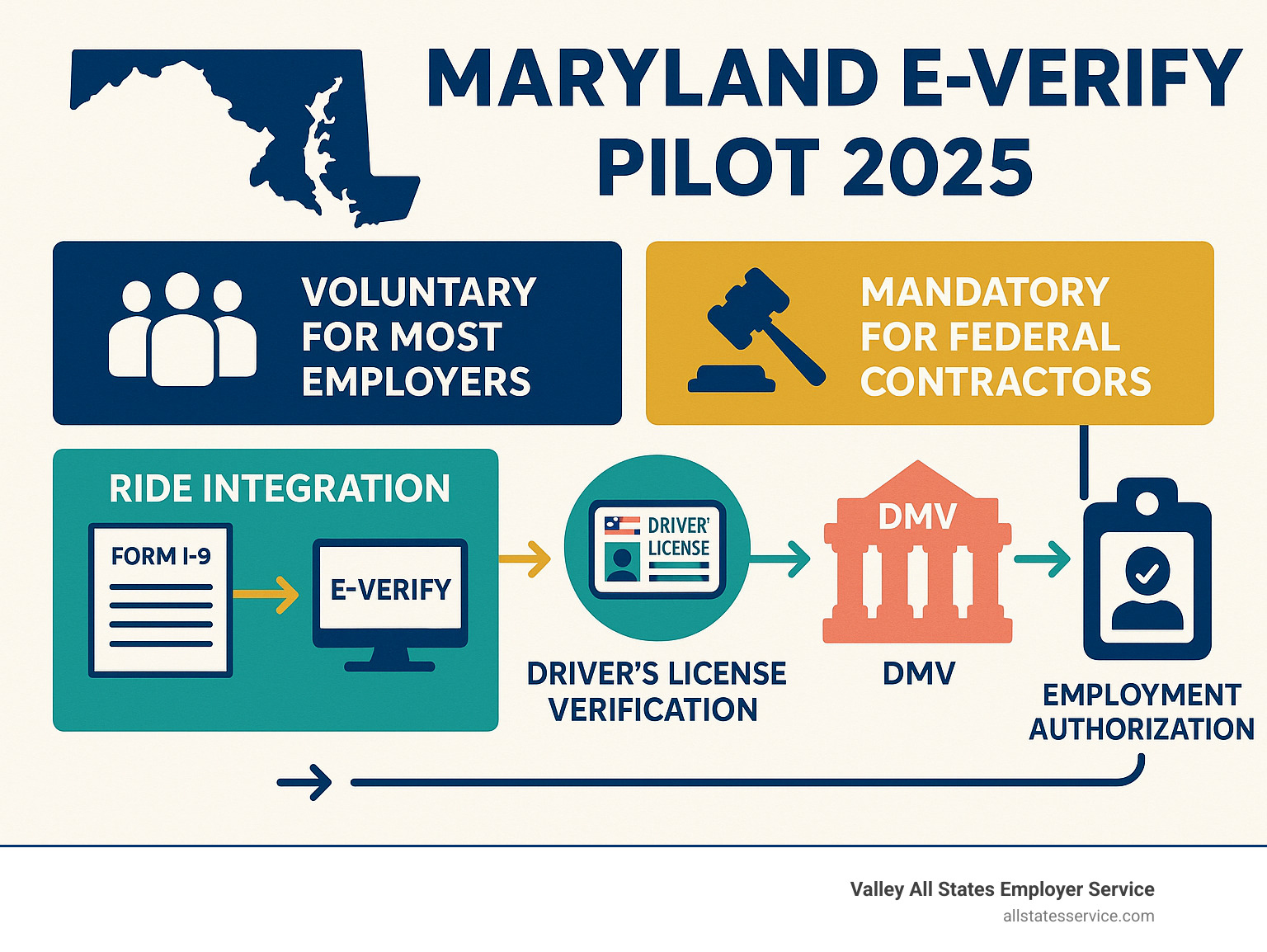
Maryland e-verify pilot programs have generated confusion among employers, but the truth is simpler than you might think. Maryland doesn’t have a traditional statewide E-Verify pilot program. Instead, the state participates in the federal RIDE (Records and Information from DMVs for E-Verify) program, which improves identity verification through driver’s license data integration.
Quick Answer: Maryland E-Verify Status
- No statewide mandate: E-Verify is voluntary for most Maryland employers
- Federal contractors: Must use E-Verify if contracts include the FAR E-Verify clause
- RIDE program: Maryland joined in July 2017 to verify driver’s licenses and state IDs
- Current participation: Over 1.3 million employers nationwide use E-Verify voluntarily
Maryland’s approach differs significantly from states like Arizona or Mississippi, which require all employers to use E-Verify. While you won’t find a specific “Maryland E-Verify pilot,” understanding the state’s participation in federal programs and voluntary adoption trends helps clarify your compliance obligations.
The RIDE program represents Maryland’s most significant E-Verify improvement. Since joining in 2017, Maryland’s driver’s licenses and state ID cards can be verified directly through the E-Verify system when employees present them as List B identity documents during Form I-9 completion.
For busy HR managers, this means fewer verification errors and stronger identity confirmation when Maryland residents use state-issued identification. The integration covers all Maryland driver’s licenses, learner’s permits, commercial driver’s licenses, and state ID cards.
The Current Status of E-Verify in Maryland
Maryland takes a voluntary participation approach to E-Verify, which might surprise employers familiar with stricter state mandates elsewhere. Unlike states such as Arizona or Mississippi, Maryland hasn’t passed legislation requiring all businesses to verify new hires through the federal system.
But here’s where it gets interesting: while Maryland keeps things voluntary at the state level, federal requirements can still apply to your business. The distinction matters more than you might think.
E-Verify operates as an internet-based system run by the U.S. Department of Homeland Security in partnership with the Social Security Administration. Think of it as a digital double-check system. After you complete the Form I-9 with your new employee, E-Verify compares that information against federal databases to confirm work authorization.
Every Maryland employer must complete Form I-9 for each new hire, regardless of whether they use E-Verify. This foundational requirement stays the same whether you’re a small business in Baltimore or a large corporation in Rockville. The relationship between E-Verify and I-9 forms the backbone of employment verification compliance.
For businesses that do choose E-Verify voluntarily, the benefits typically include improved compliance confidence and reduced risk of hiring unauthorized workers. Employees generally appreciate the transparent verification process, though occasional system mismatches can create temporary delays that require careful handling.
While you might hear references to a “Maryland E-Verify pilot,” the state’s main involvement centers on the federal RIDE program rather than any broad state-led initiative. Maryland’s focus remains on supporting federal improvements rather than creating new state mandates.
Is E-Verify Mandatory for Any Maryland Businesses?
Yes, but probably not in the way you’re expecting. Federal contractors and their subcontractors must use E-Verify when their contracts include the Federal Acquisition Regulation (FAR) E-Verify clause. This requirement applies regardless of where your business operates within Maryland.
The federal contractor mandate kicks in for contracts exceeding certain dollar thresholds and requires verification of all new hires, plus existing employees working on the federal contract. If you’re bidding on or currently hold federal contracts, understanding these obligations isn’t optional. Our specialized guidance on E-Verify for Contractors can help steer these complex requirements.
Here’s the key distinction: state law versus federal law. Maryland chose not to impose a statewide mandate, but federal law can still require your participation based on your business activities. For contractors, this creates a compliance obligation that’s just as binding as any state requirement.
Voluntary enrollment benefits attract many Maryland employers even when they’re not required to participate. Better compliance documentation, streamlined verification processes, and reduced liability concerns motivate businesses to adopt E-Verify proactively.
Penalties for Non-Compliance
Non-compliance penalties in Maryland stem from federal enforcement, not state-level violations, since E-Verify remains mostly voluntary at the state level. However, these federal consequences can be severe and expensive.
Federal penalties for Form I-9 violations finded during I-9 audit risks include substantial civil fines ranging from hundreds to thousands of dollars per violation. The exact amount depends on factors like the violation type, company size, and compliance history.
Debarment from government contracts poses the most serious threat for federal contractors. Failing to comply with the FAR E-Verify clause can result in suspension or complete exclusion from future federal contracting opportunities. For businesses that depend on government work, this penalty can be devastating.
Criminal penalties apply in extreme cases involving patterns of knowingly hiring unauthorized workers. These can include significant fines and even imprisonment for responsible parties.
Beyond direct financial penalties, non-compliance creates reputational damage, increased government scrutiny, and operational disruptions that can affect your business for years. Maintaining strong Employer HR Compliance protects against these risks while supporting ethical business practices.
The smart approach? Treat compliance as an investment in your business’s long-term stability rather than just another regulatory burden to manage.
The Maryland RIDE Program: A Closer Look at the “Pilot”
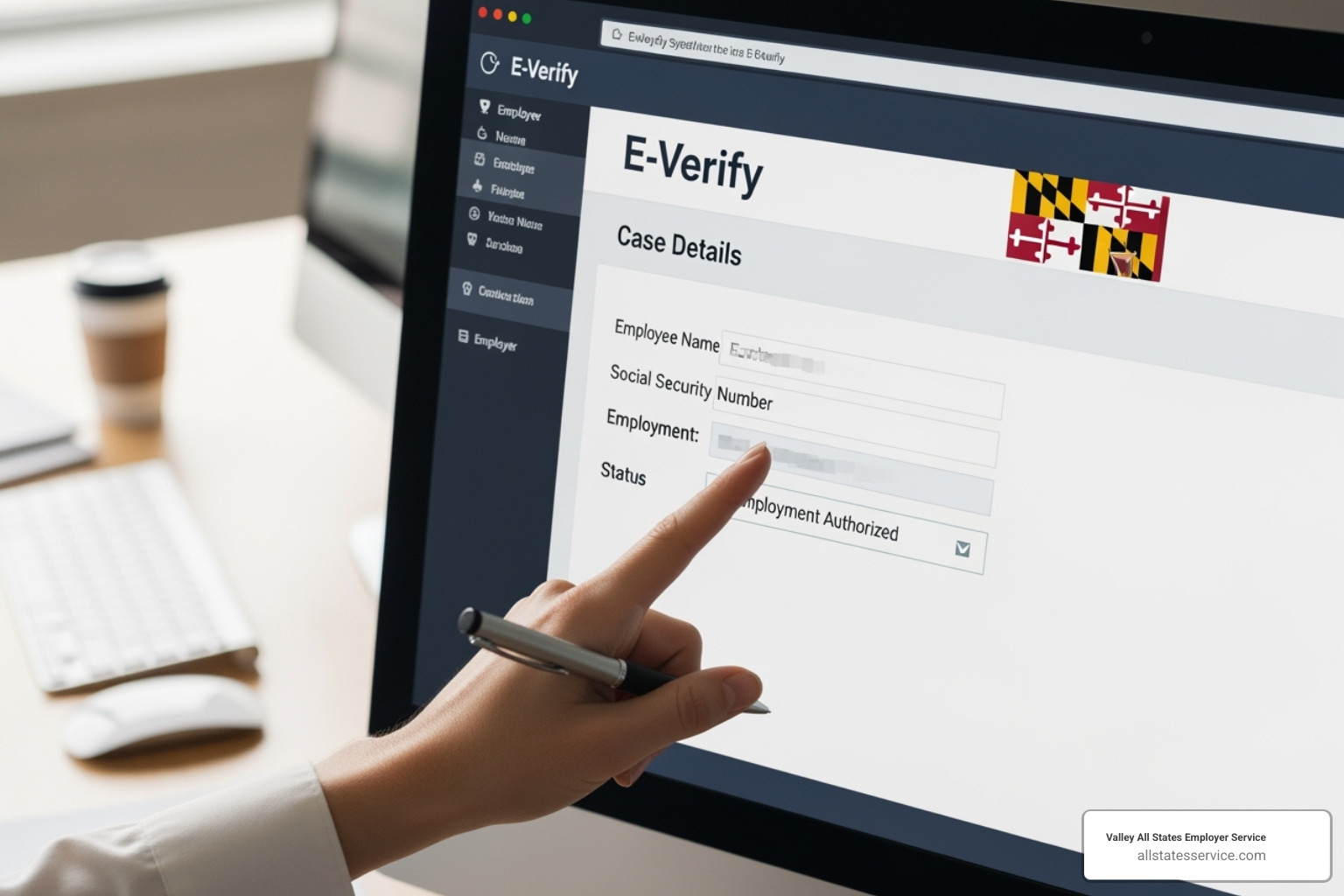
Here’s the truth about the Maryland E-Verify pilot that everyone keeps talking about: it’s not what you think it is. When people search for a Maryland E-Verify pilot program, they’re usually looking for some kind of state-led initiative to test mandatory E-Verify usage. That doesn’t exist.
What Maryland actually has is something much more practical and useful. The state joined the Records and Information from DMVs for E-Verify (RIDE) program back in July 2017. This federal program represents Maryland’s biggest contribution to improving employment verification, and it’s working behind the scenes every time someone uses a Maryland driver’s license during the hiring process.
Think of RIDE as a direct phone line between E-Verify and Maryland’s Motor Vehicle Administration. When your new employee hands you their Maryland driver’s license as proof of identity, E-Verify doesn’t just look at the document anymore. It actually calls up the state’s database and asks, “Hey, is this license real? Does the information match what you have on file?”
This collaboration between the U.S. Citizenship and Immigration Services (USCIS) and Maryland’s MVA tackles a real problem: document fraud. Before RIDE, someone could potentially use a fake Maryland ID and get through the verification process. Now, that’s nearly impossible because the system checks directly with the source.
The Maryland RIDE Fact Sheet shows how this integration covers all Maryland-issued driver’s licenses, learner’s permits, commercial driver’s licenses, and state ID cards. That means improved security for employers and better identity verification across the board.
What makes this particularly valuable is that it doesn’t change Maryland’s voluntary E-Verify status. Instead, it makes the system more reliable for employers who choose to use it. The state essentially said, “We’re not going to force anyone to use E-Verify, but if you do use it, we’ll make sure it works better.”
How the RIDE Integration Works
The beauty of RIDE lies in its simplicity. You don’t need to learn new procedures or change your hiring process. The magic happens entirely behind the scenes during your normal E-Verify verification.
Here’s what actually happens when your new hire presents a Maryland driver’s license: After you complete the Form I-9 and create the E-Verify case, the system automatically sends a query to Maryland’s DMV database. It’s checking whether that thirteen-character document number (one letter followed by twelve numbers) matches their official records.
The real-time data matching happens in seconds. E-Verify compares the document number, expiration date, and other key details against Maryland’s database. If everything checks out, you get a “Photo Match” result, confirming the document is legitimate. If there’s a problem, the system flags it as a Tentative Non-Confirmation, giving the employee a chance to resolve any issues.
This direct connection to state records makes it incredibly difficult for fraudulent documents to slip through. Someone can’t just print a fake Maryland license anymore because the system will immediately find that the document number doesn’t exist in the state’s official database.
For Maryland’s current design licenses (issued since June 2016), the system recognizes both horizontal IDs for people 21 and over and vertical IDs for those under 21. Whether your employee presents a standard driver’s license, learner’s permit, or commercial license, RIDE handles the verification automatically.
The integration with Workforce Eligibility Verification means fewer headaches for HR departments and more confidence in the verification process.
What This “Maryland E-Verify Pilot” Means for Your Hiring Process
Maryland’s RIDE participation transforms your hiring experience in ways you’ll actually notice. The most immediate benefit is streamlined verification that happens faster and more accurately than before.
When you hire someone with a Maryland ID, you’re getting verification results in seconds rather than potentially dealing with delays from document questions. The system’s ability to instantly confirm document authenticity means fewer cases get stuck in limbo while you wait for additional verification.
Increased accuracy translates to fewer frustrated employees and less administrative work for you. Before RIDE, minor discrepancies between what someone wrote on their Form I-9 and what appeared in federal databases could trigger unnecessary delays. Now, the system can confirm the document is real even if there are small data entry differences.
The improved employee experience matters more than you might think. New hires are often anxious about the verification process, especially if they’ve heard stories about delays or complications. When their Maryland license gets verified quickly and smoothly, it starts their employment relationship on a positive note.
For compliance-focused employers, RIDE strengthens your overall verification process without adding complexity. You’re still following the same E-Verify Best Practices, but now you have an extra layer of document authentication working in your favor.
The reduced mismatches benefit shows up in your administrative workload. Fewer tentative non-confirmations mean less time spent helping employees resolve verification issues and fewer cases requiring follow-up documentation.
While Maryland hasn’t implemented a traditional E-Verify pilot program, the RIDE integration represents something better: a practical improvement that makes employment verification more reliable for employers who choose to use it.
How Maryland’s E-Verify Approach Compares to Other States

Maryland’s relaxed approach to E-Verify puts the state in a unique position compared to the rest of the nation. While the maryland e-verify pilot through the RIDE program shows the state’s commitment to improving verification accuracy, Maryland hasn’t joined the growing list of states requiring all employers to use E-Verify.
This voluntary stance places Maryland among roughly half of U.S. states that let businesses decide whether to use E-Verify beyond federal contractor requirements. It’s a stark contrast to the patchwork of mandates, partial requirements, and strict enforcement you’ll find elsewhere across America.
For multi-state employers, this creates both opportunities and challenges. Operating in Maryland might feel like a breath of fresh air if you’re coming from a state with strict mandates. But it also means staying on top of different rules as you expand or hire across state lines. Understanding these E-Verify Requirements by State becomes crucial for maintaining compliance everywhere you do business.
States with Mandatory E-Verify for All Employers
Some states have gone all-in on E-Verify, requiring every employer to verify every new hire regardless of company size or federal contracting status. These aren’t suggestions or pilot programs, they’re hard requirements backed by serious penalties.
Arizona leads the pack, having required E-Verify for all employers since 2008. The state doesn’t mess around either, requiring businesses to keep E-Verify records for at least three years or one year after an employee leaves, whichever is longer.
Mississippi took an even more aggressive approach in 2011, not only requiring E-Verify for all employers but also mandating verification for 1099 independent contractors. That’s pretty unusual and shows how seriously the state takes employment verification.
South Carolina joined the club more recently in 2021, making E-Verify mandatory for all employers. The penalties range from three-year probationary periods to complete business license suspension, so compliance isn’t optional.
Alabama has required E-Verify since 2012 for any employer with even one employee. The state can revoke business licenses for non-compliance, making it one of the strictest enforcement environments in the country.
These states represent the complete opposite of Maryland’s approach. While Maryland employers can choose whether to use E-Verify (except federal contractors), employers in these states have no choice at all.
States Requiring E-Verify for Public Employers or Contractors
A larger group of states has taken a middle-ground approach, requiring E-Verify only for specific types of employers or situations. The thinking is usually that taxpayer money shouldn’t go toward employing unauthorized workers, while private businesses can make their own decisions.
Georgia requires employers with more than 10 employees to use E-Verify, while smaller businesses must prove they’re exempt. Florida mandates it for public employers and contractors since January 2021. North Carolina sets the bar at 25 or more employees, a threshold that’s been in place since 2013.
Pennsylvania takes an interesting approach by focusing on private construction businesses and state contractors specifically. Texas keeps it simple, requiring E-Verify just for state agencies and their contractors.
Some states have changed their minds over time. Colorado actually had an E-Verify mandate for several years but repealed it in 2016, showing that these laws aren’t set in stone. Political winds change, and so do state requirements.
Minnesota requires it for state contracts over $50,000, while Missouri and Oklahoma have required it for public employers and contractors since 2009 and 2007 respectively. Utah rounds out this group with similar public sector requirements.
This middle-ground approach creates the most complex compliance environment. You might need E-Verify for some employees but not others, or for certain contracts but not your regular business operations. It’s exactly the kind of situation where expert guidance becomes invaluable for staying compliant without overcomplicating your processes.
The Future of Employment Verification: E-Verify+ and Beyond
Employment verification is about to get a major upgrade. While Maryland’s maryland e-verify pilot through the RIDE program has improved identity verification, the real game-changer is coming from the federal level. The U.S. Department of Homeland Security is rolling out E-Verify+, a complete reimagining of how employers verify new hires.
Think of E-Verify+ as the smartphone version of what we currently have. It’s sleeker, smarter, and designed to make everyone’s life easier. The current system works, but it can be clunky. You complete Form I-9, then separately create an E-Verify case, entering the same information twice. E-Verify+ eliminates this duplication.
The Announcing the E-Verify+ Trial Launch! marks a significant milestone in employment verification technology. This isn’t just a minor update. It’s a complete overhaul that will affect every employer using E-Verify, whether you’re in Maryland or Montana.
For Maryland employers already benefiting from the RIDE program’s improved identity verification, E-Verify+ will build on those improvements. The combination of Maryland’s driver’s license database integration with the new streamlined federal system promises to make New Hire Eligibility verification more accurate and efficient than ever.
Key Features of the E-Verify+ Initiative
E-Verify+ brings several exciting improvements that address the biggest pain points of the current system. The most significant change is the integrated Form I-9 experience. Instead of juggling two separate processes, everything happens in one connected workflow. You hire someone, they complete their information digitally, and verification begins immediately.
Employee self-service represents another major shift. New hires can log into their secure E-Verify+ account and enter their own information directly. This eliminates the transcription errors that happen when employers manually transfer data from paper forms to computer systems. Your new employees handle their own data entry, and you get cleaner, more accurate information.
The system is mobile-friendly from the ground up. Your new hire can complete their verification on their phone during their lunch break or at home after work. No more scheduling special time during business hours just to handle paperwork.
Reduced employer data entry might be the feature that saves you the most time. When employees enter their own information, your administrative burden drops significantly. You’ll spend less time typing and more time on actual business activities. The built-in E-Verify Status Check features also make monitoring cases much simpler.
Perhaps the most innovative feature is portable employment eligibility. Employees can save their verification information in their E-Verify+ account and share it with future employers. Imagine hiring someone who’s already been verified at their previous job. The system could potentially recognize their existing verification status, speeding up your hiring process.
Preparing for Future Changes in the Maryland E-Verify Pilot Landscape
While Maryland hasn’t announced plans for a statewide E-Verify mandate, smart employers are already preparing for the federal changes coming with E-Verify+. The key is staying proactive rather than reactive.
Staying informed means more than just checking government websites occasionally. Subscribe to USCIS updates and follow reputable HR compliance resources. The E-Verify landscape changes frequently, and being caught off-guard can be costly.
Understanding legislative trends helps you anticipate future requirements. While Maryland maintains its voluntary approach, watching how other states implement E-Verify requirements gives you insight into potential future directions. The trend toward digital verification and improved security isn’t going anywhere.
Proactive compliance starts with perfecting your current Form I-9 processes. E-Verify+ will still rely on accurate I-9 information, so any shortcuts or sloppy practices you have now will become bigger problems later. Regular internal audits help identify issues before they become expensive compliance violations.
Technology adoption becomes crucial as systems become more integrated. If you’re still using paper I-9 forms, now might be the time to consider electronic systems. The employers who adapt early to digital HR processes will find the transition to E-Verify+ much smoother. Professional HR Compliance Assistance can help you evaluate your current systems and prepare for upcoming changes.
The benefits of preparing now extend beyond just compliance. Early adopters of improved verification processes often see better hiring experiences, reduced administrative costs, and stronger workforce integrity. While we can’t predict exactly when E-Verify+ will become widely available, we know it’s coming. The employers who prepare today will have significant advantages tomorrow.
Simplify Your Maryland E-Verify Compliance
Let’s be honest: keeping up with employment verification rules feels like trying to solve a puzzle where the pieces keep changing shape. You’re dealing with federal contractor requirements, wondering about the maryland e-verify pilot (which we now know is really the RIDE program), and trying to figure out what applies to your business.
Here’s the good news: you don’t have to become an E-Verify expert overnight. While Maryland keeps things relatively simple with its voluntary approach, the devil is in the details. Federal contractors still face strict requirements, and the RIDE program integration adds another layer to consider.
Think of it this way: you wouldn’t do your own electrical work just because you know where the light switches are. The same logic applies to E-Verify compliance. One small mistake in the verification process can lead to costly penalties, failed audits, or worse, losing your federal contracts.
Valley All States Employer Service specializes in exactly these situations. We handle the technical details, stay current on all the federal changes (including the upcoming E-Verify+ rollout), and make sure your verification process runs smoothly. No more wondering if you’re doing it right or scrambling to fix errors after the fact.
Our expert E-Verify processing means:
- Fewer verification errors that could trigger audits
- Less time spent on administrative paperwork
- Better compliance with federal contractor requirements
- Peace of mind knowing experts are handling the details
Whether you’re a federal contractor who must use E-Verify or a Maryland employer considering voluntary enrollment, having an experienced E-Verify Employer Agent on your side makes all the difference. We’ve seen every type of verification challenge, and we know how to handle them efficiently.
Ready to take the complexity out of your hiring process? Learn more about Employment Verification in Maryland and find how we can streamline your compliance efforts.