
I-9 acceptable documents: 3 Best Crucial Tips
Why Getting I-9 Document Verification Right Matters
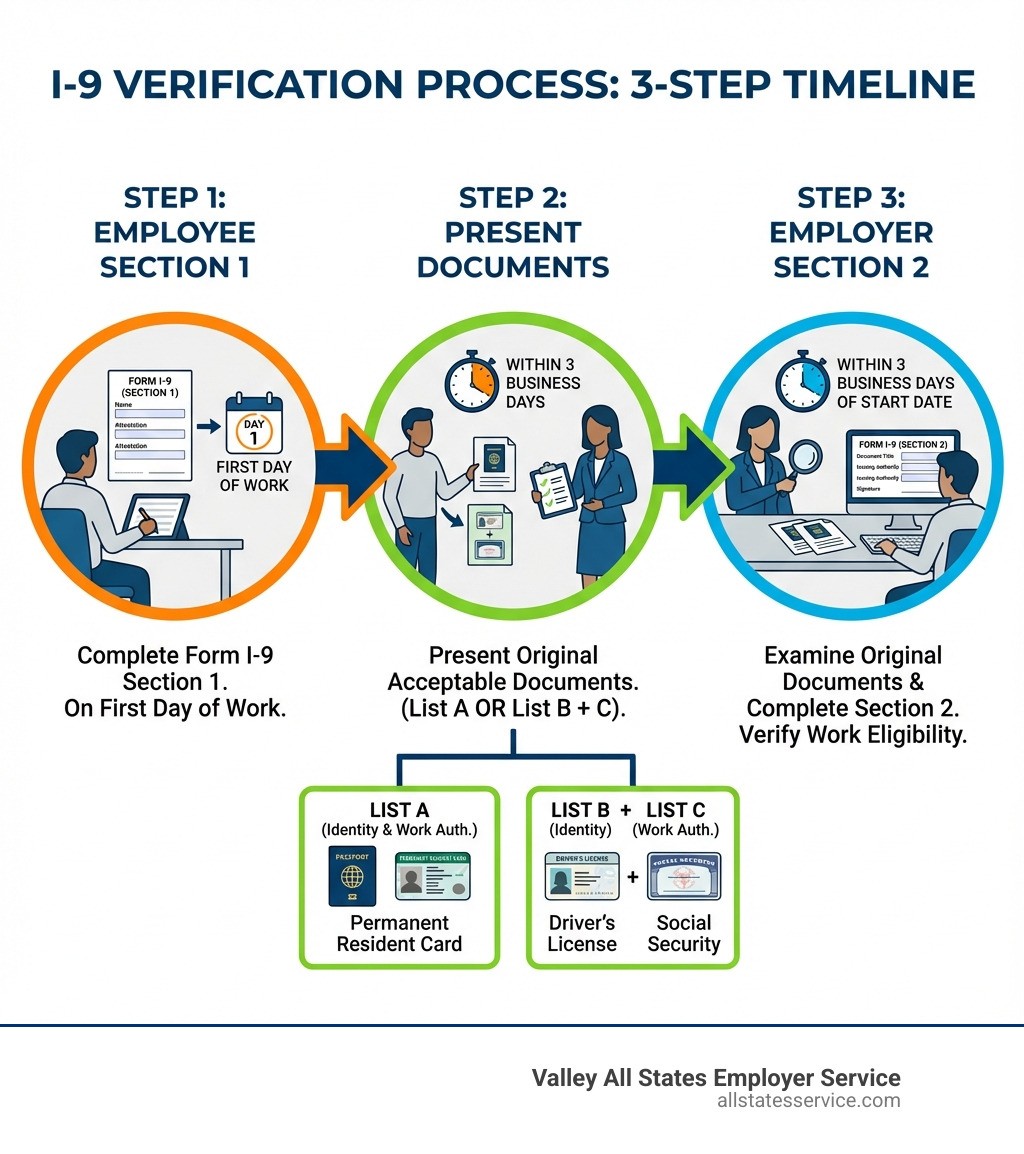
I 9 employment eligibility verification acceptable documents fall into three categories that every employer must understand. Here’s the quick answer:
Document Requirements for Form I-9:
-
Option 1: One document from List A (establishes both identity and work authorization)
- Examples: U.S. Passport, Permanent Resident Card, Employment Authorization Document
-
Option 2: One document from List B (establishes identity) PLUS one from List C (establishes work authorization)
- List B examples: Driver’s license, State ID, School ID with photo
- List C examples: Social Security card (unrestricted), U.S. birth certificate
All documents must be unexpired (unless extended by the issuing authority).
If you’re an HR manager juggling dozens of new hires, you already know the drill. Every new employee needs to complete Form I-9, and you need to verify their documents within three business days of their first day. Miss a step, record the wrong information, or accept an invalid document, and you’re looking at potential fines starting in the thousands.
The challenge isn’t just knowing which documents are acceptable. It’s understanding the combinations that work, the special rules for receipts and minors, the three-year retention requirement, and how to handle remote hires. According to USCIS, employers are liable for violations committed by anyone they authorize to complete Form I-9, which means mistakes can be costly.
This guide breaks down everything you need to know about acceptable documents for I-9 verification. We’ll walk through each list, cover common scenarios like lost documents and remote employees, and share best practices to help you stay compliant without adding hours to your workload.
Must-know i 9 employment eligibility verification acceptable documents terms:
- employer i 9 verification
- employment eligibility verification
- federal employment eligibility verification form i 9
What is Form I-9 and Why is it Crucial for Employers?
At its core, the Form I-9, or Employment Eligibility Verification Form, is a vital document mandated by the U.S. Citizenship and Immigration Services (USCIS). Its primary purpose is to verify the identity and employment authorization of every individual hired to work in the United States. This isn’t just a suggestion; it’s a legal requirement stemming from the Immigration Reform and Control Act (IRCA) of 1986. IRCA made it unlawful for employers to knowingly hire or continue to employ individuals not authorized to work in the U.S.
So, why is this form so crucial for us as employers? Beyond the legal mandate, it’s about safeguarding our organizations from significant penalties and reputational damage. By carefully completing Form I-9, we confirm two critical things about our new hires:
- Verifying Identity: We confirm that the person we’re hiring is who they say they are.
- Verifying Work Authorization: We confirm that they are legally authorized to work in the United States.
It’s a foundational step in the hiring process, ensuring we comply with federal laws. But it’s not just about us; it’s also about protecting our employees. The Form I-9 process includes important anti-discrimination provisions. We must never specify which acceptable documents an employee should present. The choice rests entirely with them, as long as the documents are valid and appear genuine. This respects their rights and prevents discriminatory practices.
Understanding the nuances of this form is a key employer responsibility. It’s part of our commitment to legal and ethical hiring practices. Want to dive deeper into why this form is so essential? Check out our guide on What is I-9 Form Needed For?.
The Official Lists of I-9 Employment Eligibility Verification Acceptable Documents
When it comes to completing Form I-9, employees have options, but these options must fall within specific guidelines set by the USCIS. The core principle is simple: an employee must present either one document from List A OR a combination of one document from List B and one document from List C. We cannot ask for more documents than required, nor can we direct an employee to choose specific documents.
A critical rule to remember is that all documents containing an expiration date must be unexpired, unless the issuing authority has officially extended their validity. In such cases, the extended document is considered unexpired. When examining documents, we’re expected to accept those that reasonably appear to be genuine and relate to the person presenting them. We’re not expected to be document fraud experts, but we should exercise reasonable judgment.
List A: Documents Establishing Both Identity and Employment Authorization
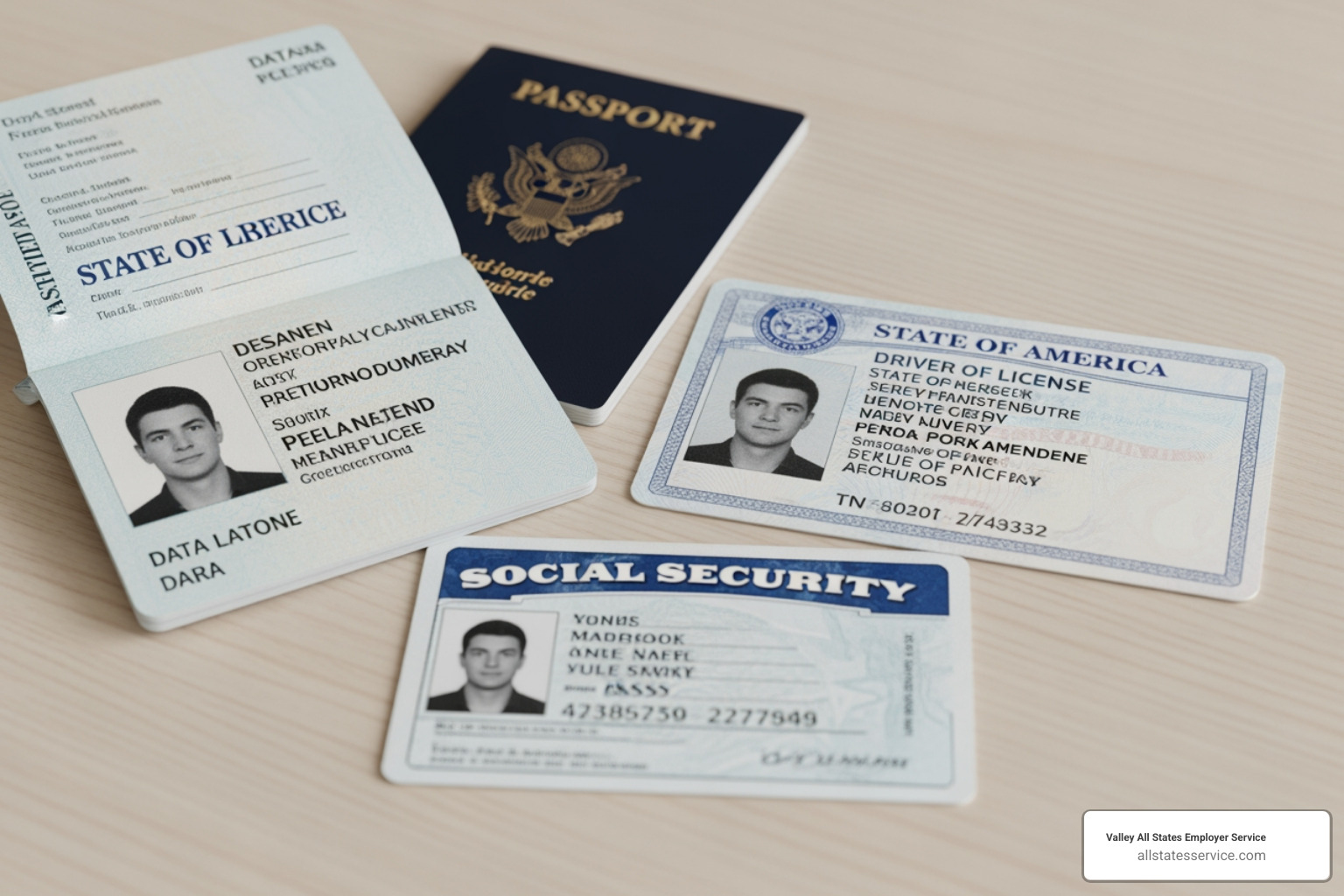
These are the power players of i 9 employment eligibility verification acceptable documents. A single document from List A is all an employee needs to satisfy both the identity and employment authorization requirements. If an employee presents a List A document, we should not ask for anything else.
Here are some of the most common List A documents:
- U.S. Passport or U.S. Passport Card: These are straightforward and widely recognized.
- Permanent Resident Card (Form I-551) (often called a “Green Card”): This card confirms lawful permanent resident status. Older designs remain valid until their expiration date, unless otherwise noted. Sometimes, a USCIS-issued sticker may extend its validity.
- Employment Authorization Document (EAD) (Form I-766) with a photograph: The EAD is a List A document, not a List C document, as it establishes both identity and work authorization. Like Permanent Resident Cards, older EAD designs are still valid until their expiration date.
- Foreign passport with a temporary I-551 stamp or temporary I-551 printed notation on a machine-readable immigrant visa: This combination indicates temporary lawful permanent resident status.
- Foreign passport with Form I-94 or Form I-94A with an endorsement of nonimmigrant status: For certain nonimmigrant aliens authorized to work for a specific employer, this combination, along with the foreign passport, serves as a List A document. The I-94/I-94A must have the same name as the passport, a valid nonimmigrant status endorsement, and an unexpired admission period that aligns with the proposed employment.
For a comprehensive look at List A documents, we often refer to official USCIS resources. You can explore more details on Form I-9 Acceptable Documents – USCIS.
List B: Documents Establishing Identity Only
When an employee chooses not to present a List A document, they must provide one document from List B to establish their identity, AND one document from List C to establish their employment authorization. List B documents typically contain a photograph or other identifying information.
Common List B documents include:
- Driver’s license or ID card issued by a U.S. State or outlying possession: This is one of the most frequently presented documents. Even if a state places restrictive notations on a driver’s license (e.g., “Not for Federal Identification”), it is generally still acceptable for Form I-9 purposes as long as it meets other I-9 requirements.
- ID card issued by federal, state, or local government agencies or entities: These must contain a photograph or identifying information such as name, date of birth, gender, height, eye color, and address.
- School ID card with a photograph: A simple and common option, particularly for younger employees.
- Voter’s registration card: This document verifies identity.
- U.S. Military card or draft record: These are valid for identity verification.
- Military dependent’s ID card: Another option for military families.
- U.S. Coast Guard Merchant Mariner Card: This specialized ID is also acceptable.
- Native American tribal document: These documents can be used to establish identity.
- Driver’s license issued by a Canadian government authority: This is specifically allowed for identity verification.

If we’re participating in E-Verify, any List B document presented by the employee must contain a photograph.
List C: Documents Establishing Employment Authorization Only
To complete the verification process when an employee presents a List B document, they must also provide one document from List C. This document solely proves their authorization to work in the U.S.
Here are some common List C documents:
- Social Security Account Number card (unrestricted): This is a very common List C document. However, there are crucial restrictions. The card is not acceptable if it includes any of the following notations: “NOT VALID FOR EMPLOYMENT”, “VALID FOR WORK ONLY WITH INS AUTHORIZATION”, or “VALID FOR WORK ONLY WITH DHS AUTHORIZATION”. Also, a laminated Social Security card is generally not acceptable.
- Certification of report of birth issued by the U.S. Department of State (Form DS-1350, FS-545, FS-240): These documents confirm U.S. citizenship.
- Original or certified copy of a birth certificate issued by a U.S. State, county, municipal authority, or territory: The birth certificate must bear an official seal. Puerto Rico birth certificates issued before July 1, 2010, are not acceptable due to concerns about fraud.
- Native American tribal document: These can also serve as proof of employment authorization.
- U.S. Citizen ID Card (Form I-197): This card confirms U.S. citizenship.
- Identification Card for Use of Resident Citizen in the United States (Form I-179): These cards, issued by the former INS, are valid indefinitely.
- Employment authorization document issued by the Department of Homeland Security (DHS): This category includes various documents, often related to specific immigration statuses, but it excludes the Form I-766 (EAD), which is a List A document. Examples here might include certain Forms I-94/I-94A with specific annotations for asylees or refugees, or Forms I-571 (Refugee Travel Document), I-327 (Reentry Permit), N-560/N-561 (Certificate of U.S. Citizenship), or N-550/N-570 (Certificate of Naturalization).
For additional examples and details on acceptable documents, we always recommend consulting the official USCIS resources, such as More on acceptable documents from USCIS.
Handling Special Cases and Common I-9 Document Scenarios
While the Lists A, B, and C cover most situations, specific circumstances require extra attention. We often encounter questions about temporary solutions or unique document rules for certain populations. Let’s explore these common scenarios.
The Receipt Rule: A Temporary Solution for i 9 employment eligibility verification acceptable documents
Sometimes, a new employee might not have their original documents immediately available. This is where the “receipt rule” comes in handy, offering a temporary bridge for i 9 employment eligibility verification acceptable documents.
An employee may present a receipt in lieu of a document from List A, List B, or List C, but only under specific conditions:
- Lost, Stolen, or Damaged Documents: The most common use of a receipt is when an employee needs a replacement for a lost, stolen, or damaged List A, List B, or List C document.
- 90-Day Rule: The receipt is valid for a temporary period, generally 90 days from the date of hire. During this 90-day period, the employee must present the actual replacement document.
- Specific Receipts for Certain Statuses: There are also specific receipts that are acceptable:
- Form I-94/I-94A containing a temporary I-551 stamp and a photograph of the individual, for lawful permanent residents.
- Form I-94/I-94A with an “RE” notation or refugee stamp, for refugees.
It’s crucial to know when receipts are not allowed:
- We cannot accept a receipt for an initial Employment Authorization Document (EAD) application.
- If employment is for less than three business days, the employee must present the actual document(s) by the first day of employment; receipts are not permitted in this specific scenario.
When an employee presents an acceptable receipt, we record the document information in Section 2 of Form I-9, noting the receipt number and the expiration date of the receipt (90 days from hire). Once the actual document is presented, we must update Form I-9 accordingly. For a deeper dive into these requirements, our I-9 Document Requirements Complete Guide provides further details.
Document Rules for Minors and Remote Employees
Some employees and employment situations have unique requirements for i 9 employment eligibility verification acceptable documents.
Employees Under 18:
For individuals under 18 years old who are unable to present a standard document from List B, special provisions apply. The USCIS understands that minors might not have driver’s licenses or state IDs. In these cases, acceptable alternative documents for identity (List B) include:
- A school record or report card.
- A clinic, doctor, or hospital record.
- A day-care or nursery school record.
If a minor employee cannot complete Section 1 themselves, a parent, legal guardian, or authorized representative can assist by completing Section 1 and signing the Preparer and/or Translator Certification. They must also write “person under age 18” in the space for the employee’s signature.
Remote Employees and Alternative Procedures:
The rise of remote work has introduced new considerations for I-9 verification. Traditionally, employers are required to physically examine the original documents in the employee’s physical presence. However, the Department of Homeland Security (DHS) has authorized alternative procedures for remote document examination, which can be a game-changer for companies with distributed workforces.
These alternative procedures allow employers (or their authorized representatives) to examine documents remotely via live video interaction, provided certain conditions are met, such as retaining copies of documents and conducting an in-person physical examination within a specified timeframe (if the alternative procedure ends). If we use such an alternative procedure, we must indicate this on Form I-9. Our team at Valley All States Employer Service can certainly help steer these complexities. You can learn more about this process in our I-9 Verification Process for Remote Employees guide.
Employer Best Practices for I-9 Compliance and Document Management
Ensuring compliance with I-9 regulations goes beyond just knowing the lists of documents. It involves establishing robust internal processes for examination, recording, retention, and preparation for potential audits. This is where best practices truly shine, helping us minimize risks and streamline our operations.
Your Responsibilities for Examining and Recording i 9 employment eligibility verification acceptable documents
As employers, our role in the I-9 process is critical. We are responsible for examining the documents presented by our new hires and accurately recording the information. Here’s how we approach it:
- Document Examination Process: We must physically examine the original documents presented by the employee. If we’re using a DHS-authorized alternative procedure for remote employees, we adhere strictly to those guidelines. The goal is to ensure the documents “reasonably appear to be genuine and relate to the person presenting them.” We are not expected to be document experts, but we must exercise good faith in our examination.
- Three-Day Completion Deadline: This is non-negotiable. We must examine the employee’s documents and record the document information in Section 2 of Form I-9 within three business days after the employee’s first day of employment. If an individual is employed for less than three business days, Section 2 must be completed by the first day of employment.
- Completing Section 2 Accurately: This section requires us to record the document title, issuing authority, document number, and expiration date (if any) for each document presented. This information must be precise. Any omissions or errors can lead to compliance issues. Our I-9 Section 2 Acceptable Documents Guide offers detailed steps on how to do this correctly.
Consistency is key. We apply the same examination standards to all employees to avoid any perception of discrimination.
Form I-9 Retention, Audits, and Penalties
Proper document management doesn’t end after Section 2 is completed. What happens next is just as important for compliance:
- Retention Rule: We must retain and store each completed Form I-9 for a specific period: either three years after the date of hire, or for one year after employment is terminated, whichever is later. This means we need to track both hire dates and termination dates for every employee.
- Secure Storage Options: Completed Forms I-9 should be stored securely, separate from personnel files, to protect sensitive employee information. Electronic storage is permissible, provided it meets DHS standards for generation, storage, and retention.
- Consequences of False Information: The stakes are high. Presenting false documents or knowingly entering false information on Form I-9 can lead to severe penalties, including fines and even imprisonment for individuals. For employers, civil money penalties can range from hundreds to thousands of dollars per violation, depending on the severity and recurrence of the error. Repeated violations can lead to criminal charges. To understand the full scope of potential repercussions, consult our I-9 Audit Penalties Complete Guide.
- The M-274 Handbook as a Key Resource: The U.S. Citizenship and Immigration Services provides an invaluable resource: the Handbook for Employers (M-274). This comprehensive guide offers detailed examples of acceptable documents, answers frequently asked questions, and clarifies complex scenarios. We consider it our go-to reference for all things I-9. You can access this essential resource directly from USCIS at 13.0 Acceptable Documents for Verifying Employment Authorization and Identity.
Regular internal audits of our I-9 forms are a smart practice. They help us identify and correct errors proactively, ensuring we’re prepared if an official audit from ICE or another government agency ever occurs.
Frequently Asked Questions About I-9 Documents
Navigating the intricacies of i 9 employment eligibility verification acceptable documents often leads to common questions. Let’s address some of these to help clarify any lingering doubts.
Can an employer tell an employee which documents to present?
Absolutely not. This is a crucial point regarding anti-discrimination provisions. As employers, we cannot specify which acceptable document(s) an employee must present from the Lists of Acceptable Documents. The choice rests entirely with the employee. We must present them with the official Lists of Acceptable Documents and allow them to choose one document from List A OR one document from List B and one document from List C. Asking for specific documents or more documents than required can be considered unlawful discrimination based on citizenship, immigration status, or national origin.
What happens if a document has a future expiration date?
If an employee presents an acceptable document from List A or List C that has a future expiration date, we must accept it. We cannot refuse to accept a document or refuse to hire an individual solely because the document has a future expiration date. Doing so could be considered discriminatory.
However, if the document is an Employment Authorization Document (EAD) or another List A or List C document that grants temporary work authorization, we will need to reverify the employee’s employment authorization before the expiration date. This is typically done using Supplement B (formerly Section 3) of Form I-9. Documents like a U.S. Passport or Permanent Resident Card generally do not require reverification unless the employee’s status changes or the document itself is replaced.
Do I need to make copies of the documents presented?
Federal regulations for Form I-9 do not explicitly require employers to make copies of the documents presented by employees. However, if we choose to make copies, we must apply this policy consistently to all employees, regardless of their national origin or citizenship status, to avoid discrimination.
If we participate in E-Verify, there is a specific requirement: if an employee presents a List B document, it must contain a photograph, and we are required to make a copy of it and attach it to the Form I-9. Many employers choose to make copies of all presented documents as a best practice for record-keeping and audit preparedness, but it’s important to be consistent.
Streamline Your Workforce Eligibility and Stay Compliant
The landscape of i 9 employment eligibility verification acceptable documents is complex, changing, and fraught with potential pitfalls. From understanding the nuances of List A, B, and C documents to navigating the receipt rule, special cases for minors, and remote verification procedures, the administrative burden and risk of costly errors can be overwhelming for any employer. Without diligent attention, even minor mistakes can lead to significant fines and legal complications.
This is precisely where expert assistance becomes invaluable. At Valley All States Employer Service, we understand these complexities inside and out. Our expertise lies in providing outsourced E-Verify and workforce eligibility verification services, specifically designed to minimize errors and alleviate the administrative burden for our clients. We offer impartial and efficient processing, ensuring that your I-9 compliance is airtight, allowing you to focus on what you do best: running your business.
We know that staying compliant with I-9 and E-Verify regulations is not just a task; it’s a critical component of responsible employment. Let us help you steer this intricate process with confidence and ease. Find how our dedicated services can simplify your compliance journey and protect your business.
Ready to take the guesswork out of I-9 compliance and ensure your workforce eligibility verification is flawless? Explore our comprehensive solutions for E-Verify and I-9 Compliance and learn how we can support your business.
Learn how to simplify your workforce eligibility verification process today.