
Federal I 9 Document: Quick Guide 2025
Your Quick Guide to I-9 Documents
When you hire someone, federal law requires you to verify their identity and work authorization with a federal I-9 document. Every U.S. employer must complete Form I-9, Employment Eligibility Verification, for each new hire. But which documents count?
Here’s what you need to know right now:
List A Documents (prove both identity AND work authorization):
- U.S. Passport or U.S. Passport Card
- Permanent Resident Card (Green Card)
- Employment Authorization Document (EAD)
- Foreign passport with temporary I-551 stamp or visa
List B Documents (prove identity only) + List C Documents (prove work authorization only):
- Driver’s license + Social Security card
- State ID card + U.S. birth certificate
- School ID with photo + Consular Report of Birth Abroad
Employees choose which documents to present. You cannot tell them which specific documents they must provide.
All documents must be unexpired and appear genuine. You have three business days from an employee’s first day to examine their original documents and complete Section 2 of Form I-9.
The process seems simple, but details matter. Accepting incorrect documents, failing to examine them, or not retaining forms correctly can lead to significant fines. Understanding which federal I-9 documents are acceptable and how to verify them protects your business and new hires.
First Things First: What Is Form I-9 and Why Does It Matter?
Form I-9 is your first line of defense for a legally compliant workforce. This federal I-9 document, officially Form I-9, Employment Eligibility Verification, is a legal requirement for every person you hire.
The Immigration Reform and Control Act of 1986 created this form to verify that everyone working in the U.S. is legally authorized to do so. This form is non-negotiable for all hires.
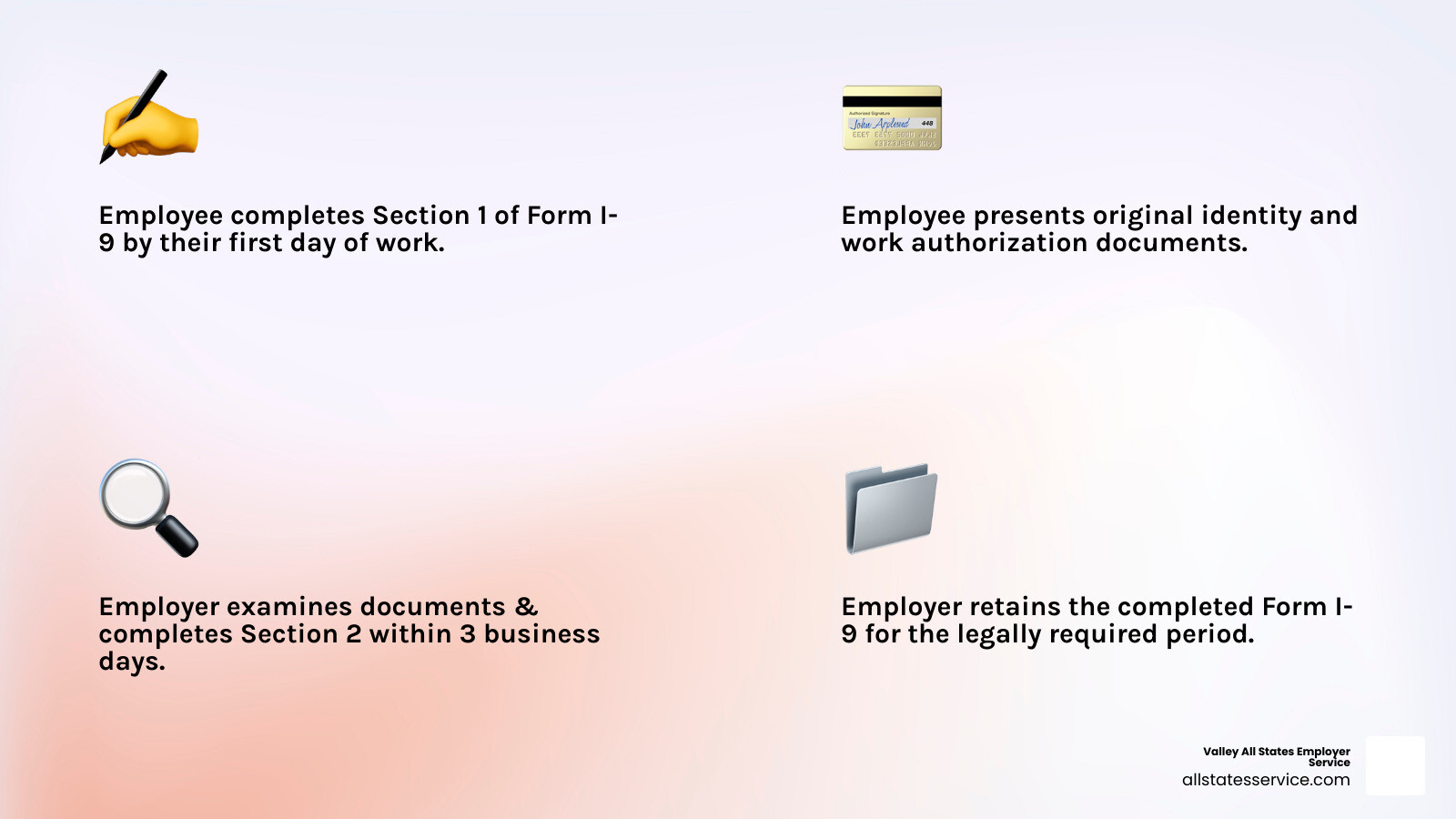
Your new hire completes Section 1 by their first day. You then review their federal I-9 documents and complete Section 2 within three business days, certifying the documents appear genuine and relate to the employee.
It’s a shared responsibility. The employee provides accurate information and valid documents, and you must examine them carefully and complete the form correctly. This protects everyone involved.
Our guide on What is an I-9 Form? covers the basics, while our resource on Filling Out Employment Eligibility Verification offers step-by-step instructions.
Who Needs to Complete a Form I-9?
If you pay someone to work in the U.S., you must complete Form I-9. Federal law requires all U.S. employers to complete this form for every new hire, regardless of company size or industry.
The law applies to everyone, from U.S. citizens to newly authorized workers. Agricultural employers, fee-based recruiters, and small businesses must all comply.
This is where New Hire Verification becomes crucial. Getting this right from day one saves you headaches down the road, especially if Immigration and Customs Enforcement comes knocking with an audit notice.
The Role of USCIS in the I-9 Process
The U.S. Citizenship and Immigration Services (USCIS) manages Form I-9. This federal agency creates, updates, and publishes all official guidance for the form.
USCIS manages everything about the federal I-9 document, from the official blank forms to the detailed instructions on which documents count. They maintain I-9 Central, your go-to online resource for the latest forms, instructions, and updates. Bookmark this site.
The Handbook for Employers (M-274) is USCIS’s comprehensive guide to I-9 compliance. It covers tricky situations, shows document examples, and explains what to do when issues arise. If you have an I-9 question, this handbook likely has the answer.
Think of USCIS as your compliance partner. Their resources help employers verify identity and work authorization effectively and without discrimination.
Decoding the Document Lists: Your Options for Verification
Many employers are surprised to learn that for the federal I-9 document, employees choose which documents to present. You cannot tell them which specific ID to provide.
The system uses three lists. Employees can present one document from List A (proving both identity and work authorization) or a combination of one from List B (identity) and one from List C (work authorization). Either combination is acceptable.
This is the law. Anti-discrimination provisions protect an employee’s right to choose. Asking for specific documents or more than required is document abuse, which can lead to penalties. Understand the options and let your new hire choose.
For a comprehensive breakdown of what to look for when reviewing these documents, our guide on I-9 Section 2 Acceptable Documents walks you through the details.

List A: Documents That Prove Both Identity & Work Authorization
List A documents are the simplest option. One document establishes both identity and U.S. work authorization. When an employee provides a valid List A document, you cannot ask for anything else.
The most common List A federal I-9 document is a U.S. Passport or U.S. Passport Card. A Permanent Resident Card, often called a Green Card, is another frequent choice, showing lawful permanent resident status and work authorization.
Employment Authorization Documents (EAD), specifically Form I-766 with a photograph, are also on List A. For certain non-citizens, a foreign passport with a temporary I-551 stamp or temporary I-551 printed notation on a machine-readable immigrant visa serves the same purpose.
Some employees might present a foreign passport with Form I-94 or Form I-94A that contains an endorsement authorizing work. Citizens of the Federated States of Micronesia or the Republic of the Marshall Islands can also use their passport combined with Form I-94 or Form I-94A.
For more details on specific document requirements, take a look at our resource on Documents for I-9.
List B: Documents That Only Prove Your Identity
List B documents only prove identity. They do not prove work authorization and must be presented with a List C document.
The most common List B documents are a driver’s license or state-issued ID card. School ID cards with a photo work for younger employees, and government-issued ID cards from federal, state, or local agencies are also acceptable.
Other valid options include a voter’s registration card, U.S. Military card or draft record, military dependent’s ID card, and U.S. Coast Guard Merchant Mariner Card. Native American tribal documents and driver’s licenses issued by Canadian government authorities also serve as valid identity proof.
What matters most is that the document has a photograph and identifying information that reasonably appears genuine and relates to the person. When Verifying I-9 Documents, we look for documents that are unexpired and appear legitimate.
List C: Documents That Only Prove Your Work Authorization
List C documents prove U.S. work authorization but not identity. They must be paired with a List B document.
The Social Security Account Number card is the most frequently presented List C document, but not all are acceptable. U.S. birth certificates are also a common choice, and must be an original or certified copy from a government authority with an official seal.
The Certification of Birth Abroad issued by the Department of State (Form FS-545 or Form DS-1350) proves U.S. citizenship for those born outside the country. Native American tribal documents can also establish work authorization.
Less common but still valid options include the U.S. Citizen ID Card (Form I-197) and the Identification Card for Use of Resident Citizen in the United States (Form I-179). Various employment authorization documents issued by the Department of Homeland Security also fall into this category.
Understanding these distinctions helps ensure accurate Work Authorization Verification and keeps you compliant.
A Closer Look at Your Federal I-9 Document Choices
When examining federal I-9 documents, you aren’t a forensic expert, but you must pay attention. Your job is to ensure documents are unexpired, appear genuine, and belong to the employee. This requires reasonable judgment, not a criminal investigation.
Look for documents that seem right. Does the photo match the person? Does it look tampered with? Are security features present? Our guide on I-9 Document Review details this critical step.
U.S. Passport vs. U.S. Passport Card: What’s the Difference?
Many employers are surprised that both the U.S. Passport and the U.S. Passport Card are valid List A federal I-9 documents. Either one establishes both identity and employment authorization.
The U.S. Passport is the familiar book for all international travel. The U.S. Passport Card is a wallet-sized card for land and sea travel to Canada, Mexico, the Caribbean, and Bermuda, but not for international air travel.
For Form I-9 purposes, this travel distinction doesn’t matter. Both documents prove U.S. citizenship and identity equally well. Your employee can choose whichever one they prefer to present.
Using a Foreign Passport as a Federal I-9 Document
A foreign passport can be a List A federal I-9 document, but only with specific additional documentation that proves work authorization.
To qualify as a List A document, a foreign passport must have a temporary I-551 stamp, a temporary I-551 printed notation on a machine-readable immigrant visa, or a Form I-94/I-94A with a work-authorizing endorsement. These additions prove both identity and work authorization.
Without these additions, a foreign passport is only a List B document (proving identity), requiring a List C document for work authorization. Getting this right is essential for accurate Workforce Eligibility Verification.
Social Security Cards and Birth Certificates
These two documents are the most commonly presented List C federal I-9 documents. They prove work authorization, but the details are important.
Not all Social Security cards work for I-9 purposes. The card must be unrestricted and cannot have phrases like “NOT VALID FOR EMPLOYMENT” or “VALID FOR WORK ONLY WITH DHS AUTHORIZATION.” A card with these restrictions is not an acceptable List C document. Also, cards issued on or after February 1, 1990, should not be laminated.
U.S. Birth certificates must be an original or a certified copy from a U.S. government authority and must have an official seal. Regular photocopies are not acceptable. Additionally, birth certificates from Puerto Rico must have been issued on or after July 1, 2010, to be valid.
These specific requirements exist to ensure documents are legitimate and that verification standards are applied uniformly nationwide.
Navigating Special Situations and Employer Rules
The Form I-9 process isn’t always straightforward. Employees may not have documents ready, or they might be minors or rehires. As an employer, you must understand what you can and cannot request for federal I-9 documents.

Remote hiring has introduced its own complexities, which is why understanding I-9 Remote Verification procedures is increasingly important. But whether you’re verifying documents in person or remotely, the same fundamental rules apply. Let’s walk through some common scenarios.
Can Employers Tell You Which Documents to Provide?
Many well-meaning employers make a mistake here. The answer is a firm no. You cannot tell employees which specific federal I-9 documents to present. This is rooted in federal anti-discrimination provisions.
The choice of which acceptable documents to present belongs entirely to the employee. If someone offers a List A document like a U.S. Passport, you must accept it. You cannot ask them to also show a driver’s license or Social Security card.
Asking for more documents than required is called document abuse. It can lead to serious discrimination penalties, even if your intentions were good. Let employees choose and accept any valid combination they offer. Our I-9 Compliance Services Complete Guide dives deeper into these anti-discrimination protections.
What If a Document is Lost, Stolen, or Expired?
Life happens. Sometimes a new employee’s documents are lost or stolen. The law accounts for these situations through acceptable receipts.
An employee can temporarily present a receipt for a replacement document. If someone’s driver’s license was lost, they can show you the receipt for their replacement. This receipt is valid for 90 days, during which time they must bring you the actual replacement document.
There are two other types of receipts. Lawful permanent residents who have a temporary I-551 stamp on their Form I-94 can present that with a photo ID. This is valid until the stamp’s expiration date. Similarly, refugees can present their Form I-94 indicating refugee status with a photo ID. This receipt is valid for 90 days, during which they must present an EAD or Green Card.
Any federal I-9 document with an expiration date must be unexpired when presented. However, documents officially extended by the issuing authority count as unexpired. For more details, the M-274 Acceptable Receipts section of the Handbook for Employers is your go-to resource.
Special Rules: Minors and Reverification
Certain employees require special attention when it comes to federal I-9 documents.
Minors under 18 often lack standard ID. If a minor cannot present a List B document, they can use a school record or report card, a clinic, doctor, or hospital record, or a daycare record. They still need a List C document to prove work authorization. If someone else completes Section 1 for the minor, you must complete the “Preparer and/or Translator Certification” section.
Reverification is required when an employee’s work authorization expires or when you rehire someone. If an employee’s List A or List C document expires, you must reverify their employment authorization using Supplement B. The employee must present new acceptable documentation.
Rehiring within three years offers a shortcut. If you rehire an employee within three years of their original Form I-9 completion date, you can use the existing form and just complete Supplement B. Our guide on the I-9 Process for Rehires explains how to handle these situations.
Staying Compliant: Retention, Penalties, and Resources
Completing Form I-9 is just the beginning. You must also properly store these federal I-9 documents, know what happens if things go wrong, and know where to turn for help. Many employers are caught off guard during audits because they misunderstand retention rules. Our resources on I-9 Record Keeping and Internal I-9 Audit Complete Guide can help you avoid these pitfalls.
How Long Must Employers Keep Form I-9s?
The rule is: you must retain Form I-9 for three years after the hire date, or for one year after employment ends, whichever is later. This “3-year/1-year rule” can be confusing.
For example, if you hire someone on March 1, 2023, and they leave on March 1, 2024, you must keep their Form I-9 until March 1, 2026 (three years from hire is later).
If another employee hired on March 1, 2023, stays until March 1, 2027, you must keep their form until March 1, 2028 (one year after termination is later).
Whichever date comes later, that’s your deadline. These forms need secure storage, separate from regular personnel files. You must be able to produce them quickly for authorized government officials.
What Are the Penalties for Non-Compliance?
The penalties for Form I-9 violations can be severe. From simple paperwork errors to knowingly hiring unauthorized workers, the consequences can significantly impact your bottom line.
Paperwork violations like missing information or incorrect dates can result in fines from hundreds to thousands of dollars per form. These add up quickly across many forms.
The penalties are much steeper for knowingly hiring or continuing to employ unauthorized workers. These fines start in the thousands per violation and escalate dramatically for repeat offenses. In serious cases, federal law allows for criminal penalties, including imprisonment.
Nobody wants to face an ICE I-9 Audit, which is why staying ahead of compliance issues is so important. Understanding the full range of I-9 Compliance Penalties is a good motivator to get your documentation in order.
Where to Find Official Help and Resources
You don’t have to steer the federal I-9 document maze alone. Several official resources exist to help you stay compliant.
The U.S. Citizenship and Immigration Services (USCIS) is your primary source for everything Form I-9. They provide the latest forms, instructions, and policy updates. Their dedicated I-9 Central website at uscis.gov/i-9-central is a one-stop shop for compliance guidance.
The Handbook for Employers (M-274) is a comprehensive guide that walks you through every aspect of the Form I-9 process, explaining acceptable documents and how to correct errors.
If you participate in the E-Verify program, you have access to an electronic system that works with Form I-9 to confirm employment eligibility. Our guide on E-Verify and I-9 explains how these two systems work together.
For anti-discrimination concerns, the Immigrant and Employee Rights Section (IER) and the Equal Employment Opportunity Commission (EEOC) enforce rules protecting employees from unfair documentary practices.
Simplify Your I-9 and E-Verify Process
Managing federal I-9 documents and compliance rules can be overwhelming. Deciphering acceptable documents, tracking retention requirements, and worrying about audit penalties is a lot to juggle with other HR duties.
That’s exactly where we come in.
At Valley All States Employer Service, we specialize in outsourced E-Verify workforce eligibility verification. We handle the detailed, time-consuming work of document verification and compliance tracking so you don’t have to. Our team provides expert, impartial, and efficient processing that minimizes errors and reduces your administrative workload.
Think of us as your compliance partner. We stay current on all regulation changes and nuances of acceptable federal I-9 documents. We know the rules for Social Security cards, when reverification is required, and can spot issues before they become costly problems during an ICE I-9 Audit.
Our services are designed for employers who want robust I-9 compliance without the headache. Whether you’re onboarding five employees or fifty, we streamline your document verification process and help you maintain accurate records. You focus on running your business, and we’ll ensure your employment eligibility verification is handled correctly, every time.
Ready to simplify your compliance obligations and gain some peace of mind? Let us handle the intricate details while you get back to what you do best.