
Why Federal Employment Compliance Matters for Your Business
Federal employment compliance is the set of laws and regulations that govern how businesses hire, pay, and treat their employees. These rules come from multiple federal agencies and cover everything from fair wages to workplace safety to equal opportunity hiring.
Understanding Federal Employment Compliance:
- Over 180 federal laws administered by the Department of Labor affect approximately 165 million workers
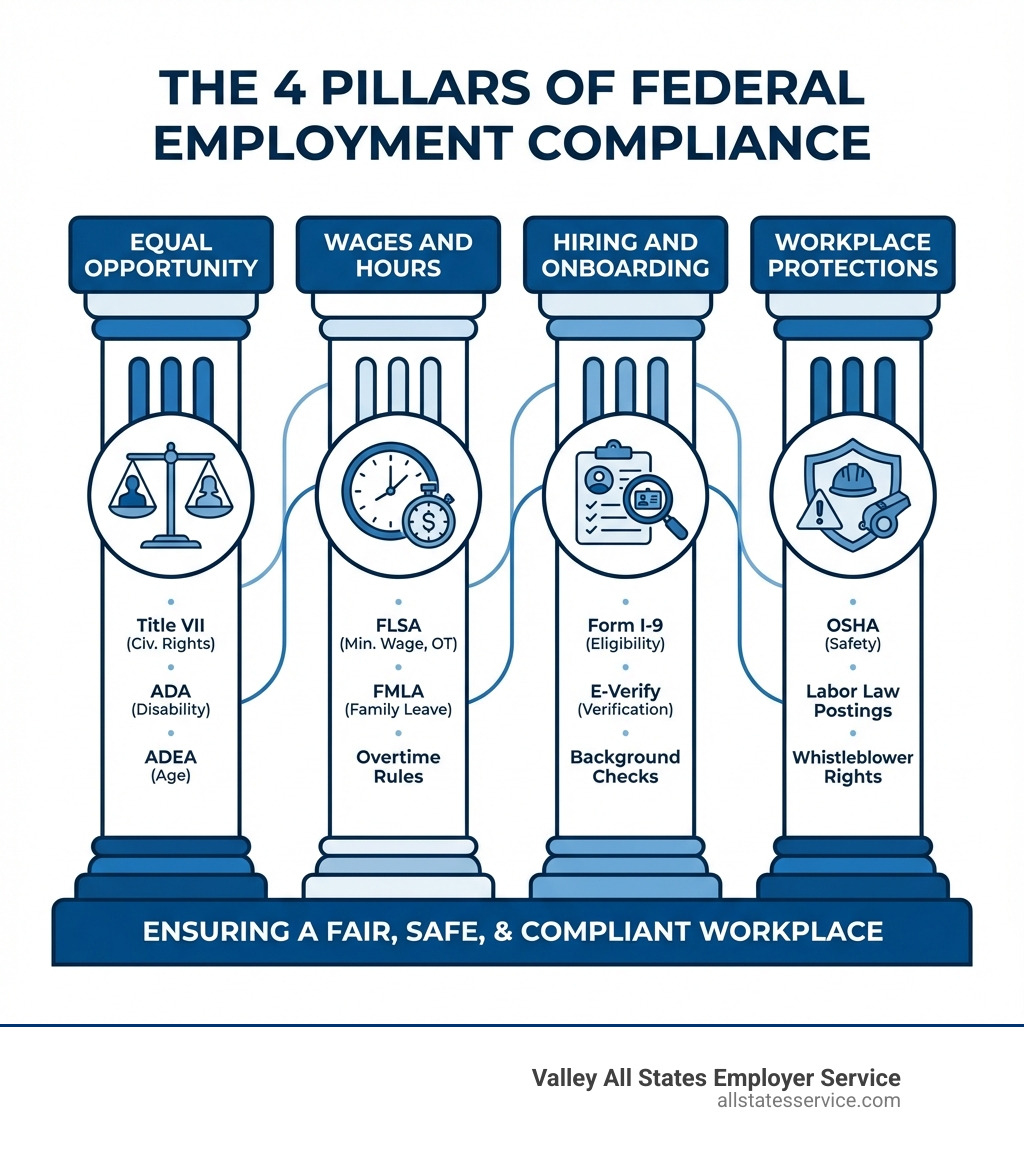
- Key areas include: equal opportunity, wages and hours, hiring verification, workplace safety, and employee benefits
- Enforcement agencies: EEOC, DOL, OSHA, USCIS, and others monitor and enforce compliance
- Penalties for violations range from fines to lawsuits to loss of federal contracts
- Federal contractors face additional requirements beyond standard employment laws
If you’re an HR manager or business owner, you know the challenge. The federal government administers more than 180 employment laws that impact nearly every aspect of your workplace. These mandates cover roughly 165 million workers across 11 million workplaces.
The complexity is real. You’re juggling anti-discrimination requirements, wage and hour rules, hiring verification procedures, safety standards, and benefit regulations. And the stakes are high. Non-compliance can mean lawsuits, fines, loss of federal contracts, and damage to your reputation.
But here’s the good news: compliance doesn’t have to be overwhelming. When you understand the core requirements and implement the right systems, you can protect your business while creating a fair, safe workplace for your team.
This guide breaks down the essential federal employment rules every employer needs to know. We’ll walk through equal opportunity requirements, wage and hour laws, hiring and onboarding compliance, workplace protections, and the special rules that apply to federal contractors.
The Foundation: Nondiscrimination and Equal Opportunity
Equal opportunity is a cornerstone of Federal employment compliance. It means ensuring all employees and applicants are treated fairly, without regard to protected characteristics. Several key federal laws establish these protections, primarily enforced by the U.S. Equal Employment Opportunity Commission (EEOC).

At the heart of these protections is Title VII of the Civil Rights Act of 1964. This landmark law prohibits discrimination based on race, color, national origin, sex, and religion. It applies to private and public employers with 15 or more employees, the federal government, employment agencies, and labor organizations. While Title VII doesn’t explicitly list sexual orientation or gender identity, the US Supreme Court has ruled that its sex discrimination provision prohibits discrimination against employees on these bases. Harassment and retaliation for reporting discrimination are also illegal under Title VII.
Beyond Title VII, other critical federal laws reinforce these nondiscrimination principles:
- Age Discrimination in Employment Act (ADEA): This act protects individuals aged 40 or older from employment discrimination based on age. It applies to private employers with 20 or more employees, and federal, state, and local governments regardless of employee count. The Older Workers Benefit Protection Act (OWBPA) further amended the ADEA to prohibit age discrimination in employee benefits.
- Americans with Disabilities Act (ADA): The ADA prohibits discrimination against qualified individuals with disabilities. It requires employers to provide reasonable accommodations to employees and applicants with disabilities, unless doing so would cause an undue hardship. The ADA applies to employers of 15 or more individuals.
- Genetic Information Nondiscrimination Act (GINA): GINA makes it illegal to discriminate against employees or applicants based on their genetic information, including family medical history.
- Equal Pay Act (EPA): This law prohibits sex-based wage discrimination, requiring men and women in the same workplace to be given equal pay for equal work. The Lilly Ledbetter Fair Pay Act amended the EPA, resetting the 180-day statute of limitations for filing a discriminatory pay charge with each new discriminatory paycheck.
- Pregnant Workers Fairness Act (PWFA): The PWFA requires covered employers to reasonably accommodate qualified employees and applicants with known limitations related to pregnancy, childbirth, or related medical conditions.
These laws collectively ensure that employers make decisions based on qualifications and performance, not prejudice.
Affirmative Action for Federal Contractors
For businesses that work with the federal government, Federal employment compliance adds another layer of responsibility: affirmative action. Executive Order 11246 specifically prohibits federal contractors and certain federally assisted construction contractors and subcontractors from discriminating in employment decisions based on protected characteristics like race, color, religion, sex, sexual orientation, gender identity, and national origin.
Furthermore, if your organization holds federal contracts of at least $50,000 and has at least 50 employees, you must actively work to bolster the number of women and minorities in the workplace. This includes developing and implementing a formal affirmative action plan, maintaining detailed recordkeeping, and engaging in data collection to demonstrate your efforts and progress. This isn’t just about avoiding discrimination; it’s about taking proactive steps to ensure equal opportunity. Managing these requirements can be complex, so many businesses look for expert guidance on HR Compliance for Small Business to steer these waters effectively.
Understanding the EEO Complaint Process
The way an employee addresses discrimination depends on who their employer is. While private sector employees typically file charges with the EEOC, the process is different for those working for the federal government. The EEOC plays a unique role in the Federal Sector EEO process, providing leadership and guidance to federal agencies and adjudicating appeals from their administrative decisions.
For federal employees and applicants, the EEO complaint process starts within their own agency. If they believe they’ve been discriminated against, they must contact an EEO Counselor at their agency within 45 calendar days of the discriminatory action. This initial contact leads to counseling or Alternative Dispute Resolution (ADR). If the issue isn’t resolved, the individual can file a formal complaint with the agency. The agency then investigates, and the employee can request a hearing before an EEOC Administrative Judge or an agency decision. If dissatisfied with the outcome, they can appeal to the EEOC’s Office of Federal Operations. This is a key difference: federal employees go through an internal agency process before appealing to the EEOC, whereas private employees typically go directly to the EEOC to file a charge.
Retaliation is strictly prohibited in both federal and private sectors. No employer, federal or otherwise, can punish an employee for reporting discrimination or participating in an EEO investigation. Navigating these complex processes, especially when it involves potential litigation, often benefits from specialized HR Compliance Consulting.
Wages, Hours, and Leave: Paying Your Team Correctly
Ensuring your employees are paid correctly for their time and provided appropriate leave is a critical component of Federal employment compliance. The U.S. Department of Labor (DOL) enforces numerous laws governing wages, hours, and employee leave.
The Fair Labor Standards Act (FLSA) is the bedrock for most employers. It sets federal minimum wage, overtime pay, recordkeeping, and child labor standards. Most non-exempt employees must be paid at least the federal minimum wage for all hours worked and receive overtime pay at one-and-one-half times their regular rate for hours worked over 40 in a workweek. The FLSA also has strict rules regarding child labor, limiting the types of jobs and hours minors can work, particularly in non-agricultural operations and jobs deemed hazardous.
Beyond wages, employees also have rights to various types of leave:
- Family and Medical Leave Act (FMLA): This act entitles eligible employees of covered employers (generally those with 50 or more employees) to up to 12 weeks of unpaid, job-protected leave for specific family and medical reasons, such as the birth of a child, caring for a seriously ill family member, or their own serious health condition. During this leave, group health benefits must be maintained.
- Uniformed Services Employment and Reemployment Rights Act (USERRA): USERRA protects the job rights of individuals who voluntarily or involuntarily leave employment to undertake military service or certain types of service in the National Guard or Reserves. It protects against discrimination based on military service and ensures reemployment rights upon their return. This applies to all employers, regardless of size.
These laws are just some of the many that fall under the umbrella of Employment Law Laws that businesses must carefully follow.
Special Pay Rules for Federal Contractors
If your business is a federal contractor, you’ll encounter even more specific wage and leave requirements. Federal employment compliance for contractors includes adherence to Executive Orders that mandate higher minimum wages and paid sick leave.
- Minimum Wage Requirements: Executive Orders 14026 and 13658 set specific minimum wage rates for employees working on federal contracts. For contracts entered into, renewed, or extended on or after January 30, 2022, Executive Order 14026 generally requires a minimum wage of $17.20 per hour (as of January 1, 2024) for both non-tipped and tipped employees. For contracts prior to this date, Executive Order 13658 applies, setting the minimum wage at $12.90 per hour and $9.05 per hour for tipped employees (as of January 1, 2024). Enforcement of Executive Order 14026 has been enjoined in Texas, Louisiana, and Mississippi for contracts entered into, renewed, or extended prior to January 30, 2022.
- Paid Sick Leave: Executive Order 13706 established mandatory paid sick leave for federal contractors. The U.S. Department of Labor published a final rule to implement this order, requiring organizations with covered federal contracts to provide covered employees with up to seven days (56 hours) of paid sick leave annually. This leave can be used for personal illness, family care, or other specified reasons.
Breaks, Benefits, and Payroll Compliance
Beyond minimum wage and overtime, Federal employment compliance extends to how you manage breaks, employee benefits, and payroll taxes.
The FLSA generally does not require meal or rest breaks, but if you offer short rest breaks (usually 20 minutes or less), they are typically considered compensable work time. Meal breaks, on the other hand, usually last at least 30 minutes and are not compensable if the employee is completely relieved from duty. A significant development in this area is the PUMP for Nursing Mothers Act, which amended the FLSA. It requires employers to provide all female employees with reasonable break time to express breast milk for one year after the child’s birth, and a private place (not a bathroom) to do so, unless doing so would cause undue hardship for employers with fewer than 50 employees.
Employee benefits are also heavily regulated:
- Employee Retirement Income Security Act (ERISA): ERISA sets minimum standards for most private employer-sponsored retirement and health plans. It imposes fiduciary duties, disclosure requirements, and reporting obligations to protect the interests of plan participants.
- Health Care Continuation (COBRA): The Consolidated Omnibus Budget Reconciliation Act (COBRA) requires employers with 20 or more employees that offer group health insurance to provide temporary continuation of health coverage to employees and their families after certain qualifying events, like job loss or reduction in hours.
- Health Information Privacy (HIPAA): The Health Insurance Portability and Accountability Act (HIPAA) includes provisions that protect the privacy and security of individuals’ health information and ensure health insurance portability.
Finally, accurate and timely payroll tax reporting and depositing are non-negotiable. Employers must withhold federal income and employment taxes (Social Security and Medicare) from employees’ pay, and then accurately report and deposit these taxes with the IRS according to strict schedules. Failing to do so can result in significant penalties. Managing these intricate requirements often leads businesses to explore Benefits Outsourcing Compliance Guide for expert assistance.
Hiring and Onboarding: Your Federal Employment Compliance Checklist
The hiring and onboarding process is a critical stage for ensuring Federal employment compliance. From verifying eligibility to conducting background checks, every step must adhere to federal regulations to avoid legal pitfalls.

The Immigration Reform and Control Act (IRCA) is central to this. It makes it unlawful to knowingly hire or continue to employ unauthorized workers. To comply, all employers must verify the identity and employment eligibility of every new hire, regardless of citizenship status, by completing Form I-9. This is why having an accurate Employment Eligibility Verification Complete Guide is so important.
After completing Form I-9, many employers, especially federal contractors, are also required to use E-Verify. This internet-based system compares information from an employee’s Form I-9 to data from U.S. Department of Homeland Security and Social Security Administration records to confirm employment eligibility.
Beyond identity and work authorization, other pre-employment checks also fall under federal scrutiny:
- Background Checks: These can include credit checks, criminal background checks, and even drug testing. Each comes with its own set of federal rules.
- Fair Chance Act: For federal agencies and contractors, this act limits when you can inquire about an applicant’s criminal history, generally prohibiting such questions until a conditional offer of employment has been made.
A thorough Complete Onboarding Compliance Checklist Guide is essential to ensure all these steps are covered accurately and legally.
Mastering Form I-9 and E-Verify for Federal Employment Compliance
Form I-9 is more than just a piece of paper; it’s a vital document for Federal employment compliance. Employers must ensure they are using the correct, most current version of the form. We stay on top of I-9 Form Updates to help you remain compliant. For instance, the current Form I-9 (edition date 01/20/25) is valid through 05/31/2027, but previous editions may still be valid until specific dates. Our I-9 Compliance Guide 2025 offers detailed insights into these requirements.
Remote verification has become increasingly common. While traditional I-9 verification requires physical examination of documents, new DHS-authorized alternative procedures allow for remote examination, which can be done through a Virtual I-9 Process for qualified employers.
For federal contractors, E-Verify is often mandatory. If your federal contract contains the Federal Acquisition Regulation (FAR) E-Verify clause, you are required to use E-Verify for all new hires and existing employees assigned to the federal contract. This is a critical aspect of Federal Contractor E-Verify requirements.
Common I-9 and E-Verify mistakes that can lead to penalties include:
- Failing to complete Form I-9 within three business days of hire.
- Accepting invalid or expired documents.
- Not re-verifying employment authorization when required.
- Failing to create an E-Verify case within three business days of hire (if mandatory).
- Improperly handling Tentative Nonconfirmations (TNCs).
- Not maintaining proper retention of I-9 forms and E-Verify records.
Navigating Background Checks and Drug Testing
When it comes to pre-employment screening, Federal employment compliance demands careful attention to several laws, balancing employer needs with applicant rights.
The Fair Credit Reporting Act (FCRA) governs the use of consumer reports, including credit checks and some background checks, for employment purposes. If you use a third party to conduct these checks, the FCRA requires you to provide specific disclosures to applicants and obtain their written authorization. You must also provide applicants with a copy of the report and a summary of their rights if you intend to take adverse action based on the report.
Criminal background checks are also subject to scrutiny. While no federal law outright prohibits inquiring about criminal history, the EEOC advises against blanket exclusions. Instead, employers should conduct individualized assessments, considering the nature and gravity of the offense, the time passed since the conviction or completion of the sentence, and the nature of the job held or sought. For federal agencies and contractors, the Fair Chance Act (also known as the Fair Chance to Compete for Jobs Act of 2019) specifically prohibits requesting an applicant’s criminal history information until a conditional offer of employment has been made, with limited exceptions. This is a significant step towards ensuring fair hiring practices. If you’re looking for support with these screenings, consider working with Pre-Employment Background Check Companies.
Drug testing policies also fall under Federal employment compliance. The Drug-Free Workplace Act requires federal contractors and recipients of federal grants to maintain a drug-free workplace, which can involve publishing a drug-free workplace policy and establishing a drug awareness program. However, this becomes particularly complex when considering state marijuana laws. Even if marijuana is legal at the state level in Maryland, federal law still classifies it as a Schedule I controlled substance. This means federal contractors, bound by federal mandates like the Drug-Free Workplace Act, must generally maintain drug-free workplaces, regardless of state laws. This conflict requires careful navigation, often meaning federal contractors cannot accommodate marijuana use if it conflicts with their federal obligations.
Workplace Safety, Postings, and Employee Protections
Creating a safe workplace and informing employees of their rights are fundamental aspects of Federal employment compliance.
The Occupational Safety and Health (OSH) Act is the primary federal law governing workplace safety. Administered by the Occupational Safety and Health Administration (OSHA), this act requires employers to provide a workplace free from recognized hazards that are causing or are likely to cause death or serious physical harm to employees. This is known as the General Duty Clause. OSHA also sets specific safety and health standards for various industries and hazards. Employers covered by the OSH Act must comply with OSHA’s regulations and are subject to inspections and potential penalties for non-compliance. You can find the complete text of the Occupational Safety and Health (OSH) Act for detailed information.
Beyond safety, employees are also protected when they speak up about violations. Federal laws provide whistleblower protections to employees who report illegal activities, safety violations, or other misconduct by their employers. These protections prevent employers from retaliating against whistleblowers, ensuring they can raise concerns without fear of losing their jobs or facing other adverse actions. OSHA enforces whistleblower protections in many laws.
In situations of significant workforce changes, the Worker Adjustment and Retraining Notification (WARN) Act comes into play. The WARN Act requires most employers with 100 or more employees to give at least 60 calendar days’ advance written notice of plant closings and mass layoffs. This notice helps employees and their families prepare for the job loss and allows time to seek new employment or retraining. Failure to provide proper notice can result in back pay and benefits for affected employees, as well as civil penalties. Staying on top of these requirements is key to maintaining Workplace Compliance Solutions for your business.
Mandatory Labor Law Postings for Federal Employment Compliance
One of the simplest yet most overlooked aspects of Federal employment compliance is displaying mandatory labor law posters. These posters inform employees of their rights and employer obligations under various federal laws.
The U.S. Department of Labor offers an elaws Poster Advisor tool that helps employers determine which federal posters they are required to display. For federal contractors, there are often additional specific postings. For example, federal contractors are typically required to display the E-Verify participation poster, informing employees about their rights regarding the E-Verify system. These notice posting requirements are not merely suggestions; they are legal mandates.
It’s crucial to understand the rules for both physical and, where applicable, digital postings. Ensure posters are prominently displayed in common areas where employees can easily see them. If you have remote employees, consider how you will ensure they have access to all required postings, whether through digital means or by mailing physical copies.
Frequently Asked Questions about Federal Employment Compliance
We understand that Federal employment compliance can raise many questions. Here are answers to some of the most common ones we encounter:
How do I handle state marijuana laws when federal contracts require a drug-free workplace?
This is a tricky area where state and federal laws directly conflict. In Maryland, medical cannabis is legal, and recreational cannabis use is also legal. However, federal law classifies marijuana as a Schedule I controlled substance. For federal contractors, federal mandates, such as the Drug-Free Workplace Act, take precedence. This means that even if an employee’s marijuana use is legal under Maryland state law, a federal contractor generally must maintain a drug-free workplace to comply with their federal contract obligations. This often means that federal contractors cannot accommodate marijuana use by employees. It’s crucial for federal contractors to clearly communicate their drug-free workplace policy, which aligns with federal law, to all employees, and to consult legal counsel to ensure their policies are robust and defensible.
What are the key differences in the EEO complaint process for federal employees versus private sector employees?
The primary difference lies in the initial stages of the complaint process. For private sector employees, the first step is usually to file a charge of discrimination directly with the EEOC within 180 or 300 days (depending on state laws) of the discriminatory act. The EEOC then investigates or mediates.
For federal employees and applicants, the process is internal to the federal agency first. They must contact an EEO Counselor at their agency within 45 calendar days of the discriminatory action. This leads to counseling or Alternative Dispute Resolution (ADR). If unresolved, the employee files a formal complaint with the agency, which then investigates. Only after the agency process is exhausted can the federal employee appeal to the EEOC’s Office of Federal Operations or file a lawsuit in federal court. So, federal employees have an extra layer of internal agency review before the EEOC gets involved in the same way it does for private sector complaints.
What are the main requirements of the Davis-Bacon and Service Contract Acts for federal contractors?
These acts impose specific wage and benefit requirements on federal contractors:
- Davis-Bacon Act (DBA): This act applies to contractors and subcontractors performing work on federally funded or assisted contracts for the construction, alteration, or repair of public buildings or public works. It requires that all laborers and mechanics employed on these projects be paid no less than the locally prevailing wages and fringe benefits for corresponding classes of laborers and mechanics employed on similar projects in the area.
- McNamara-O’Hara Service Contract Act (SCA): The SCA applies to federal government contracts principally for the furnishing of services. It requires contractors and subcontractors performing services on covered federal contracts in excess of $2,500 to pay service employees no less than the locally prevailing wages and fringe benefits, or the rates contained in a predecessor contractor’s collective bargaining agreement. It also mandates safe and sanitary working conditions and notice requirements.
Both acts are crucial for federal contractors to understand to avoid penalties and maintain eligibility for federal projects.
Conclusion
Navigating the intricate landscape of Federal employment compliance is no small feat. It requires diligence, up-to-date knowledge, and robust internal processes. From nondiscrimination laws like Title VII and the ADA, to wage and hour regulations under the FLSA, to the specific requirements for federal contractors under various Executive Orders, the rules are extensive. Add to that the complexities of Form I-9, E-Verify, background checks, and workplace safety, and it’s clear that proactive compliance is an ongoing process, not a one-time task.
Staying compliant protects your business from costly penalties, lawsuits, and reputational damage. More importantly, it fosters a fair, safe, and equitable workplace for all your employees.
We at Valley All States Employer Service understand these challenges. Our expertise in outsourced HR compliance, particularly with E-Verify, helps businesses like yours minimize errors and administrative burdens. We provide expert, impartial, and efficient E-Verify processing, ensuring you meet your federal obligations without the headache. Let us help you reduce your risk and streamline your operations.
Ready to simplify your Federal employment compliance? Learn more about our services, including our I-9 Section 2 Complete Guide, and let’s ensure your business is not just compliant, but thriving.