
Why Audit Risk Matters More Than Ever
Reduce audit risk by mastering your record-keeping, strengthening internal controls, and leveraging modern technology to catch errors before auditors do.
Quick Ways to Reduce Audit Risk:
- Keep impeccable records – Document every transaction, deduction, and employee verification (especially I-9 forms)
- Strengthen internal controls – Implement checks and balances, segregate duties, and conduct regular reconciliations
- Run internal audits – Identify problems before external auditors find them
- Train your team – Make sure everyone understands their compliance responsibilities
- Use technology – Automate repetitive tasks to eliminate human error
- Respond quickly to notices – Never ignore letters from the IRS or other regulatory agencies
If you ask Americans what makes them nervous, IRS audits rank pretty high on the list. In 2021 alone, the IRS sent nearly 16 million automated notices for math errors on tax returns. That’s just one type of audit risk facing businesses today.
Audit risk is the possibility that an auditor concludes your financial reports are accurate when they actually contain material misstatements. These mistakes can stem from innocent errors or intentional fraud, but the consequences are the same: fines, reputational damage, and loss of stakeholder trust.
For busy HR managers juggling hiring, compliance, and day-to-day operations, audit risk extends beyond financial statements. Employment verification errors, I-9 form mistakes, and payroll discrepancies can all trigger costly investigations. The SEC charged Kraft Heinz $62 million for improperly recording cost savings, and executives paid an additional $400,000 in penalties. One was banned from serving as a public company executive for five years.
The good news? Most audit risks are preventable. You don’t need to be a compliance expert or hire a massive accounting team. You just need the right systems, habits, and partners in place.
Reduce audit risk basics:
Understanding the Anatomy of Audit Risk
At its core, audit risk is the chance that an auditor issues a “clean” opinion on financial statements that are, in fact, materially misstated. This means there are significant errors or omissions in the statements that could mislead investors, creditors, or other stakeholders. The Public Company Accounting Oversight Board (PCAOB) defines audit risk as “the risk that the auditor expresses an inappropriate audit opinion when the financial statements are materially misstated.”
Why is mitigating this risk so crucial for your business? Because stakeholder trust hinges on the accuracy and reliability of your financial reporting. When an audit fails to catch material misstatements, it can erode confidence, lead to legal repercussions, and severely damage your reputation.
The Three Core Types of Audit Risk
To effectively reduce audit risk, we first need to understand its components. The auditing profession categorizes audit risk into three main types:
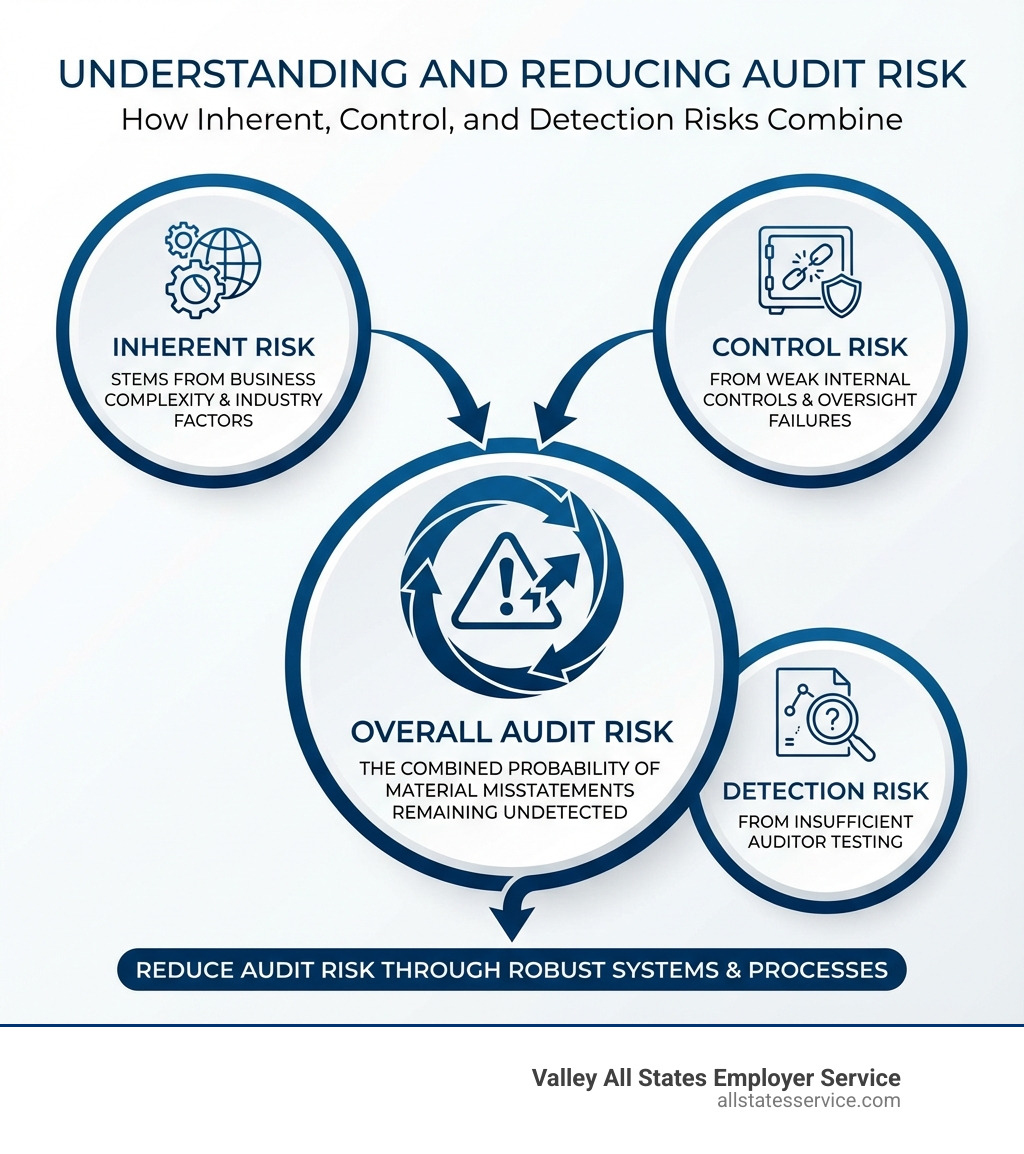
- Inherent Risk (IR): This is the risk of material misstatement occurring in your financial statements, assuming there are no related internal controls. Inherent risk often stems from the nature of your business operations, the complexity of your transactions, or external economic factors. For example, a company operating in a highly volatile industry with complex derivatives might have a higher inherent risk than a straightforward retail business. Transactions involving significant judgment or estimates, such as revenue recognition for long-term contracts, also carry higher inherent risk. The International Standard on Auditing (ISA) 200 defines inherent risk as the susceptibility of an assertion to a misstatement, due to error or fraud, that could be material, individually or in combination with other misstatements, before consideration of any related controls.
- Control Risk (CR): This type of risk arises from the failure of your internal controls to prevent or detect material misstatements on a timely basis. Even with robust internal controls in place, there’s always a chance they might not operate effectively. Weak internal control systems, poor system design, or a lack of proper oversight can significantly increase control risk. For instance, if your company doesn’t enforce segregation of duties, allowing one person to authorize, record, and reconcile transactions, the control risk for fraud or error increases dramatically. Evaluating these internal controls is a continuous process to ensure they are effective.
- Detection Risk (DR): This is the risk that the auditor’s procedures will not detect a material misstatement that exists in your financial statements. Detection risk is directly influenced by the effectiveness of the auditor’s work. Factors contributing to detection risk can include auditor error, insufficient testing of transactions, or mistakes in audit sampling. For instance, if an auditor relies on a small, unrepresentative sample of transactions, they might miss a pattern of misstatements. This is the only component of audit risk that auditors can directly control through the nature, timing, and extent of their audit procedures.
The Audit Risk Formula Explained
The relationship between these three types of risk is encapsulated in the audit risk formula:
Audit Risk (AR) = Inherent Risk (IR) x Control Risk (CR) x Detection Risk (DR)
This formula, described by the European Union in its auditing standards, is a fundamental tool for understanding and managing audit risk. It highlights that overall audit risk is a product of these three factors.
For auditors, this formula is a strategic roadmap. If inherent risk and control risk are high (meaning your business is more prone to misstatements and your internal controls are weak), the auditor must reduce detection risk to an acceptably low level. This means they will perform more extensive and rigorous audit procedures. Conversely, if your inherent and control risks are low, auditors can afford a higher detection risk, potentially reducing the scope of their work.
From our perspective as a business, this model shows us exactly where to focus our efforts. By strengthening our internal controls and reducing inherent risk through better processes, we can potentially lower the overall audit risk, which might lead to a more efficient and less intrusive audit process.
Proactive Strategies to Reduce Audit Risk
Being proactive is always better than being reactive, especially when it comes to audits. By implementing robust compliance frameworks and systematic practices, we can significantly reduce audit risk before any auditor even steps through the door. Think of it as building a strong, resilient foundation for your business’s financial and HR operations. Our HR Compliance Complete Guide for Businesses offers a great starting point.

Master Your Record-Keeping
Accurate and accessible record-keeping is your first and best line of defense against audit findings. Auditors, whether from the IRS or other regulatory bodies, will always look for documentation to substantiate your claims.
- Substantiating Deductions: For tax audits, every deduction you claim must be backed by clear, organized records. This includes receipts, invoices, bank statements, and any other relevant documentation. The IRS is particularly skeptical of deductions for chronically unprofitable businesses, viewing them as potential hobbies where expenses are not deductible. For charitable contributions, ensure you have appropriate receipts that meet IRS requirements. For larger property contributions, carefully evaluate the qualifications of appraisers.
- Supporting Findings: Beyond finances, meticulous record-keeping is critical for HR compliance. Take I-9 forms, for example. These forms, which verify an employee’s eligibility to work in the U.S., are frequently audited. Errors or omissions can lead to significant penalties. Our guide to I-9 Record Keeping emphasizes the importance of proper documentation. Ensure all documents for I-9 are correctly reviewed and stored.
- Avoid the “Dirty Dozen”: The IRS annually publishes a list of tax scams known as the “Dirty Dozen.” Engaging in any of these transactions signals to the IRS that your return might warrant an audit. Staying clear of these schemes is a direct way to reduce audit risk.
We recommend retaining substantiation documentation for at least seven years, exceeding the typical audit period, to ensure we are always prepared.
Strengthen Your Internal Controls
Robust internal controls are the backbone of effective risk management. They are the processes and procedures we put in place to ensure the accuracy of our financial data, prevent fraud, and promote operational efficiency.
- Key Control Measures:
- Segregation of Duties: No single employee should have control over an entire transaction from start to finish. Separate responsibilities for authorization, recording, and custody of assets to prevent errors and fraud.
- Regular Reconciliations: Consistently compare internal records with external statements (e.g., bank statements, vendor invoices) to identify discrepancies promptly.
- Approval Processes: Implement clear authorization levels for all expenditures, hires, and significant transactions.
- Access Controls: Limit physical and electronic access to sensitive information and assets.
- I-9 Compliance: For HR, strengthening internal controls means having a clear, documented process for completing, reviewing, and storing I-9 forms. Our Internal I-9 Audit Complete Guide provides comprehensive steps for setting up these controls.
- Conducting Self-Audits: Regularly evaluating our internal controls and performing I-9 Self Audits allows us to identify weaknesses and correct them before an external auditor does. This proactive approach significantly reduces the control risk component of audit risk.
Conduct Regular Internal Audits
Internal audits are a powerful tool for proactive risk identification and mitigation. They are an independent, objective assurance and consulting activity designed to add value and improve an organization’s operations.
- Proactive Issue Identification: By regularly conducting internal audits, we can identify potential issues in our financial reporting, operational processes, and compliance adherence before they become significant problems or are flagged by external auditors. This includes reviewing our Auditing I-9 Forms process to ensure compliance.
- Risk-Based Approach: A risk-based internal audit plan focuses our limited resources on the areas of greatest risk. This systematic approach ensures that our audit efforts are aligned with our most pressing concerns, providing insightful and future-focused assurance. The Global Practice Guide for developing a risk-based internal audit plan emphasizes this systematic approach.
- Culture of Continuous Improvement: Internal audits foster a culture where findings are seen not as criticisms but as opportunities for learning and growth. This continuous improvement mindset ensures that we are always refining our processes and controls, leading to a sustained reduction in audit risk.
Leveraging Technology and Training to Minimize Errors
In today’s business world, relying solely on manual processes is a recipe for increased audit risk. Modern solutions, especially technology, can drastically reduce audit risk by minimizing human error and streamlining complex compliance tasks. Implementing a robust Compliance Management System is a prime example of this.

How to use technology to reduce audit risk
Technology has revolutionized how we manage compliance and prepare for audits. It provides efficiency, accuracy, and insights that manual processes simply cannot match.
- AI and Data Analytics: Artificial intelligence (AI) and data analytics tools can sift through vast quantities of financial data, identifying hidden patterns, anomalies, and potential irregularities that human auditors might miss. This allows us to proactively address issues before they become material misstatements. As the field of AI in Auditing evolves, these tools become even more sophisticated, offering predictive capabilities to pinpoint high-risk areas.
- Automation Tools: Automation is key to eliminating repetitive, error-prone tasks. In accounting and HR, automation tools integrated into our ERP and payroll systems can ensure consistent data entry, calculation accuracy, and timely reporting. This not only saves time but also significantly reduces the chance of errors that could trigger an audit. The examination of automation in audit highlights its growing importance.
- Electronic I-9 Solutions: For employment verification, Electronic I-9 Solutions are a game-changer. They guide users through the form completion process, validate data in real-time, and store documents securely, drastically reducing the chances of common I-9 errors and helping us manage compliance efficiently. This leads to automated eligibility verification, which is crucial for employers.
By embracing these technological advancements, we can improve the accuracy and reliability of our data, making our processes more robust and less susceptible to audit findings.
The Importance of Employee Training and Awareness
Technology alone isn’t enough; our people are our first line of defense. A well-informed and well-trained workforce is vital for creating a strong compliance culture and significantly contributing to our efforts to reduce audit risk.
- Fostering a Compliance Culture: When employees understand the “why” behind compliance rules, they are more likely to adhere to them. Regular training helps to embed compliance into our daily operations rather than viewing it as an afterthought.
- Understanding Roles and Responsibilities: Each employee plays a role in maintaining accurate records and adhering to internal controls. Training clarifies these roles and responsibilities, ensuring everyone knows their part in the larger compliance picture. For example, specific I-9 Audit Training and I-9 Compliance Training are essential for anyone involved in the hiring process. Our I-9 Form Training ensures that all personnel are up-to-date with the latest requirements.
- Continuous Education: Regulations change, and so do best practices. Ongoing training and awareness programs ensure that our team stays current, adapting to new requirements and reinforcing existing ones. This continuous education is a proactive measure that keeps our control risk low.
Navigating an Audit: Preparation and Consequences
Despite our best efforts to reduce audit risk, sometimes an audit is simply unavoidable. When that notice arrives, whether from the IRS or another agency, panic is not an option. Preparation and a calm, organized response are key to navigating the process successfully. This is where having Expert Audit Representation can be invaluable.
How to Prepare When an Audit is Unavoidable
Receiving an audit notice can be stressful, but a structured approach can make all the difference.
- Organize Your Documents: Auditors will request specific documentation. Having all your records carefully organized and easily accessible is paramount. This includes financial statements, tax returns, payroll records, I-9 forms, and any supporting documentation for deductions or transactions. Our HR Compliance Audit Guide 2025 provides detailed steps for organizing your HR-related documents.
- Assemble a Response Team: Designate a small, knowledgeable team to handle the audit. This typically includes a lead contact person, relevant department heads (e.g., accounting, HR), and your external advisors (e.g., tax professional, legal counsel).
- Communication Protocols: Establish clear internal communication channels and a single point of contact for the auditor. This ensures consistent information is provided and prevents misunderstandings.
- Respond Promptly and Accurately: Never ignore letters or requests from auditors. Respond within the specified deadlines, providing accurate and complete information. If you need more time, communicate this clearly and formally.
The High Cost of Audit Failure
The implications of audit failure extend far beyond mere inconvenience. They can be financially devastating and inflict lasting damage on your business.
- Regulatory Scrutiny and Fines: Government agencies are serious about compliance. The IRS is expected to focus additional resources on assessing the tax compliance of wealthy individuals, large corporations, and complex partnerships, thanks to the Inflation Reduction Act. The SEC, for example, charged Kraft Heinz for improperly recording around $208 million in cost savings over several years. To settle these charges, Kraft paid a staggering $62 million fine. Beyond corporate fines, executives can face personal penalties and even bans from leadership roles, as seen in the Kraft Heinz case where the CPO and COO paid a combined $400,000 in civil penalties.
- Reputational Damage: An audit failure, especially one involving significant misstatements or fraud, can severely damage your brand’s reputation. This can lead to a loss of customer trust, difficulty attracting and retaining talent, and strained relationships with investors and business partners.
- Specific Compliance Penalties: For HR compliance, errors on I-9 forms can lead to substantial fines. Our I-9 Audit Penalties Complete Guide details the financial consequences of non-compliance. An ICE I-9 Audit can result in fines ranging from hundreds to thousands of dollars per violation, depending on the severity and recurrence.
These consequences underscore why proactive measures to reduce audit risk are not just good practice, but essential for survival.
How to manage audit risk with continuous monitoring
An audit, even a successful one, is not the end of the journey but a checkpoint. Fostering a culture of continuous improvement and ongoing monitoring is vital to ensure that past findings lead to future resilience.
- Post-Audit Action Plan: After an audit, thoroughly review the findings, even if no material misstatements were identified. Develop a clear action plan to address any weaknesses or recommendations. Assign responsibilities, set timelines, and allocate resources for implementation.
- Learning from Findings: Every audit provides valuable insights into our operations. We must treat audit findings as opportunities to refine our internal controls, update our policies, and improve our training programs. Our HR Compliance Review process can help us integrate these learnings.
- Ongoing Monitoring: Compliance is not a one-time event; it’s a continuous process. Implement systems for ongoing monitoring of key controls and processes. This might involve regular self-audits, data analytics dashboards, or periodic reviews by internal teams. Continuous monitoring allows us to catch new issues as they arise and verify the effectiveness of our corrective actions, creating a virtuous cycle of risk reduction.
Frequently Asked Questions about Reducing Audit Risk
What’s the difference between an internal and external audit?
Both internal and external audits play crucial roles in managing audit risk, but they serve different purposes and have distinct reporting structures.
- Internal Audits: These are performed by employees of your organization (or by outsourced internal audit services) to evaluate and improve the effectiveness of risk management, control, and governance processes. Internal auditors report to management and the audit committee, focusing on internal efficiency, fraud prevention, and compliance with internal policies and external regulations. Their goal is to help the organization achieve its objectives. Our Internal I-9 Audit Complete Guide is an example of an internal audit process.
- External Audits: Conducted by independent third-party accounting firms, external audits provide an objective opinion on the fairness and accuracy of your financial statements. They are primarily for the benefit of external stakeholders like investors, creditors, and regulators. External auditors must adhere to strict professional standards and maintain independence from the organization they are auditing. Their primary goal is to ensure that financial statements present a true and fair view in accordance with applicable financial reporting frameworks. PwC explains that external auditors provide credibility, while internal auditors ensure internal processes are robust.
Both types of audits contribute to managing audit risk by identifying weaknesses and ensuring accountability, albeit from different perspectives.
What are the most common red flags that trigger an IRS audit?
While the IRS uses various methods to select returns for audit, certain red flags are known to increase the likelihood of scrutiny:
- Math Errors: Even simple math errors can trigger an automated notice from the IRS. In 2021, nearly 16 million such notices were sent. While these aren’t full audits, they can lead to further review. Filing electronically significantly reduces this risk.
- Omitting Income: The IRS receives information on income paid to you from various sources (W-2s, 1099s, K-1s). If the income reported on your tax return doesn’t match what the IRS has on file, an automated matching system will flag it, often resulting in a CP-2000 notice. This is a common trigger for further inquiry.
- Unusually High Deductions: Claiming deductions that are disproportionately high compared to your income or industry averages can raise eyebrows. This includes large charitable contributions, significant business expenses for a small operation, or home office deductions.
- Chronically Unprofitable Businesses: If your business consistently reports losses, especially for several years in a row, the IRS may suspect it’s a hobby rather than a legitimate business. Deductions for hobbies are limited, so repeated losses can trigger an audit to determine the true nature of the activity.
- Ignoring Correspondence: As a general rule, ignoring letters and notices from the IRS is a bad idea. They will not go away and will only escalate the matter. Promptly responding to all IRS communications is crucial.
Understanding these triggers, as highlighted in articles like Schwab’s on how to minimize the risk of an IRS audit, allows us to proactively address potential issues and reduce audit risk.
Can I outsource compliance to reduce my audit risk?
Absolutely! Outsourcing compliance functions, especially in complex areas like employment verification, is an increasingly popular and effective strategy to reduce audit risk.
- Expert Knowledge: Compliance regulations are constantly evolving. Outsourcing provides access to dedicated experts who stay current with the latest laws and best practices. For example, our services offer specialized knowledge in E-Verify and I-9 compliance, ensuring your workforce eligibility verification is handled accurately and efficiently.
- Reduced Administrative Burden: Managing compliance internally can be time-consuming and resource-intensive. Outsourcing frees up your internal teams to focus on core business activities, while the compliance burden is handled by specialists. This can reduce HR compliance risk by outsourcing.
- Minimizing Errors: Compliance providers use specialized systems and processes designed to minimize errors. For instance, our outsourced E-Verify services ensure that all steps are followed correctly, reducing the likelihood of mistakes that could lead to audit findings or penalties. Our Outsourced HR Compliance Complete Guide details these benefits.
- Objectivity and Accountability: An external compliance partner brings an objective perspective and is directly accountable for the accuracy and timeliness of the services provided.
By leveraging outsourced compliance management, businesses can significantly improve their compliance posture and confidently reduce audit risk.
Conclusion
Successfully navigating the complex landscape of audits means moving beyond a reactive stance and embracing proactive strategies. We’ve explored how understanding the anatomy of audit risk – inherent, control, and detection – provides a roadmap for mitigation. From mastering meticulous record-keeping and strengthening internal controls to leveraging cutting-edge technology and empowering our workforce through training, every step we take contributes to a more resilient and compliant organization.
Remember the high costs of audit failure: regulatory scrutiny, hefty fines, and irreparable damage to our reputation. By fostering a culture of continuous improvement and ongoing monitoring, we can transform potential audit challenges into opportunities for growth and refinement.
At Valley All States Employer Service, we specialize in providing expert, impartial, and efficient E-Verify and I-9 compliance solutions. We help businesses like yours reduce audit risk by minimizing errors and administrative burdens in workforce eligibility verification.
Ready to take control of your compliance and fortify your defenses against audits? Read our complete guide to I-9 audits to learn more about how we can help.