
E-Verify Batch Processing: Master 2026 Efficiency
Why E-Verify Batch Processing Matters for Your Hiring Process
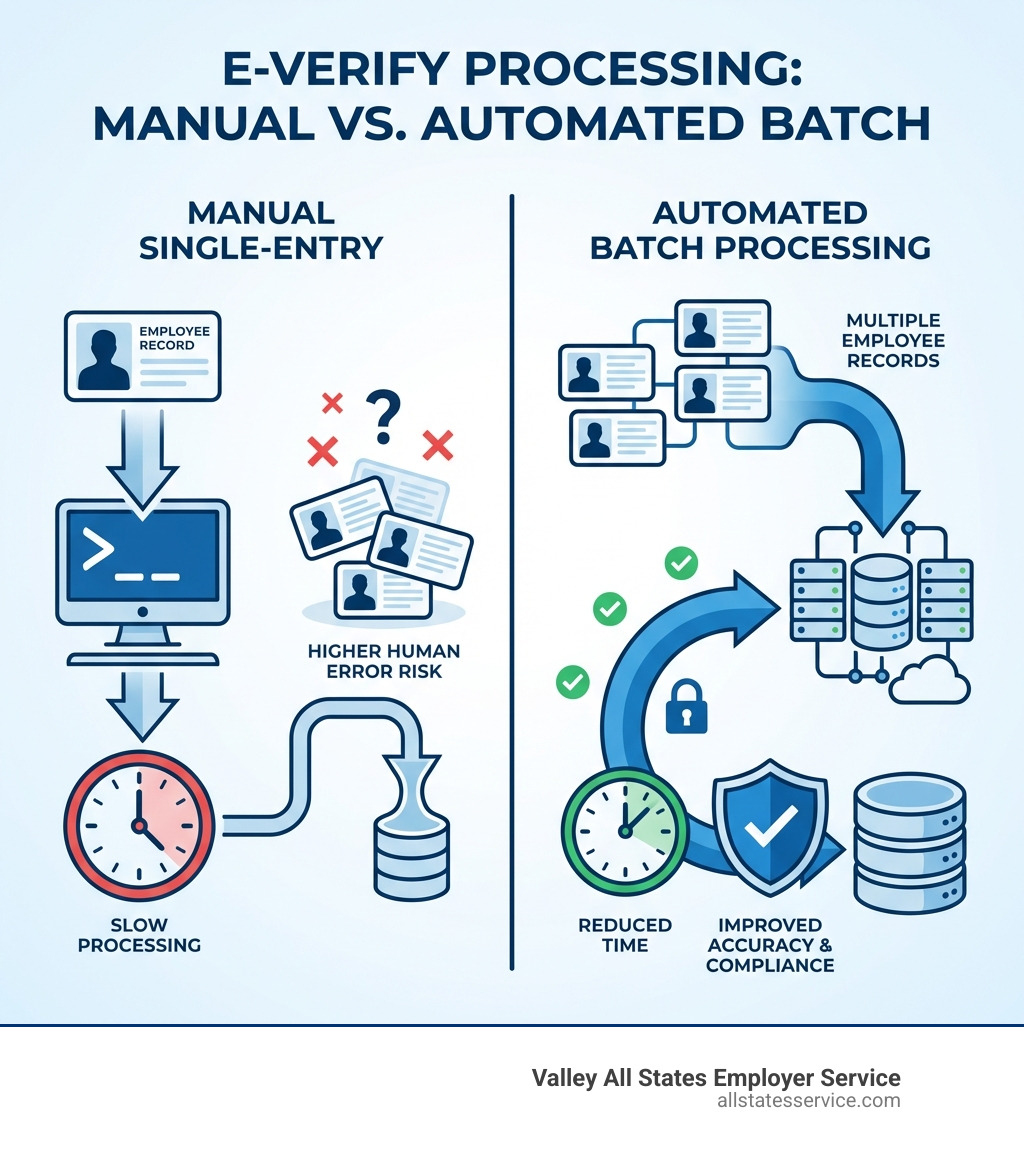
E-verify batch processing allows employers to submit multiple employee verification cases to E-Verify simultaneously, rather than entering each case individually. This method is ideal for organizations handling high-volume hiring, seasonal workforce surges, or multi-location onboarding.
Quick Answer: How E-Verify Batch Processing Works
- Prepare your data in a CSV file with employee information (name, DOB, SSN, I-9 details)
- Choose your method (web services API, third-party agent, or HRIS integration)
- Upload and monitor your batch through automated job schedulers
- Review results and address any errors or mismatches flagged by the system
If you’re managing a growing workforce, you know the drill. Manual data entry for each new hire eats up hours. One typo can trigger a compliance headache. And when you’re onboarding dozens or hundreds of employees at once, the traditional one-by-one approach doesn’t scale.
That’s where batch processing changes the game.
Instead of creating individual E-Verify cases, you can submit employee data in bulk. It’s faster, more accurate, and frees your team to focus on strategic HR work instead of repetitive data entry. With penalties for Form I-9 violations now ranging from $281 to $2,789 per form, the stakes are too high to rely on manual processes prone to human error.
Industries like construction, which faces a 21.4% annual turnover rate, can’t afford delays. Neither can companies experiencing seasonal hiring spikes or rapid expansion. Batch processing transforms a compliance burden into a streamlined workflow that scales with your business.
Basic e-verify batch processing vocab:
Understanding the Basics: Batch vs. Real-Time E-Verify

E-Verify is a powerful tool, but how you use it matters. The method you choose depends entirely on your hiring volume and operational needs. Let’s break down the two primary approaches.
What is E-Verify Batch Processing?
Think of e-verify batch processing like sending a large package of letters all at once, rather than mailing each one individually. With batch processing, we gather a group of E-Verify cases, typically from newly hired employees, and submit them to the E-Verify system in a single, consolidated submission. This “grouped data” is often scheduled to run during off-peak hours, minimizing system strain and allowing us to efficiently handle “high-volume tasks”.
This method is particularly effective for organizations that onboard many employees simultaneously or on a regular schedule. It leverages the power of automation to process these groups of verifications, ensuring consistency and reducing the need for constant manual oversight. Essentially, it’s about optimizing resource usage by tackling many items at once. For a deeper dive into the system itself, you can learn more about What Is E-Verify?.
How Does it Differ from Real-Time Processing?
Real-time processing is the more traditional, one-by-one approach. It’s like mailing each letter as soon as it’s written. With E-Verify, this means creating and submitting a case for each employee individually, often receiving an “instant verification” result. This “single-entry” method provides “immediate feedback”, which can be beneficial for “low-volume hiring” or when an urgent verification is needed.
The main difference lies in immediacy versus efficiency. Real-time processing prioritizes instant results for individual cases, while batch processing prioritizes the efficient handling of large volumes of data. Batch processing minimizes operational costs by allowing tasks to be executed during off-peak hours, reducing resource contention. It also optimizes system resources such as memory and CPU usage by grouping tasks. The systematic execution of tasks in batch processing reduces errors and ensures data integrity.
Here’s a quick comparison to highlight the distinctions:
| Feature | E-Verify Batch Processing | Real-Time Processing |
|---|---|---|
| Processing Speed | Grouped, scheduled, typically slower per individual case, but faster overall for volume | Individual, immediate, instant feedback |
| Ideal Use Case | High-volume hiring, seasonal peaks, regular bulk submissions | Low-volume hiring, urgent, single-case verifications |
| Resource Usage | Optimized during off-peak hours, efficient for large datasets | On-demand, can tie up resources for individual tasks |
| Cost-Effectiveness | Lower operational costs, reduced manual labor, efficient for scale | Higher per-transaction cost, more manual oversight |
| Feedback Loop | Consolidated reports after batch completion | Immediate feedback per case |
Why Your Business Needs E-Verify Batch Processing
Adopting a batch system isn’t just about convenience; it’s a strategic move that directly impacts your bottom line and operational resilience. With penalties for Form I-9 violations now ranging from $281 to $2,789 per form, the cost of errors is too high to ignore. Employers knowingly hiring unauthorized workers face even steeper consequences, with fines reaching $27,894 per violation for repeat offenders.
Boost Efficiency and Cut Costs

Imagine the hours your HR team spends manually entering data for every new hire. Now, picture that time being freed up. E-verify batch processing means “reduced manual entry”, which directly translates to “lower operational costs”. Our clients often see a significant shift in their HR team’s focus, moving away from repetitive tasks to more “strategic HR tasks” that truly impact the business.
Batch processing minimizes operational costs by allowing tasks to be executed during off-peak hours, reducing resource contention. It also optimizes system resources such as memory and CPU usage by grouping tasks into batches. The systematic execution of tasks in batch processing reduces errors and ensures data integrity. This “optimized resource use” and “minimized error rates” contribute to a more efficient and cost-effective hiring process. To understand the financial impact, you can Learn about E-Verify Compliance Costs.
Scale with Confidence
Are you experiencing rapid growth or dealing with seasonal hiring? Batch processing is your secret weapon for “high-volume hiring”. The construction industry, for example, faces a turnover rate of approximately 21.4% annually, creating substantial documentation challenges. Similarly, businesses that experience “seasonal workforce” fluctuations, like retail during holidays or agriculture, need a robust system that can handle sudden spikes in new hires without breaking a sweat.
“Batch processing systems are built to handle massive data volumes, making them ideal for businesses anticipating growth.” With the global data sphere expected to reach 175 zettabytes by 2025, the ability to manage and process large amounts of data efficiently is no longer a luxury, but a necessity. Our “system scalability” ensures that as your business expands, your E-Verify process can keep pace, seamlessly “handling data growth” without added stress. This allows you to focus on your business, not on paperwork. Explore E-Verify Workforce Solutions that empower your growth.
Improve Accuracy and Compliance
Human error is an unfortunate reality in manual data entry. A single misplaced digit or misspelled name can trigger a Tentative Nonconfirmation (TNC), leading to delays and potential compliance issues. E-verify batch processing significantly reduces the chance of “human error” by automating data transfer and validation.
This leads to improved “data integrity” and a more “standardized process”, ensuring that every verification follows the same rigorous steps. The result is a robust “audit trail” that stands up to scrutiny. A compliant I-9 process is critical for any business, as it helps ensure associates are authorized to work while mitigating potential liability and costly violations. By “mitigating fines” and ensuring accuracy, batch processing helps us steer the complexities of E-Verify compliance with confidence.
A Step-by-Step Guide to E-Verify Batch Processing
Ready to get started? Implementing a batch system involves a few key stages, from preparing your data to choosing the right method and monitoring the results. Here’s a practical walkthrough.
1. Prepare Your Data for Upload
The foundation of successful e-verify batch processing is carefully prepared data. We start by gathering all the necessary employee information, ensuring it’s accurate and complete. This typically includes the employee’s name, date of birth, Social Security Number (SSN), and other relevant I-9 details.
The data must be formatted correctly, usually as a “CSV file format”. This is a simple, comma-separated values file that E-Verify systems can easily read. It’s crucial to ensure thorough “data validation” at this stage to catch any errors before submission. “The systematic execution of tasks in batch processing reduces errors and ensures data integrity.” We always cross-reference the employee’s “I-9 information” with the data we’re preparing for the batch. For precise guidance on formatting, you can View the official E-Verify CSV guidelines.
2. Choose Your Batch Processing Method
Once your data is pristine, we need to select the most suitable method for submitting your batch. The E-Verify system offers flexibility here. For tech-savvy organizations with in-house development capabilities, utilizing “E-Verify Web Services” or direct “API integration” allows for custom solutions. This means developing “custom software” that can communicate directly with the E-Verify system, often pulling data from your existing Human Resources Information System (HRIS).
Many businesses, however, find it more efficient to partner with a “third-party E-Verify Employer Agent”. These agents specialize in compliance and offer platforms that streamline the process, often with pre-built “HRIS integration” for systems like Oracle, PeopleSoft, and SAP R/3. This approach leverages existing investments and expert knowledge.
Choosing the right method often depends on your internal resources, the complexity of your HR tech stack, and your desired level of hands-on involvement. For many, an E-Verify Employer Agent provides the ideal balance of automation and expertise.
3. Execute and Monitor the Batch
With your data prepared and your method chosen, it’s time for the “upload process”. This is where the magic of e-verify batch processing truly shines. We initiate the batch upload, often through “automated job schedulers” that can be set to run at optimal times, like overnight, to minimize disruption.
Once the batch is submitted, continuous “status notifications” keep us informed of its progress. If any issues arise, “error reports” are generated, highlighting specific records that may have failed. This allows for targeted “correcting failed records” without re-processing the entire batch. As Frédéric Guitton, Chief Revenue Officer at Quality Labor Management, notes, “Our team has seen a shift from 40% of new hire completion to now 60% – It’s been a game changer for fall off!” This efficiency in processing directly contributes to higher completion rates and a smoother onboarding experience. We ensure that every case is processed correctly and that any anomalies are swiftly addressed, maintaining compliance and operational flow.
Navigating Challenges and Best Practices
While powerful, a batch system requires careful management to avoid potential pitfalls. By following best practices, you can ensure your process is secure, compliant, and seamlessly integrated into your existing workflows.
Securing Sensitive Data
When dealing with employee data, especially for E-Verify, “PII safeguarding” is paramount. We understand that this sensitive information must be protected at all costs. Implementing stringent “access controls” ensures that only authorized personnel can view or process batch files. “Data encryption” is another critical layer of security, protecting data both in transit and at rest.
Our processes are designed to maintain full “compliance with regulations” like GDPR and CCPA, even though E-Verify is a U.S. federal program. These global standards for data protection inform our best practices, ensuring robust security measures. Batch processes often involve handling sensitive data. We always ensure data protection by implementing strict access controls, encryption, and data compliance. For comprehensive guidance on protecting your information, you can Learn more about E-Verify Best Practices.
Handling Errors in e-verify batch processing
Even with the best preparation, errors can occur. The key is how we handle them. In e-verify batch processing, common issues include “Tentative Nonconfirmations (TNCs)” and, less frequently, “Final Nonconfirmations”. A TNC means there’s a discrepancy between the employee’s information and government records, but it doesn’t automatically mean they’re unauthorized to work.
Our process involves prompt “mismatch resolution”. We provide employees with “Further Action Notices” and clear “employee communication protocols”, guiding them on how to resolve the discrepancy with the Social Security Administration (SSA) or Department of Homeland Security (DHS). It’s crucial to allow the employee to contest the TNC and continue working during this period. Only after a Final Nonconfirmation, and following strict guidelines, can adverse action be considered. Understanding and managing these steps is vital for compliance. For a detailed walkthrough of this process, refer to our guide on E-Verify Tentative Nonconfirmations.
Integrating with Your HR Systems
A truly efficient e-verify batch processing system isn’t a standalone tool; it’s seamlessly integrated into your broader HR ecosystem. We strive for robust “ATS integration” (Applicant Tracking System) and connectivity with “onboarding platforms” to ensure a smooth flow of new hire data. This means that once a candidate is hired, their information can be automatically pushed to the E-Verify batch system, reducing manual entry and potential errors.
Implementing “Single Sign-On (SSO)” capabilities allows your HR team to access all necessary systems with one login, enhancing security and user experience. Integration with “document management systems” like SharePoint ensures that all I-9 forms and E-Verify results are securely stored and easily retrievable for audits. The goal is to create a “unified workflow” where E-Verify is just one seamless step in your comprehensive HR process, not a separate, cumbersome task.
The Future is Automated: AI’s Role in e-verify batch processing
The evolution of batch processing doesn’t stop here. Artificial intelligence and automation are set to make these systems even smarter and more autonomous, further reducing the need for manual oversight.
Intelligent Automation
The integration of AI into e-verify batch processing is ushering in a new era of efficiency and accuracy. We’re moving towards “intelligent automation” where systems can do more than just process data; they can learn, adapt, and even predict. “AI-driven observability” means that the system can constantly monitor the entire batch process, identifying patterns and potential issues before they become problems.
“Anomaly detection” allows the system to flag unusual data entries or processing delays, alerting us to potential errors or fraudulent activity. Imagine “automated error correction” where the system can suggest or even implement fixes for common discrepancies, reducing the need for manual intervention. “Dynamic scheduling” can optimize batch run times based on system load and data volume, ensuring maximum efficiency. This concept of “Agentic AI” means that the system can act with a degree of autonomy, proactively resolving issues and ensuring the smooth flow of verifications. This future promises even greater reliability and less administrative burden, making our E-Verify processes more robust than ever.
Frequently Asked Questions about E-Verify Batch Processing
Can I use batch processing for existing employees?
No, E-Verify rules generally restrict its use to newly hired employees. You cannot process your entire existing workforce unless you are a federal contractor with the FAR E-Verify clause under specific circumstances. More on E-Verify for Existing Employees clarifies these specific requirements.
What are the most common errors in batch files?
Common errors we encounter include incorrect data formatting, missing required fields (like an SSN, which is mandatory for E-Verify cases), invalid characters, or data that doesn’t precisely match the employee’s Form I-9. Using a validated template and performing thorough data validation before submission is the best way to prevent these issues.
How is this different from the bulk upload of hiring sites?
While both involve “bulk” actions, they serve different purposes. E-verify batch processing refers to submitting multiple employee cases for employment eligibility verification. The bulk upload of hiring sites, on the other hand, is an administrative function within E-Verify that allows you to add multiple company work locations to your account at once. It’s about setting up your operational footprint within E-Verify, not about verifying employees themselves.
Streamline Your Compliance with Expert Help
Mastering e-verify batch processing is the secret to managing high-volume hiring without sacrificing compliance or efficiency. It transforms a daunting administrative task into a scalable, accurate, and cost-effective system. For organizations looking to offload this complexity entirely, partnering with an expert like Valley All States Employer Service ensures your E-Verify process is handled impartially and flawlessly, freeing your team to focus on what they do best: building your workforce.
Ready to simplify your E-Verify compliance and open up hiring efficiency? Explore our expert E-Verify services today!