
Automated I-9 verification: Revolutionize Onboarding 2025
Why Manual I-9 Processes Are Holding Your HR Team Back
Automated I-9 verification is a digital system that replaces manual paperwork with electronic forms, real-time validation, and seamless E-Verify integration. This technology:
- Eliminates manual data entry through smart forms that guide employees and catch errors instantly
- Reduces processing time by up to 70% with automated workflows and E-Verify case creation
- Cuts compliance risk by maintaining audit-ready records and flagging missing information
- Enables remote verification for distributed workforces through DHS-approved procedures
- Provides secure digital storage with encrypted documents and automated retention tracking
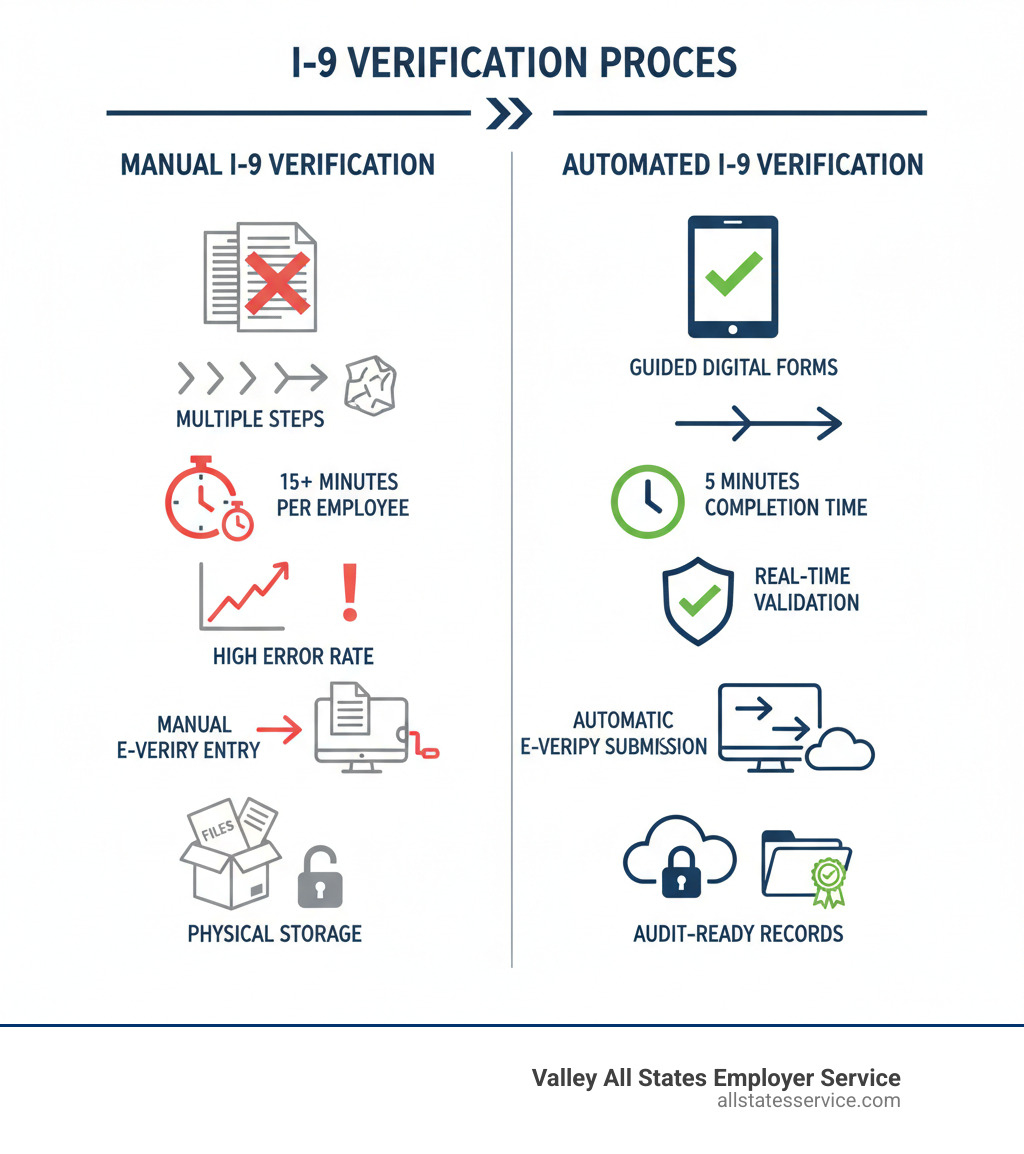
If you’re an HR manager drowning in paperwork, you know the pain. A manual I-9 process can take 15 minutes per employee, creating bottlenecks that slow down hiring and introduce costly errors. Fines for violations can range from $698 to $27,894, making manual processing a significant risk during ICE audits.
In contrast, most employees complete Section 1 in under 5 minutes using an automated system. Modern solutions do more than just digitize forms; they validate data in real-time and integrate with government databases. This shift transforms onboarding from a compliance headache into a smooth, professional experience that protects your organization from costly mistakes.
The Problem with Paper: Why Manual I-9 Verification is Obsolete
Think about processing a paper Form I-9: the illegible handwriting, the missing signatures, the incorrect boxes. This struggle is common, but the stakes are high.
Form I-9, or Employment Eligibility Verification, is the federal form required for every person hired in the United States to verify their identity and legal work authorization. While critical for maintaining the integrity of the U.S. workforce, the traditional paper-based process has become a major liability.
Manual Process Challenges: A Recipe for Headaches
Juggling paper forms during onboarding almost guarantees problems. Human error is the biggest culprit. A simple typo, a missed signature, or a blank checkbox can each represent a compliance violation costing thousands.
The manual process also creates inconsistent data, as different staff members may interpret instructions differently. These inconsistencies raise red flags during audits. Time is another casualty, with simple forms stretching into multiple back-and-forth exchanges between HR and the new hire, delaying their start date.
Compliance Risks and Hefty Fines
Form I-9 rules are complex and change often. Without automated safeguards, a manual process offers zero protection against errors that trigger audits and penalties. When ICE conducts an audit, those mistakes become expensive. According to the Federal Register’s civil monetary penalty adjustments, the numbers are sobering:
- Paperwork violations (missing signatures, incorrect dates) can cost between $272 and $2,700 per form.
- Knowingly hiring unauthorized workers brings penalties from $676 to $27,008 per violation, depending on the offense number.
These are not theoretical numbers. ICE is expanding its enforcement, making audits more a question of “when,” not “if.” Understanding your exposure is critical, which is why we offer a guide on I-9 Compliance Penalties.
Storage and Retention Issues
Your challenges don’t end after the form is completed. Paper forms must be stored securely for specific periods (three years after hire or one year after termination, whichever is later). Paper gets lost, misfiled, or damaged. During an audit, you must produce specific forms quickly, a difficult task when they are scattered across filing cabinets. Proper I-9 Record Keeping is a major challenge for most businesses. Relying on manual I-9 verification is slow, error-prone, and unnecessarily risky.
The Power of Automation: Key Benefits of Automated I-9 Verification
We’ve explored the pitfalls of manual I-9 processes. Now, let’s pivot to the solution: Automated I-9 verification. This is about changing a compliance burden into a streamlined, secure, and efficient operation.
Here’s a quick comparison:
| Feature | Manual I-9 Verification | Automated I-9 Verification |
|---|---|---|
| Time | 15+ minutes per employee, prone to delays | Section 1 in under 5 minutes, 70% time savings |
| Cost | High risk of fines ($698-$27,894 per violation), labor-intensive | Reduced penalties, lower administrative costs |
| Error Rate | High, due to human error and inconsistent data | 99% error reduction, real-time validation |
| Compliance | Difficult to track, audit vulnerability | 100% audit-ready, automated checks, E-Verify integration |
| Security | Physical storage risks, data exposure | Encrypted digital storage, role-based access |
| Onboarding | Slow, frustrating, negative candidate experience | 50% faster, seamless, positive candidate experience |
How Automation Works: The Technology Behind the Change
Switching to Electronic I-9 Solutions is like upgrading from a paper map to a GPS. Automated I-9 verification uses technology to guide everyone through the process. Employees interact with smart forms that use prompts and conditional logic to ensure correct completion.
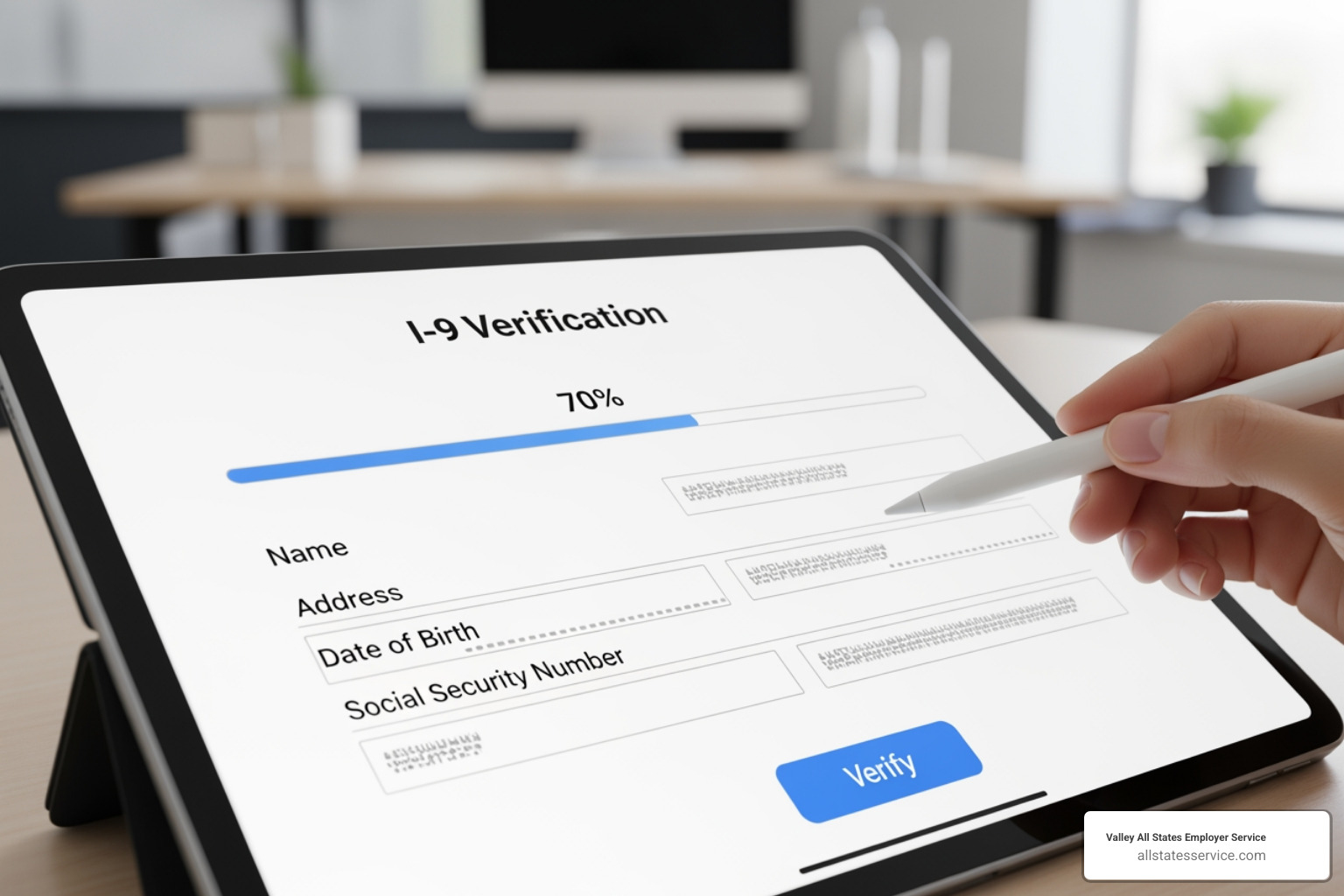
Real-time data validation instantly checks for invalid entries, flagging errors before the form is submitted. Behind the scenes, completed forms are kept in secure, encrypted cloud-based storage. The system also manages automated workflows, sending reminders and tracking deadlines. Many systems offer seamless E-Verify integration, making the connection between E-Verify and I-9 effortless.
The Unmistakable Benefits of Going Automated
The advantages are measurable and immediate.
Time savings and faster onboarding are primary benefits. With processing times reduced by up to 70%, employees complete Section 1 in under 5 minutes. This cuts onboarding delays by 50%, allowing new hires to become productive faster.
For accuracy and error reduction, automated systems achieve a 99% error reduction compared to manual methods. Real-time validation catches mistakes as they happen, resulting in a 99.9% E-Verify accuracy rate and dramatically lower compliance risk.
Improved compliance and audit readiness provides peace of mind. Automated systems maintain 100% audit-ready records with secure digital storage and automated tracking of expiring documents. This robust approach to I-9 Compliance provides clear audit trails for investigators.
Seamless E-Verify integration eliminates double-entry for employers enrolled in E-Verify, saving hours by automating data submission from a single platform.
Improved data security is crucial. Automated systems keep sensitive employee data encrypted and safe from unauthorized access, offering far better protection than a filing cabinet.
Finally, a better onboarding experience creates a positive first impression. Automated systems turn a bureaucratic task into an efficient, mobile-friendly workflow. Strong Employee Onboarding Compliance can and should be a positive experience.
A Practical Guide to Implementing Your Automated I-9 Verification System

Ready to switch to Automated I-9 verification? With the right approach, the transition is straightforward. Let’s break down the solutions available, how to handle remote verification, and what to look for in a partner.
Types of Automated I-9 Verification Solutions
You have several options, depending on your business needs.
- Standalone software offers dedicated, cloud-based I-9 compliance tools with secure storage and E-Verify integration.
- Integrated HRIS platforms may have built-in I-9 and E-Verify modules, creating a seamless flow of employee data from recruitment to onboarding.
- Outsourced HR Services can manage your entire I-9 and E-Verify process, which is ideal for businesses without dedicated HR staff.
- Third-party agents provide networks of authorized representatives to complete Section 2, a flexible option for companies with remote hires. Many businesses combine automated systems with Third Party I-9 Verification for complete coverage.
Integrating Remote I-9 Verification
Remote onboarding is now a standard business practice. The Department of Homeland Security (DHS) introduced an alternative procedure that makes remote I-9 verification both legal and practical for employers enrolled in E-Verify.
To use the DHS alternative procedure, E-Verify enrollment is mandatory for all hiring sites where you’ll complete I-9s virtually. If you need help, we can guide you through Enrolling in E‑Verify.
The procedure involves a live video interaction where the employee presents their documents. Automated systems facilitate this with secure platforms. The system also guides authorized representatives through Section 2 completion, ensuring accuracy even when you’re not physically present. Remote I-9 Services are now efficient and manageable, turning a potential compliance nightmare into a smooth process.
How to Choose the Right Automated I-9 Verification Partner
Choosing the right solution requires asking the right questions.
- Integration: How well does the system work with your existing HRIS or payroll software?
- Security: Look for encryption, secure cloud storage, and role-based access controls.
- Compliance Expertise: Does the provider understand I-9 and E-Verify regulations and stay updated on changes?
- User Experience: Is the system easy for your team and new hires to use? Request a demo.
- Customer Support: What level of support is included, and how responsive is the team?
- Audit Readiness: Does it offer comprehensive audit trails and alerts for expiring documents?
- Remote Verification: How does the system support remote verification and meet DHS requirements?
- Cost and ROI: Look beyond the price tag to the savings from reduced compliance risk and increased efficiency.
Using third-party software doesn’t absolve you of legal responsibility. You must ensure your process avoids unlawful discrimination and other violations. Review the Guidance on avoiding Form I-9 violations from the DOJ, ICE, and USCIS. The right software should make following these guidelines easier.
If navigating these options feels overwhelming, our E-Verify Employer Agent Service can provide expert support.
Future-Proofing Your Hiring: ROI and Emerging I-9 Technology
Investing in Automated I-9 verification is about building a compliant and competitive foundation for the future. Let’s look at the financial impact and where this technology is headed.
Cost vs. ROI: The Numbers That Matter
When considering the cost, focus on what you’re not spending on fines and lost productivity. Manual I-9 processes are a financial risk, with penalties for violations ranging from $698 to $27,894 per form, according to the Federal Register’s civil penalty adjustments.
Automated systems deliver a 99% error reduction, directly lowering your exposure to these fines. Some employers save up to $2,500 per violation by eliminating human error. Add in the 70% time savings for your HR team and 50% faster onboarding for new hires, and the ROI becomes clear. Your team can focus on strategic initiatives, and new employees contribute to the bottom line sooner.
Use our guide on I-9 Compliance Penalties to estimate your current risk and prioritize fixes. This quick exercise often makes the decision to automate much easier.
What’s Next: The Future of I-9 Technology
The world of employment verification is evolving quickly.
AI-powered document analysis is becoming more sophisticated, helping to verify authenticity and detect alterations in real-time. This adds a powerful layer of protection against fraudulent documents.
A significant development is E-Verify+, a new USCIS service rolling out in 2024. It combines Form I-9 and E-Verify into a single, employee-centric experience. Workers can create an E-Verify+ account and reuse their information with future employers, speeding up the process. You can learn more on the E-Verify+ official page and review the E-Verify+ Information Sheet for Employers.
Also, note the E-Verify records disposal policy. Starting January 6, 2025, USCIS will delete E-Verify cases last updated before December 31, 2014. Automated systems can help you download and retain these records to maintain audit readiness.
Automated I-9 verification has become an essential business tool. Our E-Verify Employer Agent Service incorporates the latest technology, giving you access to cutting-edge solutions without the complexity.
Frequently Asked Questions about Automated I-9 Verification
Employers often have questions when considering a switch to automated systems. Let’s address some of the most common ones about Automated I-9 verification.
What are the main differences between electronic I-9s and a fully automated system?
There’s a big difference. Electronic I-9s are just digital versions of the paper form, like a fillable PDF. You eliminate the filing cabinet but still perform most tasks manually, including error-checking, routing for signatures, and entering data into E-Verify.
A fully automated system is a comprehensive platform that manages the entire compliance lifecycle. It features:
- Automated workflows that guide employees and HR through each step.
- Real-time error checking that flags mistakes instantly.
- Seamless E-Verify integration for automatic data submission and case tracking.
- Detailed audit trails that log every action for complete documentation.
- Automated alerts for expiring work authorization documents.
In short, an electronic I-9 is a document; an automated system is an intelligent process manager.
Can automated I-9 verification handle reverifications for employees with expiring documents?
Yes, and this is a key feature for maintaining compliance. Manually tracking expiration dates for documents is risky. An automated system solves this with automated tracking and proactive alerts sent to HR and the employee well before a document expires.
When it’s time for reverification, the system guides you through completing Section 3, ensuring all new document information is recorded correctly. This prevents employees from working with expired authorization. This process is also relevant for rehires, as detailed in our guide on the I-9 Process for Rehires.
Is an automated system mandatory for using the new remote verification option?
No, an automated system isn’t strictly mandatory, but it is essential for making the process simple and compliant. The non-negotiable requirement is that employers must be enrolled in E-Verify to use the DHS alternative procedure details.
While you could technically manage the process manually with video calls and paperwork, it’s complex and error-prone. Automation simplifies compliance by providing a secure platform for the video call, guided workflows for the verifier, secure document storage, and direct E-Verify integration. It provides the structure needed to confidently use the remote option. Our E-Verify Employer Agent Service can manage this for you.
Take the Next Step Towards Flawless Onboarding
We’ve covered the journey from manual I-9 headaches to the power of Automated I-9 verification. The message is clear: the future of onboarding is digital, efficient, and compliant.
By embracing automation, your organization can:
- Boost Efficiency: Reclaim HR hours and speed up hiring by up to 70%.
- Fortify Compliance: Achieve 99% error reduction and maintain 100% audit-ready records to avoid hefty fines.
- Improve the New Hire Experience: Offer a seamless, professional onboarding journey.
- Adapt to Modern Workforces: Confidently manage remote hiring with DHS-approved procedures.
Automation is a strategic advantage that protects your business and empowers your team.
At Valley All States Employer Service, we specialize in helping businesses steer employment compliance. Our E-Verify Employer Agent Service provides expert, impartial processing that minimizes errors and administrative burden.
Ready to revolutionize your onboarding process?
Explore our Automated Eligibility Verification System today and find how we can help your business thrive.