
Acceptable I-9 documents: Avoid 2025 Fines
Why Document Verification Matters for Your Business
Acceptable I-9 documents are the original, unexpired forms of ID and work authorization every new U.S. hire must show their employer. As an HR manager, you know Form I-9 is critical, but tracking which documents are valid can be overwhelming, especially with tight deadlines and serious penalties for mistakes.
Here’s what you need to know right now:
- List A documents (like a U.S. Passport) establish both identity and work authorization.
- List B documents (like a driver’s license) prove identity only.
- List C documents (like a Social Security card) prove work authorization only.
- Employees must present one List A document OR one List B plus one List C document.
- All documents must be original and unexpired (with rare exceptions).
- Section 1 must be completed by the employee’s first day of work.
- Section 2 must be completed by the employer within three business days of hire.
Form I-9 is a federal requirement under the Immigration Reform and Control Act that verifies every new employee’s identity and authorization to work in the U.S. The employee completes Section 1, attesting to their status. You, the employer, complete Section 2 by physically examining their documents.
Getting this wrong can be costly, with penalties reaching thousands of dollars per form for anything from technical errors to knowingly hiring unauthorized workers. This guide breaks down which documents you can accept, how to handle special cases, and how to avoid common compliance pitfalls.
The Three Lists: A Quick Overview
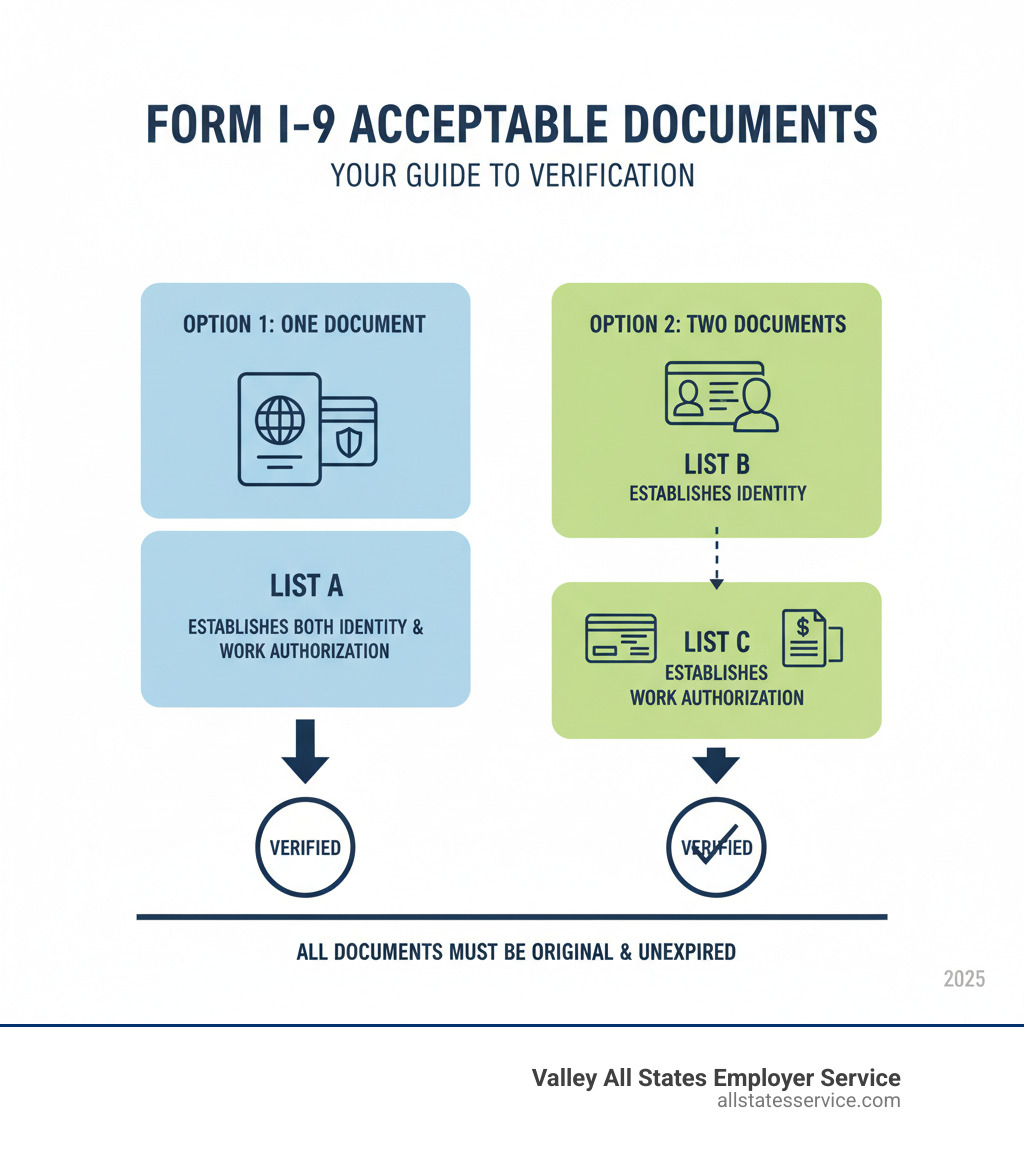
Form I-9 confirms an employee’s identity and legal right to work. To do this, U.S. Citizenship and Immigration Services (USCIS) provides three lists of acceptable I-9 documents.
- List A Documents: A single document from this list establishes both identity and employment authorization. No other documents are needed.
- List B Documents: These documents establish an employee’s identity.
- List C Documents: These documents establish an employee’s employment authorization.
If an employee doesn’t have a List A document, they must provide one from List B and one from List C. The choice of which documents to present always rests with the employee, not the employer. For a deeper dive, explore our guide on I-9 Section 2 Acceptable Documents.
Key Deadlines You Can’t Miss
Timeliness is critical in the I-9 process to avoid penalties.
- Employee completes Section 1: No later than the employee’s first day of employment.
- Employer completes Section 2: Within three business days of the employee’s first day. For example, if an employee starts on a Monday, you must complete Section 2 by Thursday.
For hires employed for less than three business days, both sections must be completed by their first day of work. For more guidance, see our I-9 Form Completion resource.
List A Documents: Proving Identity & Work Authorization in One
List A documents are the most efficient option for I-9 verification, as a single document establishes both an employee’s identity and their work authorization. If an employee presents a valid List A document, you examine it, record the details in Section 2, and you’re done. No other documents are needed.
The employee always chooses which documents to present. For specific guidance on the Permanent Resident Card, see our article on Filling Out I-9 With Permanent Resident Card.
Common List A Documents
These are the most common acceptable I-9 documents from List A:
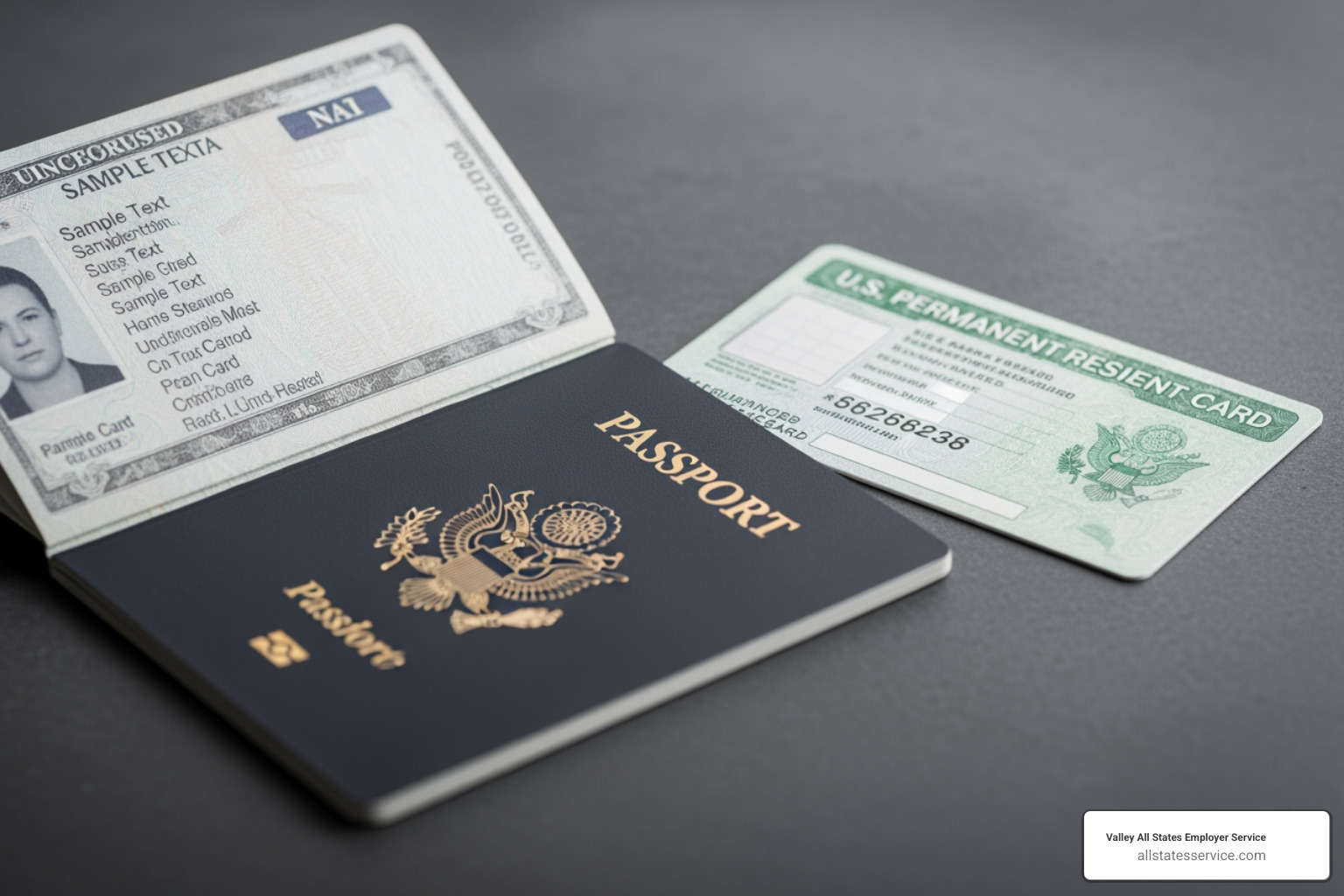
- U.S. Passport or U.S. Passport Card: Issued to U.S. citizens, this is a straightforward option confirming automatic employment authorization.
- Permanent Resident Card (Form I-551): Also known as a Green Card, this shows an individual is a lawful permanent resident with the right to live and work permanently in the U.S. Designs vary, but older versions are valid until they expire.
- Employment Authorization Document (Form I-766): This card with a photograph is issued by DHS to grant temporary work authorization to certain visa holders or individuals with pending immigration applications.
- Foreign passport with a temporary I-551 stamp or Machine Readable Immigrant Visa (MRIV): This serves as temporary proof of permanent residence and work authorization for new immigrants awaiting their physical Green Card.
- Foreign passport with Form I-94/I-94A: For certain nonimmigrants (like H-1B visa holders), this combination works as a List A document if the I-94 has an endorsement for their nonimmigrant status.
- Passport from the Federated States of Micronesia (FSM) or the Republic of the Marshall Islands (RMI) with Form I-94/I-94A: This combination is valid when it shows nonimmigrant admission under the Compact of Free Association.
For the most current list, always check the official USCIS Form I-9 resource.
Special Considerations for List A
All acceptable I-9 documents must be unexpired on the day you examine them, unless an official extension has been granted. Some List A documents are a combination of two items, like a foreign passport with a Form I-94. When you see this, treat it as a single List A document, ensuring the names match and any endorsements are still valid.
Passports from the FSM or RMI, when paired with the correct Form I-94, establish both identity and broad work authorization. For a step-by-step walkthrough of the verification process, our Verifying I-9 Documents guide can help.
The Two-Document Combo: List B (Identity) and List C (Work Authorization)
If an employee doesn’t have a List A document, they can present a combination: one document from List B (to prove identity) and one from List C (to prove work authorization). This two-document option is just as valid.
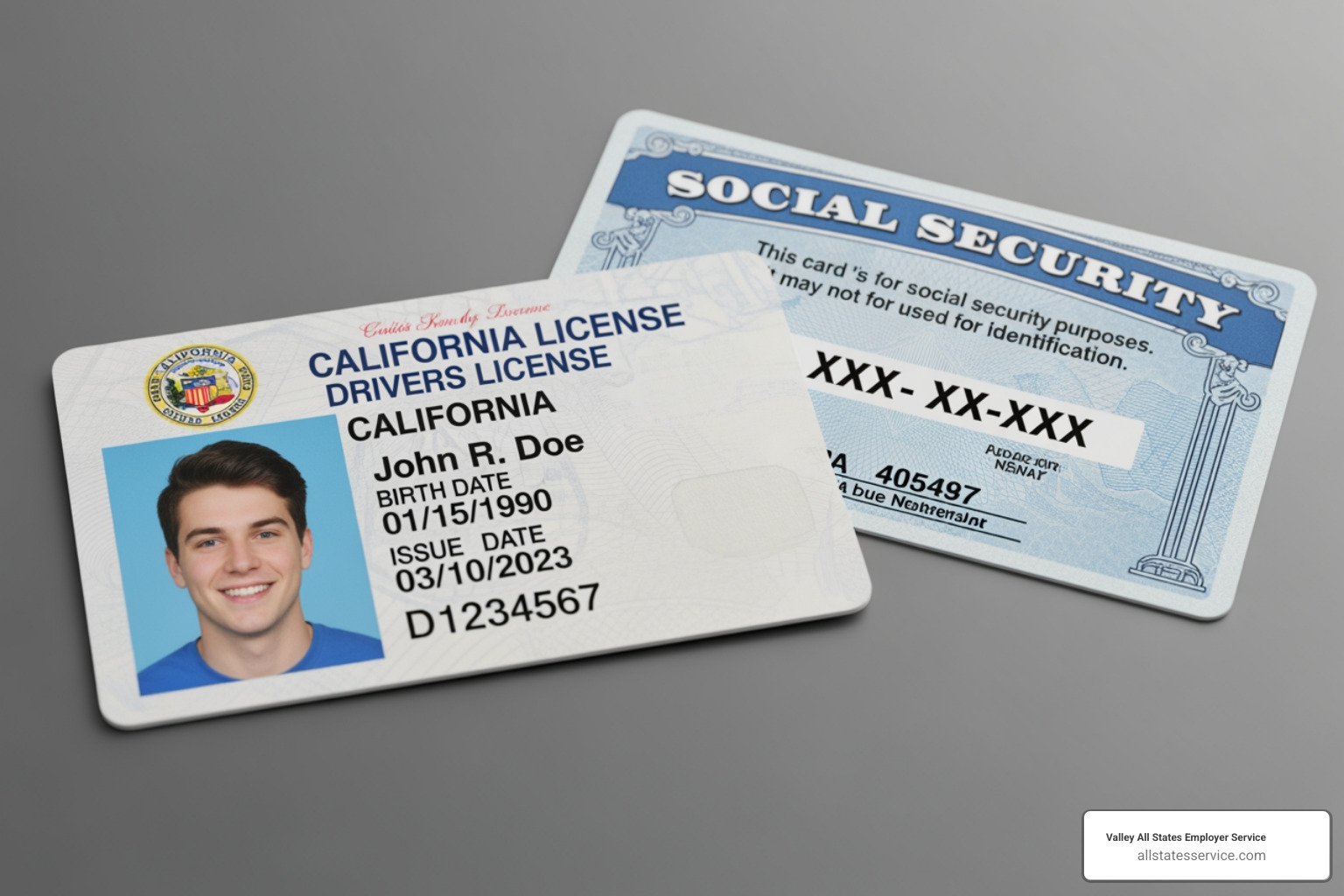
List B answers “Who are you?” while List C answers “Can you legally work here?” The choice of documents always belongs to the employee. Your role is to ensure they provide one from each list, that both are original and unexpired, and that they appear genuine.
Acceptable List B Documents for Identity
List B documents establish identity and usually include a photograph. Common examples of these acceptable I-9 documents include:
- Driver’s license or ID card issued by a state or outlying possession of the U.S.
- ID card issued by a federal, state, or local government agency
- School ID card with a photograph
- U.S. Military card or draft record
- Military dependent’s ID card
- U.S. Coast Guard Merchant Mariner Card
- Native American tribal document
- Driver’s license issued by a Canadian government authority
For a detailed breakdown, see our guide on Documents for I-9.
Acceptable List C Documents for Work Authorization
List C documents prove an employee is authorized to work in the U.S. The most common options are:
- U.S. Social Security card, as long as it is unrestricted. It cannot have phrases like “NOT VALID FOR EMPLOYMENT” or “VALID FOR WORK ONLY WITH DHS AUTHORIZATION.”
- Original or certified copy of a birth certificate issued by a U.S. state, county, or territory bearing an official seal.
- Certification of report of birth issued by the Department of State (Forms DS-1350, FS-545, FS-240).
- U.S. Citizen ID Card (Form I-197)
- Identification Card for Use of Resident Citizen in the U.S. (Form I-179)
- Employment authorization document issued by DHS that is not on List A (e.g., a Form I-94 for an asylee).
For more on federal requirements, our Federal I9 Documents resource has additional context.
Your Guide to Acceptable I-9 Documents and Special Cases
Standard I-9 rules cover most hires, but special cases like lost documents, minors, and remote employees are common. Handling them correctly is key to compliance. Our I-9 Document Review resource covers these scenarios in depth.
When Can an Employee Use a Receipt?
USCIS allows employees to temporarily use a receipt if their original document was lost, stolen, or damaged. A receipt showing they’ve applied for a replacement List A, B, or C document is acceptable. Other valid receipts include a Form I-94 with a temporary I-551 stamp or a refugee/asylee stamp.
Receipts are valid for 90 days. Within that time, the employee must present the actual replacement document, and you must update Section 2. Receipts cannot be used for initial grants of work authorization or for jobs lasting less than three business days. For more on this, see our guide to I-9 Form Processing.
What are the Acceptable I-9 documents for Minors?
USCIS provides flexibility for employees under 18 who may not have a standard List B ID. If a minor cannot produce a typical List B document, they can present one of the following to prove their identity:
- School record or report card
- Clinic, doctor, or hospital record
- Day-care or nursery school record
This flexibility helps teenagers get their first jobs. However, if you are enrolled in E-Verify, any List B document a minor presents must contain a photograph.
Reviewing Acceptable I-9 documents for Remote Employees
Verifying documents for remote hires is now easier thanks to new DHS rules. You have two primary options for handling acceptable I-9 documents from a distance.
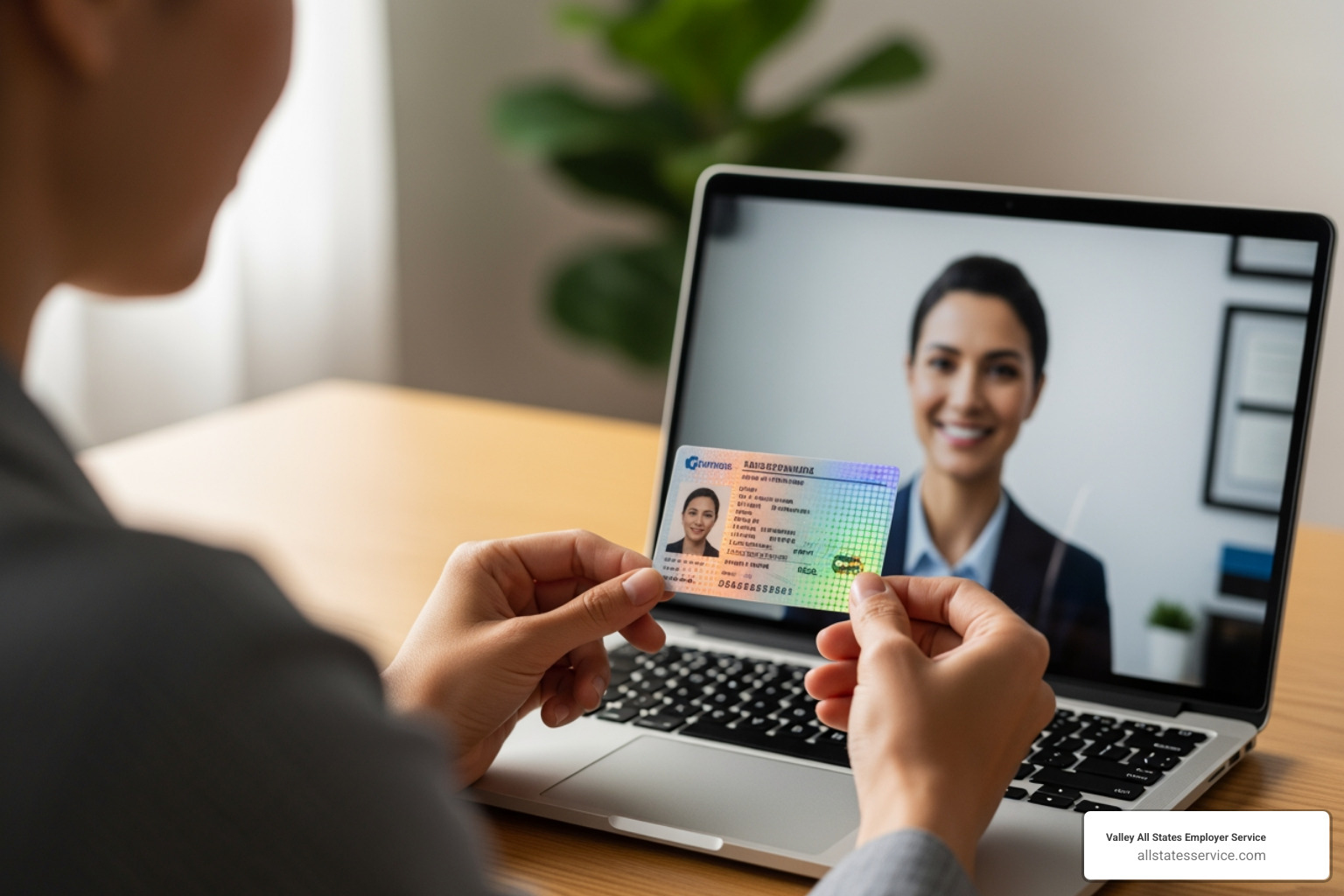
- Live Video Inspection: If you are enrolled in E-Verify, you can use an alternative procedure. The employee sends you a copy of their documents, then presents the originals during a live video call for you to inspect. You must retain clear copies.
- Authorized Representative: You can designate another person to physically examine the documents on your behalf. This can be anyone, but you remain fully responsible for any errors they make.
Our guides on Remote Form I-9 and How to Review I-9 Documents for Remote Employees provide detailed instructions.
Employer Best Practices: Ensuring Compliance and Avoiding Penalties
Beyond filling out the form, your role as an employer includes thorough examination, respecting anti-discrimination laws, and maintaining meticulous records. These best practices create a fair workplace and ensure you have a legally authorized workforce. For a comprehensive overview, see our I-9 Compliance Services Complete Guide.
Examining Documents: Your Core Responsibility
When an employee presents their acceptable I-9 documents, your examination is a critical step. You are not expected to be a fraud expert, but you must ensure the documents meet two key criteria:
- Reasonably Genuine Appearance: The document should “reasonably appear to be genuine and to relate to the person presenting it.” If a document seems altered or suspicious, you should not accept it. Instead, ask the employee for other acceptable documentation without accusing them of fraud.
- Original Documents Only: You must examine original documents. Photocopies are not allowed, with the sole exception of a certified copy of a birth certificate for List C.
Carefully record the document details in Section 2. For more guidance, see our Employer I-9 Verification Guide.
Avoiding Common Mistakes and Discrimination
Many I-9 mistakes stem from simple misunderstandings. Here are the most common pitfalls to avoid:
- Do not specify documents: The choice of which acceptable I-9 documents to present always belongs to the employee. Telling them what to bring can lead to discrimination claims.
- Avoid overdocumentation: If an employee presents a List A document, do not ask for more. The same goes for a valid List B and C combination. Stick to the “one from A OR one from B and one from C” rule.
- Don’t accept most expired documents: Documents must be unexpired. The exception is when DHS has issued an automatic extension for a specific document type.
- Don’t reject documents with future expiration dates: A valid document is acceptable even if it expires soon. Rejecting it can be discriminatory.
- Check for restrictive wording: Do not accept Social Security cards that say “NOT VALID FOR EMPLOYMENT” or “VALID FOR WORK ONLY WITH DHS AUTHORIZATION” as a List C document.
- Use the current Form I-9: Always download the latest version from the USCIS website.
Understanding these rules helps avoid I-9 Compliance Penalties. The official Handbook for Employers M-274 is the ultimate reference.
Reverification and Record-Keeping
Reverification is required when an employee’s temporary work authorization is about to expire. You must complete Section 3 (or Supplement B) before the expiration date to confirm their continued eligibility. However, do not reverify U.S. citizens, noncitizen nationals, or lawful permanent residents who presented a Green Card.
For record-keeping, you must retain a completed Form I-9 for three years after the date of hire OR one year after employment ends, whichever is later. For compliance and privacy, I-9 forms should be stored separately from general personnel files. Proper I-9 Record Keeping is a fundamental requirement.
Frequently Asked Questions about I-9 Documents
Here are quick answers to common questions about acceptable I-9 documents.
Can I accept a photocopy of a document?
No, with one exception. You must examine original documents. The only exception is a certified copy of a birth certificate, which is an acceptable List C document. For all other documents, the employee must present the original, whether in person or via live video for remote verification.
What if a document looks fake?
If a document does not reasonably appear genuine or relate to the employee, you should not accept it. Politely explain that you cannot accept the document and ask them to present other acceptable I-9 documents from the lists. Never accuse an employee of fraud; your role is to verify, not investigate.
Do I need to reverify a U.S. citizen or a lawful permanent resident?
No. Reverification is not required for U.S. citizens, noncitizen nationals, or lawful permanent residents who presented a Permanent Resident Card (Form I-551). Reverification only applies to employees with temporary work authorization that has an expiration date.
Simplify Your I-9 and E-Verify Compliance
Managing I-9 compliance is a heavy burden. Tracking deadlines, verifying every acceptable I-9 document, and avoiding costly penalties can feel like a full-time job. That’s where we come in.
At Valley All States Employer Service, we take the headache out of I-9 and E-Verify compliance. We provide outsourced E-Verify workforce eligibility verification, giving you expert eyes on every form, impartial processing to protect you from discrimination claims, and efficient handling that frees up your time.
Our team helps employers across the United States minimize errors and administrative burdens. We know the ins and outs of federal regulations, from handling remote employees to reverifications. Think of us as your compliance safety net, ensuring your I-9 process is streamlined, accurate, and audit-ready.
For a complete overview of the verification process, see our I-9 Section 2 Complete Guide. When you’re ready to simplify compliance and gain peace of mind, contact our team to learn how our E-Verify and I-9 solutions can protect your business.