
The Essential Guide to I-9 Management Services
Why I-9 Management Services Are Critical for Every U.S. Employer
I-9 management services help U.S. employers verify the identity and work authorization of every new hire, stay audit-ready, and avoid costly federal penalties.
Here’s a quick look at what these services typically cover:
- Form I-9 completion – guided electronic workflows for Sections 1, 2, and 3
- E-Verify integration – automated submission to DHS and SSA databases
- Document tracking – alerts for expiring work authorization before reverification deadlines
- Audit support – centralized, time-stamped records ready for ICE inspections
- Remote verification – authorized representatives or video calls for distributed teams
- Compliance reporting – dashboards showing pending forms, errors, and action items
If you manage hiring at a mid-sized business, you already know this pain: a new hire starts on Monday, someone in a satellite office fills out the I-9 by hand, and three months later you discover a missing signature or an expired document. Multiply that across dozens of hires and multiple locations, and the exposure adds up fast.
The stakes are real. Civil penalties for I-9 paperwork violations range from $272 to $2,701 per form, and when ICE issues a Notice of Inspection, employers typically have only 3 business days to produce their records. There’s no grace period for a disorganized filing cabinet.
The good news is that modern I-9 management solutions are built to take that burden off your team, so your HR staff spends less time chasing paperwork and more time actually hiring great people.
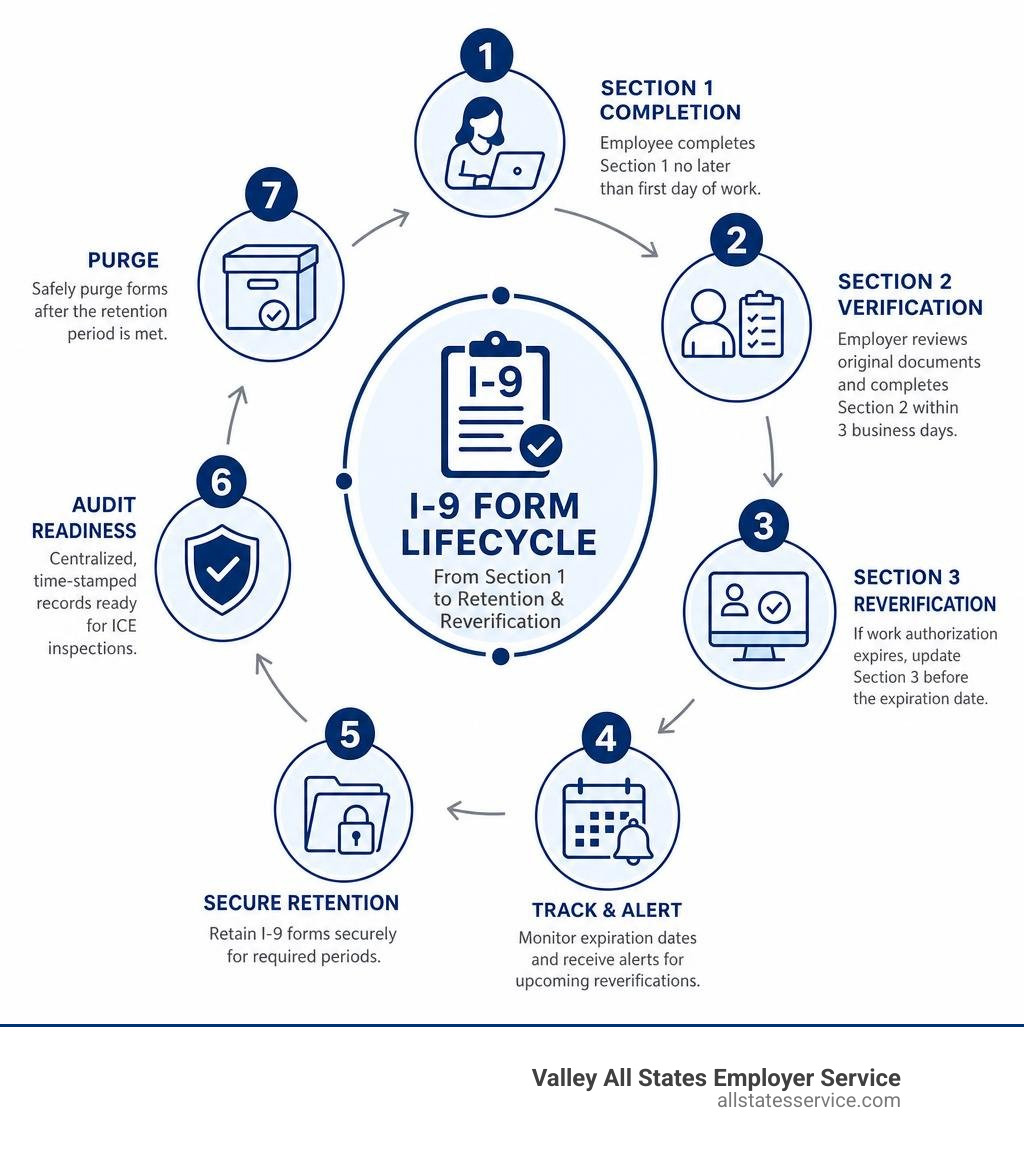
Basic I-9 management services terms:
What is I-9 Compliance and Why Does It Matter?
At its core, I-9 compliance is all about proving that your team has the legal right to work in the United States. Under the Immigration Reform and Control Act of 1986, every single employer must verify the identity and employment authorization of individuals they hire. This law applies to citizens and noncitizens alike.
To comply, your new hires must complete Section 1 of Form I-9 on or before their first day of work. You, the employer, must then examine physical documents to complete Section 2 within three business days of their start date. It sounds simple enough, but the details can trip up even the most seasoned HR teams.
If you want to dive deeper into how this works in an academic or institutional setting, you can read about Employment Eligibility Verification (I-9) – Human Resources to see how major organizations structure their onboarding protocols.
When federal agencies decide to audit your records, they do not look for good intentions. They look for exact matches, proper signatures, and correct dates. A simple technical error, like writing the wrong year or forgetting to check a box, can result in the same fines as failing to fill out the form entirely.
Staying compliant is not just about avoiding fines, it is also about protecting your brand and keeping your operations running smoothly. To learn more about the current landscape of compliance, you can Learn more about the I-9 compliance employers guide for 2026 to keep your business ahead of the curve.
The Pitfalls of Decentralized vs. Centralized I-9 Management
Many growing businesses start out using a decentralized approach to onboarding. This means managers at different storefronts, construction sites, or regional offices handle the I-9 process locally. While this might seem convenient, it is one of the riskiest ways to manage your compliance.
Decentralized management almost always leads to training gaps. A store manager who only hires two people a year will not have the muscle memory to spot a fake document or fill out Section 2 correctly. Misfiled records, missed reverification deadlines, and inconsistent workflows are incredibly common when there is no central oversight.
By contrast, centralizing your processes gives you a single source of truth. A centralized system brings all your forms into one secure digital repository, giving your HR team real-time visibility into every pending and completed document across your entire organization.
Here is a quick look at how these two approaches compare:
| Feature | Decentralized I-9 Management | Centralized I-9 Management |
|---|---|---|
| Process Consistency | Low; differs by location and manager | High; standardized digital workflows |
| Audit Readiness | Poor; files scattered across locations | Excellent; instant export of all records |
| Error Rates | High; manual entry leads to frequent typos | Low; built-in validation catches mistakes |
| Reverification Tracking | Manual calendars; high risk of missing dates | Automated alerts and queued tasks |
| Oversight | Limited; hard to track missing forms | Full dashboard with real-time analytics |
Centralizing your program ensures that every form is filled out using the exact same standard, no matter where your new hire is located. If you want to build a bulletproof system for your team, you should Read our I-9 compliance management complete guide to learn how to transition away from decentralized risks.
Key Features of Modern I-9 Management Services
Modern I-9 management services rely on smart technology to turn a stressful legal requirement into a simple, automated workflow. Instead of using paper forms that can be easily lost or filled out incorrectly, digital systems guide both the employee and the employer through each section step by step.

When you look for a modern platform, you should expect several key features that make compliance virtually hands-free:
- Smart Form Validation: Real-time error detection checks for missing fields, invalid Social Security numbers, and date mismatches. This is incredibly important because there are over 300 possible errors on a single I-9 form.
- Electronic Signatures: Fully compliant electronic signatures make it easy to sign and submit forms from any device.
- Document Expiration Alerts: The system tracks expiring work visas and automatically alerts your team 30 to 180 days before a reverification is due.
- Comprehensive Audit Trails: Every change, correction, or update made to a form is saved with a digital timestamp, showing exactly who made the edit and when.
These features drastically reduce the time your team spends on administrative tasks. If you are ready to upgrade your current setup, you can Explore our solutions for I-9 form management to find a system that fits your hiring volume.
How E-Verify Integration Enhances I-9 Management Services
E-Verify is a web-based system operated by the Department of Homeland Security in partnership with the Social Security Administration. It allows employers to confirm the employment eligibility of their new hires by matching information from the Form I-9 against federal databases.
While E-Verify is voluntary for many employers, it is mandatory for others, including federal contractors with the Federal Acquisition Regulation (FAR) clause and businesses in states with specific mandates. Integrating E-Verify directly into your I-9 management platform means that as soon as Section 2 is completed, the case is automatically submitted to the government.
This integration eliminates double data entry and ensures that any Tentative Nonconfirmations (TNCs) are flagged immediately. When a TNC occurs, the system guides you through the process of notifying the employee, who then has 10 government work days to resolve the issue. To understand how to align your business with these standards, Check out our I-9 compliance solutions guide for 2025.
Remote and Hybrid Workforce Support in I-9 Management Services
The rise of remote and hybrid work has made traditional, in-person document verification a logistical headache. Fortunately, the Department of Homeland Security introduced the DHS Alternative Procedure, which allows eligible employers who are enrolled in E-Verify to examine new hire documents virtually over a live video call.
Modern I-9 platforms make this process incredibly simple by hosting the video call and document upload features directly inside the onboarding portal. If you prefer a hands-off approach, some services also offer a network of local authorized representatives who can meet your remote employee in person to complete Section 2 on your behalf.
Enterprise-level platforms typically handle these complex remote workflows by offering integrated virtual verification and a national network of physical verification locations to ensure compliance across all states.
Managing remote hires does not have to be a source of stress for your HR department. If you want to save your sanity and streamline your distributed hiring, you can Discover how to outsource your I-9 verification before you lose your mind.
How to Choose the Right I-9 Verification Provider
Choosing the right partner for your compliance needs is a big decision. You want a provider that offers more than just a digital form, you need a solution that fits your existing technology stack and provides reliable support when you need it most.

Here are the main factors you should consider when evaluating vendors:
- Seamless Integration – Does the platform connect with your current Applicant Tracking System (ATS), HRIS, or payroll software?
- Data Security – Because I-9 forms contain highly sensitive personal data, look for SOC 2 Type II certification and advanced encryption standards.
- Comprehensive Support – If a manager has a question about a rare document type, is there an expert support team available to help?
- Historical Clean-up Options – Can the vendor help you digitize and audit your existing paper forms to fix old mistakes before an audit happens?
For a broad view of the industry and to compare different options, you can browse the I-9 Verification Services – SHRM Human Resource Vendor Directory to see how various providers stack up.
Once you have a shortlist of vendors, you should establish clear internal guidelines. You can Review our I-9 best practices complete guide to make sure your team is ready to implement your new solution successfully.
Best Practices for Maintaining Ongoing I-9 Compliance
Implementing an electronic I-9 system is a massive step forward, but compliance is an ongoing journey. To keep your organization safe from audit risks, your HR team should build several habits into their weekly and monthly routines:
- Enforce the 3-Day Rule: Never let Section 2 completion slide. Make it a strict policy that all documents must be reviewed and signed within three business days of the employee’s start date.
- Conduct Regular Self-Audits: Even with digital validation, it is smart to run internal reviews of your active and terminated files once or twice a year to catch any anomalies.
- Purge Terminated Records: Do not keep files longer than necessary. Keeping old forms past their required retention period just increases your liability during an audit.
- Stay Up to Date on the M-274 Handbook: USCIS regularly updates its official Handbook for Employers. Make sure your team has access to these updates or works with a partner who monitors them for you.
For more detailed information on professional compliance administration, you can consult official government resources or work with an experienced compliance partner who understands the nuances of federal regulations.
By combining smart software with disciplined internal habits, you will never have to panic when you receive a surprise notice from government auditors. To make this process even easier for your managers, See how I-9 compliance is made easy with the Handbook for Employers.
Frequently Asked Questions about I-9 Compliance
Many business owners and HR professionals have questions about the finer details of employment verification. Here are some of the most common questions we hear.
What are the penalties for I-9 noncompliance?
The penalties for noncompliance can be severe. Civil fines for simple paperwork violations or uncorrected technical errors range from $272 to $2,701 per form. If your business is found to have knowingly hired or continued to employ unauthorized workers, the fines are much higher and can lead to debarment from federal contracts or even criminal charges in extreme cases.
How long must employers retain Form I-9?
You must retain a completed Form I-9 for either three years after the employee’s date of hire, or one year after their employment ends, whichever date is later. Once this retention period has passed, it is best practice to securely destroy the document to keep your records organized and reduce audit liability.
Can remote I-9 verification be done entirely virtually?
Yes, but only under specific conditions. To use the virtual video call option, your business must be enrolled in and active in E-Verify, and you must follow the official DHS Alternative Procedure. This includes examining clear copies of the documents beforehand, conducting a live video call to compare the documents to the employee, and keeping copies of all documents on file.
Streamline Your Compliance Today
Managing employment verification does not have to take up hours of your weekly schedule. At Valley All States Employer Service, we specialize in providing outsourced E-Verify workforce eligibility verification for employers who want to eliminate the administrative burden of compliance.
Our expert, impartial, and highly efficient processing minimizes errors and ensures that your business stays fully compliant with federal regulations. Whether you are dealing with a growing local team or a highly distributed remote workforce, we are here to provide the support and peace of mind you deserve.
Ready to simplify compliance? Ready to simplify compliance? Access our I-9 compliance services complete guide today and let our team handle the details so you can focus on growing your business.