
Improve HR efficiency: Master 4 Core Pillars
Why HR Efficiency is Critical for Modern Business Success
Improve HR efficiency isn’t just a nice-to-have; it’s essential for survival. With 95% of HR leaders reporting increased workloads and 91% seeing more responsibilities, the pressure to do more with less has never been higher.
Quick ways to improve HR efficiency:
- Automate repetitive tasks like payroll processing, data entry, and report generation
- Implement employee self-service portals for updating information and requesting time off
- Adopt skills-based hiring to find qualified candidates 2x faster
- Centralize HR systems to create a single source of truth for all data
- Leverage AI tools for candidate screening and performance analytics
- Streamline compliance with automated I-9 and E-Verify processes
Poor HR efficiency wastes time and money, directly impacting employee satisfaction, retention, and your company’s bottom line. When HR teams are buried in administrative tasks, they can’t focus on strategic initiatives that drive business value.
Consider this: 56% of traditional HR processes can be automated, yet many companies still handle them manually. Organizations that accept HR efficiency see dramatic results, including significant cost savings and revenue expansion.
The good news? You don’t need to overhaul everything at once. Smart HR efficiency starts with understanding your current processes, identifying pain points, and implementing solutions that deliver quick wins while building toward long-term goals.
Foundation First: Aligning HR Strategy with Business Goals
To truly improve HR efficiency, you must align every HR activity with your company’s bigger picture. An HR strategy is your roadmap for managing human capital to drive business results. When HR planning connects to business objectives, every hire, training program, and policy has a purpose.
This alignment transforms HR from a cost center into a value driver. You’re no longer just processing paperwork; you’re actively contributing to success. Deloitte’s research shows that companies with well-aligned HR strategies see significant improvements in efficiency and performance. The payoff is better operational efficiency, a stronger culture, and higher employee engagement.
If developing this foundation feels overwhelming, our HR Solutions Outsourcing can help build this strategic foundation while you handle day-to-day operations.
Define Your HR Mission
Your HR mission statement is the cornerstone of your department. It’s a clear direction that guides every decision, reflecting your company values and organizational culture. It becomes the filter for evaluating policies and programs.
A strong mission, like Marquette University’s focus on delivering “strategic HR solutions,” is specific and actionable. Your mission should answer: How does HR make this company better? Whether you focus on innovation, employee development, or an inclusive workplace, a clear mission is a powerful tool for employee engagement.
Conduct a Strategic Analysis
You can’t improve what you don’t understand. A SWOT analysis provides the clear-eyed view needed to focus your efforts.
- Strengths: What does your HR team do well? This could be a talented recruiting team or great benefits. Ask employees and managers for their perspectives.
- Weaknesses: What are the pain points? Is your onboarding confusing? Are managers struggling with performance tools? Be honest about these gaps.
- Opportunities: Where can you improve? New HR tech could automate tedious processes. You might find untapped talent pools or better ways to support remote work.
- Threats: What external factors could cause problems? New regulations, increased competition for talent, or economic uncertainty could impact your plans.
The goal is to gather data-driven insights to prioritize where you invest time and money. This analysis helps with long-term planning, allowing you to spot trends, anticipate workforce needs, and position your HR function for growth.
Automate and Digitize: The Role of Technology in HR
Imagine your HR team focusing on what really matters: building relationships, developing talent, and driving strategy. That’s the promise of HR technology. When you improve HR efficiency through smart automation, you transform your HR function into a strategic powerhouse. Over half (56%) of traditional HR processes can be automated, yet many companies are still drowning in manual tasks like data entry and report generation.
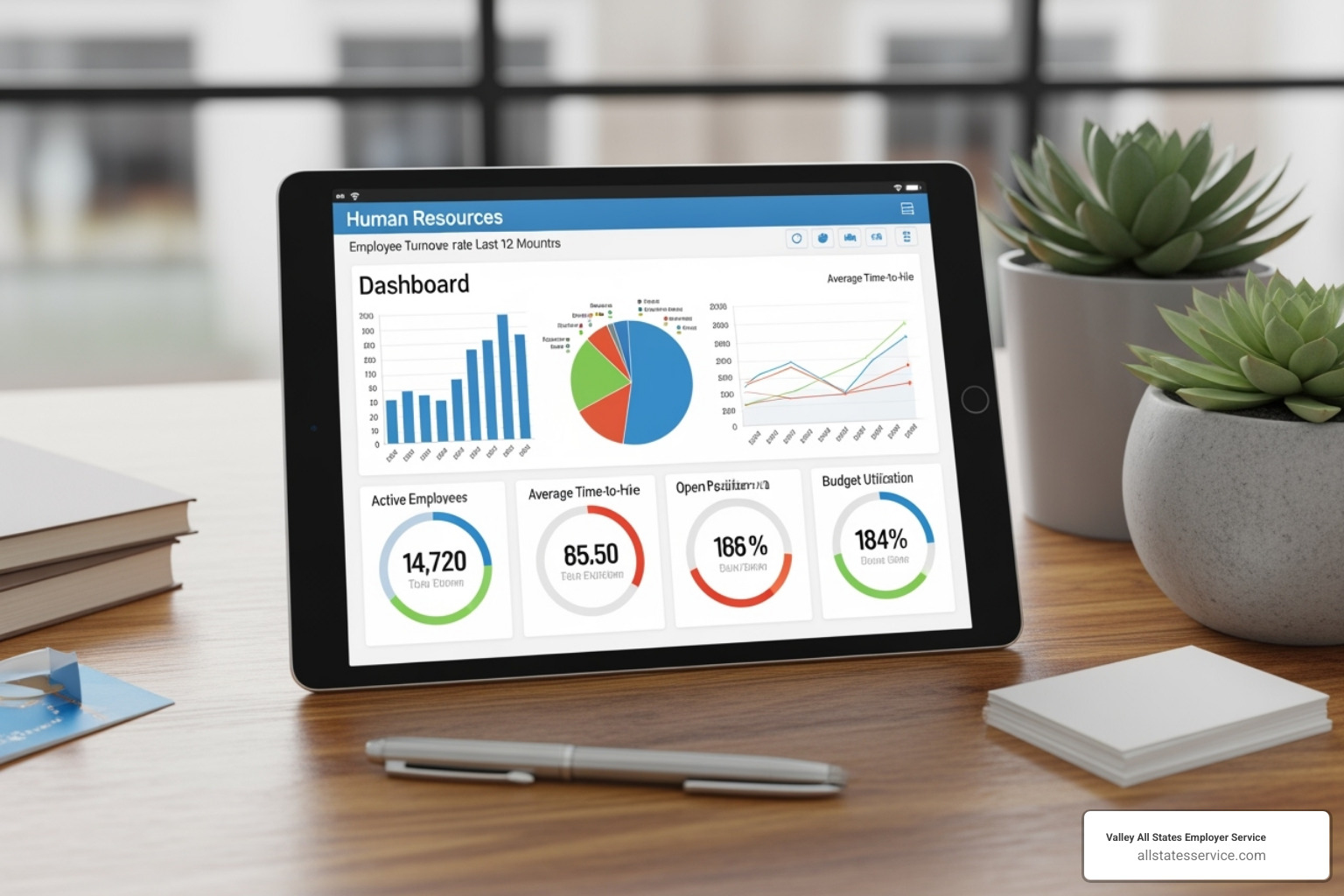
Modern HR technology acts as a command center. Centralizing your systems with an integrated HRIS creates a single source of truth for talent data, eliminating duplicate entries and confusion. This is critical, as employees spend nearly 2.4 hours weekly searching for information. A unified system improves data accessibility and enables real-time reporting.
Employee self-service portals are another game-changer. When employees can update their own information and request time off, your team is freed from routine requests. Our Automated Eligibility Verification System shows how technology can streamline complex HR tasks.
How to Improve HR Efficiency with Automation
Start with repetitive, time-consuming tasks that are prone to human error.
- Payroll processing: Automated systems save time, eliminate calculation errors, and ensure everyone is paid accurately and on schedule.
- Benefits administration: Automation simplifies everything from initial enrollment to open enrollment, guiding employees while ensuring backend compliance.
- Data entry and report generation: When systems communicate and reports generate automatically, you reclaim hours every week for strategic work.
An HR helpdesk ticketing system can route common questions automatically, allowing your team to focus on complex, high-value interactions. Our Compliance Management System exemplifies this by automating essential but time-intensive compliance tasks.
Leverage AI for Strategic Advantage
Artificial Intelligence is already delivering remarkable results in HR. Gartner reports that 76% of HR leaders believe organizations not implementing AI will fall behind. AI augments your capabilities, allowing you to focus on the human aspects of HR.
- AI in recruitment screens resumes in seconds, identifies qualified candidates, and reduces time-to-hire.
- Performance analytics powered by AI can spot patterns, predict issues, and suggest personalized development plans.
- Predictive hiring and upskilling recommendations help you select the right candidates and develop existing talent.
Boston Consulting Group projected that AI could free up 25% to 30% of an HR Business Partner’s time. Technology makes truly human-centered HR possible by removing administrative barriers.
Optimizing the Employee Lifecycle for Peak Efficiency
To improve HR efficiency, we must optimize every touchpoint in the employee journey, from application to exit. This means nurturing growth at every stage.

Career assistance helps build your internal talent pipeline and reduces recruitment costs. Promoting from within is often more effective than hiring externally, as current employees already know your culture and systems. It also sends a powerful message that growth is possible.
Employee engagement is key; when people feel connected and valued, they are more productive and more likely to stay. Smart incentives and rewards aren’t always monetary. Career advancement, public recognition, or meaningful feedback can be highly motivating.
Strategies to Improve HR Efficiency in Recruitment and Onboarding
Getting the right people in the door efficiently is critical. Skills-based hiring is a approach. Instead of focusing on degrees, you focus on what people can do. This widens your talent pool and is five times more predictive of job performance than education alone.
An Applicant Tracking System (ATS) acts as your recruitment command center, slashing your time-to-hire. However, many companies falter at onboarding. Structured onboarding sets new hires up for success from day one. When people understand their role and feel welcomed, they become productive faster.
Of course, onboarding has compliance challenges. We can help streamline things with our expertise in E-Verify & I-9 Compliance and Employee Onboarding Compliance.
Improve Employee Development and Retention
Keeping great people engaged and growing is where real efficiency gains happen. Internal mobility reduces turnover and keeps valuable knowledge in-house. Continuous feedback is replacing annual reviews, leading to better performance and happier employees.
Employee engagement surveys provide valuable insights, but acting on the feedback is what truly matters. Recognition programs, even simple ones, can significantly boost morale and productivity. The LinkedIn Workplace Learning Report found that 91% of L&D professionals see continuous learning as crucial. When you invest in your people, they invest in your company.
How to Improve HR Efficiency Through Smart Compliance and Risk Management
Legal compliance is a non-negotiable part of HR. Managing it efficiently is essential to avoid costly penalties and reputational damage. This means staying current on federal, state, and local employment laws.

Efficient compliance involves proactive measures, clear policies, and thorough record-keeping. For smaller businesses, this burden can be heavy, but we offer more info about HR Compliance for Small Business to help. HR is also responsible for organizational health and safety, as mandated by laws like the Occupational Safety and Health Act. You can find details on the Occupational Safety and Health Act for more information.
Master I-9 and E-Verify Compliance
Workforce eligibility verification is a critical area where efficiency and accuracy are vital.
- Avoiding Form I-9 errors: We must ensure every section of the I-9 form is correctly completed and verified within the required timeframe. Our more info about I-9 Self Audit resources can help.
- E-Verify mandates: For many employers, E-Verify is mandatory. This system electronically confirms employment eligibility, and efficient processing is key.
- Remote hiring compliance: Verifying I-9s for remote employees requires robust processes to maintain compliance.
- Reducing penalties: Proactive compliance and regular internal audits identify and correct issues before they lead to fines. Our our E-Verify Employer Agent services are designed to help businesses manage these processes with expert, impartial support.
Ensure a Safe and Healthy Workplace
Organizational health and safety are paramount for employee well-being and productivity. HR’s role includes:
- OSHA regulations: Understanding and complying with all relevant OSHA regulations.
- Safety training: Supporting regular safety training to educate employees on hazards and safe practices.
- Injury reporting: Maintaining accurate logs of injuries and reporting them as required.
- Creating a safety culture: Fostering a culture where safety is a shared responsibility.
- Employee well-being programs: Supporting mental health, ergonomics, and wellness to create a healthier, more productive workforce.
Measuring What Matters: Tracking HR Effectiveness
You can’t improve HR efficiency without knowing where you stand. Measuring HR effectiveness means looking at how well your department achieves its goals and delivers value. Without solid measurement, you risk hiring the wrong people, losing valuable employees, and wasting resources.
Companies that make people data accessible and actionable see significant cost savings and revenue growth. It’s about using information to make better decisions. If managing this data feels overwhelming, our Outsourced Compliance Solutions can help streamline your measurement and reporting.
Key Metrics to Track
Focus on metrics that matter for your business. Here are the essentials for a clear picture of your HR effectiveness:
- Cost-per-hire and Time-to-fill tell you how efficiently you’re bringing in new talent.
- Employee turnover rate is a critical metric. High turnover is expensive and helps you spot problems with onboarding, culture, or management.
- Your employee engagement score directly correlates with productivity and retention.
- Absenteeism rates can signal underlying issues with well-being or job satisfaction.
- HR tech ROI helps justify technology spending and ensures your solutions are driving efficiency.
Using Data to Inform Strategy
Collecting data is just the start. The real power comes from turning numbers into actionable insights.
- Identifying trends in historical data reveals patterns that help you anticipate challenges.
- Forecasting workforce needs becomes more accurate when based on solid data, not gut feelings.
- Optimizing resource allocation means putting your budget where it will have the biggest impact.
- Demonstrating HR’s value to leadership is crucial. When you can show quantifiable results, like cost savings from reduced turnover, you transform HR into a strategic partner and gain buy-in for future initiatives.
Frequently Asked Questions about Improving HR Efficiency
What are the first steps to improve HR efficiency?
Starting your journey to improve HR efficiency doesn’t have to be complex. Begin with a thorough process audit to identify bottlenecks and redundant steps. Where do things slow down? Which tasks are most tedious? Once you’ve identified problem areas, prioritize high-impact changes. Focus on automating repetitive tasks like payroll or report generation to get immediate time savings. Finally, gather employee feedback. Your team knows the daily operational pain points and can offer valuable insights. Involving them also helps create buy-in for change.
How can a skills-based approach improve HR efficiency?
A skills-based approach is a precision tool for hiring. Instead of focusing on degrees or years of experience, you focus on what candidates can actually do. This widens your talent pools to include skilled individuals from non-traditional backgrounds. It also leads to better candidate matching, as skills-based criteria are five times more predictive of job performance than education. This precision reduces turnover because people are better suited for their roles. Companies using this approach find qualified candidates twice as easily, freeing up your HR team from endless recruitment cycles.
What are the biggest challenges when improving HR processes?
Improving HR processes can present some common roadblocks.
- Resistance to change is a major challenge. People are comfortable with familiar routines. Clear communication about the benefits and proper training can overcome this.
- Limited resources, whether budget, staffing, or technology, can be a constraint. Demonstrating the ROI for each improvement can help secure what you need.
- Data security concerns are critical when digitizing HR information. Robust cybersecurity measures are essential to protect sensitive employee data.
- Technology integration challenges can create new inefficiencies if systems don’t communicate. Careful planning with IT is key.
- Ensuring legal compliance throughout any process change requires vigilance. Labor laws evolve, and mistakes in areas like E-Verify and I-9 compliance can lead to significant penalties.
Streamline Your HR Operations Today
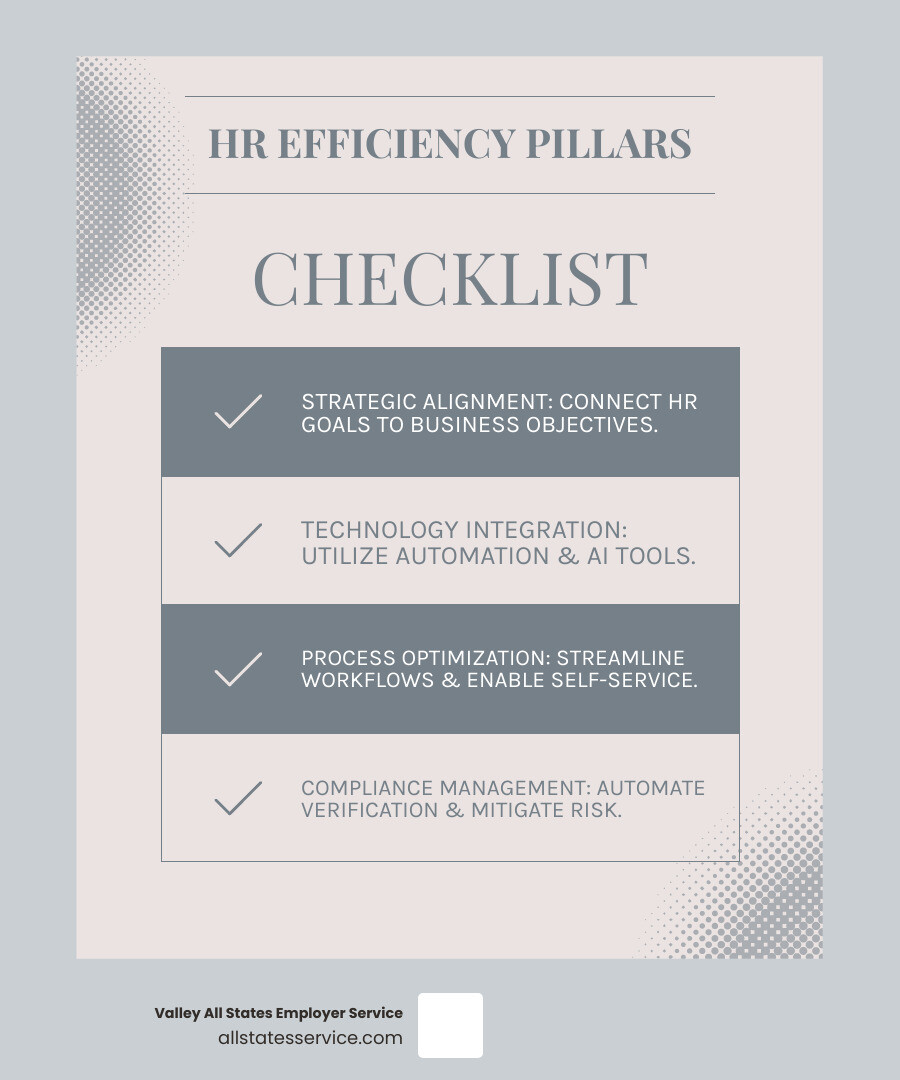
The path to improve HR efficiency is an ongoing journey. We’ve explored the four pillars of efficient HR: strategic alignment with business goals, technology adoption to automate tasks, process optimization from hiring to development, and robust compliance management to reduce risk.
This isn’t just about cutting costs. When you get HR efficiency right, your team can move from paperwork to being strategic partners who focus on what truly matters: creating an environment where employees thrive and your business grows. Every hour spent on manual tasks is an hour not spent on coaching, talent development, or solving key people challenges.
Efficient HR operations are the foundation for a successful human capital strategy. You can start small by tackling the biggest headaches, like I-9 paperwork or onboarding. Small wins build momentum and transform how you manage your most valuable asset: your people.
At Valley All States Employer Service, we’ve seen how removing compliance burdens can revolutionize an HR department. Our expert, impartial, and efficient E-Verify processing takes a major headache off your plate, freeing your team to focus on strategic initiatives.
Ready to take the first step? Learn more about our E-Verify Services and see how we can help streamline your compliance processes.