
Why Filling Out the I-9 Form is a Legal Requirement
Why do I need to fill out an I-9 form? If you’re starting a new job in the United States, this is one of the first questions you’ll ask when faced with the paperwork. The simple answer is: federal law requires it. Every employer must verify that new employees are legally authorized to work in the U.S., and the Form I-9 is how that verification happens.
Here’s what you need to know:
- It’s the law: The Immigration Reform and Control Act of 1986 mandates Form I-9 completion for all new hires.
- It applies to everyone: U.S. citizens, permanent residents, and anyone else authorized to work must complete it.
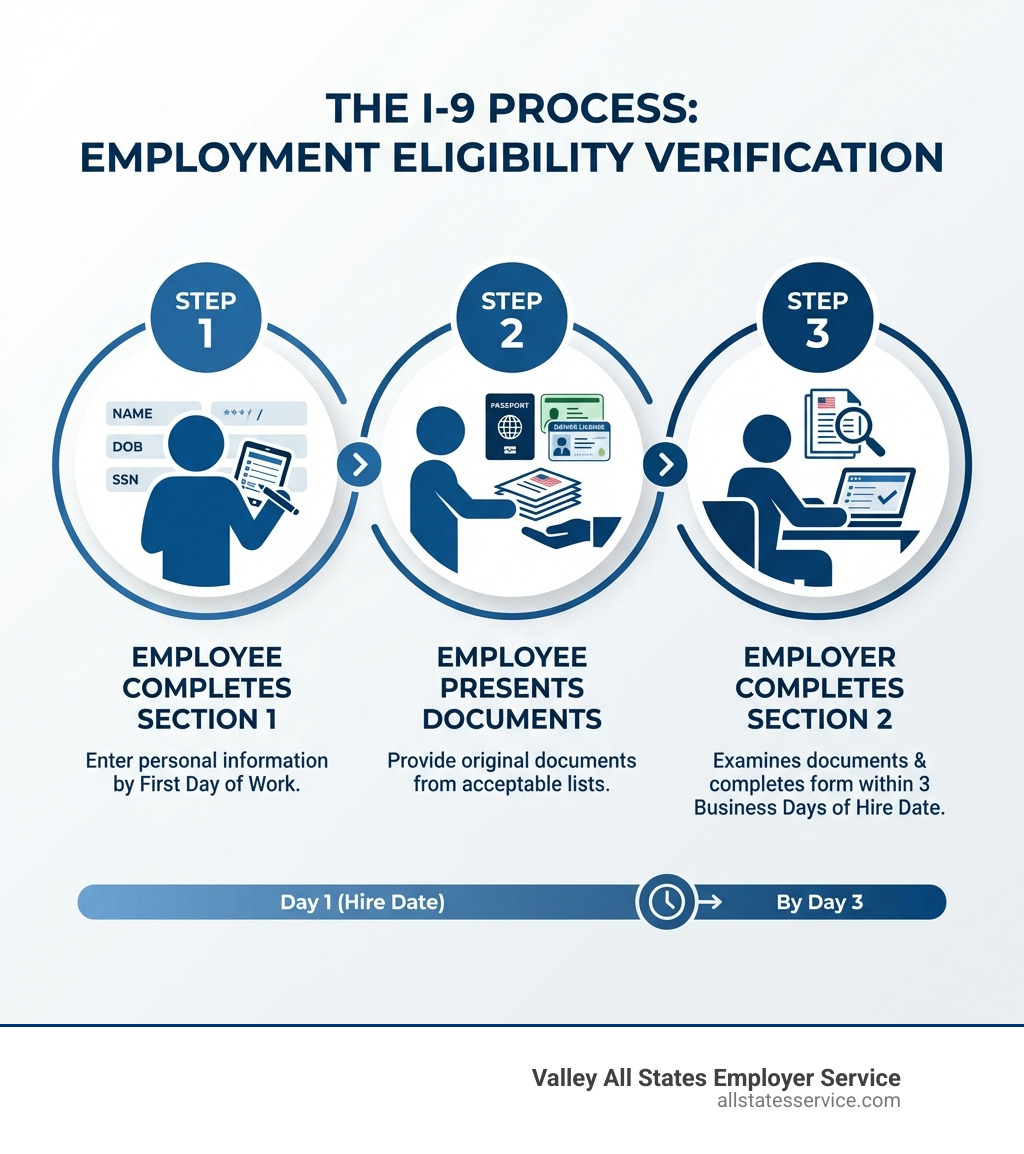
- Both parties have a role: You (the employee) complete Section 1, and your employer completes Section 2 after examining your documents.
- Timing matters: Section 1 must be done by your first day of work. Section 2 must be completed within three business days.
- Non-compliance has consequences: Failing to complete the form can result in termination for employees and significant fines for employers.
The Form I-9 serves as your Employment Eligibility Verification. It’s designed to prove two things: who you are and that you’re legally allowed to work in the United States. While it might seem like just another piece of paperwork, it’s actually a critical tool that protects both workers and employers. It helps prevent unauthorized employment while also ensuring that eligible workers aren’t discriminated against during the hiring process.
As one source notes, the form “nominally assures that no one who is entitled to work gets discriminated against, but realistically, it is to prevent or aid in preventing non-citizens and other ineligible people from being given a job.” Whether you’re a U.S. citizen presenting a passport or a permanent resident showing your green card, the I-9 is your first official step in any new employment relationship.
Simple guide to why do i need to fill out an i9 form:
So, Why Do I Need to Fill Out an I-9 Form?
The short answer is: it’s the law. The Form I-9, or Employment Eligibility Verification form, was created by the Immigration Reform and Control Act of 1986. Its main purpose is to verify your identity and confirm you are legally permitted to work in the United States. This requirement applies to nearly every new hire, including U.S. citizens. It’s a key tool for preventing unlawful employment and ensuring a fair hiring process for everyone.
The U.S. Citizenship and Immigration Services (USCIS), an agency of the Department of Homeland Security, requires the completion of this form. It’s designed to establish that an employee is eligible to work in the U.S. This not only proves employment eligibility but also helps enforce immigration laws.
Essentially, when you fill out an I-9, you’re making a declaration about your legal right to work. You must declare that you are a U.S. citizen, a non-citizen national of the U.S., a lawful permanent resident, or an alien authorized to work in the U.S. This declaration is a crucial step in the hiring process for both you and your employer.
While the primary goal is to prevent unauthorized employment, the Form I-9 process also includes anti-discrimination provisions. The Immigrant and Employee Rights Section (IER) of the Department of Justice works to protect employees from discrimination based on citizenship status or national origin during the employment eligibility verification process. This ensures that while employers are diligent, they are also fair and do not treat individuals differently based on their perceived background. For a deeper dive into the form itself, explore What is Form I-9?.
Who is Exempt from the I-9 Requirement?
While most people hired for a job must complete a Form I-9, there are a few exceptions. Generally, you do not need to complete an I-9 if you are an independent contractor, a volunteer who is not paid for their work, or an employee who was hired before November 6, 1986, and has been continuously employed by the same company.
Let’s break down some of the key exemptions:
- Independent Contractors: If you’re working as an independent contractor, you typically do not need to complete a Form I-9. Your employer would likely have you fill out a Form W-9 instead, which we’ll discuss next.
- Casual Domestic Workers: Individuals performing casual domestic work in a private home are generally exempt.
- Employees Hired Before November 6, 1986: If you were hired before this date and have been continuously employed by the same employer, an I-9 is not required for that specific employment.
- Individuals Not Physically Working in the U.S.: If your job is entirely performed outside the United States, a Form I-9 is not necessary.
- Volunteers: Those who perform services without any remuneration are usually exempt. Remuneration, by the way, can include more than just wages; it can also encompass things like food and lodging.
- Self-Employed Individuals: If you are genuinely self-employed, you do not need to complete a Form I-9 for yourself. However, if your self-employment is structured as an employee of a separate business entity, such as a corporation or partnership, then you would need to complete one.
It’s important for employers to understand these distinctions to avoid unnecessary paperwork or, conversely, to ensure compliance where it’s required.
How is Form I-9 Different from Form W-9?
It’s easy to mix up these two forms, but they serve very different purposes. The Form I-9 is for employment eligibility, while the Form W-9 (Request for Taxpayer Identification Number and Certification) is an IRS form used for tax purposes, typically by independent contractors or freelancers.
To help clarify the distinction, here’s a quick comparison:
| Feature | Form I-9 (Employment Eligibility Verification) | Form W-9 (Request for Taxpayer Identification Number and Certification) |
|---|---|---|
| Purpose | Verifies identity and employment authorization in the U.S. | Collects taxpayer identification number (TIN) for tax reporting |
| Who Completes It | Employee (Section 1) and Employer (Section 2) | Independent contractors, freelancers, or other third-party vendors |
| Legal Basis | Immigration Reform and Control Act (IRCA) | Internal Revenue Service (IRS) regulations |
| What It’s Used For | To confirm legal right to work | To report income paid to non-employees to the IRS |
| Documents Required | Identity and employment authorization documents (List A, B, or C) | Name, address, and TIN (Social Security Number or Employer ID Number) |
| Filing | Retained by employer, not filed with government | Retained by payer, information used for 1099 forms filed with IRS |
As you can see, while both are essential forms in the business world, they tackle entirely different aspects of your relationship with an employer or client. The I-9 is about your right to work, and the W-9 is about how you’re taxed. If you’re curious about the differences between these and other verification methods, our E-Verify vs I-9 Guide provides more information.
The I-9 Process: A Step-by-Step Guide
The Form I-9 is divided into sections, each with a specific purpose and deadline. Understanding who fills out what, and when, is key to a smooth onboarding process. The form itself has evolved, with the U.S. Citizenship and Immigration Services (USCIS) periodically releasing new versions. The current edition of the form is dated 08/01/23 and expires 07/31/2026. Employers must always ensure they are using the most current version available on the USCIS website.
The form consists of two main sections, completed by the employee and employer respectively, and two supplements for specific situations:
- Section 1: Employee Information and Attestation: Completed by the employee.
- Section 2: Employer or Authorized Representative Review and Verification: Completed by the employer or their designated representative.
- Supplement A: Preparer and/or Translator Certification for Section 1: Used if someone helps the employee complete Section 1.
- Supplement B: Reverification and Rehire: Used for updating employment authorization or for rehired employees.
For a comprehensive overview of the entire process, including detailed instructions, you can refer to the Completing Form I-9 guide.
Step 1: The Employee’s Role in Completing Section 1
As the new employee, your part is Section 1. You must complete and sign this section on or before your first day of employment. This means it needs to be done no later than your first day of work. While you can complete it before your first day, you should not do so before accepting a job offer.
In Section 1, you’ll provide basic personal information, including your full legal name, address, date of birth, and email address (optional). A crucial part of this section is attesting to your employment authorization status. You’ll check a box indicating if you are a U.S. citizen, a non-citizen national, a lawful permanent resident, or an alien authorized to work. If you are an alien authorized to work or a lawful permanent resident, you’ll need to provide additional details, such as your Alien Number/USCIS Number or your employment authorization expiration date, if applicable.
You are generally not required to provide your Social Security Number (SSN) in Section 1, unless your employer participates in E-Verify. If your employer uses E-Verify, providing your SSN is mandatory. It’s important to print clearly, and if someone assists you in filling out this section, they must complete Supplement A (Preparer and/or Translator Certification). Even if you receive help, you personally must sign Section 1.
Step 2: The Employer’s Role in Completing Section 2
After you complete Section 1, your employer takes over. They must physically examine the documents you present to verify your identity and work authorization, and then complete Section 2 within three business days of your start date. For instance, if you begin employment on a Monday, your employer must complete Section 2 by Thursday. If your employment is for less than three business days, both Sections 1 and 2 must be completed on your first day of employment.
The employer’s responsibility is significant. They must inspect your original documents, ensuring they reasonably appear to be genuine and relate to you. They cannot accept photocopies (with the exception of certified copies of birth certificates). They also cannot specify which documents you must present, as long as they are from the official Lists of Acceptable Documents.
Employers can designate an authorized representative to complete Section 2 on their behalf. This could be a manager, a human resources staff member, or even a third-party service. However, it’s crucial to understand that the employer remains liable for any violations in connection with the form or the verification process, including any errors made by their authorized representative. If a notary public acts as an authorized representative, they must perform the same actions but should not apply their notary seal to the Form I-9. Employees cannot act as authorized representatives for their own Form I-9.
For employers, staying on top of these requirements is vital for compliance. Our I-9 Section 2 Complete Guide and Employer I-9 Verification Guide offer comprehensive details on these responsibilities.
Acceptable Documents: Proving Your Identity and Work Authorization

To complete the I-9 process, you must present original, unexpired documents to your employer. You have the right to choose which documents you provide from the official Form I-9 Lists of Acceptable Documents. Your employer cannot tell you which specific documents to present. This is a critical anti-discrimination measure, ensuring you have flexibility in proving your eligibility.
The Lists of Acceptable Documents are divided into three categories:
- List A documents establish both your identity and your employment authorization.
- List B documents establish only your identity.
- List C documents establish only your employment authorization.
You have two main options: you can either present one document from List A, or you can present one document from List B and one document from List C. You cannot combine a List A document with a List B or List C document. The choice is yours.
What are some common examples of acceptable documents?
Let’s look at some of the most frequently used documents within each category:
List A (Documents that establish both identity and employment authorization):
- U.S. Passport or U.S. Passport Card
- Permanent Resident Card (often called a “Green Card”)
- Foreign passport with a temporary I-551 stamp or printed notation on a machine-readable immigrant visa
- Employment Authorization Document (EAD) that contains a photograph (Form I-766)
List B (Documents that establish identity only):
- Driver’s license or ID card issued by a U.S. state or outlying possession of the U.S. (must contain a photo or identifying information such as name, date of birth, gender, height, eye color, and address)
- ID card issued by federal, state, or local government agencies or entities (must contain a photo or identifying information)
- School ID card with a photograph
- Voter’s registration card
- U.S. military card or draft record
List C (Documents that establish employment authorization only):
- U.S. Social Security card (not laminated or marked “not valid for employment”)
- Original or certified copy of a birth certificate issued by a U.S. state, county, municipal authority, or outlying possession bearing an official seal
- Native American tribal document
- Employment Authorization Document issued by the Department of Homeland Security (other than those on List A)
Your employer’s role is to inspect these documents to ensure they appear genuine and relate to you, the employee. They are not expected to be document fraud experts, but they must exercise reasonable judgment. For more details on what your employer is looking for, check out our I-9 Document Review guide.
Staying Compliant: Retention, Penalties, and Best Practices
Completing the form is just the first step. Employers have strict rules they must follow for keeping I-9 records. Failure to comply can lead to significant penalties, making proper management essential. The Form I-9 should never be filed with USCIS or ICE; instead, it’s retained by the employer.
The retention rules for Form I-9s are often referred to as the “3-1 rule.” Employers must retain completed Forms I-9 for either:
- Three years after the date of hire, or
- One year after the date employment ends, whichever is later.
This means if an employee works for 10 years, the employer must keep their I-9 for one year after their last day. If an employee works for six months, the employer must keep their I-9 for three years from their start date. This applies to both paper and electronic storage. If employers choose electronic formats, they must adhere to Department of Homeland Security electronic storage regulations. For comprehensive guidance on managing these records, our I-9 Record Keeping guide is an excellent resource.
What are the consequences if I don’t fill out an I-9 form or comply?
For an employee, failing to complete Section 1 or provide acceptable documents can result in termination of employment. Furthermore, if you lie on the form or present false documents, you may be subject to criminal charges.
For employers, the consequences are financial, reputational, and can lead to increased scrutiny from immigration authorities. U.S. Immigration and Customs Enforcement (ICE) conducts I-9 inspections, and non-compliance can be very costly.
- Paperwork Violations: These are errors in completing, retaining, or making available the Form I-9. Substantive and uncorrected technical violations associated with Form I-9 compliance can range from a minimum of $281 to as much as $2,789 per Form I-9 for a first offense. These penalties increase with subsequent offenses.
- Knowingly Hiring or Continuing to Employ Unauthorized Individuals: This is a much more severe violation. Monetary penalties for this can range from $703 to $28,141 per violation, with fines increasing significantly for repeat offenses. Employers can also face criminal charges, debarment from government contracts, and court orders.
These penalties highlight why do I need to fill out an I-9 form correctly and completely, and why employers take these requirements so seriously. The administrative burden is real, but the risks of non-compliance are far greater. Our I-9 Compliance Penalties article offers a deeper look into these consequences.
How can employers ensure they are compliant?
Ensuring I-9 compliance is an ongoing process that requires diligence and attention to detail. Here are some best practices we recommend:
- Use the Current Form: Always use the most current version of the Form I-9 available on the USCIS website. The form is updated periodically, and using an outdated version can lead to technical violations.
- Conduct Regular Self-Audits: A thorough review of your Form I-9 procedures and performing a self-audit of completed Forms I-9 can help employers avoid potentially costly errors. If a mistake is found during your self-audit, USCIS provides guidance on correcting forms. This proactive approach can save significant headaches and fines down the line. Our I-9 Self Audit guide can walk you through the process.
- Train Staff: Ensure that all staff involved in the I-9 process, especially those completing Section 2, are properly trained on the requirements and best practices.
- Use E-Verify: Consider using the government’s free E-Verify system. E-Verify is an internet-based system that compares information from an employee’s Form I-9 to data from U.S. Department of Homeland Security and Social Security Administration records to confirm employment eligibility. While it doesn’t replace the I-9, it adds an extra layer of verification. Learn more about What is E-Verify? and how it can bolster your compliance efforts.
- Document Everything: Keep clear records of your I-9 process, including any internal policies, training provided, and audit results.
Common I-9 Questions and Scenarios
The I-9 process can have some unique situations. Here are answers to a few common questions.
Do I need to fill out a new I-9 if I’m rehired?
It depends. If you are rehired by the same employer within three years of the date your original I-9 was completed, your employer may be able to use your existing form and complete Supplement B (formerly Section 3) for rehires. This supplement is designed for reverification and rehires, allowing employers to update existing information rather than starting anew. However, if it’s been longer than three years since your original I-9 was completed, or if your previous employment authorization has expired and cannot be reverified, you’ll need to complete a new Form I-9. The employer must ensure the original I-9 is still valid and relates to the rehire. For detailed instructions on this process, refer to our I-9 Process for Rehires guide.
How does the I-9 process work for remote employees?
The landscape of work has changed, and so have some aspects of I-9 compliance, particularly for remote employees. Historically, employers were required to physically inspect original documents. However, recent guidance from the Department of Homeland Security (DHS) has introduced more flexibility, especially for employers enrolled in E-Verify.
- For Employers Enrolled in E-Verify: If your employer is enrolled in E-Verify, they can use a live video call to examine your documents. This alternative procedure requires the employer to examine copies of your documents via live video interaction, ensuring they are genuine. They must then indicate on the Form I-9 that they used an alternative procedure to examine the documents. This offers a convenient solution for verifying remote employees without requiring in-person meetings.
- For Other Employers: If your employer is not enrolled in E-Verify or chooses not to use the alternative procedure, they must still have an authorized representative physically inspect your original documents in person on their behalf. This representative could be a notary public, a family member, or a friend, but the employer remains legally responsible for the accuracy and completeness of the Form I-9. The representative simply acts as the employer’s agent for the physical inspection.
Understanding these nuances is crucial for both employees and employers in our increasingly remote workforce. Our Remote I-9 Compliance guide provides further details on navigating these requirements.
Why do I need to fill out an I-9 form again if I’ve worked there for years?
It can certainly be puzzling if you’ve been with a company for a long time and suddenly find yourself being asked to complete a new Form I-9. This can happen for a few reasons:
- Internal Audit or Record Review: Your employer might be conducting an internal audit of their I-9 records. During such a review, they might find that your original form was missing, had errors, or was never properly completed or retained. To correct these deficiencies and ensure compliance, they would ask you to complete a new form. As one expert notes, “The request may have come as the result of a review of records or audit in which that deficiency was identified.”
- Expired Work Authorization: If your initial employment authorization documents had an expiration date (for example, a temporary work visa or an Employment Authorization Document), your employer is legally required to reverify your continued authorization to work before that expiration date. If they missed this deadline or are updating their records, they might ask for a new I-9 or for you to present updated documents for reverification using Supplement B.
- Change in Employer Policy or Legal Requirements: Less commonly, a change in company policy or new legal guidance might prompt a review of older I-9s, leading to requests for new forms, especially if there were previous interpretations that are no longer valid.
Regardless of the reason, your employer is ultimately responsible for maintaining accurate and compliant I-9 records. Their request is likely an effort to ensure they meet federal requirements and avoid potential penalties.
Simplify Your I-9 and E-Verify Compliance
The Form I-9 is a mandatory federal form that plays a crucial role in maintaining a legal workforce. It verifies both identity and work authorization, and both employees and employers have time-sensitive responsibilities to ensure it’s completed correctly. With costly penalties for non-compliance, getting it right is not just good practice—it’s essential. The estimated paper reporting burden for Form I-9 is 34 minutes per response, and 25 minutes when using a computer, highlighting the administrative effort involved.
For employers looking to reduce the administrative burden and minimize errors, professional assistance can be a game-changer. Our team at Valley All States Employer Service provides expert, impartial, and efficient E-Verify processing, minimizing errors and administrative burden for our clients in the United States, including Maryland and Lutherville, MD. We understand the complexities of federal employment laws and are dedicated to helping businesses steer them seamlessly. From ensuring you use the latest forms to providing comprehensive HR Compliance Assistance, we are here to support your hiring processes.
Ready to master I-9 compliance and streamline your hiring process? Check out our complete Form I-9 Ultimate Guide for even more in-depth information.