
Why I-9 Document Verification Matters for Every New Hire
What I 9 documents do I need for employment eligibility verification? Here’s the quick answer:
You need to present ONE of the following:
- Option 1: One document from List A (proves both identity AND work authorization)
- Examples: U.S. Passport, Permanent Resident Card, Employment Authorization Document
OR
- Option 2: One document from List B (proves identity) PLUS one document from List C (proves work authorization)
- List B examples: Driver’s license, State ID card
- List C examples: Social Security card, Birth certificate
All documents must be unexpired.
If you’re starting a new job in the United States, Form I-9 is not optional. It’s the law. The Immigration Reform and Control Act of 1986 requires every employer to verify that each new hire is legally authorized to work in the U.S., whether they’re a citizen or not.
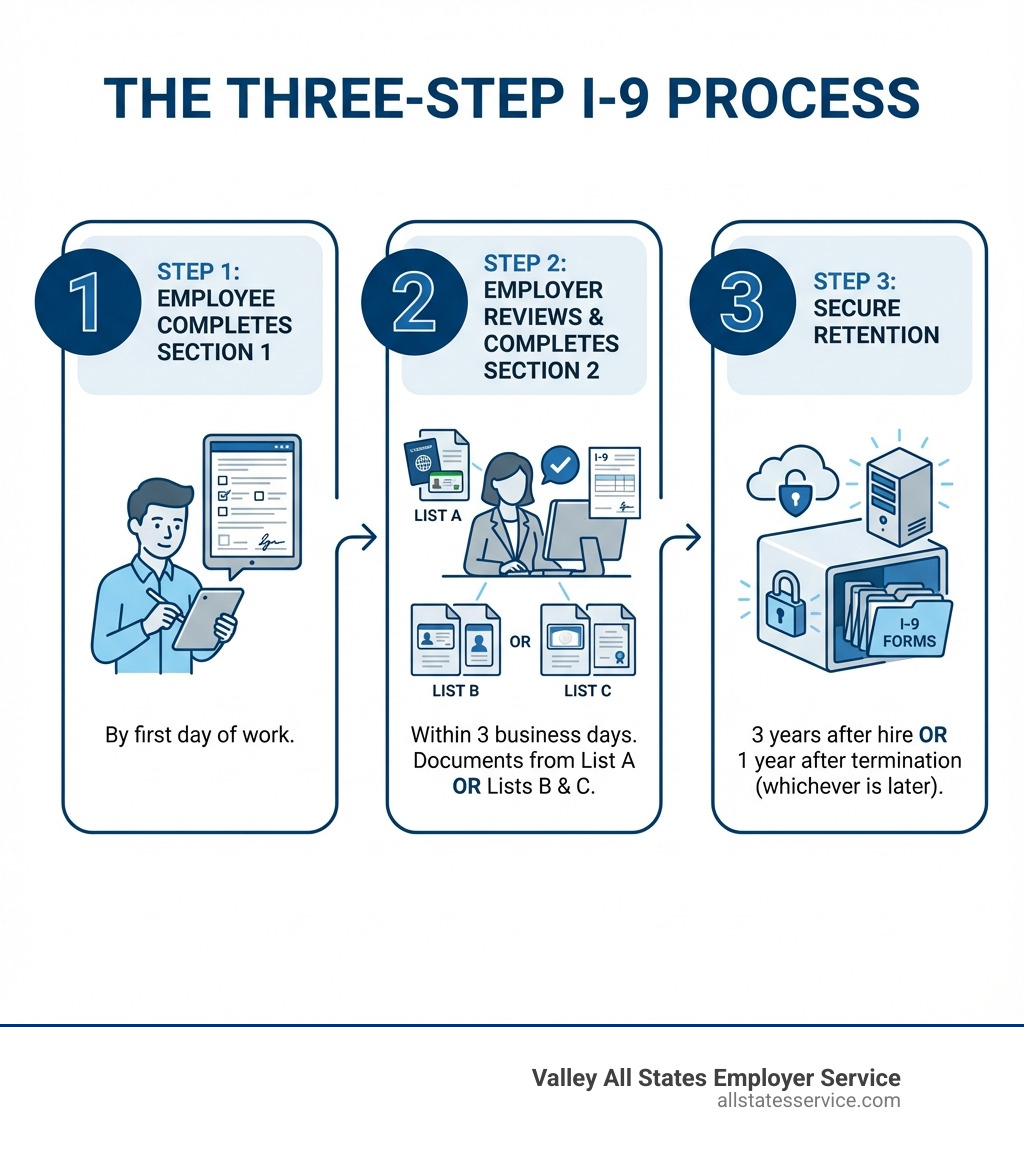
Here’s how the process works: you complete Section 1 of the form on or before your first day of work. Then, within three business days, you present your documents to your employer, who examines them and completes Section 2. It sounds simple, but the details matter. Presenting the wrong documents, expired documents, or missing the deadline can delay your start date or create compliance headaches for your employer.
The good news? Once you understand the three lists of acceptable documents and know which combination you need, the process is straightforward. Whether you’re an HR manager onboarding dozens of employees or a new hire filling out your first I-9, getting this right protects everyone involved.
Simple what i 9 documents do i need glossary:
What I-9 Documents Do I Need? The Three Lists Explained
Understanding what I-9 documents do I need is fundamental for both new employees and employers. The U.S. Citizenship and Immigration Services (USCIS) has established clear guidelines for acceptable documents, categorizing them into three distinct lists: List A, List B, and List C. The employee has the sole discretion to choose which documents to present, provided they meet the requirements. Employers cannot specify which documents an employee should provide, as this can be considered discriminatory.
The golden rule for all documents is that they must be unexpired. There are very few exceptions, typically involving documents automatically extended by the issuing authority, but these are rare. If a document has an expiration date, it must be valid on the day it’s presented for I-9 verification.
Employees have two main options when presenting their documents:
- Present one document from List A. This single document proves both your identity and your authorization to work in the U.S.
- Present one document from List B AND one document from List C. In this case, List B proves your identity, and List C proves your work authorization.
Let’s explore these lists in more detail to clarify what I-9 documents do I need for each category. For a comprehensive overview, you can always refer to the Official Lists of Acceptable Documents or our guide on Documents for I-9.

List A: Documents That Establish Both Identity and Employment Authorization
List A documents are the superstars of I-9 verification because they do double duty. Presenting just one of these means you’ve satisfied both the identity and employment authorization requirements. This simplifies the process considerably.
Common examples of List A documents include:
- U.S. Passport or U.S. Passport Card: These are among the most common and straightforward List A documents for U.S. citizens.
- Permanent Resident Card (Form I-551) or Alien Registration Receipt Card: Often referred to as a “Green Card,” this document is crucial for lawful permanent residents. Ensure you’re familiar with Filling Out I9 with Permanent Resident Card.
- Foreign Passport with a Temporary I-551 Stamp or Temporary I-551 Printed Notation on a Machine-Readable Immigrant Visa: This applies to certain non-U.S. citizens who have been granted permanent resident status.
- Employment Authorization Document (EAD) with a Photograph (Form I-766): This card is issued by DHS to individuals authorized to work in the U.S. for a specific period.
- Foreign Passport with Form I-94 or Form I-94A with an Endorsement of Nonimmigrant Status and Authorization to Work for a Specific Employer: This is often used by nonimmigrant aliens, such as those on certain visa types (e.g., H-1B, L-1), whose work authorization is tied to a particular employer. The endorsement must be unexpired and consistent with the employment. Citizens of the Federated States of Micronesia (FSM) and the Republic of the Marshall Islands (RMI) may also use their unexpired FSM or RMI passport with Form I-94 or Form I-94A.
All List A documents must be unexpired. USCIS regularly redesigns documents like Permanent Resident Cards and EADs to improve security and reduce fraud. However, older designs remain valid until their stated expiration date.
List B: Documents That Establish Identity Only
If you don’t have a List A document, you’ll need to present one document from List B to prove your identity. A List B document alone is not enough; you’ll also need a List C document to prove your work authorization.
Here are some common List B documents:
- Driver’s License or ID Card Issued by a State or Outlying Possession of the United States: This is a widely used document, provided it contains a photograph or other identifying information such as name, date of birth, gender, height, eye color, and address.
- ID Card Issued by Federal, State, or Local Government Agencies or Entities: Similar to a driver’s license, this must contain a photograph or identifying information.
- School ID Card with a Photograph: This is a popular option, especially for younger employees.
- Voter’s Registration Card: A simple yet effective way to prove identity.
- U.S. Military Card or Draft Record: For those with military connections.
- Military Dependent’s ID Card: Another option for military families.
- U.S. Coast Guard Merchant Mariner Card: For individuals working in maritime roles.
- Native American Tribal Document: A valid document issued by a federally recognized Native American tribe.
- Driver’s License Issued by a Canadian Government Authority: Acceptable for identity verification.
Again, all List B documents must be unexpired when presented.
List C: Documents That Establish Employment Authorization Only
To complete your I-9 if you’ve chosen the List B plus List C option, you’ll need one document from List C. This document proves you are authorized to work in the U.S.
Here are common List C documents:
- Social Security Account Number Card (unrestricted): This is a very common List C document. However, it cannot contain any of the following restrictions: “NOT VALID FOR EMPLOYMENT,” “VALID FOR WORK ONLY WITH INS AUTHORIZATION,” or “VALID FOR WORK ONLY WITH DHS AUTHORIZATION.” If your card has one of these notations, it’s not acceptable for List C purposes.
- Certification of Report of Birth Issued by the Department of State (Form DS-1350, FS-545, FS-240): These are official birth records for U.S. citizens born abroad.
- Original or Certified Copy of a Birth Certificate Issued by a State, County, Municipal Authority, or Territory of the United States Bearing an Official Seal: This is another widely used document for U.S. citizens. Puerto Rico birth certificates issued before July 1, 2010, are not acceptable.
- U.S. Citizen ID Card (Form I-197): Issued by USCIS to U.S. citizens.
- Identification Card for Use of Resident Citizen in the United States (Form I-179): Issued by USCIS to U.S. citizens.
- Employment Authorization Document Issued by the Department of Homeland Security (DHS): This category includes several specific documents, such as:
- Form I-94 Arrival/Departure Record issued to asylees or work-authorized nonimmigrants.
- Form I-571, Refugee Travel Document.
- An unexpired Form I-327, Reentry Permit.
- An unexpired Form N-560 or Form N-561, Certificate of Citizenship.
- An unexpired Form N-550 or Form N-570, Certificate of Naturalization.
List C documents must also be unexpired, except for certified birth certificates, which generally do not expire. Ensuring proper Work Authorization Verification is a critical step in the hiring process.
Navigating Special Cases and Exceptions
While the List A, B, C framework covers most situations, there are specific scenarios and exceptions that require extra attention. These include documents for minors, the use of receipts, and the considerations for electronic I-9 forms and remote verification.

Staying informed about these nuances is part of a robust I-9 Verification Requirements Guide.
What I-9 documents do I need if I’m under 18?
Hiring individuals under 18 years of age comes with specific considerations for Form I-9 documents. Sometimes, a minor might not have standard identification documents like a driver’s license or a state ID. Recognizing this, USCIS provides alternative options for List B documents for individuals under 18 who are unable to present a standard List B document.
For these younger employees, acceptable alternative List B documents that establish identity include:
- School Record or Report Card: This can be a reliable way to verify the identity of a minor.
- Clinic, Doctor, or Hospital Record: Medical records can also serve as proof of identity for minors.
- Day-Care or Nursery School Record: For very young employees (though less common for formal employment), these records can be used.
These documents must reasonably appear to be genuine and relate to the person presenting them. For the List C document, standard options like an unrestricted Social Security card or a birth certificate would typically apply.
Using Receipts for Lost, Stolen, or Damaged Documents
Life happens, and sometimes documents get lost, stolen, or damaged. Fortunately, USCIS allows for the temporary use of “receipts” in certain situations. This is a temporary measure, and the actual document must be presented later.
There are three main types of acceptable receipts:
- A receipt for a replacement of a lost, stolen, or damaged List A, B, or C document: This is the most common use. The employee must present the actual replacement document within 90 days from the date of hire (or, in the case of reverification, the date the original document expired).
- The arrival portion of Form I-94/I-94A with a temporary I-551 stamp and a photograph of the individual: This is a temporary receipt for lawful permanent residents. The employee must present the actual Permanent Resident Card (Form I-551) by the expiration date of the temporary I-551 stamp, or if the stamp does not have an expiration date, within one year from the date of issuance.
- Form I-94/I-94A with a “RE” notation and a photograph of the individual: This is a temporary receipt for refugees. The employee must present an Employment Authorization Document (Form I-766) or a Permanent Resident Card (Form I-551) within 90 days from the date of hire (or, in the case of reverification, the date the original document expired).
It’s crucial to note that receipts are generally not acceptable if the employment is for less than three business days, or if the employee is presenting a receipt for an initial grant of employment authorization (meaning they have never had work authorization before).
Electronic I-9 Forms and Remote Verification
In our increasingly digital world, many employers are moving towards electronic I-9 forms. Completing Form I-9 electronically can streamline the process, reduce errors, and improve record-keeping. However, it must comply with specific DHS standards for electronic generation, storage, and retention.
Key considerations for electronic I-9 forms:
- DHS Standards: Electronic systems must meet specific requirements for security, integrity, and accessibility.
- E-Signatures: Electronic signatures are generally acceptable if they meet regulatory standards.
- Secure Storage: Electronic I-9s must be stored securely, protected from unauthorized access, and readily available for inspection by authorized government officials.
- Audit Trails: Electronic systems should maintain an audit trail of all actions, including who accessed the form and when changes were made.
Remote verification has become particularly relevant with the rise of remote work. While the general rule has always been for employers or their authorized representatives to physically examine original documents, DHS has provided temporary flexibilities and, more recently, has updated guidance on permanent alternative procedures for remote document examination.
When using an authorized representative for remote verification, the employer remains liable for any errors or omissions. The authorized representative must physically examine the documents and complete Section 2 on behalf of the employer. Employers often use third-party services like ours to manage this process efficiently and compliantly. You can learn more about Electronic I-9 Solutions and best practices for I-9 for Remote Employees.
Employer and Employee Responsibilities: A Compliance Checklist
Navigating the I-9 process requires clear understanding from both sides of the employment relationship. Employers and employees each have distinct responsibilities and deadlines to ensure compliance. Failing to adhere to these rules can lead to significant penalties, including fines and legal complications.
A solid I-9 Compliance Guide 2025 is an essential tool for any HR professional.
Employee Responsibilities: Completing Section 1
The employee’s role in the I-9 process begins even before their first day on the job.
- Deadline: You, as the employee, must complete and sign Section 1 of Form I-9 no later than your first day of employment. You can complete it after accepting a job offer, but not before.
- Attesting to Status: In Section 1, you attest under penalty of perjury to your employment authorization status. This involves checking a box indicating whether you are a U.S. citizen, a noncitizen national, a lawful permanent resident, or an alien authorized to work.
- Providing Accurate Information: You must provide your full legal name, address, date of birth, and Social Security number (providing your SSN is voluntary unless your employer participates in E-Verify).
- Presenting Documents: After completing Section 1, you have three business days from your first day of employment to present your chosen acceptable documents to your employer. If you are hired for less than three business days, you must present your documents on your first day.
For more detailed guidance on this initial step, refer to Completing Section 1 of Form I-9 and our guide on New Hire Eligibility.
Employer Responsibilities: Completing Section 2 and Beyond
The employer’s responsibilities are extensive and critical for ensuring I-9 compliance.
- Deadline: The employer (or their authorized representative) must complete Section 2 within three business days after the employee’s first day of employment. If the employee is hired for less than three business days, Section 2 must be completed no later than the first day of employment.
- Document Examination Standard: Employers must physically examine the original documents presented by the employee (or use an authorized alternative procedure). We must ensure the documents “reasonably appear to be genuine and to relate to the person presenting them.” We are not expected to be document experts, but we must exercise good faith.
- Avoiding Discrimination: It’s illegal for employers to discriminate against individuals based on their citizenship, immigration status, or national origin during the I-9 process. This includes not requesting more documents than required, not specifying which documents an employee should present, or rejecting valid documents because of a future expiration date.
- Form Retention Rules: Employers must retain completed Form I-9 for a specific period. This is either three years after the date of hire or one year after the date employment ends, whichever is later. These forms must be stored securely and separately from personnel files.
- Reverification: If an employee’s work authorization document (from List A or List C) has an expiration date, the employer is responsible for reverifying their authorization before it expires. This involves completing Supplement B (formerly Section 3) of the Form I-9. Employees can present any acceptable List A or List C document for reverification.
- Rehires: If an employee is rehired within three years of the date their original Form I-9 was completed, the employer may be able to complete Supplement B instead of a new Form I-9.
Ensuring these steps are followed diligently is paramount. Our team at Valley All States Employer Service provides comprehensive support for these processes. We offer an Employer I-9 Verification Guide and I-9 Audit Services to help you maintain compliance and avoid potential pitfalls.
Frequently Asked Questions about I-9 Documents
We often hear common questions about Form I-9 documents. Here are some of the most frequent inquiries and their answers to help clarify what I-9 documents do I need.
What I-9 documents do I need if my documents are expired?
You must present unexpired documents. Expired documents are not acceptable for Form I-9, with very limited exceptions for certain documents that have been automatically extended by DHS. Always check the USCIS I-9 Central for the latest updates on extensions.
For instance, while a driver’s license typically needs to be current, DHS might issue an automatic extension for certain employment authorization documents under specific circumstances. It’s the employer’s responsibility to stay updated on these temporary policies. However, as a general rule, assume all documents must be valid and unexpired on the date of presentation. Presenting an expired document will mean your employer cannot complete Section 2 of your Form I-9, which could delay your employment.
Can my employer tell me which documents to provide?
No. It is illegal for an employer to specify which documents you must present. The employee has the right to choose which acceptable document(s) to show from the Lists of Acceptable Documents. Forcing an employee to provide specific documents can be considered discrimination.
This is a critical point for anti-discrimination laws related to the I-9 process. Employers cannot ask for specific documents, such as a “Green Card” or a U.S. passport, even if they believe it would simplify the process. They must accept any combination of valid, unexpired documents from List A, or List B and List C, that the employee chooses to present. Our role as an employer service is to ensure our clients understand and respect this employee right.
How long does an employer have to keep my Form I-9?
Employers must keep your Form I-9 for as long as you work for them. After your employment ends, they must keep the form for either three years after your date of hire or one year after your termination date, whichever is later.
For example, if you were hired on January 1, 2023, and your employment ends on January 1, 2025, your employer must retain your Form I-9 until January 1, 2026 (one year after termination). If your employment ends on January 1, 2023, the employer would keep it until January 1, 2026 (three years after hire). These retention requirements are strict, and forms must be made available for inspection by authorized U.S. government officials from DHS, the Department of Labor, or the Department of Justice.
Conclusion: Simplify Your I-9 and E-Verify Process
Understanding what I-9 documents do I need is more than just a box-ticking exercise; it’s a vital component of compliant hiring practices in the United States. From the moment an employee accepts a job offer to the day they leave, accurate I-9 and E-Verify processes are essential. Non-compliance can lead to significant fines, reputational damage, and increased scrutiny from government agencies.
At Valley All States Employer Service, we specialize in simplifying this complex landscape for employers. We provide outsourced E-Verify workforce eligibility verification, minimizing errors and administrative burdens. Our expert, impartial, and efficient processing ensures that our clients, whether in Maryland or across the U.S., meet their federal obligations without the headache.
Don’t let I-9 compliance become a source of stress. Partner with us to ensure your workforce eligibility verification is handled with precision and expertise. Ready to learn more? Explore our Form I9 Ultimate Guide or contact us today to streamline your I-9 and E-Verify processes.