
Why Employment Background Screening Is the Foundation of Smart Hiring
Employment background screening is the process employers use to verify a candidate’s identity, work history, criminal record, and other key information before making a hire.
Here’s a quick overview of what it covers and why it matters:
- What it is: A structured review of a candidate’s past, using public records, third-party databases, and direct verification
- Who runs it: Employers, often through a third-party screening company
- What it checks: Criminal history, employment and education records, credit history, drug testing, and more
- Why it matters: It protects your workplace, reduces liability, and helps you hire people you can trust
- Who it applies to: Any employer, from small businesses to Fortune 500 companies
Hiring the wrong person is expensive. Not just in dollars, but in trust, team morale, and sometimes legal exposure. A single bad hire can cost a company tens of thousands of dollars when you factor in retraining, turnover, and potential workplace incidents.
That’s why every responsible hiring process includes some form of background screening.
But here’s the thing: the process isn’t always simple. There are federal laws like the FCRA and EEOC guidelines to follow. There are state-level “ban-the-box” rules. There are candidate rights to respect. And there are industry-specific requirements that add another layer of complexity.
Whether you’re screening your first hire or managing high-volume recruiting, this guide walks you through everything you need to know, from how the process works to staying compliant and protecting your business.
Employment background screening vocab explained:
- I-9 compliance management
- employment and income verification services
- employment eligibility verification department of homeland security
What is Employment Background Screening and Why Does It Matter?
At its heart, employment background screening is about authenticity. When a candidate hands you a resume, they are presenting the best possible version of themselves. Our job as employers is to ensure that the person on paper matches the person who will be walking through the office doors.
It is no surprise that 100% of Fortune 500 companies utilize professional screening services. They understand that a single oversight can lead to significant brand damage. In fact, over 100,000 companies across the U.S. rely on these checks to maintain a safe and productive environment. By verifying facts, we aren’t just “checking boxes,” we are building a culture of honesty.
If you are just starting to build your hiring protocol, it is vital to understand the core components of a reliable check. Partnering with a background verification company ensures that you have the expertise needed to navigate the nuances of public records and private databases without losing your mind in the paperwork.
The Role of Trust in Modern Hiring
Trust is the currency of the modern workplace. With the rise of remote work and global teams, we can’t always rely on a firm handshake and a local recommendation. This is where high-quality screening comes in. Leading providers in the industry have been honing these processes for over 30 years, adapting to new technologies and stricter privacy laws.
When a company achieves a Market Leader ranking on the G2 Grid, it is because they have mastered the art of balancing speed with accuracy. Protecting your brand means ensuring that every new hire aligns with your company values. A thorough check prevents “resume padding” and uncovers potential risks before they become your problem.
The Step-by-Step Process of How Background Checks Work
Have you ever wondered what actually happens after a candidate clicks “submit” on their background check authorization? It isn’t just a magic button that spits out a report. It is a coordinated dance of data collection and verification.

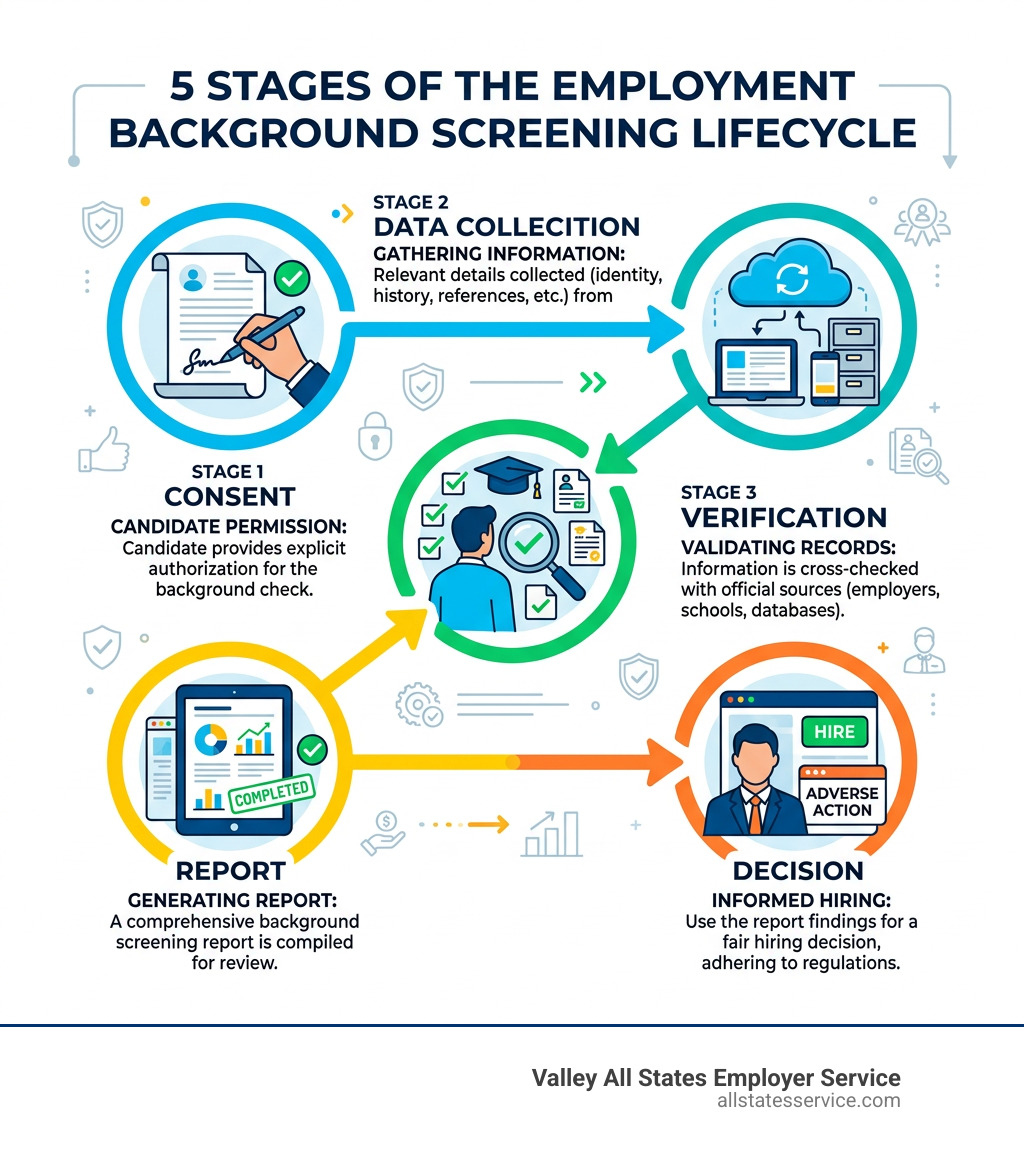
Here is how the typical employment background screening workflow looks:
- Candidate Consent: This is the most critical step. Under federal law, you must get clear, written permission from the candidate before you start.
- Data Collection: The candidate provides their full name, Social Security number, date of birth, and address history.
- Search Initiation: The screening provider combs through various sources, including county courts, federal databases, and educational institutions.
- Verification: Real people often call previous employers or schools to verify that the dates and titles provided are accurate.
- Quality Review: The data is compiled into a readable report for the employer to review.
For a deeper dive into the mechanics, you can read about cracking the code on how pre-employment background checks really work. If you need a more foundational overview, our pre-employment background checks guide is a great place to start.
Technology and Integration in Screening
In the old days, background checks involved a lot of faxing and waiting. Today, technology has transformed the industry. Modern platforms now offer over 70 ATS (Applicant Tracking System) integrations, allowing HR managers to initiate a check with a single click directly from their hiring software.
We are also seeing the rise of AI-powered tools. For example, some services use AI to perform social media searches, scanning public profiles on platforms like Facebook, Instagram, and YouTube for behaviors that might not align with a company’s mission. These searches are FCRA compliant and can provide a fuller picture of a candidate’s public persona. This “one-click” approach makes the experience seamless for both the recruiter and the applicant.
Key Components of a Comprehensive Background Report
A standard employment background screening report is like a mosaic; it is made up of many different pieces of information that, when put together, show the whole picture. Most reports include:
- Criminal Records: Searches at the county, state, and federal levels to find convictions, misdemeanors, or pending cases.
- Education History: Confirming degrees earned and dates of attendance.
- Employment Verification: Validating job titles, tenure, and sometimes the reason for leaving.
- Drug Testing: Screening for controlled substances via a network of thousands of lab locations.
- Identity Trace: Using the SSN to find previous addresses and names used.
You might be surprised to learn that credit checks are also common for roles involving financial responsibility. If you’ve ever wondered why, we have an article unlocking the mystery of why background verification includes your credit score.
When hiring for a global team, things get a bit more complex. Here is a quick comparison:
| Feature | Domestic (U.S.) Checks | International Checks |
|---|---|---|
| Turnaround Time | Usually 24 to 48 hours | 4 days to several weeks |
| Data Sources | County, State, Federal courts | Country-specific registries |
| Compliance | FCRA, EEOC, State laws | GDPR, local privacy mandates |
| Complexity | Standardized | Highly variable by region |
Specialized Screening for High-Risk Industries
Certain industries require more than just the basics. If you are in healthcare, for example, you must check sanctions lists to ensure a provider hasn’t been excluded from federal programs. In aviation, security is paramount, requiring deep dives into federal records.
Staffing agencies often need extreme agility, requiring reports that return in less than 24 hours so they can place workers quickly. Meanwhile, any role involving driving will require a thorough review of Motor Vehicle Records (MVR) to check for accidents or license suspensions. For many businesses, including Federal District Criminal History is a “best practice” because federal crimes often don’t show up in local county searches.
Navigating Compliance and Legal Requirements
Compliance is the “scary” part of employment background screening, but it doesn’t have to be. The two big names you need to know are the FCRA (Fair Credit Reporting Act) and the EEOC (Equal Employment Opportunity Commission).
The FCRA dictates how you must handle the data. For instance, you must provide a “standalone disclosure” to the applicant. This means the notice that you are running a background check cannot be buried in the middle of a 10-page job application. It has to be its own document.
The EEOC focuses on fairness. You cannot use background information to discriminate against candidates based on protected characteristics. This is why many states have “ban-the-box” laws, which prevent employers from asking about criminal history until after a conditional offer of employment has been made. For more on the federal perspective, check out the Background Checks | U.S. Equal Employment Opportunity Commission page.
Additionally, ensuring that your workforce is legally allowed to work in the U.S. is a non-negotiable part of compliance. You can find more info about e-verify background checks to see how that fits into your overall strategy.
Candidate Rights and Adverse Action
Candidates have significant rights during this process. They must give written permission before you start. If you decide not to hire someone based on what you found in the report, you must follow a strict “adverse action” process:
- Pre-Adverse Action: Send a notice to the candidate along with a copy of their report and a “Summary of Your Rights under the FCRA.”
- Wait Period: Give them a reasonable amount of time (usually 5 business days) to dispute any inaccuracies.
- Final Adverse Action: If they don’t dispute it, or the information is confirmed as accurate, you can then send the final notice of your decision.
Frequently Asked Questions about Screening
How long does an employment background screening take?
In the modern era, speed is the name of the game. Statistics show that 99% of U.S. criminal searches can be closed in just one day. Overall, more than 99% of full background check reports are returned in less than 48 hours. However, factors like unresponsive previous employers or court closures in specific counties can cause delays. For more details on what affects these timelines, check our guide on pre-employment background check time.
How far back does an employment background screening go?
The standard for most criminal searches is seven years, but this can vary. Under the FCRA, convictions can technically be reported indefinitely, though many employers choose to stick to a seven or ten-year window. Credit history usually goes back seven years (ten for bankruptcies), and most employment or education verifications cover the past five to ten years.
What are my rights as a candidate?
If you are a job seeker, you are well-protected. You have the right to know what is in your report and the right to dispute anything that is incorrect. You can even get a free additional report within 60 days if an employer takes adverse action against you. To learn more about your protections, visit Employer Background Checks and Your Rights | Consumer Advice.
Final Thoughts on Hiring with Confidence
Navigating employment background screening can feel like walking through a legal minefield, but it is an essential step in building a strong, safe team. By focusing on trust, utilizing modern technology, and staying strictly compliant with federal and state laws, you can hire with total confidence.
At Valley All States Employer Service, we specialize in making the complicated parts of hiring easy. We provide expert, impartial, and efficient E-Verify processing to ensure your workforce eligibility is always in tip-top shape. We take the administrative burden off your shoulders, minimizing errors and letting you focus on what you do best: growing your business.
Ready to simplify your hiring and ensure your team is compliant from day one? Read our employment verification services complete guide to see how we can help you streamline your process today.