
Identity document check 2025: Master Your Compliance
Why Identity Document Checks Matter More Than Ever
An identity document check is a critical safeguard in today’s digital world. Verifying that someone is who they claim to be protects your business from fraud, legal penalties, and security breaches, whether you’re hiring employees, onboarding remote workers, or complying with federal regulations.
Quick Answer: An identity document check verifies that:
- The document is genuine (not counterfeit or forged).
- The document is valid (government-issued and unexpired).
- The person presenting it is the rightful owner (via biometric or visual comparison).
This process is often legally required for employment (Form I-9), financial compliance (KYC/AML), and government services.
Identity theft is rising, fueled by remote work and digital risks like deepfakes. At the same time, regulations for employment eligibility and anti-money laundering demand rigorous identity checks.
For HR managers, this means balancing compliance with efficiency. You need to verify identities quickly without creating hiring bottlenecks, spot fraud without being a forensics expert, and protect applicant data.
Modern identity verification combines manual techniques with powerful digital tools. Understanding both helps you build a robust, compliant process that protects your organization and respects your applicants’ time.
The Fundamentals of Identity Verification
Identity verification is the process of establishing trust that an individual is who they claim to be. According to the National Institute of Standards and Technology (NIST), this process, called identity proofing, involves collecting and verifying information to confirm an individual is a real, unique person who rightfully owns the identity they present.
Core attributes gathered during this process include full name, date of birth, and current address, often along with a government identifier like a driver’s license or passport number.
What Makes an Identity Document Valid?
For an identity document check to be effective, the document must meet certain criteria to be considered valid.
A valid document must be government-issued, like a U.S. passport or state-issued driver’s license, ensuring it comes from an authoritative source. It must also not be expired, as an expired document generally loses its validity for verification.
Furthermore, a valid identity document must contain specific required elements, including:
- A clear photograph of the holder.
- The holder’s signature.
- Their full legal name.
- Their date of birth.
While physical documents are common, digital identity documents are emerging, though their acceptance and verification methods are still evolving. The core principles of official issuance and key data points remain consistent, as outlined in resources like this Proof of identity checklist.
Identity Verification vs. Identity Validation
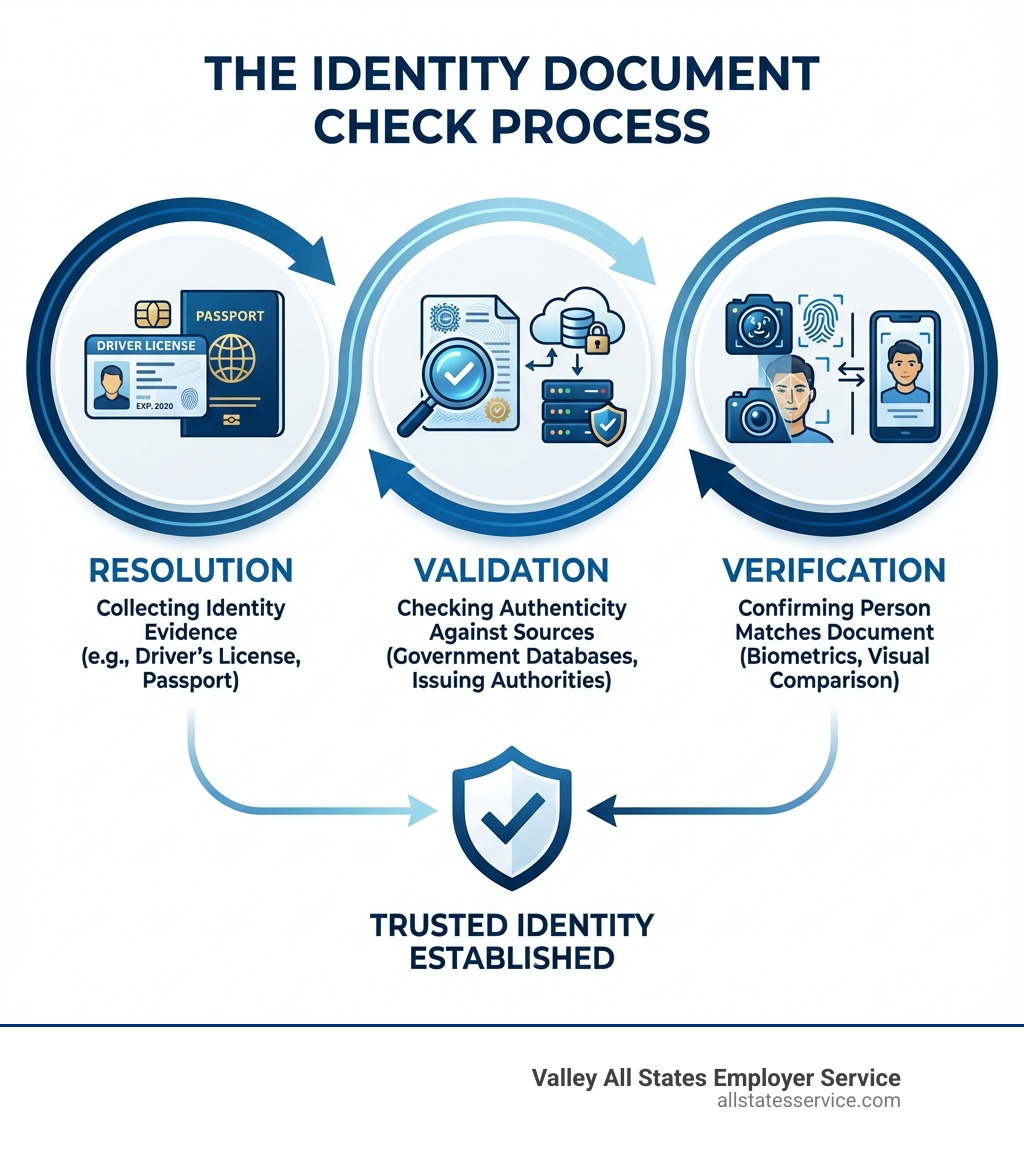
Though often used interchangeably, identity validation and verification are distinct steps. Understanding the difference is key to a secure system. The NIST framework breaks identity proofing into three steps:
- Resolution: Collecting evidence to establish the applicant is a real, unique individual.
- Validation: Confirming the authenticity and accuracy of the evidence itself. This step checks if a document is genuine and untampered.
- Verification: Linking the person to the evidence. This step confirms the applicant is the rightful owner of the document, often using biometrics.
Why does this distinction matter? Validation stops fake documents, while verification stops imposters using real documents. Performing each step rigorously strengthens the overall identity document check and makes it much harder for fraudsters to succeed. You can explore these concepts further in this overview of identity proofing from NIST.
Methods for an Identity Document Check
An identity document check can be performed using three main approaches: manual inspection, digital verification, and in-person verification.
- Manual inspection is the traditional method where a trained person physically examines a document. It is thorough but can be slow and prone to human error.
- Digital verification services use technology like AI and biometrics to quickly assess document authenticity and match the individual to their ID. This is ideal for remote scenarios.
- In-person verification is a hybrid approach where a person is physically present, but the check may use either manual or digital tools.
Digital services offer speed and scalability, while manual checks provide direct human oversight. Hybrid methods aim to balance both.
Manual Document Inspection
A manual identity document check requires scrutinizing a physical document for signs of fraud. This involves:
- Visual checks: Looking for inconsistencies in fonts, colors, and printing quality.
- Tactile checks: Feeling for distinct textures, like the raised print on a passport, or unusual thickness.
- Using basic tools: A magnifying glass can reveal microprinting, while a UV light can expose hidden security features or show if the paper is counterfeit.
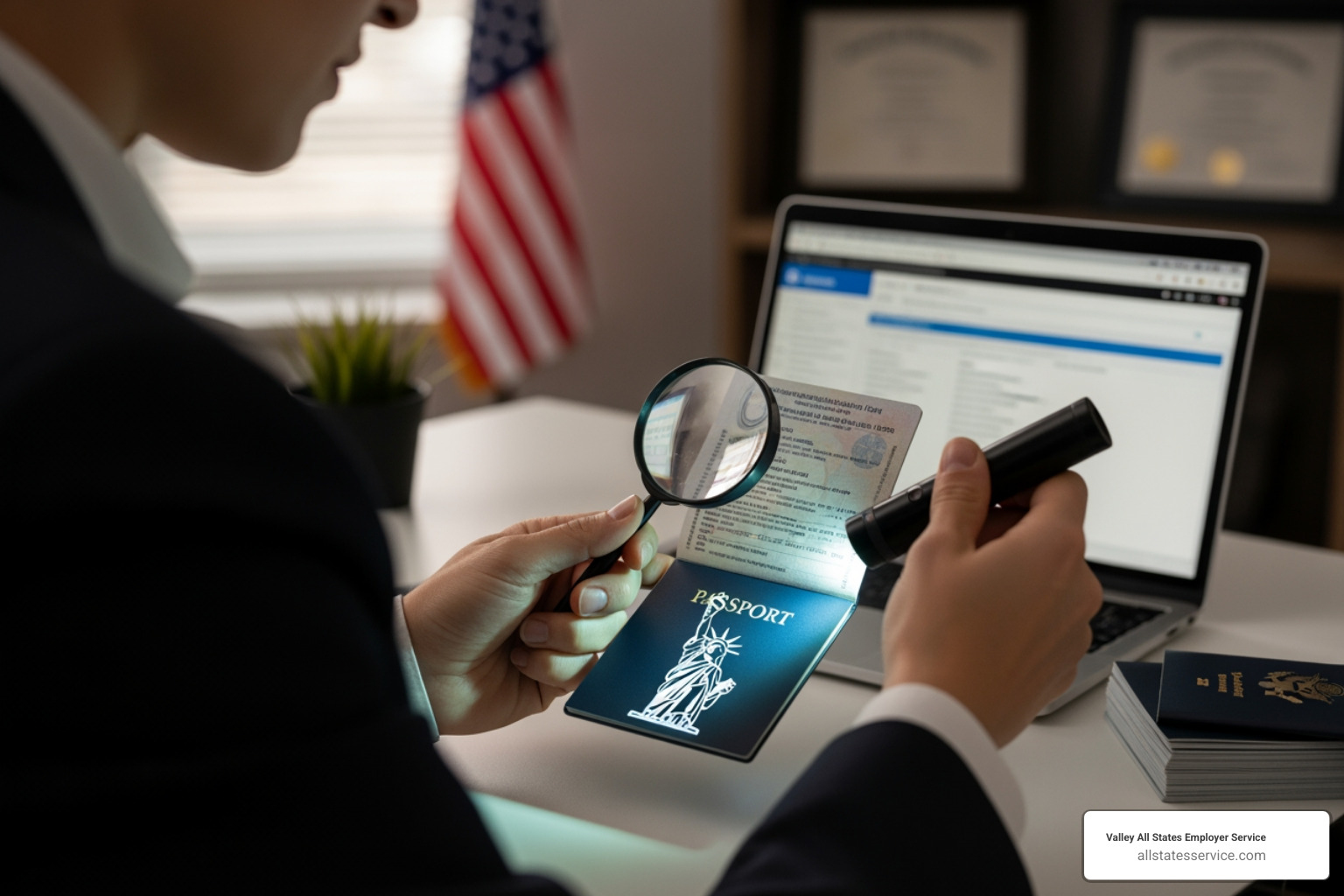
General Guidance on examining identity documents offers more detail on these hands-on techniques.
Key Security Features to Look For
Genuine identity documents have numerous security features designed to prevent fraud. Knowing what to look for is crucial for any identity document check.
- Watermarks: Translucent images embedded in the paper, visible when held to light.
- Holograms: 3D images that change color and shape when the document is tilted.
- Optically Variable Ink (OVI): Ink that changes color when viewed from different angles.
- Intaglio (raised) printing: Raised print that creates a distinct tactile feel.
- UV features: Elements like fibers or images that are only visible under ultraviolet light.
- Microprinting: Tiny text that is difficult to see without magnification.
- Machine-Readable Zone (MRZ): The coded information at the bottom of passports, which uses a specific, standardized font.
Resources like the PRADO genuine document database show examples of these features on legitimate documents.
Digital Identity Verification Services
Digital identity verification services offer an efficient alternative to manual checks, especially for remote onboarding. An individual typically submits an image of their ID and a live selfie. The service then uses:
- AI and machine learning to analyze the document for tampering and authenticity.
- Biometric verification, like facial recognition, to compare the selfie to the document photo, ensuring the person is the rightful owner. Learn more about Biometric Identification explained.
- Liveness detection to confirm the selfie is from a real, live person, preventing spoofs from photos or videos.
- NFC chip reading for ePassports and other chipped documents to securely extract encrypted data.
- Database checks to cross-reference identity data against authoritative sources.
Our Document Verification Service offers these advanced capabilities to streamline the process.
Spotting Fraud: Common Scams and How to Detect Them
Understanding common types of document fraud is key to an effective identity document check. We generally categorize document abuse into several types:
- Impersonation: A fraudster uses a genuine document belonging to someone else.
- Counterfeits: Completely fake documents manufactured from scratch.
- Forgeries: Genuine documents that have been unlawfully altered (e.g., a changed photo or date).
- Pseudo/fantasy documents: Unofficial documents with no legal basis or authority.
Counterfeit vs. Forged Documents
During an identity document check, it’s crucial to distinguish between counterfeit and forged documents.
Counterfeit documents are fakes made from scratch to mimic a genuine ID. They are intended to create a new, fake identity.
Forged documents start as genuine IDs that are then illegally altered. This could involve substituting a photo, changing personal details like a name or date of birth, or modifying an expiry date.
A counterfeit is a fake original, while a forgery is a genuine item that has been tampered with.
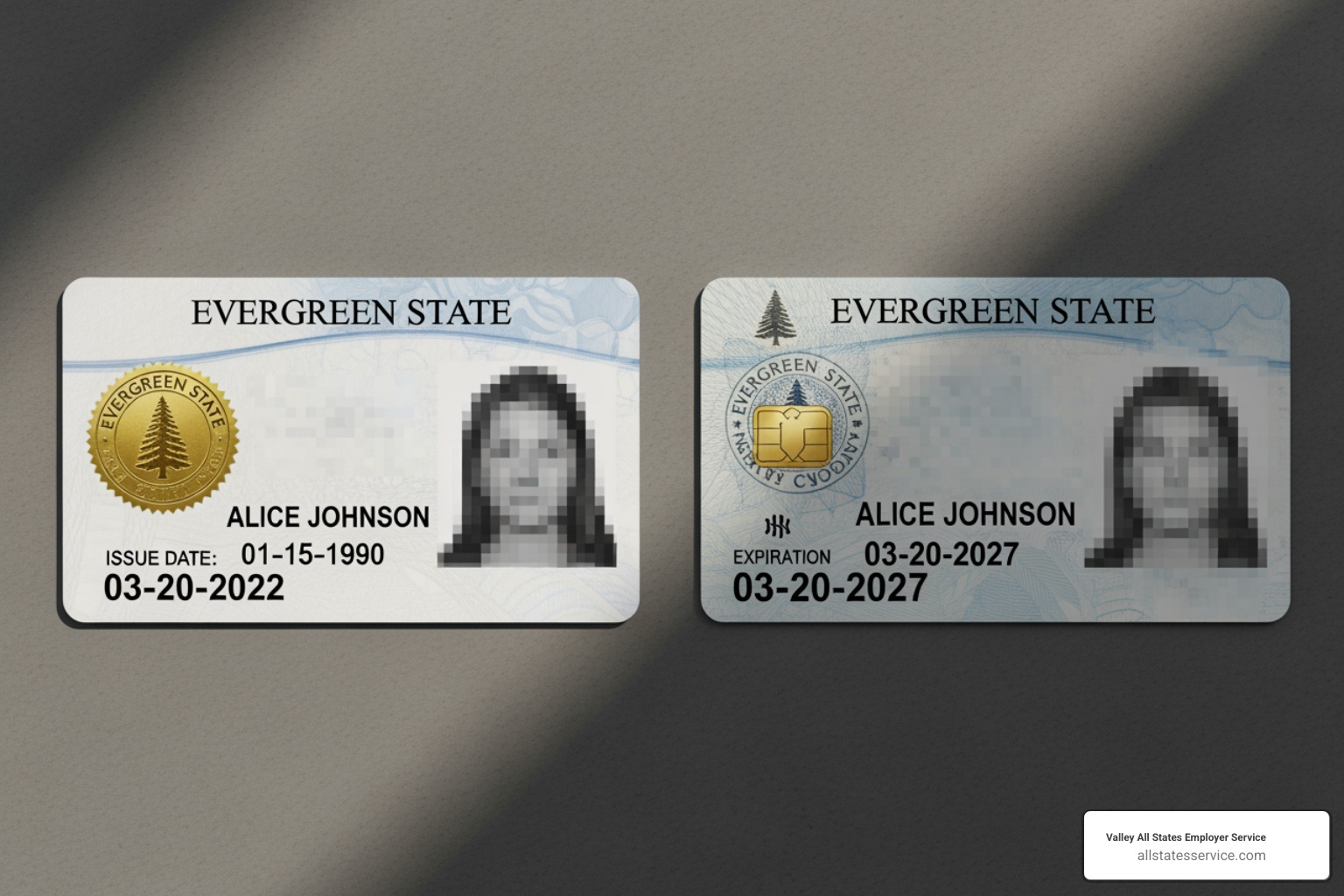
This distinction helps focus the inspection. For counterfeits, look for poor quality and missing security features. For forgeries, look for signs of alteration.
Detecting Alterations and Fakes
Detecting fakes requires a methodical approach, as a fraudster’s work often leaves tell-tale signs. Here are common indicators:
- Substituted photos: Look for uneven edges, glue residue, or laminate disturbances around the photo.
- Altered details: Examine dates and names for different fonts, color variations, or scrape marks on the paper.
- Inconsistent fonts: Genuine documents use specific, uniform fonts. Generic or varied fonts are a red flag.
- Poor print quality: Fakes often show pixelation or blurry lines, unlike the crisp printing on genuine documents.
- Incorrect UV reaction: A document glowing brightly under UV light when it shouldn’t, or missing UV features, indicates a fake.
An Identity Document Validation Technology guide can help improve detection capabilities.
The Rise of Digital Fraud
The digital age has introduced sophisticated new fraud threats, making the identity document check more complex. These include:
- Deepfakes: AI-generated synthetic videos or images where a person’s likeness is replaced with someone else’s. A fraudster could use this to impersonate a document holder during remote verification.
- Spoofing: Basic systems can be fooled by a photo or video of a person (2D spoofing). Robust 3D liveness checks analyze movement and depth to ensure the person is real and present.
- Synthetic identities: Fabricated identities created by combining real and fake data (e.g., a real Social Security number with a fake name). These are used to commit financial crime.
The escalating nature of these threats, highlighted by the latest identity theft statistics, requires robust digital solutions with advanced AI, biometrics, and liveness detection.
Legal Frameworks and Compliance Requirements
Navigating the legal landscape of an identity document check is critical. Various regulations, from global Anti-Money Laundering (AML) and Know Your Customer (KYC) rules to U.S. federal and state requirements, exist to prevent fraud and ensure security.
Industry-specific rules for financial services or healthcare add further layers of compliance, often specifying accepted documents and verification methods. Adhering to these frameworks is essential for building a trustworthy and secure operation.
Employer Obligations in the U.S: Form I-9 and E-Verify
U.S. employers must comply with federal requirements for an identity document check, centered on Form I-9, which verifies a new hire’s identity and employment eligibility. The Immigration Reform and Control Act (IRCA) mandates this for every employee.
Employers must physically examine documents from the lists of Acceptable I-9 Documents to ensure they reasonably appear genuine and relate to the employee. Employees present either one document from List A (proving identity and work authorization) or one from List B (identity) and one from List C (work authorization).
Many employers also use E-Verify, an internet-based USCIS system that compares Form I-9 information against DHS and SSA records to confirm work eligibility. Our E-Verify Program Complete Guide offers detailed insights into this system.
Remote I-9 verification rules have also evolved, with new permanent rules allowing for remote examination of documents under specific conditions, often involving authorized representatives or digital solutions.
At Valley All States Employer Service, we provide expert and efficient E-Verify processing to minimize errors and administrative burden. Our I-9 Compliance Solutions Guide 2025 can help ensure your hiring practices meet all legal standards.
Best Practices for an Organizational Identity Document Check
A robust identity document check process embeds security and compliance into your culture. Here are several best practices:
- Conduct a risk assessment: Tailor the rigor of your verification process to the risks associated with different roles or transactions.
- Create a clear policy: Document who is responsible for checks, what documents are acceptable, and how to handle discrepancies.
- Train your staff: Ensure team members can recognize fraudulent documents and use verification tools effectively.
- Use certified technology: Adhere to recognized standards for security and accuracy by using certified digital verification solutions.
- Establish data retention policies: Know what data to store, for how long, and how to secure it, consulting legal counsel for specific obligations like I-9 retention.
Our Outsourced Employee Verification Complete Guide explores how partnering with experts can help you implement these best practices efficiently.
Frequently Asked Questions about Identity Document Checks
Here are answers to some of the most frequent inquiries about identity document checks.
What are the most common documents used for an identity check?
The most commonly accepted documents for an identity document check are secure and officially issued. In the U.S., these include:
- U.S. Passports or Passport Cards
- State-Issued Driver’s Licenses or ID Cards
- Permanent Resident Cards (Green Cards)
- Employment Authorization Documents (EADs)
Our I-9 Section 2 Acceptable Documents Guide provides a comprehensive list for employment verification.
How long does a digital identity document check take?
A key advantage of digital services is speed. A digital identity document check often provides near-instant results, typically in seconds. This is thanks to AI-powered speed that automates analysis, biometric comparison, and database lookups.
However, the time can be affected by factors like poor image quality or the complexity of the check, which might require a manual review.
Can an expired document be used for an identity check?
Generally, no, an expired document is not valid for an identity document check. Most legal and financial processes require current, unexpired documents.
There can be rare exceptions. For example, government agencies have sometimes issued temporary guidance allowing recently expired documents for Form I-9 during national emergencies. However, these are not the standard rule. Always check the specific validity requirements for your situation to ensure compliance.
Conclusion: Securing Your Processes and Identity
An identity document check is a critical defense against fraud, a key to regulatory compliance, and essential for building trust. We’ve seen how manual and digital methods, from tactile checks to AI-powered biometrics, help combat threats like deepfakes and forgeries.
The challenge is to balance robust security with a smooth user experience. The future of identity will likely involve more streamlined digital solutions.
For individuals, protecting your documents is your first line of defense. For organizations, the key is implementing compliant and efficient practices.
Partnering with an expert like Valley All States Employer Service is invaluable. We provide the specialized knowledge and efficient solutions for complex employment compliance, letting you focus on your core business. We help you Streamline Your Onboarding Process and ensure your operations are secure.
Ready to ensure compliance and streamline your hiring? Explore our expert Document Verification Service.