
Human Resources BPO: Unlock Growth 2025
Introduction: Freeing Your Team to Focus on Growth
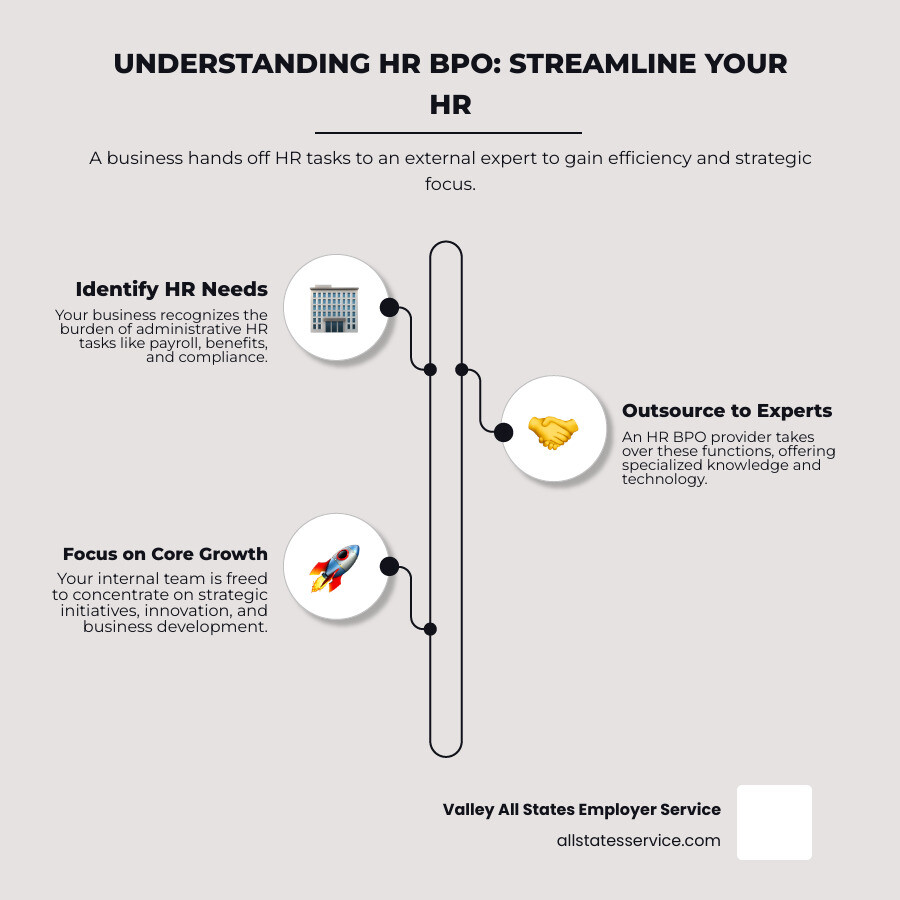
Human resources bpo (Business Process Outsourcing) is the practice of contracting external providers to handle specific HR functions like payroll, benefits administration, recruitment, and compliance management. This approach allows businesses to reduce costs, access specialized expertise, and free their internal teams to focus on strategic growth rather than administrative tasks.
What HR BPO Covers:
- Payroll and Tax Administration – Processing paychecks, managing withholdings, and ensuring tax compliance
- Benefits Administration – Managing health insurance, retirement plans, and employee enrollment
- Recruitment and Hiring – Sourcing candidates, screening applicants, and onboarding new employees
- Compliance Management – Navigating labor laws, maintaining records, and avoiding penalties
- Performance Management – Tracking employee reviews, development programs, and training initiatives
If you’re an HR manager drowning in paperwork while trying to hire great people, you’re not alone. 83% of HR leaders report being expected to do more now than ever, and 36% say finding talent is their biggest headache. Meanwhile, recruiting alone takes an average of 44 days to complete.
The reality is simple: your HR team can’t do everything, and they shouldn’t have to. HR BPO gives you a practical way out. By handing off time-consuming functions to specialists, you reduce overhead, minimize compliance risks, and let your team focus on what really matters: building a culture where great people want to work. The worldwide HR outsourcing market is projected to reach almost $46 billion by 2027, and for good reason. Businesses that use a Professional Employer Organization (PEO) see an average annual ROI of more than 27%.
This guide will walk you through everything you need to know about HR BPO: what it covers, how it saves time and money, the potential risks, and how to choose the right partner for your business.
Quick human resources bpo definitions:
- employee benefits outsourcing companies
- employee outsourcing companies
- outsourced compliance solutions
The Core of Human Resources BPO: Functions and Key Benefits
Imagine a world where your HR team isn’t buried under paperwork but is instead actively shaping your company’s future. This is the promise of human resources bpo. It’s a strategy designed to boost operational efficiency, deliver significant cost savings, provide access to specialized expertise, and offer scalability that traditional in-house HR often can’t match.
The market for HR outsourcing is booming, with projections showing it might reach almost $46 billion by 2027. This growth isn’t surprising when you consider the pressures businesses face today. With the right HR BPO partner, you can transform your HR department from a cost center into a strategic asset.

What is human resources bpo and what does it cover?
At its core, human resources bpo is about strategically delegating your HR tasks to an external provider. This allows you to leverage the focused expertise of a BPO provider for complex and time-consuming workforce administration. This is a segment of what’s often referred to as back-office outsourcing, focusing on internal business functions rather than direct customer interactions.
The scope is broad and flexible, allowing you to outsource anything from basic administrative tasks to more complex strategic functions. Commonly outsourced HR tasks include:
- Payroll and Tax Administration: Processing paychecks, managing withholdings, filing payroll taxes, and ensuring compliance with federal and state tax regulations.
- Benefits Administration: Managing health insurance, retirement plans, COBRA, FMLA, and other employee benefits, including enrollments, claims, and inquiries.
- Recruitment and Talent Acquisition: Managing job postings, candidate sourcing, screening, and interviewing to streamline your hiring process.
- Onboarding: Ensuring new hires complete all necessary paperwork, receive proper training, and feel welcomed and integrated.
- Performance Management: Implementing performance improvement plans and managing employee development programs to build a high-performing workforce.
- HRIS Management: Handling your Human Resources Information Systems, ensuring data accuracy, security, and leveraging technology for better HR operations.
- Compliance Management: Navigating the ever-changing landscape of labor laws and regulations to reduce your risk of fines and lawsuits.
For a deeper dive into the overall concept, you can explore our guide on Human Resources Outsourcing.
How does outsourcing boost efficiency and savings?
One of the most compelling reasons businesses turn to human resources bpo is the promise of improved efficiency and substantial cost savings. It significantly reduces overhead costs associated with an in-house HR department, such as salaries, benefits, and office space. By outsourcing, you pay only for the services you need, which is particularly beneficial for small to medium-sized businesses.
Furthermore, it frees your internal staff from tedious and time-consuming administrative tasks. When functions like payroll and benefits paperwork are outsourced, your team can redirect their energy toward core business operations, leading to higher productivity and a focus on revenue-generating activities. For example, outsourcing payroll to a specialist ensures accuracy and compliance, often at a lower cost than managing it internally. If you’re looking to optimize these processes, our Affordable Payroll Services can provide a solution.
What are the strategic advantages for your business?
Beyond cutting costs, human resources bpo offers significant strategic advantages that can directly impact your business’s growth.
- Access to Specialized Skills: BPO providers bring deep knowledge of best practices, current regulations, and cutting-edge HR technologies that your in-house team might not possess.
- Improved Employee Experience: When HR functions are handled by specialists, employees benefit from smoother processes, faster responses, and more accurate administration of payroll and benefits. This improved support can lead to higher employee satisfaction and trust.
- Better Talent Attraction: Finding talent is a major challenge for many businesses. HR BPO providers specializing in recruitment can leverage broader networks and advanced tools to attract and secure top talent more effectively, often reducing the time it takes to fill a position.
- Data-Driven Decision Making: Modern HR BPO solutions often include sophisticated analytics and reporting. This allows you to gain valuable insights into your workforce data, helping you make more informed strategic decisions about talent management and resource allocation.
Navigating the Risks: Compliance, Data Security, and Mitigation
While the benefits of human resources bpo are clear, it’s important to understand the potential risks, primarily concerning data privacy, compliance, and employee relations. Concerns like a loss of direct control or cultural misalignment are valid, but they can be managed with careful partner selection and clear communication.
How can HR BPO ensure legal and regulatory compliance?
Navigating the labyrinth of federal, state, and local labor laws is one of the most complex aspects of HR management. Non-compliance can lead to severe fines, costly lawsuits, and damage to your company’s reputation. This is where the specialized expertise of an HR BPO provider becomes invaluable.
HR BPO partners are experts in compliance, staying current on ever-changing employment laws. Managing legal and compliance in HR can be complicated, but a good provider ensures your policies and procedures meet all legal requirements, significantly mitigating your risk.
At Valley All States Employer Service, we understand these challenges, especially with tasks like E-Verify. We provide outsourced E-Verify workforce eligibility verification for employers, offering expert, impartial, and efficient processing. This minimizes errors and administrative burden, ensuring your business adheres to federal employment eligibility requirements. Our focus is on helping you Reduce HR Compliance Risk by Outsourcing. For more details, see our guide on Outsourcing HR Compliance.
How do you protect sensitive employee data?
Data privacy is paramount when handling employee information. Human resources bpo involves sharing sensitive data, so robust protection is crucial. Employers are required by law to keep personal information safe, and doing so builds trust with your employees.
When you partner with a BPO, a third party handles your employees’ sensitive information, from social security numbers to health data. Therefore, you must ensure your chosen provider adheres to the highest standards of data security.
Key considerations for protecting sensitive data include:
- Robust Security Protocols: Does the provider use advanced encryption, firewalls, and intrusion detection systems?
- Confidentiality Agreements: Ensure your contract includes strict confidentiality clauses.
- Regular Audits and Certifications: Look for providers with third-party security audits and relevant certifications (e.g., ISO 27001, SOC 2).
- Employee Training: The provider’s staff should be thoroughly trained in data privacy best practices.
- Data Breach Response Plan: Understand their protocol in the event of a data breach.
It’s critical to vet your provider to ensure they follow strict security protocols. For more information on securing employee data, our Outsourced Employment Verification Ultimate Guide offers valuable insights.
Choosing Your Partner: Models, Costs, and Selection Criteria
Deciding to outsource your HR functions is a big step, and finding the right partner is crucial for success. 57% of business executives outsource HR functions, highlighting the widespread adoption of this strategy. However, the benefits only materialize when you choose a provider that aligns with your specific needs and goals. This section will guide you through the different models, cost structures, and essential criteria for selecting your ideal human resources bpo partner.
What are the different HR BPO models?
Not all human resources bpo is created equal. There are several models, each offering a different level of partnership and responsibility. Understanding these distinctions is key to choosing the right fit for your business.
| HR BPO Model | Description | Your Role as Employer – PEO (Professional Employer Organization) | The BPO acts as a co-employer, taking on virtually all HR liabilities, including compliance, payroll, and benefits. They often provide better benefits due to economies of scale. | You share employer responsibilities with the PEO, while retaining control over day-to-day management and core business decisions. |
- ASO (Administrative Services Organization) | The BPO manages specific HR administrative tasks like payroll and benefits administration. The client remains the sole employer of record and retains all liabilities. | You retain full employer responsibility. The ASO provides administrative support, reducing your workload without taking on legal liabilities. |
- Managed Services | This flexible model allows you to pick and choose specific HR functions to outsource, ideal for companies with some in-house HR capabilities. | You retain full employer responsibility and control. The BPO acts as a service provider for specific, agreed-upon tasks. |
For a broader understanding of how various companies manage their workforce externally, you can explore our resources on Employee Outsourcing Companies.
What are the typical costs and pricing structures?
The cost of human resources bpo services isn’t one-size-fits-all. Fees vary based on the number of employees and the services you need. It’s always wise to get quotes for comparable offerings from multiple providers.
Common pricing models include:
- Per-Employee-Per-Month (PEPM): A fixed fee for each employee every month, making budgets predictable.
- Percentage of Payroll: A percentage of your total payroll, which can be attractive if your payroll varies.
- Retainer Fees: A flat monthly or project-based fee for more strategic or project-based work.
- Project-Based Pricing: A set fee for a one-off project, like developing an employee handbook.
- Custom Pricing: A customized structure for complex needs or very large organizations.
When considering costs, evaluate the Return on Investment (ROI). For example, the average annual ROI for using a PEO is more than 27%. This comes from reduced administrative burden, improved compliance, and time saved. Our Payroll Outsourcing Solutions can help illustrate potential savings.
How to choose the right human resources bpo provider
Selecting the right human resources bpo provider is a critical decision. It’s about finding a strategic partner, not just the cheapest option. Here’s how to approach the selection process:
- Conduct a Needs Assessment: Clearly define what HR functions you want to outsource and why. What are your pain points and goals?
- Request for Proposal (RFP): Create a detailed RFP outlining your needs and expectations so you can compare proposals effectively.
- Evaluate Expertise and Experience: Look for providers with a proven track record, industry experience, and deep knowledge of HR best practices and compliance.
- Check Credentials and Reviews: Ask for references from current clients and check for professional certifications or accreditations.
- Assess Scalability: Choose a provider that can scale their services to accommodate your changing requirements.
- Technology Integration: Evaluate the provider’s HRIS, cloud platforms, and integration capabilities with your existing software.
- Customer Support and Communication: A good BPO partner will offer strong customer support and be readily available to address your questions.
Choosing a provider that can grow with your business is important. For a more comprehensive guide, refer to our HR Outsourcing Solutions Ultimate Guide.
The Future of HR: Technology, AI, and Automation
The landscape of human resources is rapidly evolving, with technology at the forefront of this change. Human resources bpo providers are leading the charge, integrating cutting-edge tools to deliver more efficient, insightful, and employee-centric services. The future of HR BPO promises greater automation, AI-driven insights, and a stronger focus on strategic HR initiatives.
What role does technology play in modern HR BPO?
Technology is the backbone of modern human resources bpo, enabling providers to deliver services more efficiently, accurately, and at a lower cost.
- HRIS Management: Human Resources Information Systems (HRIS) are central to managing employee data, payroll, and benefits. BPO providers leverage advanced, often cloud-based, platforms to streamline these functions.
- Cloud-Based Platforms: The cloud allows for greater flexibility and remote access to HR services. This means your employees can access self-service portals for benefits or payroll information anytime. Our Web-Based Payroll Service is a prime example of how cloud technology simplifies HR tasks.
- Data Analytics for HR: BPO providers use analytics tools to extract insights from your HR data. This can help identify turnover trends, predict talent needs, and inform strategic business decisions.
- Seamless Software Integration: A key aspect of effective HR BPO is the ability to integrate with your existing business systems, such as accounting or time-tracking tools, which minimizes manual data entry and reduces errors.
BPO providers continuously invest in the latest HR technology, offering you access to tools that might be too expensive to implement and maintain in-house.
What is the future outlook for HR BPO?
The future of human resources bpo is dynamic, driven by technology and a growing demand for strategic HR.
- Increased Automation: Routine HR tasks like data entry and scheduling will become more automated through Robotic Process Automation (RPA), freeing up HR professionals for more complex roles.
- AI-Driven Insights: Artificial Intelligence (AI) and Machine Learning (ML) are revolutionizing HR BPO. AI can analyze data to predict employee turnover, personalize training, and assist with performance reviews, enabling smarter and more efficient HR operations.
- Focus on Strategic HR: With administrative burdens lifted, internal HR teams can shift their focus to strategic initiatives like organizational development, culture building, and talent strategy.
- Predictive Analytics: The ability to predict future HR challenges will become more sophisticated. BPO providers will leverage AI and big data to offer predictive analytics for everything from staffing needs to employee well-being.
- Global BPO Market Growth: The overall BPO market is expanding rapidly. The global business process outsourcing market was valued at $280.64 billion in 2023 and is projected to grow significantly, fueling further innovation in HR BPO.
The future will see HR BPO becoming an even more indispensable partner for businesses seeking to optimize their human capital and maintain a competitive edge.
Frequently Asked Questions about HR BPO
We understand you might have more questions as you consider human resources bpo for your business. Let’s address some common inquiries to help you make an informed decision.
When is the right time for a business to consider outsourcing HR?
Several signs indicate it might be the right time to outsource HR functions:
- Rapid Growth: If your company is growing quickly, your HR needs can outpace your internal team’s capacity. Outsourcing allows you to scale up HR support without the expense of hiring more in-house staff.
- Compliance Concerns: If you’re struggling to keep up with changing labor laws, outsourcing to experts can provide peace of mind. Our HR Compliance for Small Business guide offers more on this.
- Overwhelmed Internal Team: If your HR staff is drowning in administrative tasks, they have little time for strategic initiatives. Outsourcing can free them to focus on higher-value work.
- Desire to Focus on Core Operations: Many businesses realize that HR administration is essential but not their core competency. Outsourcing allows leadership to focus on what they do best.
- Lack of Specialized Expertise: If you need expertise in a specific area, like complex benefits administration or multi-state payroll, a BPO provider can fill this gap instantly.
If you’re feeling the strain of HR administration or facing compliance challenges, it’s a good time to explore human resources bpo.
How does HR BPO impact company culture?
This is a crucial question, as employee morale and company culture are vital. While some worry about a disconnect when using a third party, outsourcing can actually improve the employee experience. When HR tasks like payroll and benefits are handled with greater accuracy and efficiency by specialists, employees benefit from fewer errors and faster resolutions. This can lead to increased trust and satisfaction, ultimately bolstering a positive culture.
The key is to choose a provider that values employee experience and to maintain open communication throughout the transition and partnership.
Can I outsource only specific HR functions?
Absolutely! One of the greatest strengths of human resources bpo is its flexibility. You don’t have to outsource your entire HR department.
- Selective Outsourcing: Many businesses choose to outsource specific, high-volume, or highly specialized functions. For instance, you might start by outsourcing just payroll and tax administration or complex benefits administration. Our Employee Benefits Outsourcing Companies can provide targeted support in this area.
- A La Carte Services: This “pick and choose” approach allows you to retain control over strategic HR functions internally while offloading administrative burdens.
- Managed Services Model: This model is designed for businesses that want to select certain HR functions for external management, providing targeted expertise without a full co-employment relationship.
Whether you need comprehensive support or just a helping hand with particular tasks, human resources bpo can be customized to fit your exact requirements.
Take the Next Step Toward HR Efficiency
We’ve explored the diverse world of human resources bpo, from its core functions and strategic advantages to navigating potential risks and choosing the right partner. The message is clear: outsourcing HR isn’t just about cutting costs; it’s about building a more efficient, compliant, and strategically focused business. It’s a powerful tool that allows your internal teams to thrive, unburdened by administrative complexities, and empowers your business to achieve its growth objectives.
By partnering with an expert HR BPO provider, you gain access to specialized knowledge, advanced technology, and scalable solutions that can adapt as your business evolves. You ensure compliance with intricate federal and state regulations, protect sensitive employee data, and ultimately improve the overall employee experience.
Ready to streamline your HR and compliance tasks? Explore our solutions to see how we can help. At Valley All States Employer Service, we’re here to provide the expert, impartial, and efficient support you need, allowing you to focus on what you do best. Don’t let HR administration hold your business back; let us help you open up true efficiency. Learn more about our Outsourced HR Services and how we can become your trusted partner.