
Federal Employment Compliance: 2025 No-Nonsense Guide
Why Federal Employment Compliance Matters More Than You Think
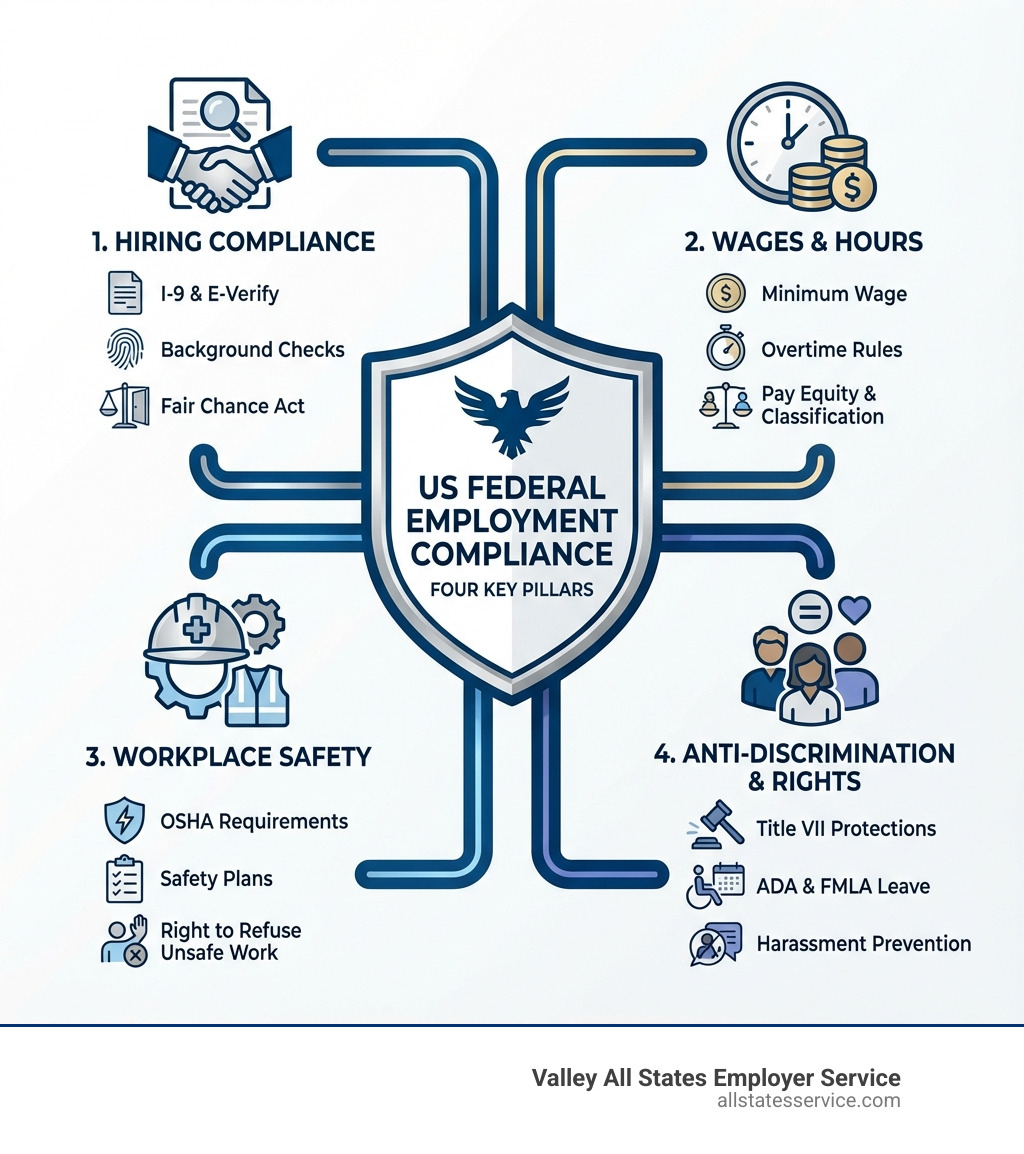
Federal employment compliance is the set of laws and regulations that govern how U.S. employers must treat their workers, from the moment they’re hired until they leave the company. These rules cover everything from verifying work eligibility and paying fair wages to maintaining safe workplaces and preventing discrimination.
Here’s what you need to know about federal employment compliance:
- Who must comply: Private employers, federal contractors, and government agencies
- Key areas covered: Hiring practices, wages and hours, workplace safety, anti-discrimination protections, and employee leave rights
- Governing agencies: EEOC (discrimination), Department of Labor (wages/safety), OSHA (workplace safety), USCIS (work authorization)
- Consequences of non-compliance: Substantial fines, legal penalties, public naming, and reputational damage
Navigating the maze of employment law can feel like a full-time job. Between E-Verify deadlines, I-9 forms, OSHA requirements, and anti-discrimination rules, it’s easy to miss something critical.
Here’s the reality: federal employment compliance isn’t optional. Whether you’re a small business hiring your first employee or a mid-sized company managing hundreds of workers, these rules apply to you. And they’re not just bureaucratic red tape. They exist to protect workers from exploitation, ensure fair treatment, and create safer workplaces.
The stakes are high. Employers who fail to comply face penalties that can reach substantial amounts. Beyond the financial hit, non-compliance can damage your reputation, trigger costly lawsuits, and expose your company to government audits.
But here’s the good news: compliance doesn’t have to be complicated. When you understand the core requirements and build the right systems, you can protect your business while fostering a workplace that treats employees fairly and follows the law.
This guide breaks down everything you need to know about federal employment compliance in the United States. We’ll cover the major laws, explain who enforces them, and show you practical steps to stay compliant from hiring through termination. Unlike Canadian employment law, which divides authority between federal and provincial governments, U.S. federal law applies uniformly across all states for core employment standards, though some states add additional protections.
Handy federal employment compliance terms:
- employment verification process
- company background verification process
- professional reference checking company
The Core Laws: Who Must Comply and Why?
Understanding who must comply with federal employment compliance is the first step toward building a legally sound workplace. In the United States, federal jurisdiction extends broadly. It covers virtually all private employers, regardless of size, for certain foundational laws like those prohibiting discrimination. However, specific laws, such as the Family and Medical Leave Act (FMLA), apply only to employers with a certain number of employees.
Federal contractors and the federal government itself face an even more stringent set of rules, including additional requirements for E-Verify and affirmative action. The Department of Labor (DOL) is a primary enforcer of many of these laws. You can find a Summary of the Major Laws of the Department of Labor on their website.
Key governing bodies ensure these laws are upheld:
- The Equal Employment Opportunity Commission (EEOC): Dedicated to preventing and remedying unlawful employment discrimination.
- The Department of Labor (DOL): Oversees a vast array of labor laws, including wage and hour rules, workplace safety, and unemployment insurance.
- The Occupational Safety and Health Administration (OSHA): A division of the DOL, responsible for ensuring safe and healthful working conditions.
- U.S. Citizenship and Immigration Services (USCIS): Manages lawful immigration to the United States, including the E-Verify program for employment eligibility.
Unlike some countries, where employment laws can vary significantly by province or state, the core federal employment compliance framework in the U.S. provides a baseline of protection that applies nationwide. While states like Maryland may have their own additional protections, federal laws serve as the universal floor for employee rights. For comprehensive support, consider our Human Resources Compliance services.
Understanding Your Obligations Under Major Federal Acts
Let’s explore some of the cornerstones of federal employment compliance that shape your obligations as an employer.
- Fair Labor Standards Act (FLSA): This act establishes minimum wage, overtime pay, record-keeping, and child labor standards affecting full-time and part-time workers in the private sector and in federal, state, and local governments. It dictates who is eligible for overtime (non-exempt employees) and who is not (exempt employees).
- Title VII of the Civil Rights Act of 1964: This landmark law prohibits employment discrimination based on race, color, religion, sex (including pregnancy, childbirth, and related medical conditions, transgender status, and sexual orientation), and national origin. The EEOC is charged with enforcing these federal laws.
- Americans with Disabilities Act (ADA): The ADA prohibits discrimination against individuals with disabilities in all areas of public life, including employment. It requires employers to provide reasonable accommodations to qualified individuals with disabilities unless doing so would cause undue hardship.
- Age Discrimination in Employment Act (ADEA): This act protects individuals who are 40 years of age or older from employment discrimination based on age.
- Occupational Safety and Health Act (OSH Act): Employers have a general duty under this Act to provide a workplace free from recognized hazards that are causing or are likely to cause death or serious physical harm to employees. OSHA enforces these standards.
- Family and Medical Leave Act (FMLA): This act entitles eligible employees of covered employers to take up to 12 workweeks of unpaid, job-protected leave for specified family and medical reasons with continuation of group health insurance coverage under the same terms and conditions as if the employee had not taken leave.
Special Considerations for Federal Contractors
If your business holds contracts with the federal government, your federal employment compliance obligations go a step further. The Federal Acquisition Regulation (FAR) often includes clauses that mandate specific employment practices.
For instance, federal contractors are frequently required to use E-Verify to confirm the employment eligibility of their new hires. Beyond this, the Office of Federal Contract Compliance Programs (OFCCP) enforces specific affirmative action requirements. These requirements aim to ensure that federal contractors and subcontractors take affirmative steps to ensure equal employment opportunity in their employment practices. The OFCCP monitors compliance, ensuring that contractors do not discriminate and instead take proactive measures to recruit and advance qualified minorities, women, individuals with disabilities, and protected veterans. To learn more about specific requirements, especially for verifying employment eligibility, explore our guide on E-Verify for Federal Contractors.
Getting It Right from Day One: Hiring and Onboarding Compliance
The journey of federal employment compliance begins even before an employee’s first day. A compliant hiring and onboarding process is crucial to setting a strong foundation for your organization. This includes everything from how you conduct background checks to the information you provide to new hires.

When it comes to background checks, federal regulations, such as those under the Fair Credit Reporting Act (FCRA), dictate how you can obtain and use consumer reports for employment purposes. Beyond that, the Fair Chance Act, implemented through final regulations by the U.S. Office of Personnel Management (OPM), prohibits federal agencies and contractors from requesting an applicant’s criminal history information until a conditional offer of employment has been made. This “Ban the Box” rule aims to ensure that individuals with criminal records get a fair chance to compete for federal jobs, with qualifications being the primary criteria. While this specifically applies to federal hiring, many private employers adopt similar “ban the box” practices to promote fairness.
While there isn’t a single federal requirement for a written “employment statement” in the same way some other countries have, it’s best practice to provide new hires with an offer letter or employment contract that clearly outlines terms, conditions, wages, and benefits. This transparency can prevent misunderstandings down the line.
Additionally, maintaining accurate and complete employee records is a fundamental aspect of federal employment compliance. These records are essential for demonstrating compliance with various laws, responding to audits, and managing employee benefits and payroll.
The Essentials of Employment Eligibility Verification
One of the most critical steps in the hiring process for any U.S. employer is verifying an individual’s legal right to work in the United States. This is primarily achieved through the Form I-9 process. Every employer must complete and retain a Form I-9 for each employee hired after November 6, 1986. This form documents the employee’s identity and employment authorization.
The process involves:
- Employee Section 1: Completed by the employee, attesting to their employment authorization.
- Employer Section 2: Completed by the employer, where we physically examine documents from the U.S. Citizenship and Immigration Services (USCIS) list of acceptable documents that establish both identity and employment authorization.
- Reverification: If an employee’s employment authorization expires, we must reverify their eligibility.
It’s crucial to understand the nuances of this process to avoid errors and penalties. Our I-9 Compliance Guide 2025 offers detailed insights. When examining documents, we must be careful not to discriminate against individuals based on their national origin or citizenship status. We cannot request specific documents, but rather accept any document from the I-9 Acceptable Documents Ultimate Guide that reasonably appears to be genuine and relates to the person presenting it.
Navigating the E-Verify System
Beyond the Form I-9, many employers, particularly federal contractors, use the E-Verify system. But What is E-Verify?? E-Verify is a federal electronic system, administered by USCIS in partnership with the Social Security Administration (SSA), that compares information from an employee’s Form I-9 to government records to confirm employment eligibility. It’s a powerful tool, but it also comes with its own set of rules and responsibilities.
While E-Verify is voluntary for most employers, it is mandatory for certain federal contractors and for employers in some states. For example, some states may mandate E-Verify for public employers or those receiving state contracts. Employers in Maryland should always check local and state regulations in addition to federal mandates.
One of the key challenges with E-Verify is handling Tentative Nonconfirmations (TNCs). A TNC means the information provided by the employee does not match government records. When this happens, we have specific procedures to follow:
- We must notify the employee of the TNC and provide them with the opportunity to contest it.
- If an employee receives a TNC, and we previously issued a Referral Date Confirmation, we must reissue that notice with updated instructions or deadlines, especially after system outages. This ensures the employee has the full time allowed to resolve the mismatch.
Staying on top of E-Verify updates is vital. For instance, USCIS announced that starting January 6, 2025, they will permanently delete E-Verify cases updated before December 31, 2014. This means employers must proactively download Historic Records Reports and retain them with corresponding Forms I-9 for audit preparedness.
Understanding your E-Verify Employer Responsibilities is critical to avoid compliance pitfalls.
Managing Your Workforce: A Guide to Federal Employment Compliance
Once your employees are on board, federal employment compliance shifts to the day-to-day management of your workforce. This includes adhering to wage and hour laws, providing required leaves, and ensuring a safe and respectful workplace. A proactive approach here is key to avoiding costly legal issues. To help stay organized, consider utilizing an Employer Compliance Checklist.
Wages, Hours, and Pay Equity
The Fair Labor Standards Act (FLSA) is your primary guide for federal employment compliance regarding wages and hours.
- Federal Minimum Wage: Currently, the federal minimum wage is $7.25 per hour. Many states and localities have higher minimum wages, and employers must pay the higher rate that applies.
- Overtime Pay Rules: The FLSA generally requires that non-exempt employees receive overtime pay at a rate of one and one-half times their regular rate of pay for all hours worked over 40 in a workweek.
- Employee Classification (Exempt vs. Non-Exempt): Correctly classifying employees as exempt or non-exempt from overtime pay is critical. Misclassification can lead to significant back-pay liability. Exemptions usually depend on an employee’s salary level and job duties.
- Pay Equity vs. Equal Pay: In the U.S., the Equal Pay Act (EPA), part of the FLSA, prohibits sex-based wage discrimination. It requires that men and women in the same workplace be given equal pay for equal work, meaning jobs requiring equal skill, effort, and responsibility, performed under similar working conditions. This differs from “pay equity” laws in some countries, which may require proactive adjustments to address systemic undervaluation of jobs predominantly held by women. We focus on ensuring equal pay for equal work under the EPA.
- Proactive Pay Audits: Conducting regular pay audits is a best practice to ensure compliance with the EPA and identify any potential disparities that could lead to discrimination claims.
Here’s a quick comparison of key provisions:
| Feature | U.S. Equal Pay Act (EPA) | Canadian Pay Equity Act (Conceptual Difference) |
|---|---|---|
| Focus | Equal pay for equal work, regardless of sex. | Proactive elimination of systemic wage gaps between male- and female-dominated jobs of equal value. |
| Mechanism | Prohibits wage discrimination based on sex. | Requires employers to develop and implement pay equity plans to identify and correct gender-based wage disparities. |
| Initiation | Complaint-driven (employee files a claim). | Proactive obligation on employers, often with committees and regular reviews. |
| Scope | Applies to all employers covered by FLSA. | Applies to federally regulated employers in Canada. |
Leaves of Absence and Employee Rights
Providing appropriate leaves of absence is another vital area of federal employment compliance.
- FMLA Eligibility and Requirements: The Family and Medical Leave Act (FMLA) allows eligible employees to take up to 12 workweeks of unpaid, job-protected leave in a 12-month period for specific family and medical reasons. Eligibility typically requires an employee to have worked for a covered employer for at least 12 months, for at least 1,250 hours over the previous 12 months, and at a location where the employer has 50 or more employees within 75 miles.
- Military Leave (USERRA): The Uniformed Services Employment and Reemployment Rights Act (USERRA) protects individuals who serve in the uniformed services from discrimination in employment and ensures their right to reemployment following a period of service.
- Paid Sick Leave Mandates: While there is no universal federal law mandating paid sick leave for all private sector employees, many states and localities, including some in Maryland, have passed their own laws requiring employers to provide paid sick leave. Employers must comply with these state or local requirements where they apply.
- Reasonable Accommodations for Pregnancy: The Pregnancy Discrimination Act (PDA) prohibits discrimination based on pregnancy, childbirth, or related medical conditions. Additionally, under the ADA, employers must provide reasonable accommodations for employees with disabilities related to pregnancy, just as they would for other temporary disabilities.
Understanding the processes for addressing complaints related to these rights is also critical. For insights into how federal employees steer such issues, refer to the Overview Of Federal Sector EEO Complaint Process.
Workplace Safety and Harassment Prevention
Ensuring a safe and harassment-free workplace is not just good business practice, it’s a core component of federal employment compliance. OSHA leads the charge on safety, while the EEOC focuses on harassment prevention.
- OSHA Requirements: Under the Occupational Safety and Health Act, employers have a fundamental responsibility to provide a workplace free from recognized hazards. This is known as the General Duty Clause. OSHA sets and enforces standards that employers must follow, covering everything from chemical exposure to machine guarding.
- Workplace Safety Plans: Developing and implementing comprehensive workplace safety plans is essential. These plans should identify potential hazards, outline preventive measures, and establish clear procedures for responding to incidents.
- Employee Right to Refuse Unsafe Work: Employees have the right to refuse to perform a task if they have a reasonable belief that it presents an imminent danger of death or serious physical harm, and there is insufficient time to eliminate the danger through normal enforcement procedures.
- Harassment and Violence Prevention Policies: Under Title VII and other anti-discrimination laws, employers must take reasonable steps to prevent and promptly correct workplace harassment based on protected characteristics. This includes sexual harassment, racial harassment, and other forms of unlawful harassment.
- Anti-Retaliation Provisions: Federal laws strongly prohibit retaliation against employees who exercise their rights, such as reporting safety concerns, filing discrimination complaints, or participating in investigations.
Here are essential elements for a robust workplace harassment prevention policy:
- A clear, unambiguous statement that harassment will not be tolerated.
- A definition of harassment that aligns with federal anti-discrimination laws.
- Examples of prohibited conduct.
- A clear reporting procedure that includes multiple avenues for reporting.
- A commitment to prompt, thorough, and impartial investigations.
- A statement that corrective action will be taken when harassment is found.
- A strong anti-retaliation statement.
- Information on training for employees and managers.
Navigating Separations, Complaints, and Penalties
The end of an employment relationship, whether through termination or layoff, requires careful attention to federal employment compliance. This stage can be fraught with legal risks if not handled correctly. In the U.S., most employment is “at-will,” meaning either the employer or employee can terminate the relationship at any time, for any reason, or no reason, as long as it’s not an illegal one.
However, there are crucial exceptions to the at-will doctrine:
- Public Policy Exceptions: An employer cannot terminate an employee for reasons that violate public policy, such as refusing to commit an illegal act, reporting illegal activity (whistleblowing), or exercising a legal right.
- Implied Contract Exceptions: An employer’s handbooks, policies, or even verbal assurances can sometimes create an implied contract, limiting the at-will nature of employment.
- Covenant of Good Faith and Fair Dealing: While less common in at-will employment, some states recognize an implied covenant of good faith and fair dealing, meaning employers cannot fire employees for reasons that violate basic fairness.
When these exceptions are violated, it can lead to claims of wrongful termination. The concept of “unjust dismissal” with specific reinstatement remedies, as seen in Canadian federal law, does not directly apply to the U.S. private sector. Instead, U.S. claims typically focus on violations of anti-discrimination laws, contract breaches, or public policy.
Handling Terminations and Layoffs Correctly
Properly managing terminations and layoffs is a critical aspect of federal employment compliance.
- Final Pay Requirements: Federal law does not dictate when final wages must be paid, but many states, including Maryland, have specific deadlines for providing final paychecks to terminated employees. It’s crucial to follow the state laws where your employees work.
- Group Termination Rules (WARN Act): The Worker Adjustment and Retraining Notification (WARN) Act is a federal law that requires most employers with 100 or more employees to provide 60 calendar-day advance notice of plant closings and mass layoffs. This notice must be given to affected workers, state dislocated worker units, and the chief elected official of the local government.
- Severance Pay Considerations: Federally, there is no requirement to provide severance pay. However, it is often offered in exchange for a release of claims, particularly during layoffs, to mitigate legal risk.
- Documenting Termination Decisions: Thorough documentation is your best defense. Clear, consistent records detailing the reasons for termination, performance issues, and disciplinary actions are essential.
Failure to comply with I-9 regulations can also lead to significant penalties, as detailed in our guide on I-9 Compliance Penalties.
Responding to Discrimination Complaints
Even with the best intentions, employers may face discrimination complaints. How we respond to these complaints is a key part of federal employment compliance.
- The Role of the EEOC: The Equal Employment Opportunity Commission (EEOC) is the primary federal agency responsible for investigating and mediating charges of employment discrimination. They enforce Title VII, the ADA, the ADEA, and other federal anti-discrimination laws.
- The Complaint and Investigation Process: When an individual believes they have been discriminated against, they can file a charge with the EEOC. The EEOC will investigate the claim, which may involve interviewing witnesses, gathering documents, and attempting to mediate a resolution. For federal employees and applicants, there’s a specific internal Overview of Federal Sector EEO Complaint Process that begins with contacting an EEO Counselor within their agency.
- Mediation and Resolution: The EEOC often offers mediation as a voluntary alternative dispute resolution (ADR) option to resolve charges without litigation.
- Duty to Accommodate: Under the ADA, employers have a duty to provide reasonable accommodations to qualified individuals with disabilities. This also extends to religious accommodations under Title VII. When an employee requests an accommodation, we must engage in an “interactive process” to determine if a reasonable accommodation can be provided without undue hardship.
It’s crucial for employers to understand the rights and processes available to Federal Employees & Job Applicants to ensure fair treatment across the board.
The High Cost of Non-Compliance
Ignoring federal employment compliance is a gamble with incredibly high stakes. The consequences of non-compliance extend far beyond a slap on the wrist.
- Potential Fines and Penalties: Federal agencies, like the DOL and EEOC, have the authority to levy substantial fines and Administrative Monetary Penalties (AMPs) for violations. These can range from thousands to hundreds of thousands of dollars, depending on the severity and frequency of the violation. For instance, penalties for I-9 violations can quickly escalate.
- Public Naming of Violators: Some agencies may publicly disclose the names of employers found to be in violation, leading to significant reputational damage.
- Legal Fees and Settlements: Even if a lawsuit is settled out of court, the legal fees alone can be exorbitant. If a case goes to trial and the employer loses, they could be on the hook for back pay, front pay, compensatory damages, punitive damages, and the plaintiff’s attorney fees.
- Damage to Company Reputation: In today’s interconnected world, news of non-compliance can spread rapidly. This can harm your brand, make it difficult to attract top talent, and erode customer trust.
The financial and reputational costs of non-compliance are far greater than the investment in proactive compliance measures. That’s why many businesses choose to Reduce HR Compliance Risk by Outsourcing their compliance needs to experts.
Conclusion
Navigating the complexities of federal employment compliance is an ongoing journey, not a one-time destination. As we’ve explored, it touches every aspect of the employment lifecycle, from the crucial steps in hiring and verifying eligibility, through ensuring fair wages, hours, and a safe workplace, to managing separations and addressing complaints.
Compliance is about more than just avoiding penalties. It’s about building a strong, ethical foundation for your business, fostering a positive workplace culture, and protecting your most valuable assets: your employees and your reputation. The legal landscape is constantly evolving, making continuous vigilance and education essential.
That’s where expert assistance becomes invaluable. We understand that keeping up with every nuance of federal regulations can be overwhelming. That’s why Valley All States Employer Service specializes in providing outsourced E-Verify workforce eligibility verification for employers. Our unique selling point is expert, impartial, and efficient E-Verify processing, minimizing errors and administrative burden for our clients. We help you take proactive steps to protect your business and ensure your hiring practices are always compliant.
Ready to master your hiring compliance? Explore our ultimate guide to the employment verification process to learn how we can support your business.