
E-Verify vs I-9: Avoid Fines 2025 Guide
Why Understanding E-Verify vs I-9 Matters for Your Business
E-Verify vs I-9 is a common point of confusion for HR professionals, but understanding the distinction is critical for compliance and avoiding penalties. Here’s the quick answer:
| Form I-9 | E-Verify |
|---|---|
| Paper or electronic form that verifies identity and work authorization | Web-based system that electronically confirms I-9 information |
| Mandatory for all U.S. employers | Voluntary for most employers (mandatory for federal contractors and some states) |
| Does not require Social Security number | Requires Social Security number |
| Accepted documents don’t need photos | List B identity documents must have photos |
| Used for reverifying expired work authorization | Cannot be used for reverification |
| Must be completed within 3 days of hire | Created after I-9 is complete, by day 3 of hire |
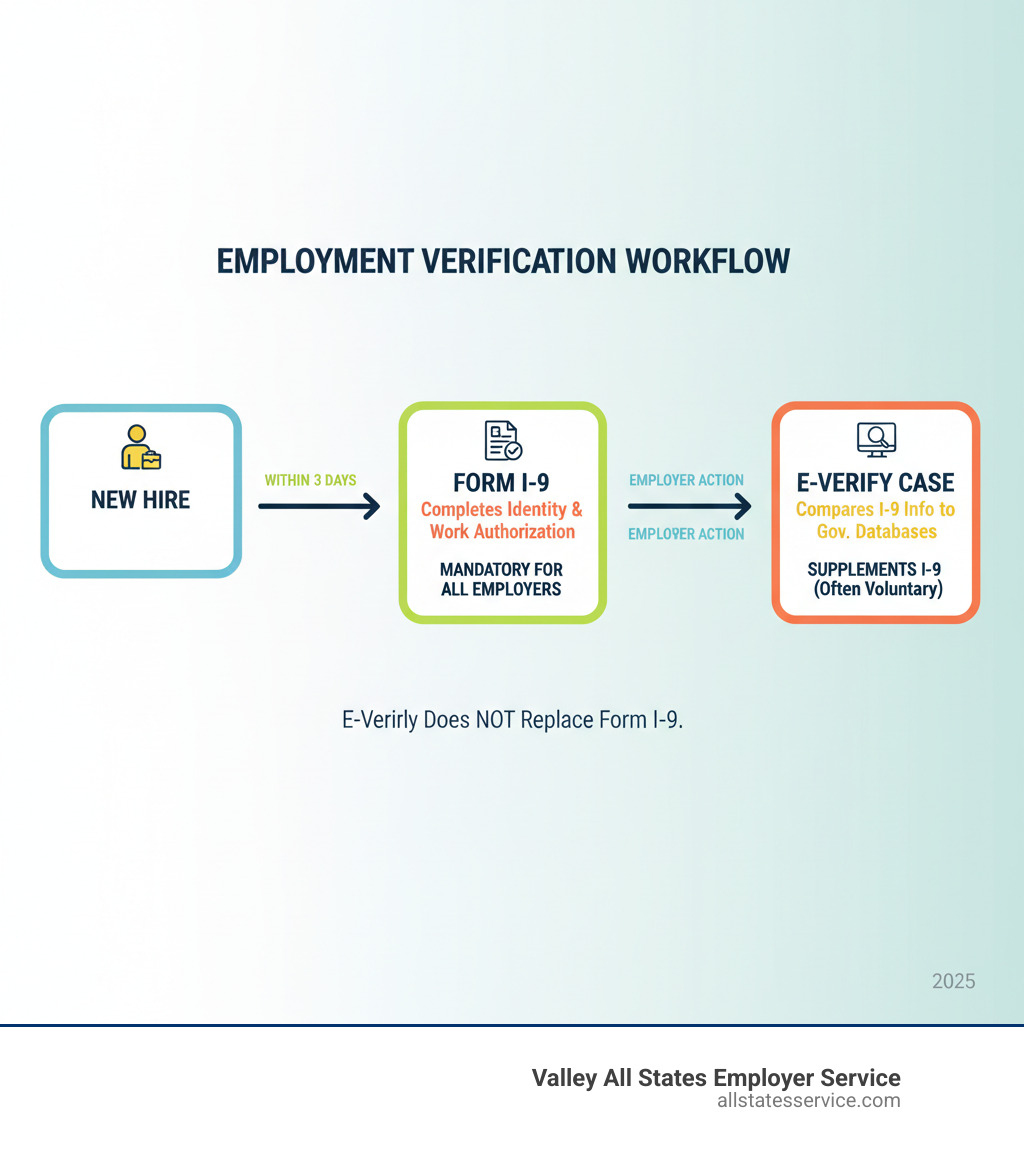
The bottom line: E-Verify does not replace Form I-9. It supplements it.
Many HR managers mistakenly believe E-Verify replaces Form I-9. This is incorrect. Every employer must complete Form I-9 for every new hire. E-Verify is an additional step that uses I-9 data to check government databases.
Mistakes can lead to ICE audits, significant fines, and legal trouble. The specific rules and strict timelines for both systems can be overwhelming.
This guide clarifies what each system does, how they work together, and what you need to know to stay compliant.
The Foundation: What is Form I-9?
To understand E-Verify vs I-9, you must first understand Form I-9, the foundation of U.S. employment verification.
Purpose of Form I-9
Form I-9’s purpose is to verify identity and confirm employment authorization. It is mandatory for every new hire at every U.S. company, regardless of the employee’s citizenship status.
This requirement stems from the Immigration Reform and Control Act of 1986 (IRCA), which prohibits knowingly hiring unauthorized workers and established a standardized, non-discriminatory verification process.
History: Immigration Reform and Control Act of 1986 (IRCA)
IRCA established Form I-9 as the standard tool for employment verification, and its core purpose remains unchanged today.
Process: Employee and Employer Responsibilities
The I-9 process has strict deadlines:
The employee completes Section 1 by their first day of work. They provide basic information and attest to their work authorization.
The employer completes Section 2 within three business days of the start date. This involves physically examining the employee’s documents, recording the information, and signing the form. Missing these deadlines can lead to audits and fines.
Documentation: Lists of Acceptable Documents
Employees choose documents from the official Lists of Acceptable Documents. List A documents establish both identity and work authorization (e.g., U.S. passport). List B documents establish identity (e.g., driver’s license), and List C documents establish work authorization (e.g., Social Security card).
The employee chooses which documents to present; employers cannot dictate their choice. This rule prevents discrimination.
Crucially for the E-Verify vs I-9 comparison, Form I-9 does not require a Social Security number or that documents have a photo. This flexibility is a key difference from E-Verify.
Want to dig deeper? Check our guides on What is I-9 Form? and I-9 Section 2 Acceptable Documents.
The Digital Check: What is E-Verify?
E-Verify is the digital partner to Form I-9. It takes the information from a completed I-9 and runs it through a government fact-checking process.
Purpose of E-Verify
E-Verify is a web-based system from the federal government that electronically confirms employment eligibility. It provides an extra layer of confidence by cross-referencing Form I-9 data with official government records in real time. While Form I-9 is a physical document review, E-Verify is a digital check.
How it Works
The process is simple. After completing Form I-9, you enter the data into the E-Verify system. The system compares this Form I-9 data against records from the Social Security Administration (SSA) and the Department of Homeland Security (DHS). You typically receive a result confirming work authorization within seconds.
Voluntary vs. Mandatory E-Verify
A key E-Verify vs I-9 distinction is its mandatory status. While Form I-9 is universal, E-Verify is:
- Voluntary for most private employers.
- Mandatory for federal contractors with the FAR E-Verify clause in their contracts.
- Mandatory in some states that have passed their own laws.
Always check your state and federal contract requirements. To dive deeper, check our guide on What is E-Verify?. If you’re wondering about requirements, see our resource on E-Verify Mandatory requirements.
The Core Differences: A Head-to-Head E-Verify vs I-9 Comparison
The most critical point in the E-Verify vs I-9 discussion is that E-Verify does NOT replace Form I-9. It is a companion tool. Form I-9 is the foundational document based on physical document review. E-Verify is the digital check that confirms the I-9 information against government databases. If you use E-Verify, you must still complete Form I-9.
To truly understand their relationship, let’s break down the key differences side by side:
| Feature | Form I-9 | E-Verify |
|---|---|---|
| Purpose | Verifies identity and employment authorization | Electronically confirms employment authorization based on I-9 data |
| Mandatory Status | Mandatory for all U.S. employers | Voluntary for most; Mandatory for federal contractors and some states |
| SSN Requirement | Not always required (optional field unless E-Verify is used) | Mandatory for case creation |
| Photo on List B ID | Not required | Required for List B identity documents |
| Reverification | Must be used for re-verifying expired employment authorization | Cannot be used for re-verifying expired employment authorization |
| Completion Timing | Employee Section 1 by Day 1; Employer Section 2 within 3 business days | Case created after I-9 is complete, by Day 3 of hire |
| Database Check | Manual document examination | Electronic comparison with DHS and SSA databases |
| Legal Basis | Immigration Reform and Control Act of 1986 (IRCA) | E-Verify Program (administered by USCIS) |
Key Documentation Differences: E-Verify vs I-9
The SSN requirement is a major difference. An SSN is optional for Form I-9 alone, but it is mandatory for creating an E-Verify case.
The photo requirement is another distinction. Form I-9 allows List B identity documents without a photo. However, E-Verify requires that any List B document presented must contain a photo, partly for its photo matching tool. These details are crucial for compliance. For a deeper look, visit our page on E-Verify and I-9.
Process and Timing: E-Verify vs I-9
Reverification highlights a key process difference. You must use Form I-9 (Section 3) to reverify an employee’s expiring work authorization. E-Verify cannot be used for reverification; it is only for new hires.
Timing requirements also differ. Form I-9 must be fully completed within three business days of the employee’s start date. The E-Verify case must be created after the I-9 is complete, but also within those same three business days. The sequence is crucial: I-9 first, then E-Verify.
The government emphasizes that E-Verify uses information from Form I-9, rather than replacing it. You can review this directly from the source at the official government clarification on E-Verify and Form I-9.
Staying Compliant: Timelines, Penalties, and Best Practices
Understanding the timelines, penalties, and best practices for Form I-9 and E-Verify is essential for compliance.

Hiring Timeline: Don’t Miss a Beat
- On Day 1, the new employee must complete Section 1 of Form I-9.
- By Day 3, the employer must complete Section 2 of Form I-9 by physically examining the employee’s documents.
- By Day 3, if you use E-Verify, you must also create the case, but only after the Form I-9 is complete.
Both deadlines are critical and missing them can lead to penalties.
Risks of Non-Compliance: The High Cost of Mistakes
The consequences of E-Verify vs I-9 errors are severe.
- Form I-9 paperwork fines for simple mistakes like missing signatures can range from hundreds to thousands of dollars per violation.
- ICE audits can uncover these errors, leading to substantial civil fines or even criminal prosecution for knowingly hiring unauthorized workers.
- E-Verify misuse creates discrimination risks. Pre-screening applicants or taking adverse action due to a Tentative Nonconfirmation (TNC) is illegal.
- A Tentative Nonconfirmation (TNC) means E-Verify needs more time; it does not mean the employee is unauthorized. You must notify the employee, allow them to contest it, and cannot take adverse action while the case is pending.
For a deeper dive into financial consequences, see our resource on I-9 Compliance Penalties. Our I-9 Audit Complete Guide can help you prepare for an audit.
Anti-Discrimination Rules: Fair Play is the Only Play
The Immigration and Nationality Act prohibits discrimination based on citizenship or national origin during verification. Key rules include:
- Treat all employees equally. Apply the same I-9 and E-Verify procedures to every new hire without exception.
- Never prescreen applicants. E-Verify can only be used after an employee has accepted a job offer.
- Allow employees to choose documents. You cannot dictate which documents an employee presents from the acceptable lists.
- Handle TNCs with care. Immediately notify the employee of a Tentative Nonconfirmation. You cannot take any adverse action while they contest the finding.
Recent Updates: Staying Ahead of the Curve
Staying current with evolving rules is critical.
- Alternative remote verification procedures for Form I-9 documents are now available for E-Verify enrolled employers, offering flexibility for remote hires. Our Remote I-9 Verification Complete Guide has details.
- The 2025 E-Verify record disposal policy requires action. USCIS is deleting E-Verify cases from before December 31, 2014. You must download and save Historic Records Reports for these cases before they are permanently removed.
- State-specific requirements also change frequently. You must monitor regulations in every state where you operate.
The complexity of these evolving rules is why many businesses outsource compliance.
Frequently Asked Questions about E-Verify and I-9
Here are answers to common questions about E-Verify vs I-9.
Does E-Verify replace the Form I-9?
No. E-Verify does not replace the legal requirement to complete and retain Form I-9. It is a supplemental tool. Every U.S. employer must complete a Form I-9 for every new hire. E-Verify is an additional step that uses the I-9 information to run an electronic check. For official guidance, see the Handbook for Employers (M-274).
Is E-Verify mandatory for my business?
It depends. While Form I-9 is mandatory for all employers, E-Verify is only mandatory in specific cases:
- If you hold federal contracts with the FAR E-Verify clause.
- If you operate in certain states that have passed laws requiring it.
For most private employers, E-Verify is voluntary. It’s crucial to check your federal contract and state-specific requirements. Consult our E-Verify State Requirements Guide 2025 for more.
Can I use E-Verify for existing employees?
Generally, no. E-Verify is designed for new hires only. You cannot use it for employees hired before you enrolled in the program. The primary exception is for federal contractors who may be required to verify existing employees assigned to a specific federal contract. Using it for other existing employees can lead to compliance and discrimination issues. Learn more at our resource on E-Verify for Existing Employees.
Simplify Your Compliance and Focus on Your Business
Keeping up with E-Verify vs I-9 requirements is a significant challenge. Tracking rule changes, meeting deadlines, and avoiding audit risks can feel like a full-time job, distracting you from your core business.
The Challenge: Keeping Up and Staying Ahead
The main challenges for businesses include:
- Keeping up with changing rules from federal and state agencies.
- The administrative burden on your HR team to process paperwork and manage records.
- The risk of costly errors that can lead to fines and audits.
These issues drain resources and shift focus away from growing your business.
The Solution: Outsourcing Compliance to Experts
Valley All States Employer Service specializes in outsourced E-Verify workforce eligibility verification. We take this complex burden off your shoulders, acting as your dedicated compliance partner so you can focus on your business.
Benefits: Peace of Mind and Efficiency
Partnering with us provides peace of mind and efficiency. We reduce your workload by handling the entire E-Verify process, freeing up your HR team. Our expertise ensures accuracy and consistency, minimizing errors. Most importantly, we help mitigate your audit risks by establishing a process of good faith compliance, giving you confidence that your documentation will withstand scrutiny.
Valley All States Employer Service: Your Trusted Partner
We pride ourselves on expert, impartial, and efficient E-Verify processing. We understand the nuances of federal requirements and stay current on state-specific regulations that might affect your operations. We act as an extension of your team, bringing specialized knowledge without the overhead of hiring additional in-house staff.
Don’t let employment verification complexity hold your business back. Let us streamline your processes, minimize your risks, and ensure unwavering compliance so you can focus on what you do best.
Ready to transform how you handle HR compliance? Explore our Outsourced HR Compliance Ultimate Guide to see how outsourcing can simplify your operations. For a comprehensive understanding of I-9 requirements, check out our Form I-9 Ultimate Guide.
Contact our team today and let’s discuss how we can support your business with expert E-Verify processing that gives you peace of mind and frees you to focus on growth.