
Your Gateway to a New Business Opportunity
How to become an E-Verify employer agent is a question many payroll providers, HR consultants, and business service companies are asking as they look to expand their offerings. The short answer: enroll through the official E-Verify website, select “E-Verify Employer Agent” as your access method, complete your company information, designate a Program Administrator and Signatory, and sign the Memorandum of Understanding (MOU). Once approved, you can begin enrolling client companies and verifying their employees’ work eligibility.
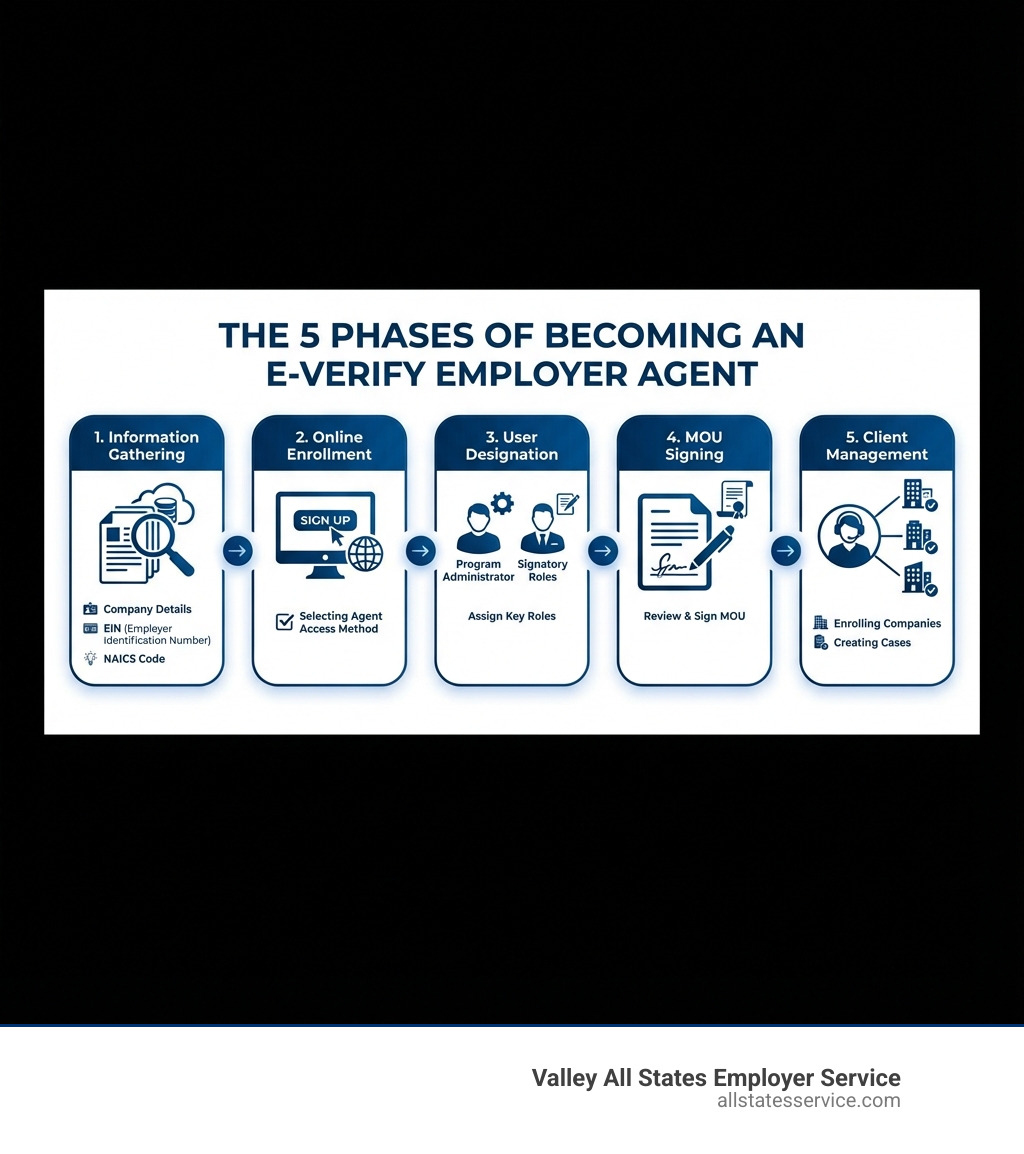
Quick Steps to Become an E-Verify Employer Agent:
- Prepare your information – Gather your company’s legal name, EIN, physical address, NAICS code, and contact details for your Program Administrator and MOU Signatory
- Visit the E-Verify enrollment portal – Go to the official USCIS E-Verify enrollment page
- Select “E-Verify Employer Agent” – Choose this access method (not “Employer” or “Corporate Administrator”)
- Complete the enrollment form – Enter all required company details in one session
- Sign the MOU – Review and electronically sign the legal agreement outlining your responsibilities
- Start enrolling clients – Once approved, you can add client companies and begin verification services
The E-Verify system represents a growing market opportunity for businesses that already provide HR services, payroll processing, or compliance support. As an employer agent, you act as a third-party verification provider for other companies, handling their employment eligibility checks through the government’s E-Verify database.
Why this matters now: Seventeen states have already made E-Verify mandatory for certain employers, and federal requirements continue to expand. This creates consistent demand for expert third-party providers who can steer the compliance complexities on behalf of busy business owners.
Becoming an E-Verify Employer Agent opens a new revenue stream while positioning your company as an expert in employment compliance. You can charge for your services (E-Verify itself is free, but the DHS doesn’t regulate agent fees), bundle verification with background checks or payroll integration, and become an essential partner for client businesses struggling with workforce verification requirements.
This guide walks you through the complete process, from understanding what an employer agent actually does to managing client relationships and staying compliant with federal regulations. Whether you’re a payroll company looking to expand services or an HR consultant seeking to add value, you’ll find the practical steps you need to get started.
Ready to explore this business opportunity? Let’s start by understanding exactly what an E-Verify Employer Agent does and why this role matters for both you and your potential clients.
Understanding the Role and Benefits of an E-Verify Employer Agent
What Exactly is an E-Verify Employer Agent?
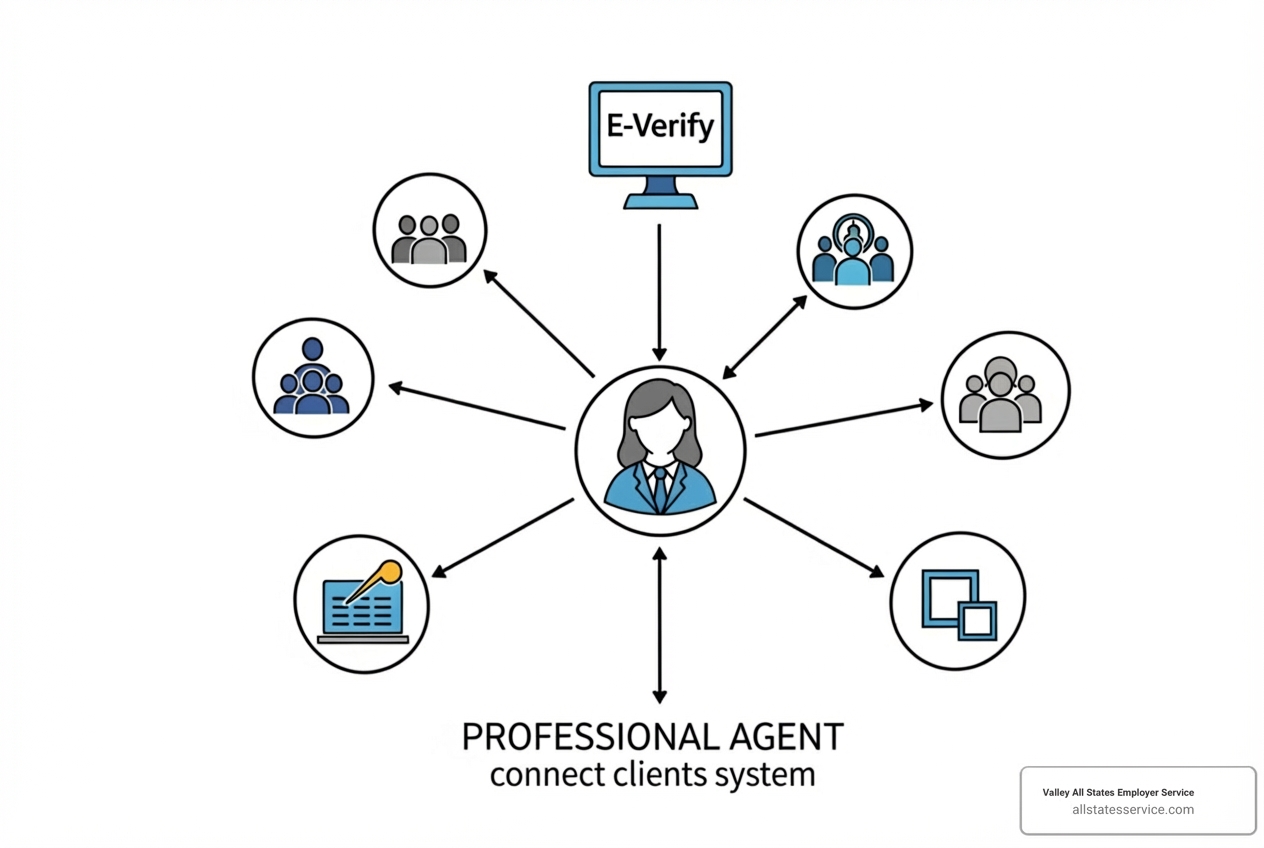
An E-Verify Employer Agent is a third-party provider authorized by the U.S. Citizenship and Immigration Services (USCIS) to use the E-Verify system on behalf of other employers. Essentially, we act as a bridge between client companies and the E-Verify database, performing the crucial task of workforce eligibility verification for their new hires. We use E-Verify to confirm the employment eligibility of employees for other businesses, taking on the administrative burden so our clients can focus on their core operations.
This role often extends beyond just E-Verify submissions. Many E-Verify Employer Agents, like us at Valley All States Employer Service, bundle this service with other essential HR functions. This can include comprehensive Outsourced HR Services, payroll integration, background checks, and even managing the entire Employment Eligibility Verification (Form I-9) process. We become an integral part of a company’s HR compliance strategy, ensuring they meet federal and state requirements.
An E-Verify Employer Agent is distinct from a direct E-Verify employer. A direct employer enrolls their own company and manages their own verifications. An agent, however, enrolls their clients under their own agent account and then conducts verifications for those clients. This distinction is key to understanding the specific enrollment process and ongoing responsibilities.
The Business Case: Why You Should Become an Agent
Becoming an E-Verify Employer Agent isn’t just about offering another service; it’s about tapping into a significant market demand and establishing your business as a trusted compliance partner. Here’s why this is a smart move for your company:
- New Revenue Stream: E-Verify itself is a free service provided by the Department of Homeland Security (DHS). However, as an authorized agent, you are permitted to charge fees for the valuable service of managing E-Verify compliance for your clients. The DHS does not regulate these fees, allowing you to price your services competitively based on the value you provide.
- Value-Add Service: Many businesses, especially small to medium-sized ones, find navigating E-Verify complex and time-consuming. By offering E-Verify services, you provide a critical solution that saves your clients time, reduces their administrative hassle, and helps them avoid costly penalties for non-compliance. This positions you as an indispensable partner.
- Growing Market Demand: Employment verification laws are constantly evolving. Certain states, including Maryland, have specific E-Verify requirements for employers, and federal mandates for contractors are strict. You can stay ahead of these legislative changes and proactively help clients steer the landscape. Our E-Verify State Requirements Guide 2025 provides more details on these evolving requirements.
- Expert Positioning: Offering specialized E-Verify services demonstrates your expertise in employment compliance and HR Compliance Consulting. You become the go-to resource for businesses seeking to ensure their workforce is legally authorized to work in the United States, enhancing your reputation and attracting new clients.
- Cost Savings for Clients: While clients pay for your services, they often save money in the long run by avoiding fines associated with non-compliance or inadvertently hiring ineligible workers. Your expertise helps them prevent these expensive mistakes.
Consider the landscape: employers who lack the necessary equipment or internet access, those without sufficient staff or time, or those already outsourcing their Form I-9 process are prime candidates for your services. You provide a streamlined solution that allows them to focus on growing their business, not on complex government regulations.
How to Become an E-Verify Employer Agent: The Enrollment Process

Starting on the journey to become an E-Verify employer agent requires careful preparation and adherence to the official enrollment steps. It’s a structured process designed to ensure that agents understand their responsibilities and can effectively manage client accounts.
Preparing for Enrollment: Your First Step on How to Become an E-Verify Employer Agent
Before you even touch a keyboard, gathering the necessary information is crucial. The E-Verify enrollment process must be completed in a single session, so having everything at hand will prevent interruptions and frustration. Here’s what you’ll need:
- Company Legal Name: This must be the official, registered name of your business.
- Employer Identification Number (EIN): Your federal tax ID number is essential for identification.
- Primary Physical Address and Mailing Address: Provide the physical location of your business and a separate mailing address if applicable.
- Hiring Sites: Even as an agent, you’ll need to indicate the physical addresses for any of your own company’s hiring sites that will use E-Verify, as well as the number of clients you anticipate enrolling.
- Total Number of Current Employees: This refers to the number of employees in your own company.
- North American Industry Classification System (NAICS) Code: This code identifies your company’s primary business activity. If you don’t know it, there’s usually a lookup tool available during enrollment.
- Contact Information for Your Program Administrator: This individual will manage your company’s E-Verify account and users.
- Contact Information for Your MOU Signatory: This person must have the authority to legally bind your company to the E-Verify Memorandum of Understanding. Often, this is an owner, president, or authorized officer.
A quick tip: while E-Verify can be accessed on mobile devices, completing the initial enrollment is best done on a desktop computer. This ensures a smoother experience with forms and document uploads. For a comprehensive list, refer to the official Enrollment Checklist.
A Step-by-Step Guide to Agent Enrollment
Once you have all your information ready, the actual enrollment process is straightforward:
- Go to the E-Verify Enrollment Page: Start by visiting the official E-Verify enrollment page. This is the gateway to setting up your account.
- Select “E-Verify Employer Agent” Access: When prompted to choose your account access method, select “E-Verify Employer Agent.” This is a critical step that distinguishes your account from a standard employer or corporate administrator account. The system offers four methods: Employer, E-Verify Employer Agent, Corporate Administrator, and Web Services.
- Enter Company Details: You’ll be guided through a series of screens where you’ll input all the preparatory information we discussed above, including your company’s legal name, EIN, addresses, NAICS code, and employee count. You must complete this section in one sitting.
- Designate User Roles: You will need to designate at least one Program Administrator and one Signatory for your own E-Verify Employer Agent account. The Program Administrator handles day-to-day operations and user management, while the Signatory is responsible for signing the E-Verify Memorandum of Understanding (MOU). These roles can be held by the same person.
- Review and Submit: Carefully review all the information you’ve entered for accuracy. Any errors could delay your enrollment. Once you’re confident, submit your enrollment application.
- Sign the Memorandum of Understanding (MOU): After submission, the designated Signatory will receive an email with instructions to electronically sign the E-Verify MOU. This is the legal agreement that outlines your responsibilities as an E-Verify Employer Agent. It’s essential to sign this promptly to complete your enrollment.
Upon successful completion and MOU signing, your company will be officially enrolled as an E-Verify Employer Agent, ready to start bringing on clients.
The E-Verify Memorandum of Understanding (MOU) for Agents
The E-Verify Memorandum of Understanding (MOU) is the cornerstone of your relationship with the E-Verify program. This legally binding agreement outlines the responsibilities of both your E-Verify Employer Agent business and the Department of Homeland Security (DHS) and Social Security Administration (SSA). For agents, there’s a specific version of this document: the E-Verify Memorandum of Understanding for Employer Agents (PDF).
This document is crucial because it details the rules you must follow, including:
- Your obligations regarding data security and privacy.
- The timeliness of creating E-Verify cases for clients’ new hires.
- Proper handling of case results, including Tentative Nonconfirmations (TNCs).
- Your commitment to upholding fair employment practices.
Signing the MOU signifies your understanding and agreement to adhere to these terms. It’s a fundamental part of demonstrating your commitment to HR Regulatory Compliance and operating responsibly within the E-Verify system. We recommend that your designated Signatory thoroughly review the MOU to ensure full comprehension of all requirements and responsibilities.
Managing Your Clients: Responsibilities and Best Practices
Once you’ve successfully enrolled as an E-Verify Employer Agent, your next critical step is to understand how to onboard and manage your client companies effectively. This involves a clear process for client enrollment and a deep understanding of your ongoing responsibilities.
The Client Enrollment Process: A How-To for Agents
As an E-Verify Employer Agent, you must enroll each of your client companies under your own E-Verify account before you can create E-Verify cases for their employees. This process mirrors your own agent enrollment in many ways, but it’s done from your agent dashboard:
- Log in to Your E-Verify Account: Access your E-Verify Employer Agent portal.
- Steer to the “Clients” Section: You’ll find a dedicated section for managing your client companies.
- Add a New Company: Select the option to add a new client. You’ll then be prompted to enter specific information about your client.
- Information Needed from Clients: To enroll a client, you’ll need:
- The client’s legal name, physical address, and mailing address.
- Their Employer Identification Number (federal tax ID).
- The total number of their employees.
- The first three digits of their NAICS code.
- The physical addresses for each of their hiring sites that will participate in E-Verify.
- Confirmation of whether the client is a federal contractor, airport operator, or government organization.
- Contact information for the client’s MOU signatory and a secondary contact if different.
- Client MOU Process: After you submit their information, E-Verify will send an email to your client’s designated MOU signatory. This email contains a link to electronically sign their client version of the E-Verify MOU. It’s crucial that they sign this within the specified timeframe (usually 24 hours) to finalize their enrollment. As the agent, you initiate this, but the client’s signatory must complete it.
- Provide Required Posters: Upon enrollment, you are responsible for providing your client with the E-Verify Participation and Right to Work posters, in both English and Spanish. These must be displayed in a prominent location visible to prospective and current employees, including digitally for remote settings. You should also provide new posters whenever DHS updates them.
This systematic approach ensures that your clients are properly registered and compliant. For detailed instructions, refer to the Client Enrollment Guide. We also have resources on the E-Verify Onboarding Process that can help streamline this for your clients.
Understanding Your Responsibilities: A Critical Part of How to Become an E-Verify Employer Agent
Being an E-Verify Employer Agent comes with significant responsibilities to both your clients and the E-Verify program itself. Adhering to these guidelines is paramount for maintaining compliance and trust.
- Form I-9 and E-Verify Integration: E-Verify does not replace the Form I-9. Your clients must still properly complete and retain a Form I-9 for each new hire. As an agent, you’ll obtain the necessary information to create an E-Verify case directly from the client’s completed Form I-9. Our resources on Form I-9 and E-Verify can help clarify this relationship.
- Case Creation Timeline: You must create an E-Verify case for each new hire no later than the third business day after the employee starts work for pay. This is a strict deadline that must be consistently met.
- Handling Tentative Nonconfirmations (TNCs): If an employee receives a TNC, it means their information didn’t immediately match government records. Your responsibility is to notify the client, who then must inform the employee. The employee has the right to contest the TNC, and you (via the client) must provide them with a written notice explaining the mismatch and how to resolve it. It is absolutely critical that neither you nor your client take any adverse action against an employee based solely on an initial TNC.
- Privacy and Security (PII Protection): You will be handling Personally Identifiable Information (PII) for your clients’ employees. Protecting this data is a top priority. This includes safeguarding all personal information collected, using it only for purposes outlined in the MOU, storing it securely, and restricting access to authorized users. All discussions regarding E-Verify results, especially TNCs, must be held privately with the employee. E-Verify records containing PII are disposed of annually if over 10 years old, minimizing security risks.
- Record-Keeping: Ensure that your clients maintain proper Form I-9 records. For E-Verify cases, you must either record the E-Verify case number on the employee’s Form I-9 or print the case details and keep it on file with the employee’s I-9.
Maintaining rigorous E-Verify Compliance is not just good practice; it’s a legal requirement that protects both your business and your clients.
Assisting Special Clients: Federal Contractors
Federal contractors represent a unique and often mandatory segment of the E-Verify market. If you have clients who are federal contractors, understanding their specific requirements is essential.
The Federal Acquisition Regulation (FAR) E-Verify clause mandates that certain federal contractors use E-Verify for all new hires and, in some cases, for existing employees assigned to a federal contract. This can include employees who were hired before the E-Verify mandate came into effect for that contractor.
Key compliance nuances for these clients include:
- Scope of Verification: Federal contractors may need to verify not just new hires, but also existing employees who are performing work under a covered federal contract. This is a significant difference from general E-Verify requirements.
- Subcontractor Requirements: The FAR clause often flows down to subcontractors, meaning your client’s subcontractors may also need to use E-Verify, and your client might be responsible for ensuring their compliance.
- Unique Entity Identifier (UEI): Federal contractors subject to the FAR E-Verify Clause will need their Unique Entity Identifier (UEI) during enrollment.
As an E-Verify Employer Agent, you can provide invaluable assistance to these clients by navigating these complex requirements. Our resources on Federal Contractor E-Verify and the official Supplemental Guide for Federal Contractors are excellent tools for understanding these specific obligations. By becoming proficient in these areas, you can become an indispensable partner for federal contractors in Maryland and across the United States.
Frequently Asked Questions about Being an E-Verify Agent
As you consider how to become an E-Verify employer agent, you likely have some common questions about the operational aspects of this role. Let’s address a few of them.
Can I charge my clients for E-Verify services?
Yes, absolutely! While E-Verify itself is a free service provided by the U.S. Department of Homeland Security, you, as an E-Verify Employer Agent, are providing a valuable service. You are charging for your expertise, time, and the administrative burden you take off your clients’ shoulders.
The DHS explicitly states that it does not certify E-Verify Employer Agents nor does it regulate the fees they charge. This gives your business the flexibility to determine a pricing structure that reflects the value you deliver, whether that’s a per-employee fee, a monthly retainer, or bundling E-Verify with other HR or payroll services. This value-added service is a key component of your business model.
How is an Employer Agent different from a Corporate Administrator?
This is a common point of confusion, but the distinction is clear and important for your enrollment. E-Verify offers different access methods: Employer, E-Verify Employer Agent, Corporate Administrator, and Web Services.
- An E-Verify Employer Agent uses E-Verify to confirm the employment eligibility of employees for other employers (your clients). You manage separate E-Verify accounts for each client company under your overarching agent account.
- A Corporate Administrator manages E-Verify for multiple hiring sites or business units within a single, large company. They are verifying employees for their own organization, not for external clients.
When you enroll, selecting “E-Verify Employer Agent” ensures you get the correct account type to serve multiple external businesses.
What happens if my client’s employee gets a Tentative Nonconfirmation (TNC)?
A Tentative Nonconfirmation (TNC) means that the employee’s information did not immediately match records with the Social Security Administration (SSA) or Department of Homeland Security (DHS). This is a critical point where your guidance as an agent is vital.
Your responsibility involves:
- Notifying the Client: You must immediately inform your client about the TNC result.
- Client Notifies Employee: The client is then responsible for informing the employee about the TNC and providing them with a “Further Action Notice” that explains why they received the mismatch and the steps they can take to resolve it.
- Employee’s Right to Contest: The employee has the right to contest the TNC within eight federal government workdays. During this time, they should contact the SSA or DHS to resolve the discrepancy.
- No Adverse Action: Crucially, neither you nor your client can take any adverse action against the employee, such as terminating their employment, reducing their pay, or delaying training, solely based on an initial TNC. This is a strict E-Verify rule.
We have a detailed guide on E-Verify Tentative Nonconfirmation that further explains the process and best practices for handling these situations. Your role is to ensure your clients understand these rules and follow them diligently to protect employee rights and maintain compliance.
Simplify Compliance: The Smart Alternative to Becoming an Agent
We’ve explored the comprehensive journey of how to become an E-Verify employer agent, from understanding the role and its benefits to navigating the enrollment process and managing client responsibilities. Becoming an agent presents a fantastic opportunity to diversify your services and position your business as a leader in employment compliance.
However, we also recognize that for many businesses, the complexity of compliance, the administrative burden, and the ongoing need to stay updated with evolving regulations can be overwhelming. While becoming an agent offers significant advantages, it also demands dedicated resources, training, and a meticulous approach to data security and legal adherence.
For companies who prefer to focus on their core operations without taking on the intricate responsibilities of becoming an E-Verify Employer Agent themselves, outsourcing this function is a smart alternative. This is where Valley All States Employer Service steps in. We specialize in providing expert, impartial, and efficient E-Verify workforce eligibility verification. By partnering with us, businesses can minimize errors, reduce administrative burden, and ensure seamless compliance without having to steer the E-Verify system directly.
We handle the entire E-Verify process for you, allowing you to:
- Focus on Your Business: Reclaim valuable time and resources that would otherwise be spent on E-Verify management.
- Ensure Accuracy: Benefit from our specialized expertise, reducing the risk of errors and potential penalties.
- Stay Compliant: Rest assured that your employment verification processes adhere to the latest federal and state requirements.
Ready to streamline your hiring process and ensure robust compliance without the hassle of becoming an agent yourself? Explore our E-Verify Employer Agent services today and let us handle your employment eligibility verification with confidence.