
Why Employee Work Authorization Matters for Your Business
Employee work authorization is the legal permission that allows a person to work in a specific country. Without proper authorization, both the employee and employer face serious legal consequences, including fines, penalties, and potential criminal charges.
Quick Answer: Core Components of Work Authorization
- Identity verification – Confirming who the employee is through official documents
- Employment eligibility – Proving the person has legal permission to work
- Documentation – Form I-9 in the U.S., work permits in Canada
- Employer compliance – Verifying and retaining proper records
- Time limits – Many authorizations expire and require renewal
You are an employer recruiting for an open position. In assessing a foreign national applicant’s work authorization status, you learn that the individual holds an open work permit based on a particular set of “temporary measures.” What should you be aware of when hiring such individuals?
This scenario plays out thousands of times each year. More than 286,000 Ukrainian nationals have arrived in Canada under the CUAET program alone. In the U.S., Form I-9 has been the cornerstone of employment verification since November 6, 1986.
Work authorization isn’t just a one-time checkbox during hiring. It’s an ongoing responsibility that affects your entire employment relationship. Permits expire. Documents get lost. Immigration policies change. And the penalties for getting it wrong can be severe.
Whether you’re hiring a temporary foreign worker in Canada, verifying a student’s Optional Practical Training status in the U.S., or navigating special crisis-response programs, understanding work authorization protects both your business and your employees.
The good news? Once you understand the framework, verification becomes straightforward. This guide walks you through the essential requirements in both Canada and the United States, so you can hire confidently and stay compliant.
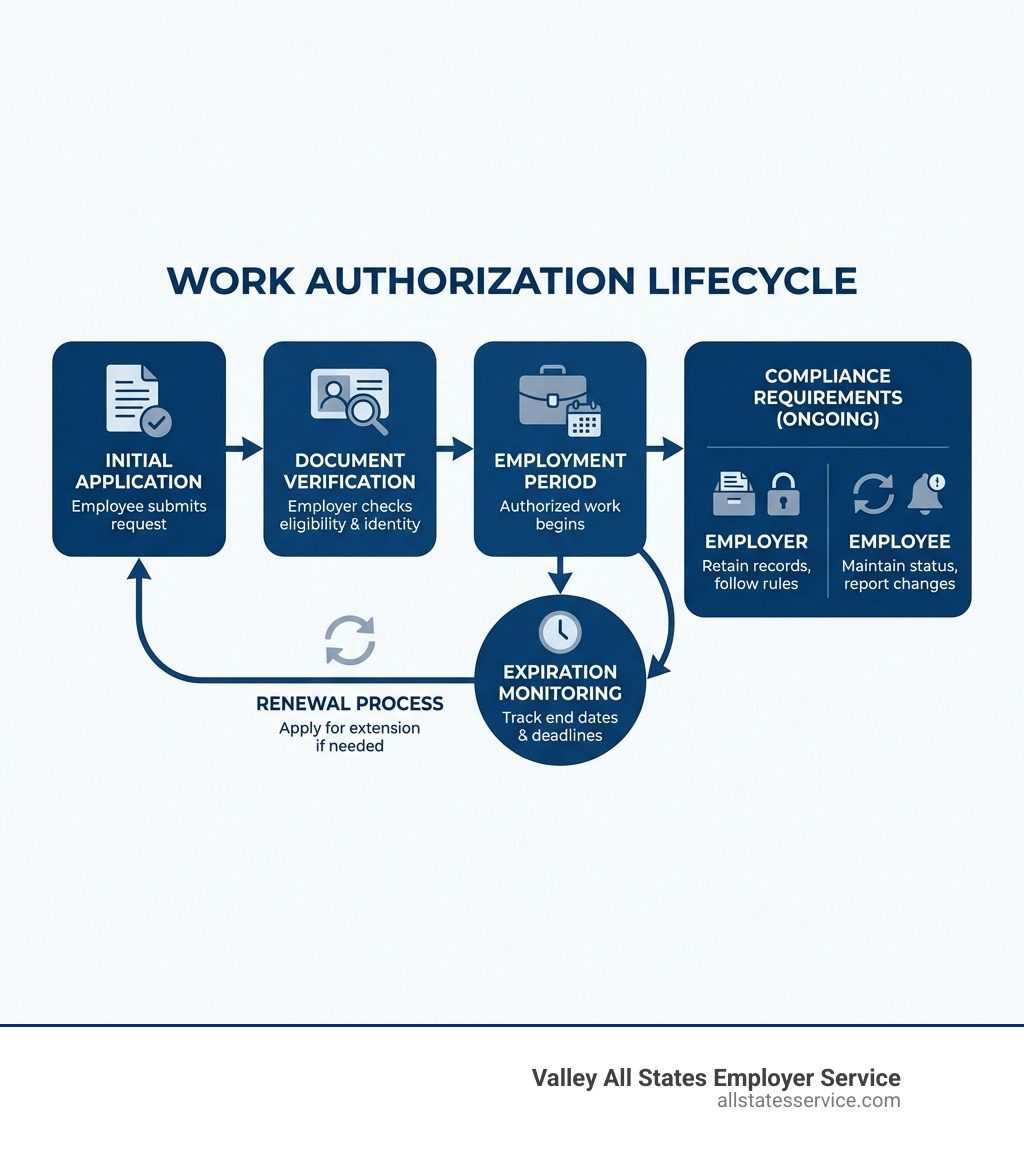
Simple guide to Employee work authorization:
Understanding Employee Work Authorization in Canada
Navigating the Canadian immigration system requires a clear understanding of the different types of permits available. Generally, work permits fall into two main categories: open work permits and employer-specific work permits.
An open work permit allows a foreign national to work for any employer in Canada, with a few exceptions like those on a restricted list. This provides immense flexibility for the worker and simplifies the hiring process for you, the employer. On the other hand, an employer-specific work permit, often called a “closed” permit, ties the worker to a specific company, location, and job title.
When hiring someone with a closed permit, you usually need a Labour Market Impact Assessment (LMIA) to prove that no Canadian citizen or permanent resident was available to do the job. However, many workers qualify for LMIA exemptions based on international agreements or significant benefit to Canada. To ensure you are meeting all legal standards, it is helpful to review a work authorization verification resource to stay on the right side of IRCC regulations.
Special policies often arise during global crises. For example, the Canada-Ukraine measures provided a lifeline for those fleeing conflict, granting them open work permits that bypass many of the standard problems.
Navigating Temporary Measures for Employee Work Authorization
Temporary public policies are implemented by Immigration, Refugees and Citizenship Canada (IRCC) to address specific humanitarian situations. These measures often include fee exemptions and expedited processing for open work permits.
The Canada-Ukraine Authorization for Emergency Travel (CUAET) is a prime example, having welcomed over 286,000 Ukrainians. These permits typically last for up to three years. Similar measures have been enacted for Iranian nationals, Sudanese family members, and Haitian nationals.
As an employer, you should be aware that while these permits provide immediate Employee work authorization, they are temporary. Early planning is vital. If an employee’s permit is set to expire, you may need to look into LMIA-supported extensions or permanent residency pathways. Staying informed through a legal employment verification guide 2025 can help you manage these transitions without losing valuable talent.
Changing Jobs with an Employer-Specific Work Permit
If you find a great candidate who currently holds an employer-specific work permit for a different company, they cannot simply start working for you tomorrow. They must apply for a new work permit.
However, there is a way to speed things up. Under certain public policies, an employee can request interim authorization to start their new job while their application is still being processed. To do this, they must use the IRCC web form and include the specific code PPCHANGEWORK2020.
Once the request is submitted, IRCC typically sends an email authorization within 10 to 15 days for online applications. This allows the worker to bridge the gap between their old and new roles legally. For more on how to handle these specific onboarding scenarios, check out our guide on new hire verification.
The U.S. Employment Eligibility Framework
In the United States, the process is centered around the Form I-9, Employment Eligibility Verification. This form is mandatory for every new hire, regardless of whether they are a U.S. citizen or a foreign national.
The goal is to verify both identity and the legal right to work. This process must be completed within three business days of the employee’s first day of work. For a deep dive into the mechanics of this process, our employment eligibility verification complete guide offers a step-by-step breakdown.
Employees must present original, unexpired documents from the Lists of Acceptable Documents. List A documents, such as a U.S. Passport or a Permanent Resident Card, establish both identity and authorization. If the employee doesn’t have a List A document, they must provide a combination of one document from List B (identity) and one from List C (work authorization).
Maintaining Employee Work Authorization for Students
International students on F-1 and M-1 visas have specific rules regarding their Employee work authorization. F-1 students can often work on-campus for up to 20 hours a week while school is in session. For off-campus work, they typically use Curricular Practical Training (CPT) or Optional Practical Training (OPT).
CPT is for work that is an integral part of an established curriculum, like an internship. OPT, meanwhile, allows for 12 months of employment related to the student’s major, usually after they graduate. M-1 vocational students have more limited options, generally restricted to a maximum of six months of practical training after completing their studies. You can find more official details at Employment Authorization – USCIS.
STEM OPT and Cap-Gap Extensions
Students who graduate with degrees in science, technology, engineering, or mathematics (STEM) may be eligible for a 24-month extension of their post-completion OPT. This brings their total work authorization period to 36 months.
To hire a STEM OPT student, you must be enrolled in E-Verify and help the student complete a Form I-983 Training Plan. This plan outlines how the employment will help the student reach their academic goals. Understanding E-Verify employer requirements is essential for any business looking to tap into this highly skilled talent pool.
Another important concept is the “cap-gap.” This occurs when an F-1 student’s OPT expires before their H-1B status begins on October 1. If a timely H-1B petition was filed, the student’s work authorization is automatically extended until the H-1B start date, allowing them to continue working without interruption.
Employer Responsibilities and Compliance Risks
Compliance isn’t just about filling out the form; it’s about keeping it. You must retain Form I-9 for three years after the date of hire or for one year after employment is terminated, whichever is later. Failing to produce these forms during an audit can lead to massive fines.
Our I-9 compliance management complete guide explains how to build a system that prevents these errors. Beyond just record-keeping, you must also steer anti-discrimination provisions. You cannot specify which documents an employee must present, and you cannot refuse a valid document because it has a future expiration date.
Using E-Verify employment verification adds an extra layer of security by electronically comparing the information on the I-9 to government records. This helps ensure your workforce is legal and reduces the risk of manual errors.
What to Do When Permits Expire or Documents Are Lost
When an employee’s Employee work authorization is nearing its end, you need to act fast. In Canada, if an employee applies for an extension before their current permit expires, they gain “maintained status.” This allows them to keep working under the same conditions as their old permit until a decision is made.
In the U.S., the rules are different. While some categories of Employment Authorization Documents (EADs) offer automatic extensions of up to 180 days while a renewal is pending, others do not. If an EAD is lost or stolen, the employee must file a new Form I-765 and pay the fee to get a replacement.
| Feature | Canada (Maintained Status) | United States (Automatic Extension) |
|---|---|---|
| Eligibility | Applied before expiry | Specific EAD categories only |
| Work Rights | Continue under old permit terms | Up to 180 or 540 days (varies) |
| Proof | IRCC Acknowledgement of Receipt | Receipt notice for Form I-765 |
| Replacement | N/A (Status is digital/paper) | File new I-765 for lost card |
If you find yourself facing an audit or realize your records are incomplete, understanding I-9 compliance penalties can help you understand the urgency of correcting those errors.
Frequently Asked Questions about Work Permits
What is maintained status in Canada?
Maintained status allows a foreign worker to legally stay and work in Canada after their work permit expires, provided they submitted a renewal application before the expiry date. They can continue working under the same conditions until IRCC makes a decision on their new application.
How do I replace a lost or stolen EAD in the U.S.?
To replace a lost, stolen, or destroyed Employment Authorization Document, the employee must file a new Form I-765, Application for Employment Authorization. In most cases, they will also have to pay the filing fee again unless they qualify for a fee waiver.
Can I work while my work permit extension is pending?
In Canada, yes, if you applied before your permit expired. In the U.S., it depends on your specific visa or EAD category. Some categories allow for an automatic 180-day extension of work authorization upon filing a renewal, while others require the new card to be in hand before work can continue.
Final Steps for a Compliant Career
Managing Employee work authorization doesn’t have to be a source of stress for your HR department. By staying proactive and understanding the specific requirements for both Canadian and U.S. workers, you protect your business from legal liability and ensure your employees can focus on their jobs.
At Valley All States Employer Service, we specialize in taking the administrative burden off your shoulders. We provide expert, impartial, and efficient E-Verify processing that minimizes errors and keeps your business compliant with federal laws. Whether you are operating in Lutherville, MD, or anywhere else in Maryland, our team is ready to help you streamline your onboarding process.
Ready to simplify your compliance? Explore our automated eligibility verification system and find how we can help you maintain a legal, productive workforce with ease. Contact us today to learn more about our E-Verify services.