
Maryland New Hire Reporting Requirements and Where to Find Them
What Maryland Employers Need to Know About New Hire Reporting
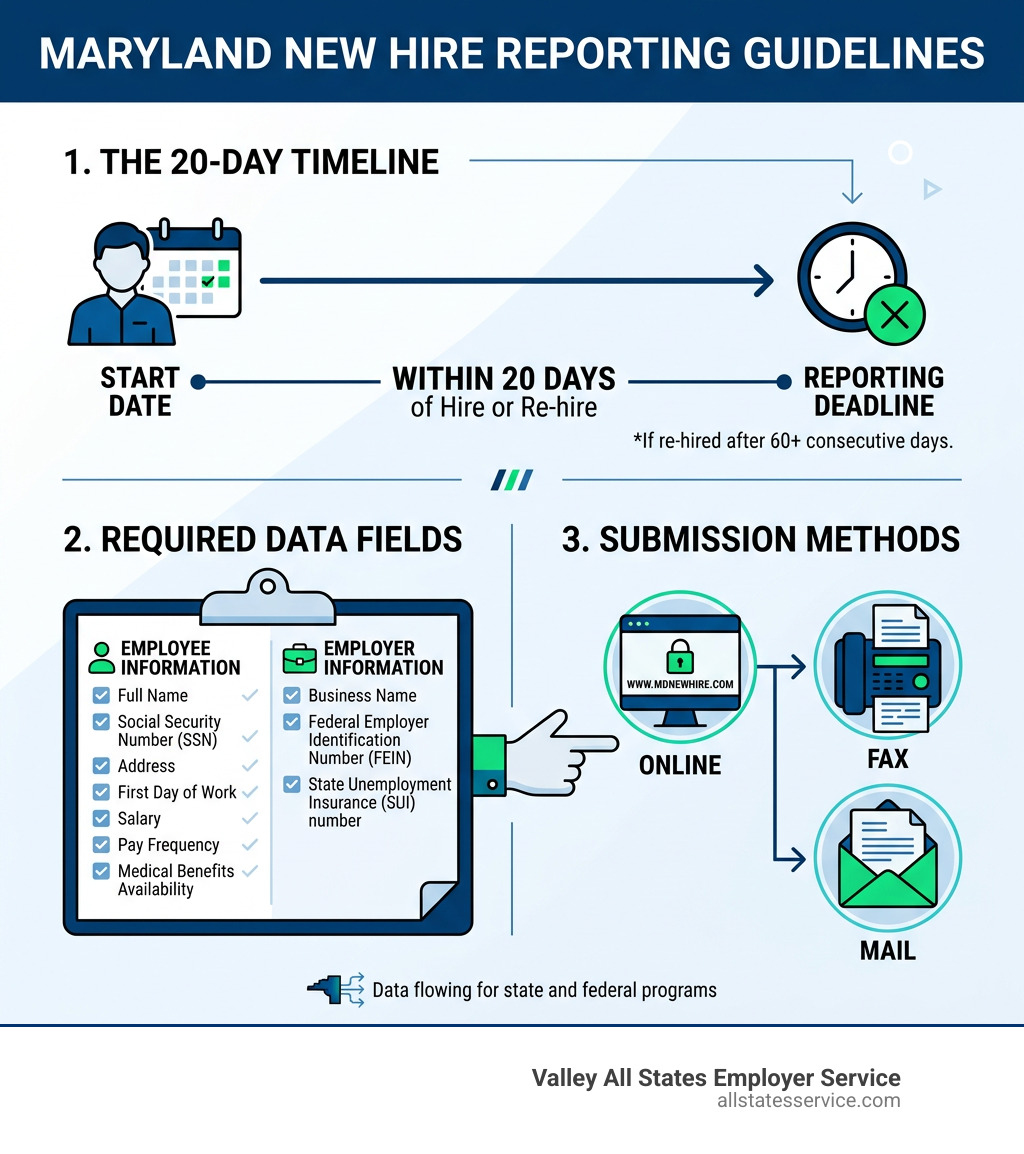
Maryland new hire reporting is a mandatory process that requires every employer in the state to report newly hired and re-hired employees to the Maryland State Directory of New Hires within 20 days of their start date.
Here’s a quick summary of what’s required:
- Who must report: All Maryland employers, regardless of size or industry
- What to report: Employee’s full name, SSN, address, first day of work, salary, pay frequency, and medical benefits availability
- Employer details required: Business name, Federal Employer Identification Number (FEIN), and State Unemployment Insurance (SUI) number
- Deadline: Within 20 days of hire or re-hire date
- How to report: Online at www.mdnewhire.com, by fax, or by mail
- Re-hire rule: Report again only if an employee returns after a break of 60 or more consecutive days
If you’re an HR manager juggling onboarding paperwork, payroll setup, and compliance deadlines all at once, this requirement is easy to overlook. But missing it carries real risk, including financial penalties and audit exposure.
The rules come from both federal law (the Personal Responsibility and Work Opportunity Reconciliation Act of 1996) and Maryland’s own Labor and Employment Code. The data you submit feeds directly into child support enforcement programs and helps state agencies detect unemployment insurance fraud.
The good news? The process is straightforward once you know exactly what to submit and where to send it.
Understanding the Legal Basis for Reporting
We often get asked why this extra step is necessary. It feels like just another form in a mountain of paperwork, but it serves a vital social and economic purpose. The legal foundation for maryland new hire reporting is built on both federal and state mandates.
At the federal level, the Personal Responsibility and Work Opportunity Reconciliation Act (PRWORA) of 1996 (specifically 42 U.S.C. 653a) requires all states to establish a New Hire Registry. Maryland fulfills this through the Maryland Labor and Employment Code Ann. § 8-626.1.
The primary goal is child support enforcement. By reporting new hires quickly, the state can locate parents who owe child support and issue income withholding orders more efficiently. This ensures children receive the financial support they deserve without long delays when a parent changes jobs.
Beyond child support, the registry is a powerful tool for the Division of Unemployment Insurance. It helps the state detect and prevent fraudulent unemployment claims. If someone is collecting benefits while simultaneously earning a paycheck, the new hire report flags the overlap. This protects the integrity of the state’s trust fund and keeps tax rates more stable for honest employers like you.
If you want to dive into the specific legal language, you can browse the Maryland Annotated Code to see how these rules are codified. For a broader look at staying compliant with various state regulations, check out our Maryland employment law compliance guide.
Who Must Comply with State Requirements?
In Maryland, the definition of an “employer” is quite broad. If you have one or more employees, you are generally required to comply with maryland new hire reporting rules. This applies to private businesses, state and local government agencies, and even non-profit organizations.
Whether your new team member is working part-time or full-time, they must be reported. The law doesn’t distinguish between a 40-hour-a-week executive and a college student working ten hours a week in your warehouse. If you are paying them wages and they meet the definition of an employee for tax purposes, they belong in the registry.
We should also talk about contractual payroll. Even if an employee is hired on a contractual basis through a state agency or a similar arrangement, the organization that actually pays the salary is the one responsible for the report.
There is one interesting exception to keep in mind. Labor organizations and referral agencies that only refer individuals for jobs but do not actually pay their wages are not required to report those individuals. The reporting obligation always falls on the entity that issues the paycheck.

If you are unsure whether a specific worker counts as an employee or an independent contractor, it is worth taking a closer look at their status. Misclassification can lead to issues far beyond just new hire reporting. You can find more details on determining who needs to be reported in our guide on new hire eligibility.
Information Required for the Maryland New Hire Registry
When you sit down to complete your maryland new hire reporting, you’ll need two sets of data: one for the employee and one for your business. Most of this information can be pulled directly from the employee’s Form W-4 and your own payroll records.
Maryland is a bit more detailed than some other states. For example, you are required to report whether medical insurance is available to the employee. This helps the state determine if a child can be covered under a parent’s health plan.
Here is a breakdown of the specific data points you must provide:
| Employee Information Required | Employer Information Required |
|---|---|
| Full Legal Name | Business Name |
| Social Security Number (SSN) | Federal Employer ID Number (FEIN) |
| Current Home Address | State Unemployment Insurance (SUI) Number |
| Date of Birth (Optional but encouraged) | Business Address |
| First Day of Work (Hire Date) | Contact Person Name and Phone |
| Availability of Medical Benefits (Y/N) | Payroll Address (if different) |
| Salary and Pay Frequency |
A common hurdle for new businesses is the State Unemployment Insurance (SUI) number. If you have recently started your business and haven’t received your SUI number yet, don’t let that stop you from reporting on time. The state allows you to write “APPLIED FOR” in that field. Similarly, if your organization is specifically exempt from unemployment insurance taxes, you can write “EXEMPT.”
Accuracy is key here. The FEIN you use for new hire reporting should be the exact same one you use for your quarterly wage reports. This consistency allows the state’s computers to match records without triggering unnecessary red flags or audits.
For a complete checklist of all the forms you need to gather during the first week of employment, visit our resource on Maryland new hire paperwork.
Submission Methods and Deadlines
The clock starts ticking the moment your new employee performs their first hour of work for pay. In Maryland, you have exactly 20 days from that hire or re-hire date to get the report to the registry.
We highly recommend using the online portal for maryland new hire reporting. It is the fastest, most secure, and most efficient way to stay compliant. The official portal is located at www.mdnewhire.com.
If you have reported online recently, your email address will likely serve as your User ID. If you are a brand-new employer, you can simply click the “Sign me up” link on the homepage to create an account.
However, if you prefer more traditional methods, you still have options:
- By Fax: You can fax a completed Maryland New Hire Registry Reporting Form to (410) 281-6004 or toll-free to 1-888-657-3534.
- By Mail: Send your paper forms to the following address: Maryland New Hire Registry PO Box 1316 Baltimore, MD 21203-1316
When filling out the paper form, use black or blue ink and print neatly in capital letters. The scanning equipment used by the state can be picky, so try to keep your letters inside the boxes and avoid touching the edges.
Federal law requires you to verify employment eligibility using Form I-9 within three business days, but you have the full 20 days for the state new hire report. Balancing these different timelines is a core part of effective new hire verification.
Frequently Asked Questions about Maryland New Hire Reporting
Navigating state regulations often brings up specific “what if” scenarios. We have gathered some of the most common questions Maryland employers ask to help you stay on the right side of the law.
One question that comes up often involves multi-state employers. If you have employees in Maryland and Virginia, for example, do you have to report to both? Federal law allows multi-state employers to designate one state where they will report all their new hires electronically. If you choose this route, you must notify the Secretary of the Department of Health and Human Services in writing, identifying which state you have selected.
Another common point of confusion is whether to report independent contractors. Generally, if they are true 1099 contractors who meet the state’s three-part test for independence, they do not need to be reported to the New Hire Registry. However, if there is any doubt about their status, reporting them is usually a safer bet for employee onboarding compliance.
When do I need to report a re-hired employee for maryland new hire reporting?
Re-hires are a frequent source of errors. The rule in Maryland is based on the “break in service” duration. You must report a returning employee as a “new hire” if they have been separated from your company for at least 60 consecutive days.
This is common for seasonal businesses, such as landscaping companies or summer camps. If your star employee works every summer but takes the rest of the year off, you will need to file a new report every time they return for the new season.
The report should use their most recent “first day of work” as the hire date. If the break in service was less than 60 days, for example, if an employee took a six-week leave of absence and then returned, no new report is required because they were never truly separated from employment in the eyes of the New Hire Registry.
How does maryland new hire reporting link to E-Verify?
While maryland new hire reporting and E-Verify both happen at the start of employment, they serve very different masters. New hire reporting is about child support and fraud prevention, while E-Verify is about workforce eligibility.
E-Verify is a federal system that compares information from an employee’s Form I-9 to records available to the U.S. Department of Homeland Security and the Social Security Administration. It confirms that the person is legally allowed to work in the United States.
In Maryland, E-Verify is mandatory for certain state contractors with 100 or more employees. Even if it isn’t mandatory for your business, many employers use it voluntarily to ensure they aren’t accidentally hiring unauthorized workers. Using E-Verify alongside the state’s new hire registry creates a robust compliance shield for your business. You can learn more about how to integrate these steps in our guide on E-Verify for new hires.
What are the penalties for missing the reporting deadline?
We know you have a lot on your plate, but ignoring the 20-day deadline can be expensive. While the new hire registry itself focuses on compliance through education, failing to report can trigger broader audits.
Maryland law allows for fines of up to $500 per affected employee for various pay-related law violations. Furthermore, if the state discovers that you have a pattern of not reporting new hires, you may find yourself facing a more intensive audit of your unemployment insurance records and quarterly wage reports.
The Division of Unemployment Insurance uses new hire data to cross-match against active claims. If they find an employee is working for you but still collecting benefits because you didn’t report the hire, you could be pulled into a fraud investigation. This often leads to the highest possible UI tax rates for up to four years, which is a massive financial burden for any small business.
Streamlining Your Onboarding Process
Managing maryland new hire reporting is just one piece of the larger compliance puzzle. From verifying I-9 forms to navigating the complexities of E-Verify, the administrative burden on HR teams is significant. Errors in these early stages can lead to long-term legal headaches and financial strain.
At Valley All States Employer Service, we specialize in taking that weight off your shoulders. We provide expert, outsourced E-Verify workforce eligibility verification to ensure your team is compliant from day one. Our goal is to minimize administrative errors and let you focus on what you do best: growing your business and supporting your new team members.
By centralizing your compliance tasks, you can ensure that every deadline is met, every form is filed correctly, and every employee is verified with total accuracy. Whether you are a small business in Lutherville or a large enterprise with locations across Maryland, we are here to help you navigate the landscape of employment law.
Ready to simplify your process and protect your business? Visit our Employee Onboarding Compliance guide to see how we can help you streamline your workflow today.