
The Core of Employment Eligibility Verification Maryland
Employment eligibility verification Maryland is a federal requirement that applies to every employer in the state, and getting it wrong can cost you thousands of dollars per violation.
Here’s a quick summary of what Maryland employers need to know:
- Form I-9 must be completed for every employee hired after November 6, 1986
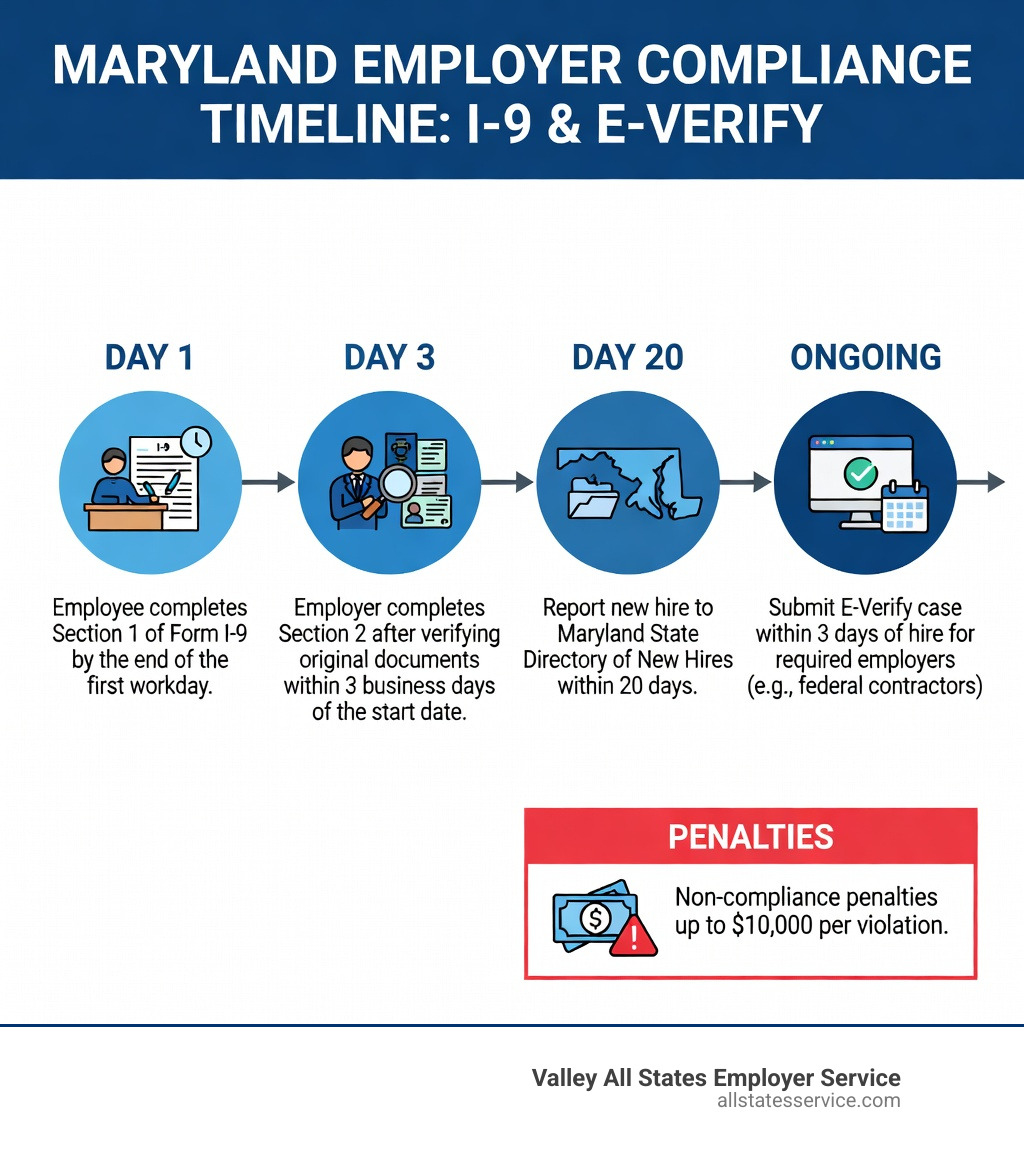
- Section 1 (employee info) must be done by the end of the first workday
- Section 2 (employer review of documents) must be completed within 3 business days of the start date
- E-Verify is required for federal contractors and certain public employers, including Prince George’s County Government
- New hires must be reported to the Maryland State Directory of New Hires within 20 days
- Penalties for non-compliance can reach up to $10,000 per violation
If you manage hiring for a Maryland business, you already know the feeling: a new employee starts, paperwork piles up fast, and one missed deadline can trigger serious legal exposure.
The rules aren’t just federal anymore. Maryland layers its own reporting requirements, agency-specific mandates, and now pay transparency laws on top of the baseline I-9 process. For a busy HR team, that’s a lot to track.
And the stakes are real. A single compliance gap, like a missed document review or a late new hire report, can result in civil fines, audits, or worse.
This guide breaks down exactly what Maryland employers are required to do, who has to use E-Verify, what documents are acceptable, and where the most common mistakes happen. Whether you’re onboarding your first employee or managing hundreds of new hires a year, here’s what you need to stay on the right side of the law.
At the heart of every hiring process in the Old Line State is the Form I-9. This document was born from the Immigration Reform and Control Act of 1986, which made it illegal for employers to knowingly hire individuals who are not authorized to work in the United States. Since then, Employment eligibility verification Maryland has become a standard, albeit sometimes stressful, part of the first week on the job.
The purpose of the I-9 is simple: it documents that each new employee, whether a U.S. citizen or a noncitizen, is legally allowed to work. You can find the official I-9 Form – U.S. Employment Eligibility Verification Form through the Maryland Courts resources or directly from USCIS.
Timing is everything here. Your new hire must complete Section 1 of the form no later than their very first day of work. As the employer, you have a bit more breathing room, but not much. You must complete Section 2 within three business days of the employee’s start date. If they start on a Monday, you need that paperwork finalized by Thursday.
Navigating these tight windows is much easier when you have a clear i-9-form-verification-maryland-guide/ to follow. Missing these deadlines is one of the most common reasons for fines during a government audit, so we always recommend setting calendar alerts the moment a job offer is accepted.
Acceptable Documents for Employment Eligibility Verification Maryland
When it comes to proving someone can work, not just any ID will do. The government categorizes acceptable documents into three lists: A, B, and C. For a deep dive into the specifics, you can always check the official List of Acceptable Documents for the I-9 Process.
Here is the breakdown of how these lists work:
- List A: These documents establish both identity and employment authorization. If an employee shows you one of these, like a U.S. Passport or a Permanent Resident Card (Green Card), you are done.
- List B: These prove identity only. Common examples include a Maryland driver’s license or a school ID with a photo.
- List C: These prove employment authorization only. The most common is a Social Security card that doesn’t have employment restrictions printed on it.
If an employee doesn’t have a List A document, they must provide one from List B and one from List C. You must always see the original documents. Scans, photocopies, or cell phone pictures are not acceptable for Section 2. We have put together a resource on employment-verification-maryland/ to help you train your hiring managers on what to look for.
Remote Workers and Employment Eligibility Verification Maryland
With more people working from home in places like Lutherville or Baltimore while their “office” is miles away, remote verification has become a hot topic. Historically, employers had to physically examine documents in person. However, DHS has recently authorized alternative procedures for certain employers.
If you are an E-Verify participant in good standing, you may be eligible to use a live video link to examine documents remotely. This is a huge relief for businesses hiring across the state. However, there are still strict rules about how these documents are transmitted and stored. Our maryland-i-9-remote-guide/ explains how to stay compliant without making your remote hires drive hours just to show you a passport.
Navigating E-Verify and State-Specific Mandates
While Form I-9 is a federal requirement for everyone, E-Verify is a bit more selective in Maryland. E-Verify is a free web-based system that compares information from an employee’s I-9 to records available to the U.S. Department of Homeland Security and the Social Security Administration.
In Maryland, you aren’t generally required by state law to use E-Verify for every private business, but there are major exceptions. If you are a federal contractor or subcontractor, you likely have an E-Verify clause in your contract. Furthermore, specific jurisdictions like the Prince George’s County Government require all new hires to be processed through E-Verify on their first day.
Using E-Verify – Confirm Employment Eligibility adds an extra layer of security, but it also adds another step to your workflow. You can learn more about these nuances in our maryland-e-verify/ guide or check out our navigating-e-verify-services-in-maryland-your-compliance-checklist/ to see if you are meeting every requirement.
Maryland State Agency and University Requirements
If you are working with state agencies or large educational institutions like the University of Maryland (UMD), the rules get even more specific. For instance, the University of Maryland Baltimore (UMB) requires new hires to schedule appointments at their HR Service Center for in-person verification.
Institutions like UMD often have centralized support for Employment Compliance | University Human Resources. They even use specific employer codes, such as 14654, for their E-Verify submissions. If you are a vendor or a partner working with these entities, staying aligned with their maryland-e-verify-pilot-complete-guide/ is essential for a smooth partnership.
Maryland New Hire Reporting and Labor Laws
Don’t confuse I-9 verification with New Hire Reporting! While they both happen around the same time, they serve different purposes. Federal and Maryland law requires every employer to report newly hired and re-hired employees to the Maryland State Directory of New Hires within 20 days of their hire date.
This reporting is primarily used to help the Department of Human Services with child support enforcement and to detect fraud in unemployment or workers’ compensation programs. You can find the necessary maryland-new-hire-paperwork/ through the state’s online portal.
| Feature | Form I-9 Verification | New Hire Reporting |
|---|---|---|
| Primary Purpose | Verify work authorization | Child support & fraud detection |
| Deadline | 3 business days from start | 20 calendar days from hire |
| Where to File | Retain on-site (or E-Verify) | Maryland New Hire Registry |
| Required For | All U.S. employers | All U.S. employers |
Compliance Risks and Special Accommodations
The “verification maze” isn’t just a catchy phrase, it is a legal reality. The penalties for failing to properly handle Employment eligibility verification Maryland can be staggering. Civil fines for I-9 errors can range from a few hundred dollars to over $2,000 per form for first-time offenses. If a business is found to have a pattern of knowingly hiring unauthorized workers, those fines can jump to $10,000 per violation.
Beyond the money, there are criminal repercussions for serious or repeat offenders. This is why proper recordkeeping is so vital. You must keep an employee’s I-9 for three years after their date of hire, or one year after their employment is terminated, whichever is later. We recommend using a maryland-employment-law/ checklist to ensure your filing system is audit-ready.
Handling Minors and Employees Without Social Security Numbers
Sometimes, the standard “ID and Social Security card” combo isn’t available. For example, if you are hiring a minor under the age of 18, they might not have a driver’s license or a passport. In these cases, you can accept school records, report cards, or even clinic records. You may also need to help them with a Minor Work Permit (online application) depending on their age and the type of work.
What about international employees who are still waiting on their Social Security Number (SSN)? You can’t turn them away just because the card hasn’t arrived. At places like the University of Maryland, these employees can often sign an Affidavit of Compliance. This allows HR to complete Section 1 temporarily and update the record once the permanent SSN is issued. Our maryland-hr-services-complete-guide/ covers these “what if” scenarios in detail.
Intersection with Pay Transparency and Pay Stub Laws
In 2024, Maryland introduced new laws that intersect with the onboarding process. The Pay Transparency Law now requires employers to include a good-faith wage range and a general description of benefits in every job posting. This means before you even get to the I-9 stage, you must be transparent about compensation.
Additionally, the new Pay Stub law requires very specific information to be included on every pay statement, such as the employer’s name, address, and a breakdown of hours worked for non-exempt staff. You can find more details on the Employment Standards Service-Wage and Hour Information page. Keeping up with these changes is a core part of our maryland-employment-law-compliance-guide/, as failing to provide a proper pay stub can lead to fines of up to $500 per employee.
Frequently Asked Questions about Maryland Verification
Are all Maryland employers required to use E-Verify?
No, not all of them. While every employer must use Form I-9, E-Verify is generally only mandatory for federal contractors, subcontractors, and certain public-sector employers like those in Prince George’s County. However, many private businesses choose to use it voluntarily to ensure their workforce is fully authorized and to take advantage of remote verification options.
What happens if an employee cannot produce documents within three days?
If an employee cannot present the required documents within three business days, they must be terminated unless they can provide a “receipt” for the replacement of a lost, stolen, or damaged document. This receipt is usually valid for 90 days, after which the actual document must be presented.
How long must I-9 forms be retained in Maryland?
You must follow the federal “3-year or 1-year” rule. Retain the I-9 for three years after the date of hire or one year after the date employment ends, whichever is later. It is best practice to store these separately from general personnel files to make audits easier and more secure.
Streamlining Your Maryland Compliance Strategy
We know that managing Employment eligibility verification Maryland feels like a full-time job on top of your actual job. Between the three-day I-9 window, the 20-day new hire reporting deadline, and the ever-shifting E-Verify rules, it is easy for things to slip through the cracks.
That is where we come in. At Valley All States Employer Service, we specialize in taking the administrative burden off your shoulders. We provide expert, impartial, and efficient e-verify-outsourcing-maryland-guide/ to help you minimize errors and stay focused on growing your business.
Whether you need a dedicated i-9-form-verification-lutherville/ expert to review your files or a complete overhaul of your onboarding workflow, our team is here to help. We make sense of the maze so you don’t have to.
Ready to simplify your compliance? Contact our team at Valley All States Employer Service today and let’s get your hiring process on the right track.