
I-9 remote verification 2022: New Rules
The Shifting Landscape of I-9 Verification
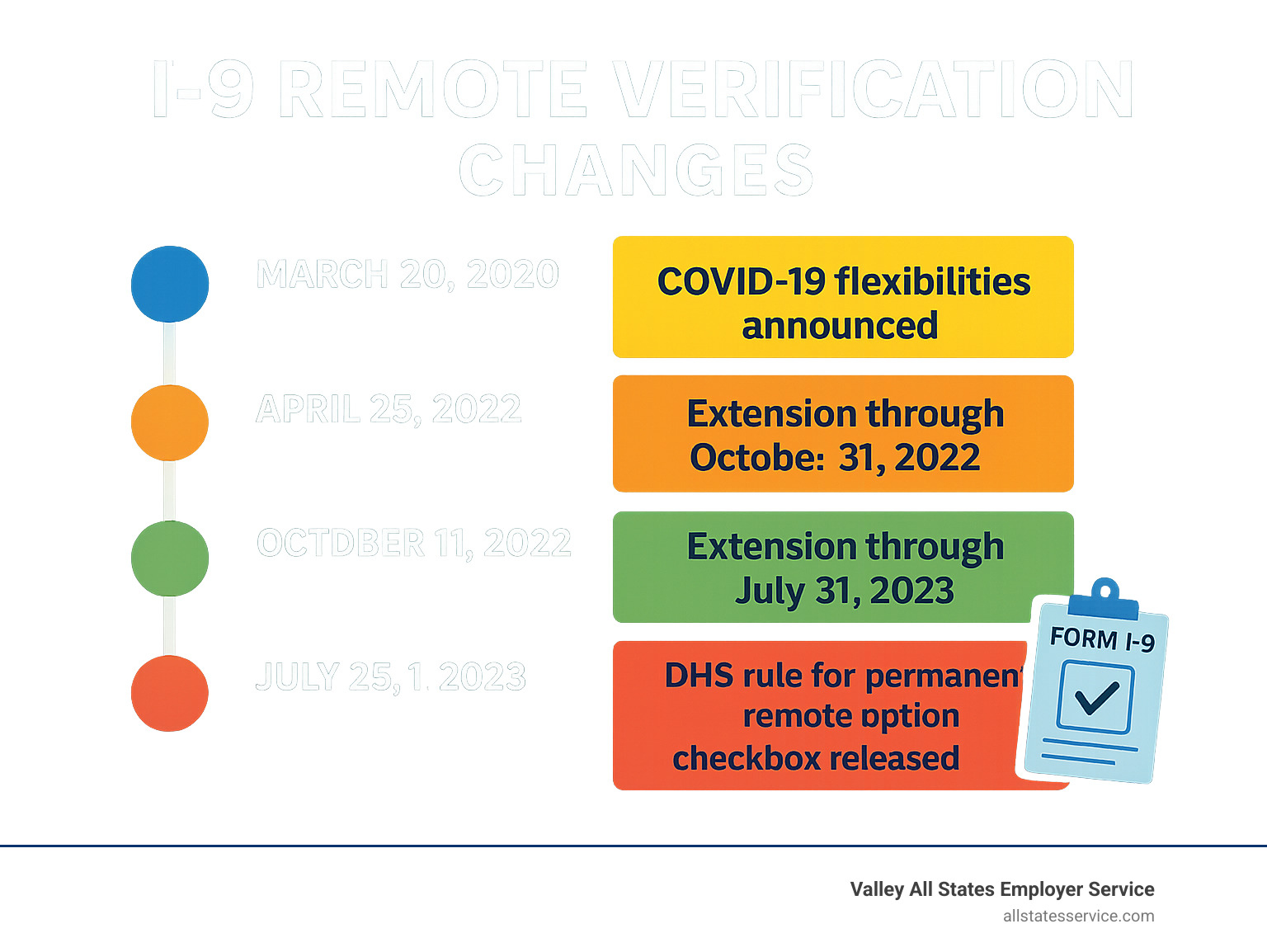
I-9 remote verification 2022 marked a pivotal year in employment compliance history. The Department of Homeland Security (DHS) extended COVID-19 flexibilities through October 31, 2022, then again until July 31, 2023, before introducing a permanent remote verification option in August 2023.
Key Timeline for I-9 Remote Verification 2022:
- March 20, 2020 – Initial COVID-19 flexibilities announced
- April 25, 2022 – First extension through October 31, 2022
- October 11, 2022 – Final extension through July 31, 2023
- July 25, 2023 – DHS Final Rule introduces permanent remote option
- August 1, 2023 – New Form I-9 with remote verification checkbox released
The pandemic forced millions of employers to rethink how they verify employee eligibility. What started as emergency measures became a catalyst for permanent change in I-9 compliance.
Remote work created unprecedented challenges. Employers couldn’t conduct in-person document reviews for employees working from home. The government responded with temporary flexibilities, but these came with strict deadlines and compliance requirements.
As one legal expert noted during this transition: “The new I-9 and remote verification process are still fraught with confusion and challenges for employers across the U.S.”
Now, with permanent remote verification available for qualified E-Verify employers, the landscape has fundamentally shifted. But understanding what happened in 2022 and how we got here is crucial for making smart compliance decisions today.
The COVID-19 Era: A Timeline of Temporary I-9 Flexibilities
March 2020 changed everything. One day, employees were sitting in offices filling out paperwork with HR representatives physically examining their documents. The next day, entire workforces went remote, and employers faced an impossible question: How do you verify someone’s identity and work authorization through a computer screen?
The Department of Homeland Security (DHS) and Immigration and Customs Enforcement (ICE) had to act fast. Traditional Form I-9 compliance required in-person document inspection, but suddenly “in-person” wasn’t an option for millions of workers.
I-9 remote verification 2022 became a reality because of these emergency flexibilities, but the journey started two years earlier with unprecedented temporary policies.

What Were the COVID-19 Flexibilities?
Picture this: you’re hiring someone who lives three states away and will never set foot in your office. Under normal I-9 rules, you’d need them to appear in person or send an authorized representative to physically examine their driver’s license and Social Security card. Not exactly practical during a pandemic.
The COVID-19 flexibilities changed the game. Employers could now inspect I-9 documents remotely using video calls, email, or fax transmission. It was groundbreaking for its time, even if it came with strict conditions.
These flexibilities weren’t a free-for-all, though. They only applied to employees hired on or after March 20, 2020, who worked exclusively in remote settings due to COVID-19 precautions. If someone later started working on-site, or if your company returned to normal operations, you still had to complete the physical document inspection.
Employers using remote verification still had to obtain, inspect, and retain copies of documents within three business days of the hire date. You also needed written documentation of your remote onboarding and telework policies. Think of it as building a paper trail to show you were following the rules during extraordinary circumstances.
The catch? Once things returned to “normal,” you had to “perfect” those I-9 forms by conducting physical inspections. This requirement would later create a massive compliance challenge for employers.
See the original ICE news release from March 20, 2020 for the complete details of how it all began.
Key Extensions for i-9 remote verification 2022
Nobody expected the pandemic to last as long as it did. What started as a temporary emergency measure kept getting extended as remote work became the new normal for many businesses.
I-9 remote verification 2022 saw two critical extension announcements. First, on April 25, 2022, DHS extended the flexibilities through October 31, 2022. Many employers breathed a sigh of relief, thinking they had more time to figure out their compliance strategies.
Then came October 11, 2022, with another extension, but this one was different. DHS announced the final extension through July 31, 2023, making it clear that this was truly the end of the road for temporary measures.
This final extension gave employers a concrete deadline to work with. No more guessing games about whether another extension might come. It was time to either prepare for traditional in-person verification or hope that DHS would introduce a permanent remote option.
Looking back, these extensions were crucial. They gave the government time to develop the permanent remote verification rule that would eventually replace the temporary flexibilities. Without the 2022 extensions, the transition would have been much more chaotic.
DHS has extended the Form I-9 flexibilities until July 31, 2023 provides all the details on that final, decisive extension announcement.
The End of an Era: Sunsetting Flexibilities and What It Meant for Employers
The summer of 2023 marked a turning point for i-9 remote verification 2022 policies. After more than three years of temporary COVID-19 flexibilities, July 31, 2023, became the final sunset date. But employers weren’t left completely in the dark—ICE provided a 30-day grace period until August 30, 2023, for completing physical document inspections.
This wasn’t just another compliance deadline. For businesses that had built entire remote workforces during the pandemic, it represented a massive logistical challenge. Suddenly, companies needed to track down employees hired remotely since March 2020 and arrange in-person document reviews.
The clock was ticking, and the stakes were high. Employers who missed this deadline faced potential auditing risks and significant penalties. Many HR departments found themselves scrambling to coordinate physical inspections across multiple states and time zones.

Navigating the Physical Re-Verification Rush
The physical re-verification process required careful attention to detail. Employees hired after March 20, 2020, whose documents were only reviewed remotely, needed to present their original documents for in-person inspection by the August 30 deadline.
Here’s where things got tricky. Simply seeing the documents wasn’t enough—employers had to properly document the process. The Additional Information field in Section 2 of Form I-9 became crucial for compliance management. Employers needed to record the date of physical inspection and include the initials or full name and title of the person conducting the review.
Many companies found that their remote employees had scattered across the country. This led to creative solutions, including using authorized representatives like notary publics or trusted third parties to conduct inspections. The key was ensuring these representatives understood the requirements and could properly complete the documentation.
Smart employers also realized this was an opportunity to review their overall I-9 processes. Understanding compliance requirements became more important than ever, especially given the potential consequences outlined in our guide on I-9 Compliance Penalties.
Penalties for Non-Compliance
The consequences of missing the August 30, 2023, deadline were serious and expensive. I-9 violations fall into two main categories that every employer should understand.
Paperwork violations might seem minor, but they add up quickly. These include missing signatures, incorrect dates, or failure to properly annotate re-verifications. Even something as simple as forgetting to note the physical inspection date could trigger penalties.
Substantive violations carry much heavier consequences. Missing the physical re-verification deadline entirely could be classified as a substantive violation, even if the original remote inspection followed all the temporary guidelines perfectly.
The penalties stem from Section 274A of the Immigration and Nationality Act, and they’re not just slaps on the wrist. Civil penalties for paperwork violations can range from hundreds to thousands of dollars per violation. Substantive violations carry even steeper fines, and repeat offenses face escalated penalties.
The good news? Proactive employers could minimize their risk through regular self-audits. Identifying and correcting errors before an ICE audit provides significant protection. This process has become so important that many companies now treat it as essential preventive maintenance—you can learn more about implementing this protective strategy through our I-9 Self Audit resources.
The August 2023 deadline represented the end of an era, but it also marked the beginning of a new chapter in I-9 compliance—one where permanent remote verification options would soon become available for qualified employers.
A New Permanent Solution: The Alternative Procedure for i-9 remote verification 2022 and Beyond
The sunset of those temporary COVID-19 flexibilities didn’t spell the end of remote Form I-9 verification. Instead, it marked the beginning of something better. On July 25, 2023, DHS issued a Final Rule that introduced a permanent remote I-9 verification option. This wasn’t just a band-aid solution, it was a complete modernization of how we handle employment eligibility verification.
This new alternative procedure acknowledges what we all learned during the pandemic: remote work isn’t going anywhere. The old in-person-only system simply couldn’t keep up with how businesses actually operate today. Alongside this groundbreaking rule, USCIS released a brand-new Form I-9 on August 1, 2023, complete with a dedicated checkbox for employers using this remote option.
But here’s the catch, you can’t just decide to go remote tomorrow. This permanent solution comes with specific requirements that ensure the system remains secure and fair for everyone.
Eligibility Requirements for the New Remote Option
Think of the eligibility requirements as your ticket to the remote verification club. Not everyone gets in, but if you qualify, the benefits are substantial.
E-Verify enrollment is your first hurdle. To use this alternative procedure, your company must be an active E-Verify participant. No exceptions here, this is non-negotiable.
Good standing means more than just being enrolled. You need to be a model E-Verify participant, consistently submitting timely queries for all newly hired employees at your E-Verify locations. Think of it as having a clean driving record before getting approved for a new insurance policy.
All hiring sites must be covered if you want to use this option. You can’t cherry-pick which locations get the remote treatment while leaving others out of the E-Verify system entirely.
Consistent application is crucial for avoiding discrimination issues. You can choose to offer remote verification for all remote hires while still doing physical inspections for on-site employees at the same location. What you can’t do is treat similar employees differently based on protected characteristics.
These requirements ensure that while you gain flexibility, the employment verification system maintains its integrity. Understanding E-Verify and how it integrates with I-9 compliance is essential for making this work. You can dive deeper into this relationship by exploring our comprehensive guide on E-Verify and I-9.
Step-by-Step Guide to the New Remote Verification Process
The new permanent remote verification process is more structured than the old COVID flexibilities, but it’s also more reliable. Here’s how qualified E-Verify employers can make it work:
The process starts when your employee provides digital copies of their chosen documents within three business days of their first day. These need to show both front and back if applicable, and they must come from the official Form I-9 Lists of Acceptable Documents.
Next, you’ll examine those digital copies to determine if they reasonably appear genuine. This isn’t just a quick glance, you’re looking for obvious signs of tampering or inconsistencies that would raise red flags during a normal in-person review.
The live video interaction is where the magic happens. During this scheduled call, the employee must physically present the exact same documents they submitted digitally. You’re essentially doing a side-by-side comparison between the digital copies and the physical documents the employee is holding up to the camera.
Annotating the Form I-9 is simpler now with the new form. There’s a specific checkbox in Section 2’s “Additional Information” area just for this purpose. If you’re still using the older form (edition date 10/21/19), you’ll write “Alternative Procedure” in that same field.
Finally, you must retain clear copies of all documents in your I-9 file. These copies become part of your permanent record and must be available during any government audit.
This structured approach ensures you get the convenience of remote verification without sacrificing the thorough review that makes the I-9 system effective. The complete details of this process are outlined in the official Handbook for Employers (M-274).
Frequently Asked Questions about Remote I-9 Verification
The landscape of i-9 remote verification 2022 and beyond has created plenty of confusion for employers. Let’s tackle the questions we hear most often.
Do I have to use the new remote option if I’m an E-Verify employer?
Here’s the good news: absolutely not. The new remote verification procedure is completely optional, even if you’re an E-Verify employer in good standing.
You can stick with the traditional in-person verification process if that works better for your business. Many employers prefer the familiarity of having employees physically present their original documents during onboarding.
The golden rule is consistency. If you choose remote verification, you must apply it consistently at each hiring site. You could use remote verification for all remote hires while keeping in-person verification for office-based employees. Just make sure your approach isn’t discriminatory or based on protected characteristics.
Think of it like choosing between two valid paths to the same destination. Both get you to compliance, but one might be more convenient for your specific situation. Need help navigating these choices? Our Employer HR Compliance resources can guide you through the decision-making process.
What if I missed the August 30, 2023 re-verification deadline?
This is a tough spot to be in, and unfortunately, missing the August 30, 2023 deadline could expose your business to potential liability.
DHS made it clear that ICE wouldn’t suspend enforcement actions for I-9 forms completed using the COVID-19 flexibilities after March 20, 2020. Missing the physical re-verification deadline could be viewed as a substantive violation, which carries more serious penalties than simple paperwork errors.
Time is critical if you’re in this situation. Document your good faith efforts and the reasons you couldn’t meet the deadline. Then get legal counsel involved immediately to assess your specific risk and determine the best corrective action.
While the government may consider circumstances that prevented compliance, the responsibility ultimately rests with employers. Swift action and proper documentation of your efforts can be crucial for your defense.
Where can I find the latest official Form I-9 and instructions?
USCIS is your one-stop shop for all things Form I-9. Getting the right version is crucial since using an outdated form creates automatic paperwork violations.
The current Form I-9 has an edition date of 08/01/23 and became mandatory on November 1, 2023. This version includes the new checkbox for employers using the alternative remote procedure.
You’ll find everything you need at two key USCIS locations:
Form I-9, Employment Eligibility Verification gives you direct access to download the current form and instructions.
I-9 Central serves as your comprehensive resource hub with guidance, FAQs, and additional compliance materials.
Bookmark these pages and check them regularly. Form updates don’t happen often, but when they do, using the wrong version can trigger costly penalties during an audit.
Staying Compliant in the New Era of I-9 Verification
The change from i-9 remote verification 2022 to today’s permanent compliance landscape represents more than just regulatory updates. It’s a complete shift in how we think about employment verification in our modern, flexible workplace.
Think about where we started. Back in March 2020, employers were scrambling to figure out how to verify new hires when everyone was suddenly working from home. What began as emergency measures evolved through multiple extensions in 2022, finally becoming a structured, permanent solution by August 2023.
The evolution taught us something important: flexibility and compliance can coexist, but only with the right framework in place.
For employers today, the path forward is clearer but requires deliberate choices. E-Verify participation has become the gateway to streamlined remote verification. If your workforce is distributed or you frequently hire remote employees, this isn’t just a compliance tool anymore. It’s become essential infrastructure for modern hiring.
Documentation remains king in this new era. Whether you’re conducting in-person verification or using the alternative remote procedure, your processes need to be rock-solid. Every checkbox matters, every annotation counts, and consistency across your organization isn’t negotiable.
Staying informed has never been more critical. DHS and USCIS continue refining guidance as employers adapt to these changes. What worked during the temporary flexibilities might not meet today’s permanent requirements.
Here’s the reality many employers face: managing I-9 compliance across multiple locations, different employee types, and varying work arrangements creates complexity that can quickly overwhelm your HR team. The stakes are high, with penalties for violations reaching thousands of dollars per form.
That’s exactly why Valley All States Employer Service exists. We specialize in taking the burden of E-Verify workforce eligibility verification off your plate entirely. Our team understands every nuance of these regulations, from the original COVID flexibilities through today’s permanent procedures. We handle the complexity so you don’t have to.
Your business deserves to focus on growth, not compliance headaches. When you partner with us, you get expert, impartial E-Verify processing that minimizes errors and eliminates the administrative burden that comes with managing verification in-house.
Whether you’re hiring locally or building a distributed team across the country, we ensure every employee is properly verified according to the latest requirements. No missed deadlines, no annotation errors, no sleepless nights wondering if you’re compliant.
Ready to simplify your Form I-9 compliance and focus on what you do best? Find how our expert team can streamline your verification process with I-9 Verification Assistance.