
I-9 acceptable documents: Your 3 Perfect Lists
Why I-9 Acceptable Documents Matter for Your Business
Hiring a new team member should be exciting, not stressful. Understanding I-9 acceptable documents helps you onboard smoothly and stay compliant from day one.
I-9 acceptable documents are the forms of ID and work authorization new employees must present to verify their identity and legal right to work in the U.S. These fall into three categories: List A, List B, and List C.
Here’s what you need to know:
List A Documents (choose ONE):
- U.S. Passport or U.S. Passport Card
- Permanent Resident Card (Form I-551)
- Employment Authorization Document (Form I-766)
- Foreign passport with temporary I-551 stamp
List B Documents (for identity, choose ONE):
- Driver’s license or state ID card with photo
- School ID card with photograph
- U.S. Military card or draft record
- Native American tribal document
List C Documents (for work authorization, choose ONE):
- Social Security card (without employment restrictions)
- U.S. Birth Certificate
- Consular Report of Birth Abroad
- U.S. Citizen ID Card (Form I-197)
The Rule: Employees must present either one document from List A, or one document from List B and one from List C. All documents must be unexpired.
Getting this right is critical. Since 1986, federal law requires every U.S. employer to verify each new hire’s identity and employment authorization using Form I-9. Penalties for mistakes range from $288 to $2,861 per paperwork violation, and up to $28,619 for knowingly hiring unauthorized workers.
The tricky part is that employers cannot dictate which documents employees present, reject valid documents with future expiration dates, ask for more documents than required, or treat employees differently based on citizenship.
Many HR managers get stuck here. While juggling onboarding tasks, you must also master document types, valid combinations, and anti-discrimination rules to stay compliant.
The good news is the system is manageable once you understand it. This guide covers everything about I-9 acceptable documents, from basics to special cases like receipts and remote employee verification.
Your First Step in I-9 Compliance: Understanding the Basics

Before you review I-9 acceptable documents, get comfortable with the form itself. Think of Form I-9 as the foundation of your hiring compliance. When you follow the rules, you avoid costly penalties and protect your business.
You can always Find the official Form I-9 and instructions here for the most current version from USCIS.
What is Form I-9 and Why is it Crucial?
Form I-9, Employment Eligibility Verification, is your legal responsibility for every person you hire. It has been required since the Immigration Reform and Control Act of 1986 made it illegal to knowingly employ unauthorized workers.
The form has two goals. It verifies identity, ensuring the person is who they claim to be, and it verifies employment authorization, confirming they can legally work in the U.S.
Why care? Because penalties for paperwork violations range from $288 to $2,861 each. Knowingly hiring an unauthorized worker can lead to fines up to $28,619 per violation. Non-compliance can also trigger audits, damage your reputation, and create legal headaches.
Handling Form I-9 correctly shows your company takes compliance seriously. For a deeper dive, see our guide, What is an I-9 Form?
Who Needs to Complete a Form I-9?
All U.S. employers must complete Form I-9 for every new hire, citizens and noncitizens alike.
This includes full-time, part-time, seasonal, and temporary employees. If they are on your payroll, they need a Form I-9.
The main exception is for independent contractors, 1099 workers. Since contractors are not employees, they are exempt from I-9 requirements.
You also do not need the form for anyone hired before November 6, 1986, individuals doing casual domestic work in a private home, or employees working exclusively outside the United States.
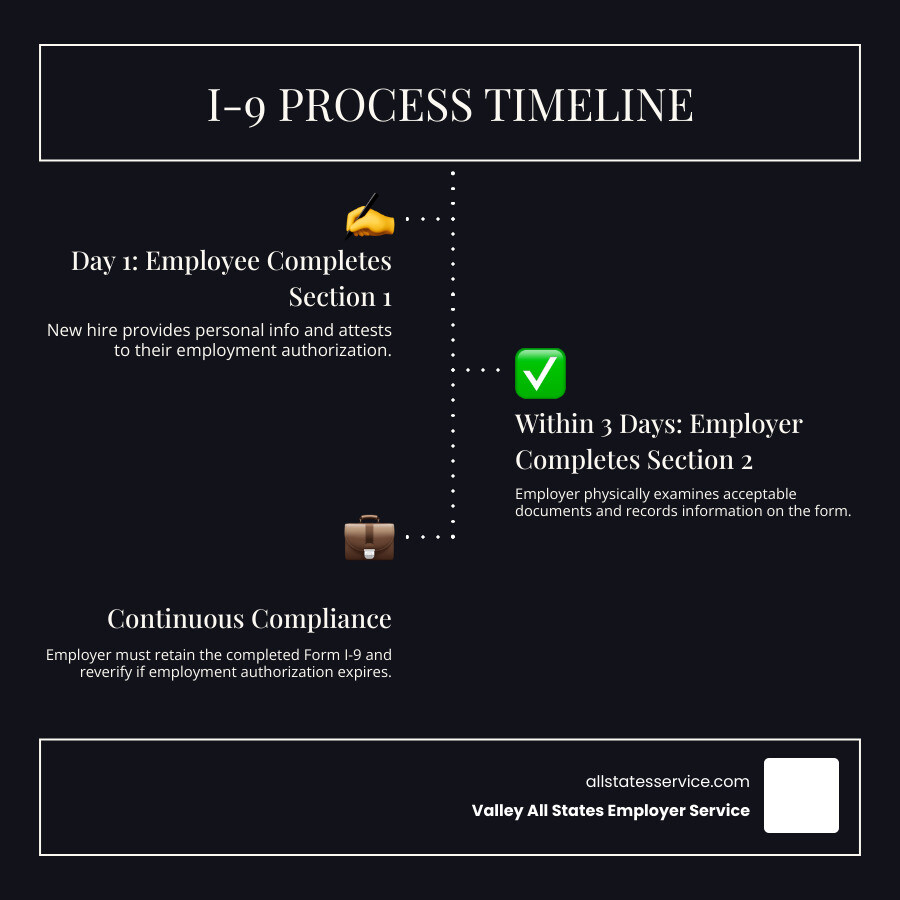
The timeline is strict. Your new employee must complete Section 1 of Form I-9 on their first day. You then have three business days to complete Section 2 by examining their I-9 acceptable documents.
To ensure you are covering all your bases during onboarding, review our resource on New Hire Paperwork I-9. It details what you need and when.
Decoding the Three Lists of I-9 Acceptable Documents
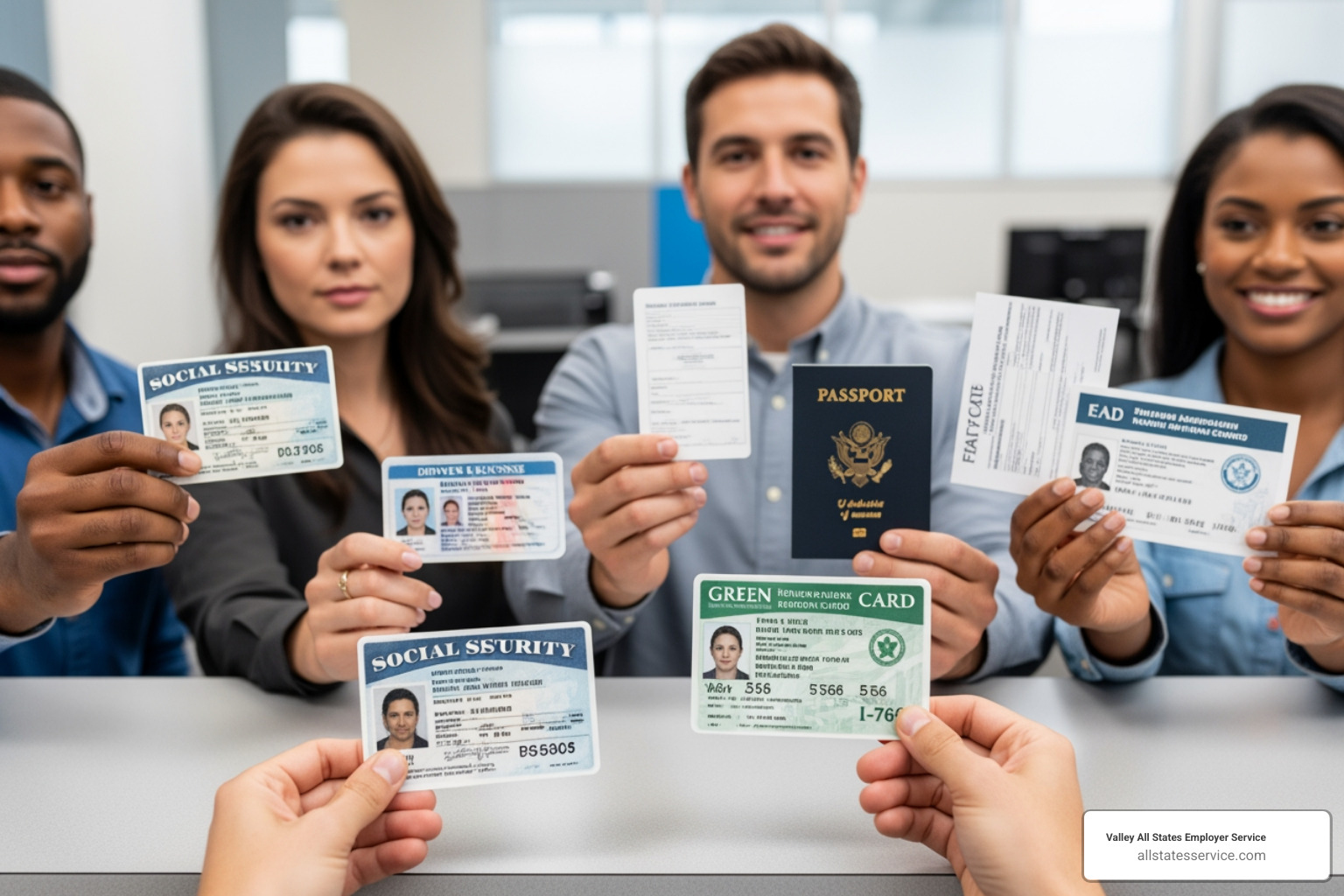
Understanding the three lists of I-9 acceptable documents is the heart of compliance, and it is simpler than it seems. The employee chooses which documents to present, not you. Telling employees which documents to bring or rejecting valid ones can lead to discrimination claims.
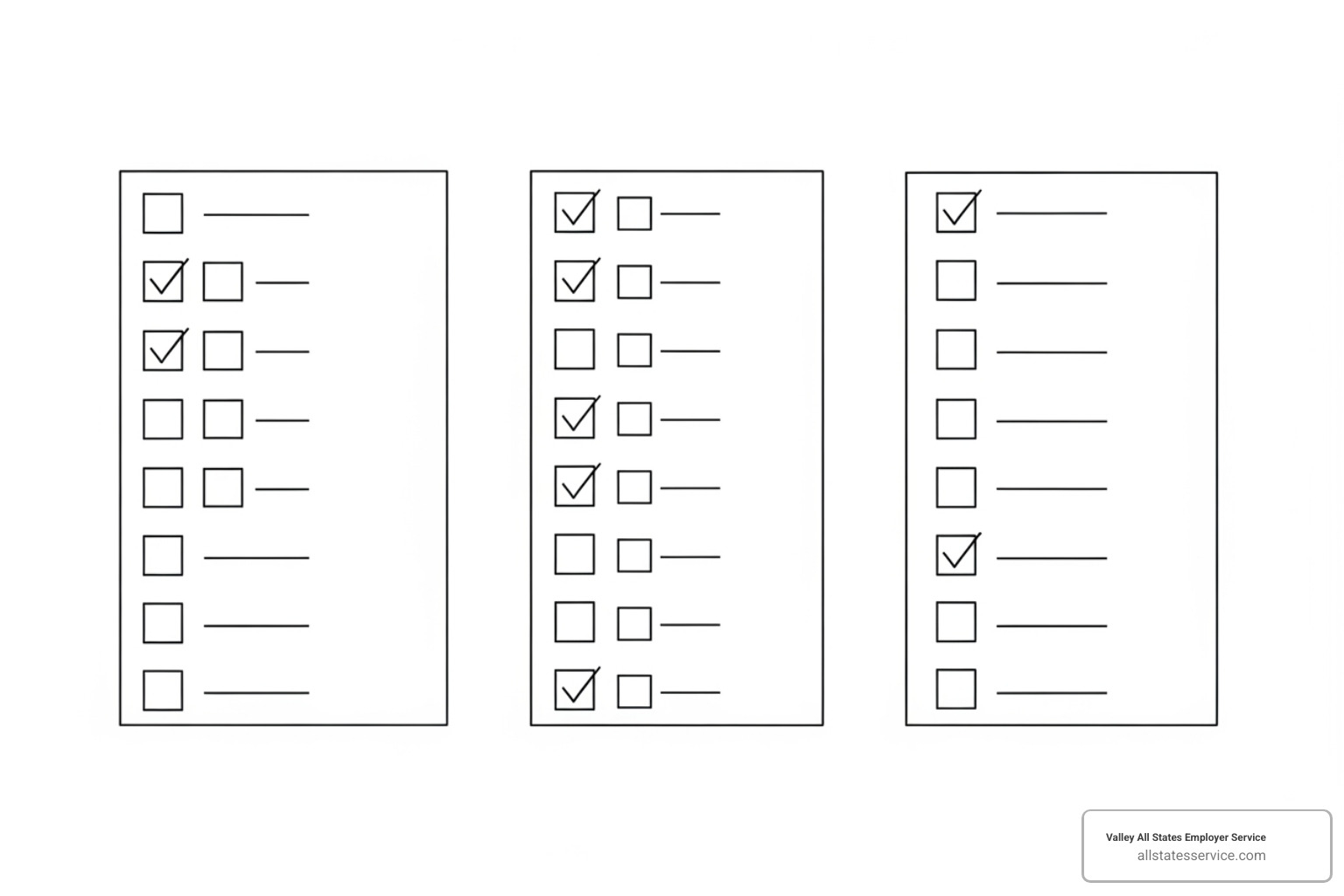
The rule is simple. An employee presents either one document from List A or one from List B and one from List C. All documents must be unexpired, unless officially extended by the issuing agency.
If you need to double-check, The official list of acceptable documents from USCIS is your best resource.
List A: Documents That Establish Both Identity and Employment Authorization
List A documents are the all-in-one option, proving both identity and work authorization. If an employee presents a valid List A document, the process is complete. Asking for more documents can lead to discrimination claims.
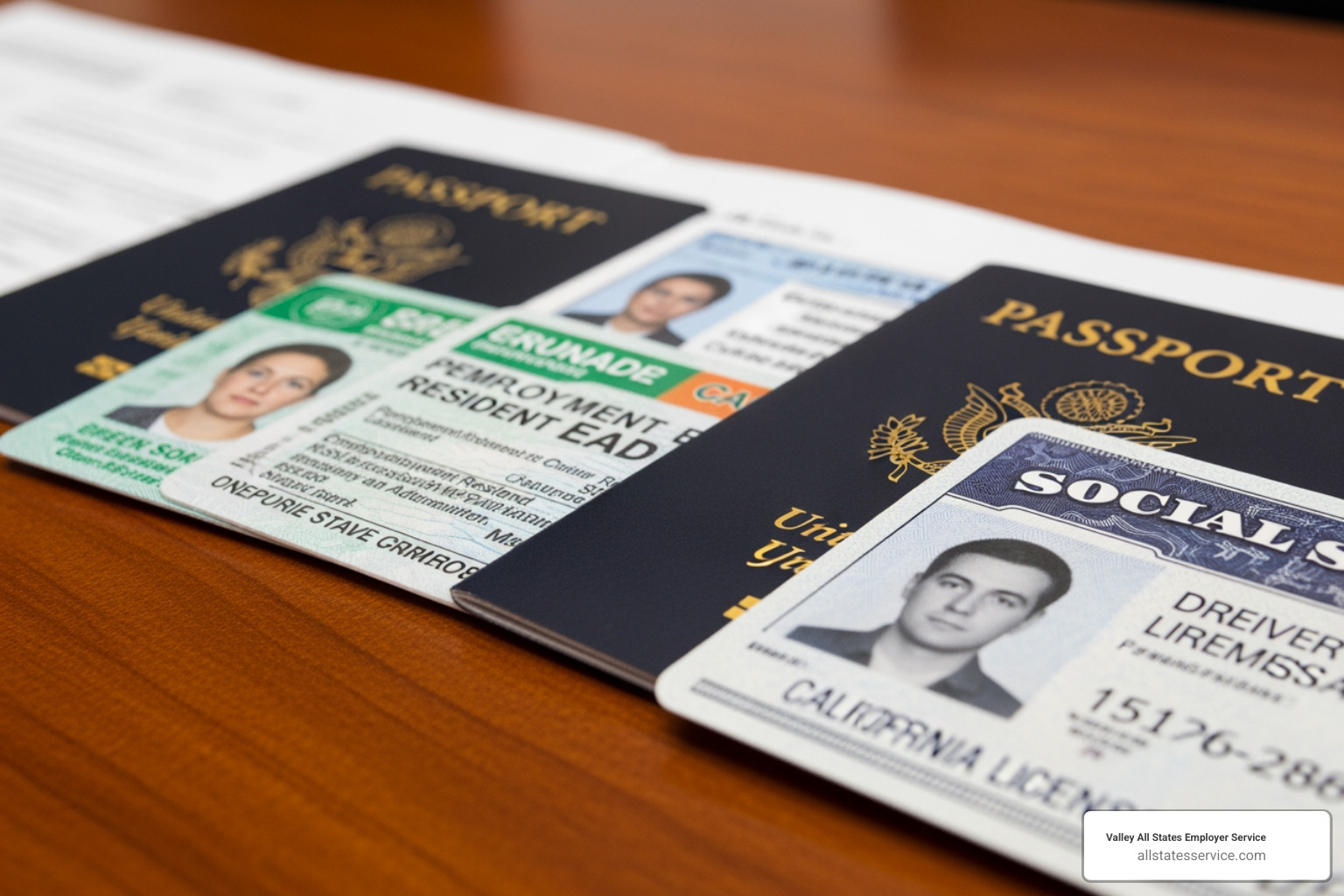
The most common List A documents are a U.S. Passport or U.S. Passport Card and the Permanent Resident Card, Form I-551, also called a Green Card. USCIS redesigns these cards periodically to prevent fraud, so you may see different versions. Older designs are still valid until they expire. For more on this, see our guide on Filling out I9 with Permanent Resident Card.
The Employment Authorization Document, Form I-766, is another key List A option. Often called a work permit, this document is redesigned periodically. An older design is acceptable if it is unexpired.
Other List A documents include foreign passports with temporary I-551 stamps or notations, and foreign passports with Form I-94 or I-94A showing nonimmigrant work authorization for a specific employer.
List B: I-9 Acceptable Documents for Identity Only
If an employee lacks a List A document, they must present one document from List B for identity and one from List C for work authorization. List B documents must have a photograph or identifying information like name, birth date, and gender.
The most common is a driver’s license or state-issued ID card. Even licenses marked “Not for Federal Identification” are acceptable for I-9 purposes.
Other List B documents include school ID cards with photographs, U.S. Military cards or draft records, military dependent ID cards, Native American tribal documents, and a driver’s license issued by a Canadian government authority.
A List B document only proves identity. The employee must still provide a List C document.
List C: I-9 Acceptable Documents for Employment Authorization Only
List C documents prove a person is authorized to work in the U.S. When paired with a List B document, verification is complete.
The most common List C document is a Social Security card. The key is that the card must be unrestricted. You cannot accept a card that says “NOT VALID FOR EMPLOYMENT” or has similar restrictions.
An original or certified copy of a U.S. birth certificate with an official seal is another option. An important exception, Puerto Rico birth certificates must be issued on or after July 1, 2010, due to security updates.
Other valid documents include a Certification of Report of Birth issued by the Department of State, Forms DS-1350, FS-545, and FS-240, the U.S. Citizen ID Card, Form I-197, and the Identification Card for Use of Resident Citizen in the United States, Form I-179.
The employee chooses which I-9 acceptable documents to present. Your job is to verify the documents appear genuine and relate to the employee. For more details, our Documents for I-9 page has you covered.
Navigating Special Cases and Common Questions
Even with a clear understanding of the document lists, special situations arise. What about employees without documents on day one, minors, or expiring documents? Here is how to handle the most common scenarios with confidence.
For a deeper dive into completing Section 2, where document examination occurs, check out our I-9 Section 2 Complete Guide.
What if an Employee Presents a Receipt?
An employee might not have their original I-9 acceptable documents if they are lost, stolen, or being renewed. In these situations, you can accept a receipt for a replacement document from List A, B, or C as a temporary stand-in.
The employee must then present the actual replacement document within 90 days of their hire date. There are also specific receipts for certain immigration statuses, like a Form I-94 with a temporary I-551 stamp, which acts as a receipt for a Permanent Resident Card.
A key limitation, you generally cannot accept a receipt for an initial application for employment authorization. Following these rules precisely is essential for compliance. For more details, USCIS provides information on Acceptable I-9 receipts explained by USCIS.
Are There Different Rules for Minors?
Yes, there are special rules for employees under 18. A 16-year-old might not have a standard List B document like a driver’s license.
If a minor cannot present a typical List B document, they can use alternatives to establish identity, such as a school record or report card, a clinic, doctor, or hospital record, or a day-care or nursery school record.
If a minor needs help with Section 1, a parent or legal guardian can complete it and sign the Preparer and or Translator Certification. This flexibility helps younger employees meet I-9 requirements.
What About Expired Documents?
The rule is clear, documents must be unexpired when presented. However, a few nuances can prevent headaches.
Issuing authorities sometimes automatically extend certain documents, like specific EADs, which are then considered unexpired. Also, to avoid discrimination, you cannot refuse to hire someone because their document has a future expiration date. This date does not always mean their work authorization is ending.
Reverification is required when an employee’s temporary employment authorization document, from List A or C, expires. You do not need to reverify permanent work authorization documents like a U.S. Passport or a Permanent Resident Card, nor do you reverify List B identity documents. Tracking these dates is vital. For more on this, our I-9 Process for Rehires article offers valuable insights.
Employer Best Practices for Document Verification and Compliance
Your role in the I-9 process extends beyond collecting paperwork to correctly examining, recording, and retaining I-9 acceptable documents. With a clear process, it becomes second nature. For full support, our I-9 Compliance Services Complete Guide walks you through every step.
How to Properly Examine and Record Documents
Within three business days of an employee’s start date, you or an authorized representative must complete Section 2 of Form I-9. This involves physically examining the documents the new hire presents.
This is a careful inspection, not a forensic investigation. You must examine original documents, photocopies are not allowed except for certified birth certificates, to ensure they appear genuine and relate to the employee. Use reasonable care.
Ask yourself, does the photo match the employee, is the document intact, does the information match Section 1? If something seems off, you can ask for another acceptable document, but you cannot specify which one.
After examining the documents, record the details in Section 2, document title, issuing authority, document number, and expiration date. Then sign and date the form.
Updated Form I-9 policies allow for remote document examination, but only for employers in good standing who are enrolled in E-Verify. If you do not use E-Verify, you must still review documents in person. Our guide on How to Review I-9 Documents for Remote Employees breaks down the specifics.
The employee chooses from the acceptable lists. Demanding specific documents could be considered discrimination.
The Difference Between Form I-9 and E-Verify
Form I-9 and E-Verify are related but distinct. Understanding the difference is crucial for compliance.
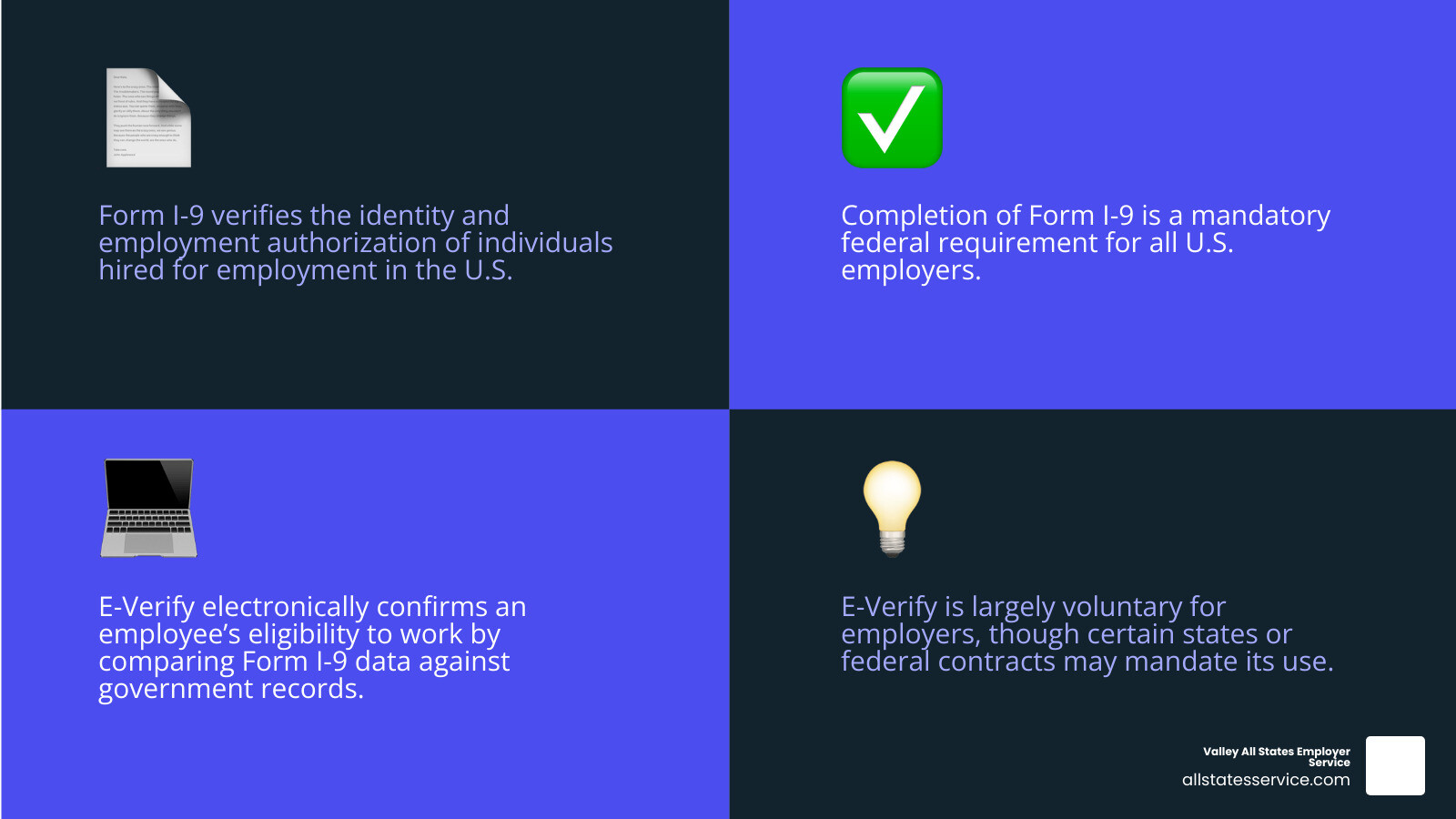
Form I-9 is mandatory for every U.S. employer. It is the form where you physically or electronically examine an employee’s I-9 acceptable documents and record the information.
E-Verify is different. It is an electronic system that cross-checks information from a completed Form I-9 against Social Security Administration and Department of Homeland Security records. It is an extra verification step after you complete the I-9.
E-Verify is voluntary for most employers but mandatory for federal contractors and in some states. For example, certain Maryland employers may be required to use it. If you use E-Verify, employees must provide their Social Security Number, and List B documents must have a photo.
E-Verify must be used within three business days of the employee’s start date for new hires only. Our E-Verify and I-9 guide explains how these systems work together.
Avoiding Steep Penalties for Non-Compliance
The penalties for I-9 non-compliance are serious. Immigration and Customs Enforcement conducts thorough audits, so being prepared is essential.
Paperwork violations, like missing signatures or incorrect data, are the most common issue. These errors can cost $288 to $2,861 per Form I-9. The fines add up quickly across multiple employees.
Knowingly employing unauthorized workers brings severe penalties. Fines start between $716 and $5,724 per unauthorized worker for a first offense and can rise to $8,586 to $28,619 for subsequent offenses.
Severe cases involving a pattern of violations or fraud can lead to criminal penalties, including imprisonment. Regular internal I-9 audits are a smart practice. Proactively reviewing forms helps you find and fix errors before a government audit does.
Understanding these risks is about protection. For a complete breakdown of consequences, our I-9 Compliance Penalties guide lays it all out.
Conclusion: Master Your I-9 Process with Confidence
You have the essentials of I-9 acceptable documents covered, from the three document lists to special cases like receipts and expiring documents. With a clear process, you can reduce risk, avoid penalties, and keep hiring moving.
I-9 compliance protects your business and your workforce. Attention to detail and a proactive mindset are key.
You also do not have to handle it alone.
That is where Valley All States Employer Service helps. We simplify verification for businesses like yours. As your expert partner, we offer outsourced E-Verify workforce eligibility verification that is efficient and impartial. We reduce errors, lighten your administrative load, and give you confidence that your I-9 process is solid.
Ready to take control of your compliance strategy and truly perfect it? Let us help you gain that confidence.
Explore our Form I-9 Ultimate Guide for comprehensive support.