
HR Administrative Support: Vital Guide for 2025
Why HR Administrative Support Is the Backbone of Every Successful HR Department
HR administrative support refers to the essential clerical and operational tasks that keep a human resources department running smoothly. These professionals handle everything from maintaining employee records and assisting with recruitment to supporting payroll processes and ensuring compliance with employment laws.
Quick Overview: What HR Administrative Support Covers
- Recruitment Support: Posting jobs, screening resumes, scheduling interviews
- Onboarding: Preparing new hire paperwork, conducting orientations
- Record-Keeping: Maintaining employee files, updating HRIS databases
- Payroll & Benefits: Providing data for payroll, tracking PTO, answering employee questions
- Compliance: Managing I-9 forms, employment contracts, and audit documentation
Think of Batman without Robin, or Frodo without Sam. Even the greatest heroes need someone watching their back, handling the details that make victory possible. HR managers are no different.
Behind every strategic HR initiative, every smooth onboarding experience, and every compliant audit sits an HR administrative professional making it all work. They’re the ones updating employee records at 4 PM, scheduling interviews between meetings, and catching the missing signature on a critical compliance form.
These professionals don’t make hiring decisions or design benefits packages. But without them? The HR department grinds to a halt. Records go missing. New hires show up to empty desks. Payroll errors multiply. Compliance gaps widen into legal risks.
With over 418,000 HR assistants currently employed across the United States, this role forms the operational backbone of human resources departments everywhere. They transform HR strategy into HR reality, one carefully maintained record and properly filed form at a time.
For busy HR managers drowning in compliance paperwork and onboarding tasks, understanding what HR administrative support truly involves can help you build a more efficient department, whether you’re hiring your first admin or evaluating whether to outsource certain functions.
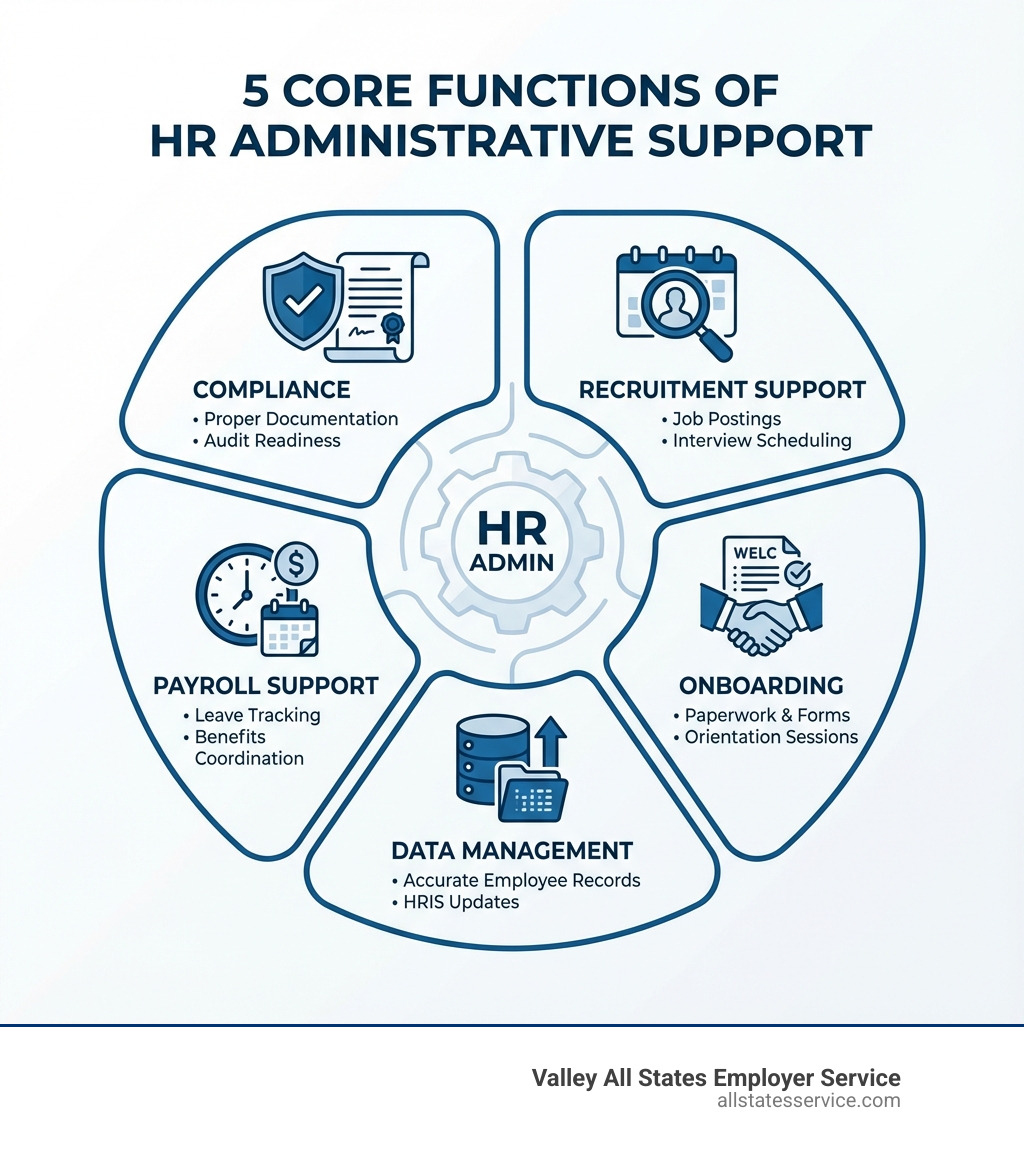
HR administrative support terms explained:
What Does an HR Administrative Assistant Actually Do?
At its core, the primary role of an HR administrative support professional, often called an HR Administrative Assistant, is to provide essential administrative and clerical assistance to the human resources department. They are the central point of contact for many employee inquiries and the behind-the-scenes force that keeps daily HR operations running smoothly. We see them as the glue that holds the department together, ensuring that HR managers can focus on more strategic initiatives.
Their work touches almost every stage of the employee lifecycle, from the moment a candidate applies to their departure and beyond. They maintain the flow of information, documents, and processes, acting as indispensable support for the entire HR team. This role is crucial for organizations looking to streamline their HR processes and operate efficiently.
Supporting Recruitment and Onboarding
Imagine a company trying to hire without someone to manage the flood of applications or schedule interviews. It would be chaos! HR administrative assistants are key players in the recruitment process, even if they aren’t making the final hiring decisions. Their responsibilities often include posting job ads on various platforms, screening resumes against basic qualifications, and coordinating interview schedules between candidates and hiring managers.
Once a candidate accepts an offer, these professionals pivot to onboarding. They prepare new hire packets, which might contain company policies, benefit enrollment forms, and emergency contact information. They collect essential paperwork, ensuring all necessary documents are completed and filed correctly. Effectively, they set the stage for a positive start, making sure new employees feel welcomed and have all the information they need. For a deeper dive into making this process seamless, check out our complete guide to streamlining the onboarding process.
Employee Record-Keeping and Data Management
Accuracy is the name of the game here. HR administrative assistants are meticulous record-keepers, responsible for maintaining both soft and hard copies of employee records. This includes everything from personal details, employment contracts, performance evaluations, and disciplinary actions to vacation and sick leave requests. They are the guardians of employee data, ensuring that all information is up-to-date and easily accessible when needed.
Updating HR Information Systems (HRIS) databases is a daily task, reflecting new hires, separations, changes in job classifications, and shifts in personal information. This data integrity is paramount, not just for operational efficiency but also for compliance and reporting. Given the sensitive nature of this information, confidentiality is not just important—it’s absolutely critical. We understand the importance of secure and accurate employee data, which is why we also offer insights into outsourced employee verification.
Assisting with Payroll and Benefits
While HR administrative assistants typically don’t process payroll directly, they play a vital supporting role. They often assist in payroll preparation by providing relevant data, such as absences, vacation and sick leaves, bonuses, and new hire information to the payroll department. Their accurate tracking of employee hours and time off is fundamental to ensuring everyone gets paid correctly and on time.
Beyond payroll, they often serve as the first point of contact for employees with basic questions about their benefits—health insurance, retirement plans, or paid time off policies. They might help employees steer enrollment forms or direct them to the right resources. They also frequently liaise with external partners, such as insurance vendors, to ensure smooth administration of benefits programs.
HR Admin vs. Administrator vs. Generalist: What’s the Difference?
The world of human resources has many titles, and it’s easy to get them confused. While all these roles contribute to the HR function, they differ significantly in their scope, responsibilities, and level of strategic involvement. Understanding these distinctions is key to recognizing the career progression within HR.

An HR administrative assistant is generally an entry-level role, focusing heavily on clerical support and transactional tasks. As professionals gain experience and take on more complex duties, they may advance to an HR administrator role. This position often involves more responsibility in managing specific HR programs or processes, such as benefits administration or HRIS management, and requires a deeper understanding of HR policies. An HR generalist, on the other hand, typically has a broader scope, handling a wider range of HR functions independently and often acting as a strategic partner to management on employee relations, talent management, and policy development.
Here’s a quick comparison to clarify:
| Role | Key Responsibilities | Scope | Typical Experience Level |
|---|---|---|---|
| HR Administrative Assistant | Record-keeping, data entry, scheduling, recruitment support, basic employee inquiries, document preparation. | Primarily clerical and administrative support for the HR department. | Entry-level (0-2 years) |
| HR Administrator | Manages specific HR programs (e.g., benefits, HRIS), policy implementation, compliance support, more complex employee queries. | Operational management of HR processes and programs; requires deeper HR knowledge. | Mid-level (2-5 years) |
| HR Generalist | Manages a wide range of HR functions independently, employee relations, talent management, policy development, strategic input. | Broad, comprehensive HR management across multiple functions; acts as a business partner. | Experienced (3-7+ years) |
The Makings of a Great HR Admin: Skills and Qualifications
What does it take to excel in HR administrative support? It’s a blend of foundational personal attributes, technical prowess, and a commitment to continuous learning. These professionals are often the unsung heroes, and their skills directly contribute to an organization’s ability to improve HR efficiency.
Foundational Skills and Personal Attributes
For us, the bedrock of a great HR administrative assistant lies in their soft skills and personal qualities. Attention to detail is paramount; a misplaced decimal in payroll data or an incorrectly filed document can have significant repercussions. Confidentiality is non-negotiable, as they handle highly sensitive employee information daily. We look for individuals with exceptional organizational skills to juggle multiple tasks and maintain meticulous records.
Beyond that, strong time management abilities are essential to prioritize tasks in a environment. Excellent interpersonal communication skills are needed to interact with employees at all levels, answer questions clearly, and maintain a positive demeanor. Finally, a knack for problem-solving allows them to address minor issues before they escalate, often being the first line of defense for employee queries.
Technical Skills and Common HR Tools
Technical proficiency is not just a bonus—it’s a requirement. HR administrative assistants must be adept with the MS Office Suite, particularly Word for document creation, Excel for data tracking and reporting, and Outlook for managing communications and calendars.
Familiarity with HR Information Systems (HRIS) is crucial. These systems, like Workday or ADP, are central to managing employee data, benefits, and payroll. They also often interact with Applicant Tracking Systems (ATS) for recruitment tasks. Experience with database management principles ensures data accuracy and efficient retrieval. Understanding these tools is fundamental to providing a comprehensive human resource solution.
How to Prepare for a Career in HR Administrative Support
If you’re considering a career in HR administrative support, there are clear paths to get started. Many professionals begin with an Associate’s or Bachelor’s degree in Business Administration or Human Resources. These programs provide a solid foundation in business principles and HR practices. While on-the-job training is common, formal education can significantly boost your prospects.
Gaining relevant experience, even in general administrative roles, can be highly beneficial. Look for opportunities that involve record-keeping, scheduling, and direct communication with staff. Additionally, pursuing professional certifications can demonstrate your commitment and expertise. Consider certifications such as the SHRM – Certified Professional Course or the HRCI – Professional in Human Resources, which are highly respected in the industry.
The Critical Role of HR Administrative Support in Compliance
In the complex landscape of employment law, HR administrative support stands as a crucial line of defense for any organization. We know that navigating the myriad of federal and state regulations, especially in states like Maryland, can be daunting. These professionals ensure that our HR practices adhere to the legal framework, significantly mitigating risks and protecting the company from potential fines or lawsuits. Their diligent work in maintaining compliant records and supporting audits is indispensable for overall human resources compliance.

Managing Essential Compliance Paperwork
From the moment an employee is hired, a stack of compliance-related paperwork begins. HR administrative assistants are responsible for carefully managing these documents. This includes ensuring the accurate completion and filing of I-9 forms for employment eligibility verification—a critical federal requirement in the United States. They also handle employment contracts, policy acknowledgements (like employee handbooks), and W-4s for tax withholding. Their precision in these tasks directly impacts a company’s ability to pass audits and avoid penalties. For us, ensuring employer HR compliance is about dotting every ‘i’ and crossing every ‘t’.
Supporting Audits and Reporting
Audits are a fact of life for HR departments, whether internal reviews or external government inspections. When an audit comes knocking, the HR administrative assistant is often at the forefront, gathering documentation, compiling reports, and ensuring everything is in order. Their organized record-keeping makes this process smoother and less stressful. They might prepare reports for regulatory bodies, detailing aspects like employee demographics, training records, or compensation data. The accuracy of their work is vital for a successful HR compliance review, demonstrating the company’s adherence to all relevant labor laws and regulations.
Career Path, Salary, and Future Outlook
Understanding the career trajectory and earning potential for HR administrative support roles helps us appreciate their value and plan for future growth. This is an entry point into the dynamic field of human resources, offering various opportunities for advancement. Effective management of this workforce is also a key component of workforce management best practices.
Salary Expectations for HR Administrative Support
The compensation for HR administrative assistants can vary based on location, experience, and specific responsibilities. According to Salary.com, the average salary for a Human Resources Assistant in the United States is around $47,500. Salaries typically range from $38,400 to $58,000.
Location plays a significant role in determining pay. For instance, HR Assistants in Chicago earn an average annual salary of $55,000, while those in New York City take home approximately $59,000 per year, as reported by Glassdoor. While specific Maryland data isn’t detailed here, we know that metropolitan areas generally command higher salaries. The median salary for human resources administrative assistants (excluding payroll and timekeeping) was $43,250 per year as of May 2020. Data from Zippia.com indicates there are over 418,000 HR Assistants employed in the U.S., with women making up 84.5% of the workforce.
Career Progression and Opportunities
Starting as an HR administrative assistant opens doors to a rewarding career in human resources. We’ve seen many professionals use this role as a springboard. With experience, an HR administrative assistant can progress to an HR Administrator, taking on more responsibility in specific HR functions like benefits or HRIS management. From there, the path often leads to an HR Generalist position, which involves a broader range of responsibilities and a more strategic role within the department.
Further advancement can lead to HR Manager roles, overseeing entire HR functions, or specializing in areas like recruitment, compensation, or employee relations. Some might even choose to specialize further in payroll or benefits administration, becoming experts in those complex domains. The foundational knowledge gained in an administrative role is invaluable for these advanced positions.
Job Outlook and Working Conditions
The Bureau of Labor Statistics (BLS) projects a decline of 3% for the role of human resources administrative assistant (excluding payroll and timekeeping) between 2020-2030. This projection is largely due to the increased use of HR software, automation, and organizations consolidating administrative functions. However, it’s important to note that while some routine tasks may be automated, the need for human oversight, interpersonal skills, and critical thinking in HR remains strong.
The working conditions for HR administrative assistants are typically in an office environment, often in environmentally controlled settings. They usually work standard business hours, though some roles might require occasional overtime during peak periods like open enrollment or audit season. The role involves constant contact with others, daily email and telephone conversations, and a high importance placed on accuracy and teamwork. They often spend more than half their time sitting but engage in frequent face-to-face discussions.
Conclusion: The Foundation of an Effective HR Strategy
We’ve explored how HR administrative support professionals are truly the unsung heroes of any HR department. They are the operational backbone, carefully handling the details that enable HR managers to focus on strategic initiatives. From facilitating recruitment and onboarding to maintaining precise employee records and ensuring compliance, their contributions are indispensable. Without their diligent work, the complex machinery of human resources would simply not function.
Their dedication ensures compliance, mitigates risks, and ultimately fosters a more organized and efficient workplace. For businesses navigating the intricate world of employment regulations, having robust HR administrative support is not just beneficial—it’s essential.
For specialized tasks like E-Verify workforce eligibility verification, which demands expert, impartial, and efficient processing, services like Valley All States Employer Service can provide the specialized support your team needs, minimizing errors and administrative burden.
Ready to ensure your HR is compliant and running smoothly? Get expert HR compliance assistance from our team today.